
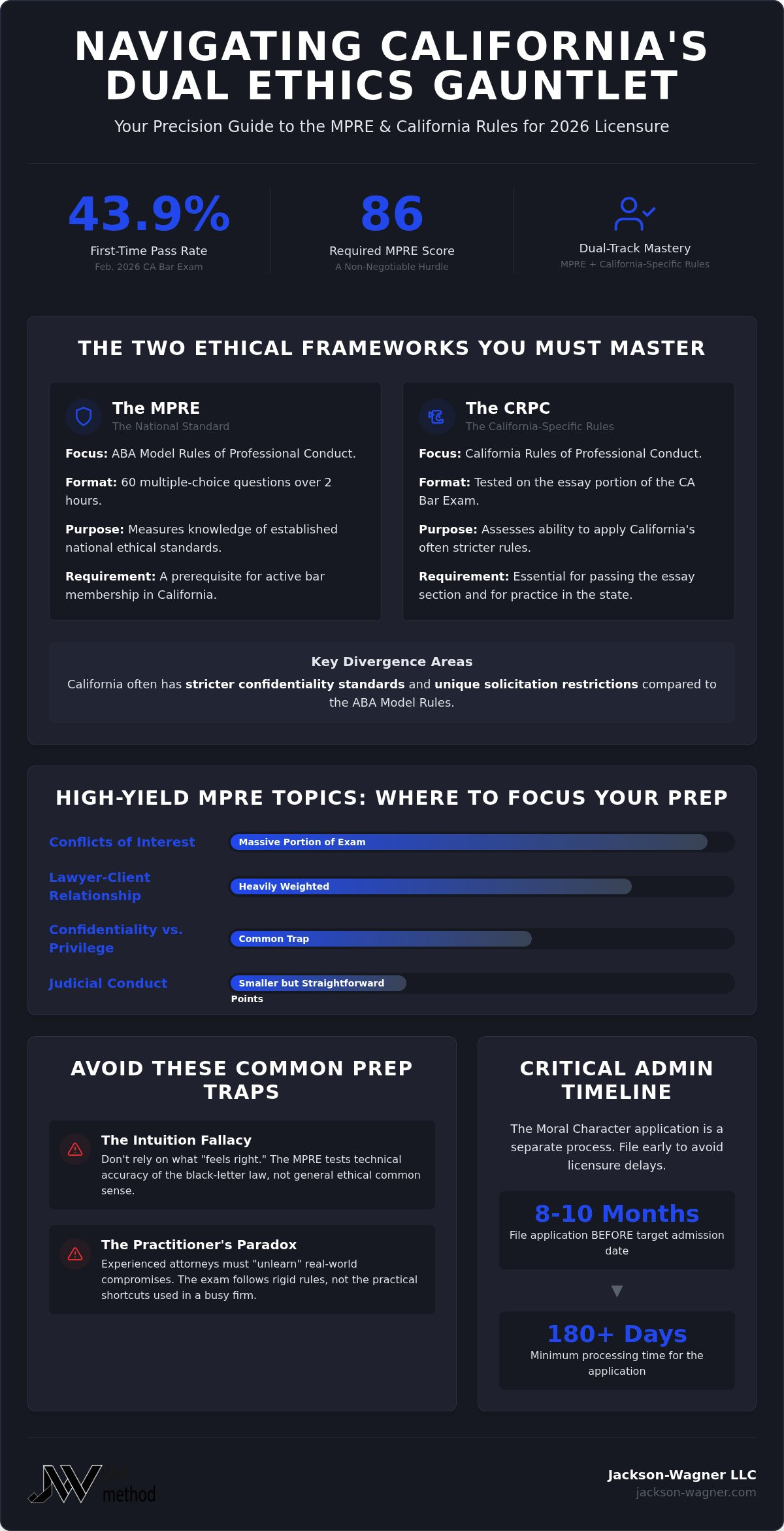
The 43.9% first-time pass rate for the February 2026 California Bar Exam is a sobering reminder that "good enough" study habits won't cut it in this jurisdiction. You aren't just facing a test of memory; you're navigating a minefield of conflicting ABA Model Rules and unique California-specific ethics requirements. If you feel anxious about the high-stakes Moral Character application or overwhelmed by legacy courses, your california professional responsibility exam prep needs a radical shift toward precision. It's frustrating to study for the MPRE only to find those rules don't always apply when you're writing California Bar essays.
This guide delivers a high-precision strategy to help you secure 2026 licensure. We'll show you how to pass the MPRE on your first attempt with the required 86 scaled score while simultaneously mastering the California Rules of Professional Conduct. You'll learn to distinguish between these frameworks efficiently, allowing you to balance ethics study with the rest of your Bar preparation. We're moving past the information overload of traditional models to give you a clear, structured path toward your professional goals.
Key Takeaways
- Understand the dual-track requirement for California licensure, which demands mastery of both the MPRE and the distinct California Rules of Professional Conduct for Bar Exam essays.
- Implement a high-precision strategy for your california professional responsibility exam prep to secure the mandatory 86 scaled score required for 2026 admission.
- Identify critical areas where California ethics rules diverge from the ABA Model Rules, specifically regarding stricter confidentiality standards and new 2026 solicitation restrictions.
- Learn to replace legacy, volume-heavy study habits with a pedagogical approach that focuses on high-yield topics like conflicts of interest and artificial intelligence ethics.
- Discover how accelerated prep tracks allow busy professionals to balance rigorous ethics mastery with full Bar Exam preparation without sacrificing performance.
Understanding California Professional Responsibility Requirements in 2026
California licensure demands a dual-track mastery of ethical standards. You're required to pass the national MPRE and demonstrate proficiency in the California Rules of Professional Conduct (CRPC) during the Bar Exam essays. It's a common mistake to assume one replaces the other. They're distinct hurdles. For 2026 admission, you must achieve a minimum scaled score of 86 on the MPRE. This score is non-negotiable. Your california professional responsibility exam prep must account for both the national standard and the state-specific nuances that appear in the essay portion of the General or Attorney’s Exam.
The MPRE: Your First Gate to Licensure
The Multistate Professional Responsibility Examination (MPRE) is a two-hour, 60-question multiple-choice test developed by the NCBE. It's designed to measure your knowledge of the ABA Model Rules of Professional Conduct. In California, passing this exam is a prerequisite for active bar membership. You can take it while still in law school or after graduation, but delaying it can stall your licensure. Most candidates schedule the MPRE during their second or third year of law school to clear the path for their final Bar Exam push. Because the test occurs only three times a year, missing a registration deadline can push your admission back by months.
The California Rules of Professional Conduct (CRPC)
While the MPRE focuses on national standards, the California Bar Exam tests your ability to apply the CRPC. These rules are often stricter than the ABA model. You'll need to master these for the essay portion of the Bar Exam, where ethics is a recurring theme. Success here requires more than just memorization. It requires understanding how the State Bar of California enforces these rules once you're licensed. It's also vital to distinguish these academic requirements from the administrative burden of decoding the California bar exam moral character application. The Moral Character application is a separate fitness evaluation that takes at least 180 days to process. You should file it at least 8 to 10 months before your target admission date to avoid delays. Effective california professional responsibility exam prep integrates these timelines so you aren't scrambling at the finish line.
MPRE Prep Strategy: Mastering the ABA Model Rules
Success on the MPRE isn't about being a "good person." It's about technical accuracy. Many candidates approach california professional responsibility exam prep with the assumption that common sense will guide them to the correct answer. This is a dangerous misconception. The NCBE designs questions to exploit the gap between what feels right and what the ABA Model Rules actually require. To hit the 86 scaled score mandated by the California MPRE requirements, you must abandon intuition in favor of black-letter law.
Practicing attorneys often struggle more than students because real-world legal practice frequently involves practical compromises that don't align with the rigid exam standards. If you've been in practice for years, you've likely developed habits that violate the technical requirements of the Model Rules. You must unlearn these professional shortcuts to succeed here. High-precision study focuses on the rules as they're written, not as they're practiced in a busy firm.
High-Yield MPRE Subject Breakdown
Conflicts of interest make up a massive portion of the exam. You must distinguish between current client conflicts and former client duties with surgical precision. The lawyer-client relationship also carries heavy weight; duties of competence and diligence attach much earlier than many realize. You don't need a signed retainer for a duty to exist. Another common trap is the distinction between privilege and confidentiality. While attorney-client privilege is a narrow evidentiary rule, the ethical duty of confidentiality is broad, covering all information relating to the representation regardless of the source. Finally, don't ignore judicial conduct. It's a smaller slice of the pie, but these questions provide straightforward points if you've reviewed the specific rules governing judges' extrajudicial activities.
Effective MPRE Practice Drills
Rule memorization is only half the battle. You need to apply those rules to complex, often distracting scenarios. When drilling with authentic NCBE questions, always analyze the "Call of the Question" first. The exam creators love to provide a set of facts that point toward one ethical issue, only to ask about a completely different one in the final sentence. Timing is also critical. You have 120 minutes for 60 questions, giving you exactly two minutes per item. If you're spending three minutes debating a fee dispute, you're stealing time from easier points later in the booklet. Our accelerated prep tracks are designed to cut through this noise, focusing only on the high-yield topics that actually move the needle on your score.
MPRE vs. California Rules: Navigating the Ethical Divergence
Mastering the MPRE is only half the battle. While the national exam tests your knowledge of the ABA Model Rules, the California Bar Exam requires you to pivot to the California Rules of Professional Conduct (CRPC). This is where many candidates fail. They apply national standards to state-specific essays, losing easy points on technicalities. To succeed, your california professional responsibility exam prep must evolve from simple memorization of the ABA rules to a comparative analysis of where California diverges from the national norm.
The most dangerous divergence lies in the Duty of Confidentiality. Under ABA Model Rule 1.6, a lawyer may reveal confidential information to prevent substantial financial injury resulting from a client's crime or fraud. California recognizes no such exception. In this jurisdiction, the duty is nearly absolute, with the only major exception being the prevention of a criminal act likely to result in death or substantial bodily harm. If you cite the ABA financial harm exception on a California essay, you've already missed the mark. This level of precision is what separates successful candidates from those who have to retake the exam.
Financial integrity rules also differ significantly. California has strict requirements for client trust accounts and generally prohibits fee-splitting with non-lawyers, even in scenarios where other states might be more permissive. Additionally, California does not have a mandatory "snitch rule" similar to ABA Rule 8.3. While the ABA requires lawyers to report the misconduct of others, California focuses on self-reporting duties for specific events, such as being sued for malpractice or sanctioned by a court. Understanding these nuances is critical for the California Bar admission exams.
Key Differences You Must Memorize
Conflicts of interest in California require informed written consent in a broader range of scenarios than the ABA rules. For example, California requires written disclosure even when there's no significant risk of material limitation, simply because of a lawyer's past relationship with a party. Trial publicity rules also use a specific "substantial prejudice" test that you must apply correctly. Regarding sexual relations with clients, while the ABA imposes an absolute ban unless the relationship predated the representation, California’s Rule 1.8.10 adds specific prohibitions against demanding sex as a condition of representation or using coercion, even if a relationship existed previously.
Why This Distinction Matters for Bar Exam Essays
California Bar essays frequently feature "crossover" ethics issues, often blending Professional Responsibility with Evidence or Business Associations. A high-scoring answer doesn't just state the California rule; it acknowledges the ABA standard and then applies the CRPC to reach the final conclusion. This demonstrates a sophisticated understanding of the law. For a broader context on how these ethics requirements fit into your overall journey, consult our 2026 guide to licensure success. Precision here isn't just about passing; it's about establishing the disciplined mindset required for a successful legal career in California.
Accelerated Prep for Busy Professionals and Attorneys
Legacy bar prep models operate on a "more is better" philosophy. They bury you in 40-hour video modules and 800-page outlines. For a working professional, this volume isn't just overwhelming; it's ineffective. Your california professional responsibility exam prep needs to be as efficient as your billable hours. High-precision study focuses on active recall rather than passive consumption. Watching a three-hour lecture on fee-splitting doesn't build the neural pathways needed to spot a crossover issue under exam pressure. You need to be doing, not just viewing.
The JW Bar Method replaces these outdated formats with a structured, pedagogical approach. We prioritize high-stakes drills that force you to apply rules immediately. This method allows you to integrate ethics mastery into a 30-day or 60-day Bar Exam track without sacrificing other critical subjects. You'll spend less time "reviewing" and more time performing. This shift from passive to active learning is what allows our students to master the material in a fraction of the time required by conventional courses.
The Attorney’s Exam Advantage
If you're an out-of-state lawyer, you face a unique challenge. You have years of experience, but that experience can often be a liability. We call this "practice bias." In your daily work, you might handle client funds or conflict waivers based on firm culture or local customs that don't align with the technical CRPC standards. You must approach the California Attorney’s Exam as a fresh academic challenge. Our accelerated tracks leverage your existing legal logic while stripping away non-compliant habits. This ensures you're answering based on the law, not your last settlement conference. We help you unlearn the "practical" shortcuts to ensure your essay answers meet the State Bar's exacting standards.
JW Bar Method: Precision Over Volume
Efficiency is our primary metric. By eliminating low-yield materials, the JW Bar Method can save you over 20 hours of study time. We don't ask you to memorize every obscure statute; we focus on the rules that actually appear on the exam. This precision-first model is the modern alternative to legacy courses that rely on sheer volume to justify their existence. Whether you're preparing for the full California Bar or the specialized Attorney’s Exam, your study path should be a steady, structured progression toward success. Don't settle for a generic course when you can choose JW Bar Method Accelerated Prep for a more reliable path to licensure.
The JW Bar Method: Your Path to California Licensure
The State Bar of California often highlights its low pass rates as a warning, but we see it as a call for better methodology. Legacy prep courses have failed to adapt, leaving students drowning in volume while missing the technical precision required for the 2026 exams. The JW Bar Method is the modern alternative designed for the candidate who refuses to leave their licensure to chance. We've stripped away the fluff to focus on the pedagogical triggers that lead to actual passing scores. Your california professional responsibility exam prep shouldn't be a test of endurance; it should be a strategic strike.
Our approach is built on "bold reliability." We're so confident in our proprietary system that we offer a binary performance guarantee. This unique marker distinguishes us from cautious competitors who offer nothing but a library of videos. By assuming the financial risk of your outcome, we transform the study process into a partnership. You provide the work; we provide the reliable path to success. It's a structured, modern, and results-oriented environment designed to replace high-stakes anxiety with professional empowerment.
Comprehensive Prep for Every Candidate
Choosing the right track is your first step toward the bar. For those facing the complete battery of tests, JW Bar Method Prep - Full Exam California Bar provides a comprehensive pedagogical system covering every essay subject and multistate requirement. If you're already licensed elsewhere, JW Bar Method Prep - Attorney’s Exam California Bar is tailored to leverage your experience while correcting the "practice bias" that often sinks experienced practitioners. Both tracks embody why many consider this the best bar exam preparation service through a relentless focus on precision over volume.
Take the Next Step Toward Your California License
Enrolling for the 2026 exam cycle is simple. If you're a full-time student, our standard tracks provide a steady, structured progression. For the busy professional, JW Bar Method Accelerated Prep - Full California Bar Exam or the Attorney’s Exam equivalent offers a high-impact curriculum designed for a 30-day or 60-day window. These accelerated tracks don't cut corners; they cut waste. They're built for the modern learner who requires flexibility without compromising on the final outcome.
The final word on California ethics is simple: precision beats volume every time. You don't need more information; you need the right information, delivered through a system that guarantees performance. Secure your spot in our next cohort and replace the anxiety of the unknown with the confidence of a proven method. Your California license is within reach. We'll help you take it.
Secure Your Path to 2026 California Licensure
Mastering the dual requirements of the MPRE and the California Rules of Professional Conduct is the final technical barrier to your legal career. You now understand that hitting the 86 scaled score is only the baseline. True success requires a comparative mastery of where California's strict confidentiality standards and unique conflict rules depart from the national ABA model. Precision in your california professional responsibility exam prep isn't a luxury; it's the difference between immediate licensure and a frustrating delay.
The proprietary JW Bar Method offers a structured, results-oriented alternative to the volume-heavy legacy courses that lead to information overload. By choosing our accelerated tracks, you leverage California-exclusive expertise to master these high-stakes requirements efficiently. We assume the financial risk of your performance so you can focus entirely on your professional empowerment. Take the decisive step toward your future today. Master the California Bar with the JW Bar Method and cross the finish line with absolute confidence.
Frequently Asked Questions
What is the required MPRE score for California in 2026?
You must achieve a minimum scaled score of 86 to satisfy the California requirement for 2026 admission. This score is reported by the NCBE directly to the State Bar. Because the MPRE is only offered three times per year, you should plan your california professional responsibility exam prep early to ensure your score is on file. Delaying this step can prevent you from being sworn in even after passing the bar exam.
Does California test the ABA Model Rules or the CA Rules of Professional Conduct?
California tests both, but in different contexts. The MPRE focuses exclusively on the ABA Model Rules of Professional Conduct and the ABA Code of Judicial Conduct. However, the California Bar Exam essays require mastery of the California Rules of Professional Conduct (CRPC). Successful candidates must distinguish between these two frameworks, as applying ABA standards to a California essay will result in significant point deductions on your exam.
Can I take the California Bar Exam before passing the MPRE?
Yes, you can sit for the General Bar Exam or the Attorney’s Exam before passing the MPRE. There is no requirement to pass the ethics exam first. However, you won't receive your license or be sworn in as an attorney until you have satisfied all requirements, including the MPRE and the Moral Character application. Most applicants prefer clearing the MPRE early in their third year to avoid admission delays.
How long does it take to prepare for the MPRE effectively?
Most candidates require two to four weeks of focused study to master the ABA Model Rules. However, the exact timeline depends on your familiarity with legal ethics and your specific study method. Volume-heavy legacy courses often waste your time on low-yield topics. Efficient california professional responsibility exam prep uses high-precision drills and active recall to achieve the required 86 score in a significantly shorter window, often through our specialized accelerated study tracks.
Are there specific ethics rules for the California Attorney’s Exam?
The California Attorney’s Exam tests the same California Rules of Professional Conduct (CRPC) as the General Bar Exam. Practitioners must be particularly careful to avoid "practice bias," which is the tendency to answer based on firm habits rather than black-letter law. Your preparation should focus on the technical nuances of California-specific rules, such as the nearly absolute duty of confidentiality and the unique informed written consent requirements for conflicts of interest.
What happens if I fail the MPRE but pass the California Bar Exam?
If you pass the bar exam but fail the MPRE, your admission to the State Bar will be placed on hold. You'll remain a "successful applicant" but won't be eligible to practice law or take the oath of office. You must retake the MPRE during a subsequent administration and achieve a score of 86 or higher. Your bar exam results typically remain valid while you work to resolve the remaining MPRE requirement.
How does the JW Bar Method handle professional responsibility prep?
The JW Bar Method integrates professional responsibility into a broader pedagogical system focused on precision. We eliminate the low-yield fluff found in legacy courses, focusing instead on the high-stakes rules that actually appear on the exam. Our curriculum covers both the ABA standards for the MPRE and the CRPC for bar essays. This structured approach ensures you master the material through active application rather than passive video consumption or reading long outlines.
Is the MPRE required for out-of-state attorneys seeking a CA license?
Yes, every applicant for the California Bar, including those taking the Attorney’s Exam, must satisfy the MPRE requirement. California doesn't offer reciprocity or waive this requirement for licensed attorneys from other jurisdictions. Even if you passed the MPRE years ago for another state, you must ensure your score meets California's 86-point threshold or retake the exam if your previous score has expired or is insufficient for this jurisdiction.


