

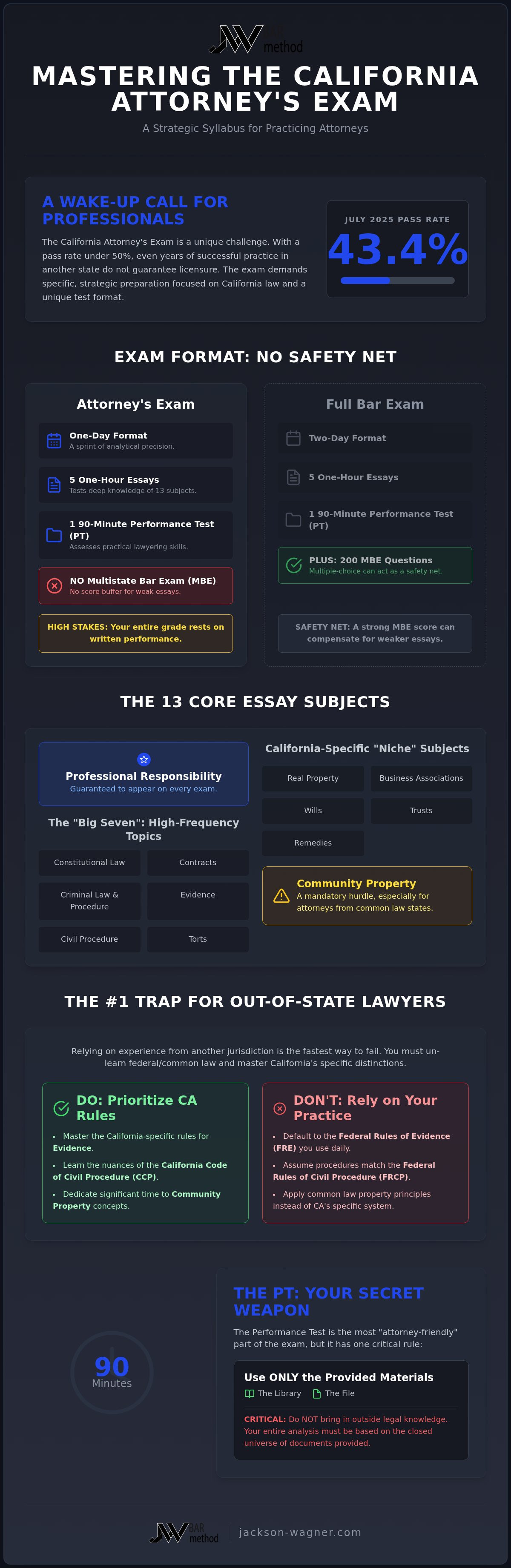
Did you know that in July 2025, only 43.4% of candidates passed the California Attorney's Exam? For a seasoned professional, that number is more than a statistic; it's a wake-up call that years of successful practice don't automatically translate to licensure in the Golden State. The challenge isn't your legal acumen, but rather the sheer volume of california attorney's exam subjects you're expected to master while maintaining your current caseload.
It's exhausting to juggle a full-time practice while trying to distinguish nuanced California-specific rules from the general common law you use every day. You don't have time for information overload or legacy prep courses that treat you like a first-year law student. This guide provides a structured, strategic syllabus to help you master the 13 core subjects and the 90-minute Performance Test with professional efficiency. We'll provide a weighted list of priorities and clarify the CA-only distinctions to ensure you have a clear path to passing without closing your practice.
Key Takeaways
- Understand why the absence of the Multistate Bar Examination (MBE) makes the remaining essay portions significantly higher stakes for seasoned practitioners.
- Identify the high-frequency california attorney's exam subjects and master the nuances of Professional Responsibility, the only subject guaranteed to appear on every exam.
- Learn to navigate the "California vs. Federal" dichotomy in Evidence and Civil Procedure to avoid the common trap of relying on out-of-state common law.
- Develop a tactical approach to the 90-minute Performance Test, transforming it into your strongest scoring asset through efficient use of the File and Library.
- Discover how to replace legacy 10-week study models with an accelerated, professional-centric path that integrates with your current practice requirements.
Attorney’s Exam vs. Full Bar: Defining the 2026 Syllabus
The primary distinction for the 2026 cycle remains the exclusion of the Multistate Bar Examination (MBE). For attorneys licensed in good standing for at least four years in another U.S. jurisdiction, the State Bar of California offers this condensed, one-day format. While skipping 200 multiple-choice questions feels like a reprieve, it's actually a high-stakes pivot. Your entire grade rests on five one-hour essays and a single 90-minute Performance Test. This structure demands absolute mastery of the california attorney's exam subjects because there's no MBE score to buffer a weak essay performance.
Seasoned practitioners often underestimate this "shorter" exam. The lack of multiple-choice questions means your analytical writing must be flawless. In the full bar exam, a strong MBE can sometimes save a candidate with mediocre essays. Here, you have no such safety net. Every sentence you write is scrutinized for rule precision and logical depth. If you fail to hit the specific keywords the graders expect for the 13 california attorney's exam subjects, there's no way to recover those points elsewhere.
The One-Day Format Advantage
A one-day exam changes your physiological and mental preparation. You aren't training for a two-day marathon of endurance; you're training for a sprint of analytical precision. You can focus 100% of your energy on writing and rule application. This allows for a more specialized study plan that prioritizes essay templates and timing. However, don't mistake brevity for a lighter workload. You're still responsible for all 13 core subjects. The syllabus isn't smaller; the window to prove your competence is just narrower. Success requires a shift from passive recognition to active, high-speed production under pressure.
Scoring Realities for Practitioners
The danger for seasoned lawyers lies in the "practice trap." Relying on your years of experience in a different jurisdiction can be fatal to your score. The examiners aren't looking for how you'd handle a case in your home state; they're looking for a specific CA-specific rubric. You must achieve a total scaled score of 1390 to pass. Without the MBE, every point on your essays is magnified. The Performance Test (PT) acts as the ultimate weight in your final grade. It's designed to test your ability to handle a legal task using only the provided materials. While this is the most "attorney-friendly" part of the day, it's also where many lose points by bringing in outside legal knowledge that wasn't in the provided "Library."
The 13 Core California Attorney’s Exam Subjects
Success on this exam requires more than general legal knowledge. You must navigate a specific syllabus of 13 california attorney's exam subjects. While the scope seems broad, the frequency of certain topics allows for a strategic, weighted approach. Professional Responsibility stands as the only guaranteed subject. It appears on every single administration, often crossing over with other topics like Business Associations or Evidence. Mastery here is non-negotiable; it's the anchor of your scoring strategy. You must treat it as the most important subject in your arsenal.
The examiners group these subjects into categories that often overlap in a single essay prompt. The "Big Seven" form the core of your study plan because they represent the highest probability of appearance. These include:
- Professional Responsibility
- Constitutional Law
- Contracts
- Criminal Law and Procedure
- Evidence
- Civil Procedure
- Torts
The High-Frequency Essay Topics
Constitutional Law, Contracts, and Criminal Law and Procedure are foundational. However, Evidence and Civil Procedure are where out-of-state attorneys often stumble. These subjects are heavily influenced by California-specific rules that diverge sharply from the Federal Rules of Evidence or the FRCP. You can't rely on your "gut" or "common sense" here. Torts requires a return to academic rigor. You must focus on precise definitions of negligence and strict liability that you might have simplified in your years of practice. Real Property often appears as a complex crossover, testing your ability to handle ownership disputes alongside contract law.
California-Specific 'Niche' Subjects
Don't let the "minor" label fool you. Community Property is a mandatory hurdle. If you come from a common law state, the concepts of quasi-community property and the tracing of assets will feel foreign. You'll need to master the various presumptions that govern asset characterization. Wills and Trusts similarly require a deep dive into the California Probate Code. It isn't enough to know the general principles; you must understand how California treats holographic wills and spendthrift trusts. Business Associations covers Corporations, Partnerships, and Agency, often testing the fiduciary duties of directors and the nuances of piercing the corporate veil in a CA context.
Balancing these 13 california attorney's exam subjects with a full-time practice is the ultimate test of efficiency. Most legacy courses overwhelm you with thousands of pages of irrelevant material that you'll never use. If you need a more streamlined approach, the JW Bar Method Prep - Attorney’s Exam California Bar focuses exclusively on the high-impact rules you actually need to pass. This modern evolution in prep ensures you aren't wasting hours on low-probability topics when your time is at a premium.
California Distinctions: The #1 Trap for Out-of-State Lawyers
Your greatest professional asset is also your most significant liability when facing the California Bar. Years of successful practice in another jurisdiction create a mental "autopilot" based on the Federal Rules or your home state's statutes. In California, this intuition is often wrong. Graders don't award points for general legal competence; they look for the application of specific California rules. A California Distinction is the specific legal delta between general common law principles and the unique statutory frameworks adopted by the state legislature. If you fail to identify these deltas within the california attorney's exam subjects, you risk falling into the same traps that lead to the high failure rates seen in previous years.
Evidence and Civil Procedure Nuances
The gap between the California Evidence Code (CEC) and the Federal Rules of Evidence (FRE) is a frequent source of lost points. You can't simply rely on the FRE's "catch-all" hearsay exception because it doesn't exist in the CEC. Similarly, the way California handles the physician-patient privilege and the specific requirements for "propensity evidence" in sex offense cases differs sharply from federal standards. Civil Procedure is equally treacherous. The California Code of Civil Procedure dictates strict timelines for service of process and discovery that don't align with the FRCP. Mastering these california attorney's exam subjects requires unlearning the default settings of your daily practice to focus on the technicalities of the CA code.
The CRPC vs. ABA Model Rules
Professional Responsibility is the highest-stakes subject because it appears on every exam. Most attorneys are comfortable with the ABA Model Rules, but the California Rules of Professional Conduct (CRPC) are significantly more protective and restrictive. For example, the duty of confidentiality in California is notoriously strict. While the ABA allows for disclosure to prevent a broad range of financial crimes, California's "death or substantial bodily harm" exception is one of the narrowest in the country. Conflict of interest rules also require a more rigorous disclosure and consent process under the CRPC. You must be able to pivot between these two frameworks instantly to secure a passing score.
Understanding these distinctions is only one part of the process. You also need to ensure you meet all the administrative hurdles before you sit for the test. Review the California Attorney's Exam Requirements to confirm your eligibility and documentation are in order for the 2026 cycle. Preparation is about more than just reading outlines; it's about shifting your entire analytical framework to match what the State Bar demands.
The Performance Test (PT): Your Secret Weapon
While the 13 california attorney's exam subjects require rigorous memorization and precise recall, the Performance Test (PT) operates on a completely different logic. It is a closed-universe simulation. You aren't expected to bring outside legal knowledge into this 90-minute window. Instead, you're tested on your ability to process information and produce a professional work product under extreme pressure. For a seasoned practitioner, this is your home turf. It rewards the "lawyering skills" you've honed over years of practice rather than your ability to recite academic rules. The PT consists of three parts: the Task Memo, the File, and the Library. The Task Memo is your boss; it tells you exactly what to do and how to do it.
The 90-minute clock is your most dangerous opponent in this section. Success requires a disciplined 45/45 split. You must spend the first 45 minutes researching the Library and organizing the facts in the File. Use the remaining 45 minutes for drafting. This temporal precision ensures you don't run out of time before reaching your final analysis. If you've spent years drafting motions and memos, you already have the muscles for this. You just need to adapt them to the specific constraints of the California rubric.
Research and Analysis Strategy
Efficiency is the core of a high-scoring PT. You must extract the governing law from the Library without falling into the trap of over-reading every footnote or secondary case. Identify the specific rules that apply to your client's situation and ignore the distractions. When reviewing the File, filter the facts to match the requirements of the task. If the Task Memo asks for an objective memorandum, don't write a persuasive brief. Matching the required tone is essential. Graders will penalize you for being argumentative when the task calls for a neutral assessment of a client's risks.
Drafting for Maximum Points
The most common reason for PT failure is ignoring the Task Memo. If the memo asks for a letter to a client, don't provide a court motion. Graders look for a specific structure that mirrors real-world legal documents. Use clear headers and a logical flow to make your answer grader-friendly. This makes it easy for them to check off every required element in their scoring key. For a deeper look at how this fits into your overall study plan, read our guide on Passing the California Bar Exam in 2026.
Mastering the PT allows you to walk into the exam center with absolute confidence. You don't need to fear the unknown when you have a repeatable system for analysis and drafting. If you want to refine your speed and accuracy on these tasks, the JW Bar Method Prep - Attorney’s Exam California Bar provides high-impact simulations designed specifically for the professional learner. This modern approach ensures you're practicing the skills that actually move the needle on your final score.
Accelerated Prep: Mastering the Syllabus with the JW Bar Method
Legacy bar prep providers often ignore the reality of a modern legal career. They demand a three-month hiatus from practice that most attorneys simply cannot afford. This creates unnecessary anxiety and a fear of failing a "basic" exam after years of professional success. You don't need more information; you need better organization of the california attorney's exam subjects. The JW Bar Method provides this structure by filtering out the academic noise and focusing on the specific analytical patterns required for California licensure. We replace the stress of high-pressure certification with a structured, modern, and reliable path to success.
The JW Bar Method for Attorneys
This pedagogical shift moves the focus from "learning the law" to "scoring points." By using the JW Bar Method Prep - Attorney’s Exam California Bar, you prioritize the high-impact rules that represent the bulk of the available points. Strategic abandonment is a core component of this efficiency. You don't need to be an expert in every obscure sub-topic of the 13 california attorney's exam subjects; you need to master the high-yield areas that graders consistently reward. This precision ensures you aren't wasting hours on low-probability topics when your billable time is at a premium.
Accelerated Success Tracks
Balancing a full-time practice with exam preparation requires a structured, flexible path. The JW Bar Method Accelerated Prep - Attorney’s Exam California Bar offers 30-day and 60-day tracks that integrate high-stakes drills into your existing schedule. This allows you to maintain your client caseload while building the muscle memory needed for essay precision. It's about bold reliability. We assume the financial risk of your performance outcome by providing a methodology so efficient it fits into the margins of a busy professional life. This makes the brand feel both cutting-edge and deeply dependable for the modern learner.
Most candidates lose points not because they don't know the law, but because they fail to present it in the specific format graders expect. You learn to identify the "trigger" facts in a prompt and respond with pre-formatted rule blocks that satisfy the CA-specific rubric. This method allows you to compress the study of 13 subjects into a manageable window, ensuring you spend your limited time only on what actually moves the needle. It's time to replace the stress of legacy models with a modern, reliable path to success that doesn't require you to close your practice.
Pass the California Attorney's Exam with Jackson-Wagner
Your Strategic Path to California Licensure
Licensure in the Golden State is a high-stakes transition that demands more than just general legal competence. You've seen how the 13 california attorney's exam subjects require a sharp pivot from federal standards to CA-specific statutes, particularly in Evidence and Professional Responsibility. By transforming the Performance Test into your primary scoring engine and identifying the critical "deltas" in the law, you eliminate the guesswork that leads to high failure rates. The traditional 10-week study model is a relic of the past that doesn't fit your professional life.
You deserve a modern alternative designed by California bar pedagogy experts who understand the time constraints of a full-time practice. Our proprietary JW Bar Method focuses on high-impact results, providing a structured environment with a results-oriented financial assurance that protects your investment. You don't have to choose between your clients and your future. Secure your California license with the JW Bar Method Prep - Attorney’s Exam California Bar. Your professional experience is your greatest asset; it's time to use a prep method that treats it like one. Success is within your reach.
Frequently Asked Questions
What are the specific subjects tested on the California Attorney's Exam?
The 13 california attorney's exam subjects include:
- Business Associations
- Civil Procedure and Community Property
- Constitutional Law and Contracts
- Criminal Law and Procedure
- Evidence and Professional Responsibility
- Real Property and Remedies
- Torts, Trusts, and Wills and Succession
You must be prepared to handle any of these in the five one-hour essay slots. Examiners frequently use crossover questions that merge multiple topics into a single fact pattern.
Is the California Attorney's Exam easier than the full bar exam?
Easier is a dangerous misconception. While the exam is shorter because it lacks the MBE, the grading is notoriously strict. In July 2025, the pass rate for attorneys was only 43.4%. Without the multiple-choice section to buffer your score, your written analysis must be flawless. You're competing against a high-tier pool of experienced lawyers, and the examiners expect a level of sophisticated reasoning that exceeds what's required of standard law students.
Do I have to take the MBE if I'm taking the Attorney's Exam?
You don't have to take the MBE if you qualify for the Attorney's Exam. This path is reserved for lawyers who have been active members in good standing of another U.S. jurisdiction for at least four years. If you meet these criteria, you only complete the written portion, which consists of five essays and one Performance Test. This allows you to focus your energy entirely on analytical writing and California-specific legal distinctions rather than broad multiple-choice memorization.
How much time should an attorney spend studying for the CA Bar?
Most practitioners find that traditional 10-week student schedules are incompatible with their billable requirements. Instead of counting total hours, focus on high-impact drills. An accelerated 30-day or 60-day track is often more effective for experienced lawyers. This approach prioritizes the california attorney's exam subjects that appear most frequently, such as Professional Responsibility and Constitutional Law, while using the Performance Test to maximize your scoring potential without sacrificing your entire practice.
What happens if I fail one subject on the California Attorney's Exam?
There isn't an automatic fail for a single subject, but the margin for error is slim. Your final result depends on your total scaled score reaching at least 1390. Because the Attorney's Exam only has six scoring components, a low grade in one essay puts immense pressure on the others. You must achieve consistency across the board. The Performance Test is weighted heavily, so a strong PT can often compensate for a weaker performance in a minor essay subject.
Can I work full-time while studying for the California Attorney's Exam?
You can definitely maintain a full-time practice if you use a results-oriented study plan. The JW Bar Method was specifically developed to help professionals master the syllabus in the margins of their workday. By focusing on essay precision and rule application rather than passive reading, you can prepare effectively without taking a leave of absence. Success requires a strategic shift from learning law to scoring points through high-yield, structured drills that fit your schedule.
Which subject is most likely to appear on the California Bar essays?
Professional Responsibility is the only subject guaranteed to appear on every single administration of the exam. It is often tested as a standalone essay, but it can also appear as a crossover element in other topics like Evidence or Business Associations. Because it's a certainty, your mastery of the California Rules of Professional Conduct must be absolute. It's the most reliable way to secure a high score and anchor your overall performance against the scaling process.


