

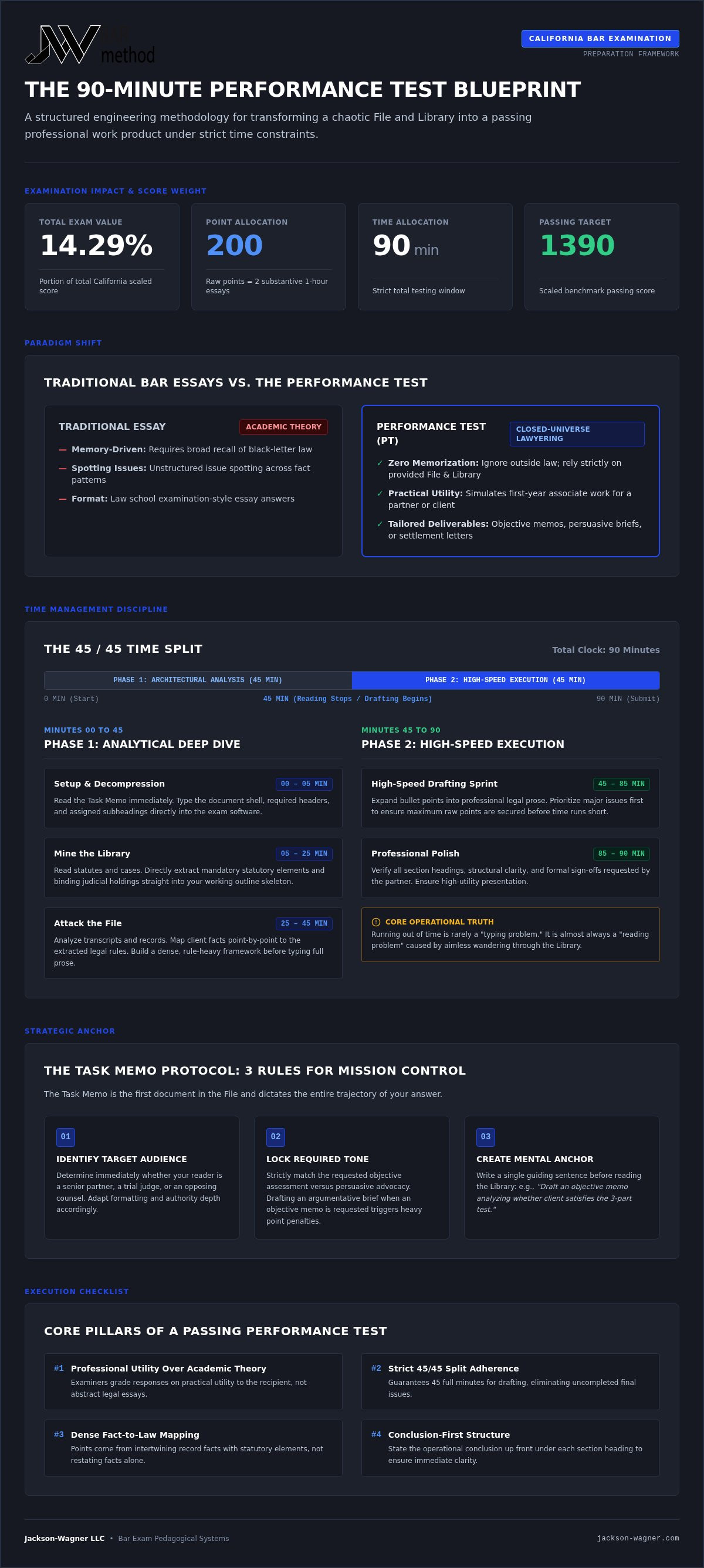
A passing Performance Test isn't a creative writing exercise; it's a high-stakes engineering project. You have exactly 90 minutes to transform a chaotic stack of transcripts and statutes into a professional work product that carries 14.29% of your total California Bar Exam score. Learning how to write a passing performance test requires you to stop "writing" and start "architecting" your response before you even touch the keyboard.
It's natural to feel anxious about the clock. Most examinees lose their passing margin because they over-read the Library or fail to adopt the correct professional tone, leaving them scrambling to finish the final pages. This guide will show you how to replace that stress with a structured 45/45 split that ensures you hit every pass-critical rule while maintaining a professional format. We're moving beyond legacy study habits to give you a modern, results-driven blueprint for the 2026 exam.
You'll learn how to extract the exact statutory elements you need, build a high-scoring outline in minutes, and draft with the confidence of a practicing attorney. By the end of this article, you'll have a repeatable strategy to turn a complex File and Library into a professional legal work product under intense pressure.
Key Takeaways
- Learn to prioritize professional utility over academic theory to meet the specific expectations of California Bar examiners.
- Implement the 45/45 Split to master time management, ensuring you have ample space to execute a complete, high-scoring response.
- Discover how to write a passing performance test by perfecting the art of rule extraction and dense fact-to-law mapping.
- Use a conclusion-first structural blueprint to maintain professional formatting and clarity under intense pressure.
- Pivot from legacy, volume-heavy study habits to a modern, pedagogical system designed for the rigors of the 2026 examination.
What is the California Performance Test (PT)?
The California Performance Test (PT) is a 90-minute simulated lawyering task designed to test your ability to handle a legal problem as a first-year associate. Unlike the substantive essays, the PT doesn't require you to memorize black-letter law. Instead, it provides a "File" containing client facts and a "Library" containing statutes and cases. Your goal is to produce a specific work product, such as a memo or brief, within a strict time limit. This shift from academic recall to professional execution is where many candidates fail. The Bar Examiners aren't looking for a law school exam; they want a document that has utility for a senior partner or a client.
The PT vs. Traditional Essays
Traditional essays reward your ability to spot issues and recite memorized rules. The PT is a different beast because it's a "closed-universe" exam. You must ignore everything you know about real-world law and rely solely on the provided materials. This bar exam performance test overview explains how this format assesses practical skills rather than just rote memorization. In the 2026 California Bar Exam, the PT is worth 200 raw points, making it equivalent to two one-hour essays. This represents 14.29% of your total scaled score. Because it's weighted so heavily, understanding how to write a passing performance test is often the difference between a passing 1390 and a failing score. You'll be asked to draft various documents, including objective memos, persuasive briefs, or even settlement letters, each requiring a specific professional tone.
The Role of the Task Memo
The Task Memo is the first document in your File and serves as your master plan. It identifies your audience, whether that's a senior partner, a judge, or a client, and dictates the tone you must adopt. If the memo asks for an objective analysis, an argumentative brief will result in heavy point deductions. You must extract every specific deliverable mentioned. A winning strategy is to write a single sentence defining your objective before you read the Library. For example: "Draft an objective memo to Partner Smith analyzing whether our client meets the three-part test for adverse possession." This mental anchor prevents you from getting lost in red herrings. Mastering this initial step is the foundation of how to write a passing performance test because it ensures you're actually answering the question asked.
The 90-Minute Blueprint: Mastering Time Management
The 90-minute clock is the greatest adversary on the California Bar. Most candidates fail not because they're slow typists, but because they lack a disciplined workflow. The 45/45 split is the industry gold standard for anyone learning how to write a passing performance test. This method forces you to spend exactly half your time on architectural analysis and the remaining half on high-speed execution. Running out of time is rarely a "typing problem." It's almost always a "reading problem" caused by aimless wandering through the Library.
Phase 1: The Analytical Deep Dive
Minutes 0 to 5 are for decompression and setup. Read the Task Memo and immediately type your document shell into your exam software. This includes the header and any requested subheadings. Between minutes 5 and 25, you must mine the Library for rules. Don't just read cases; extract the specific statutory elements and judicial holdings directly into your outline. From minutes 25 to 45, attack the File. Map client facts to the rules you've already extracted. Studying California State Bar past performance tests and selected answers reveals that top scorers have a dense, rule-heavy skeleton before they ever start writing full sentences.
Phase 2: High-Speed Execution
At the 45-minute mark, your "reading" phase ends. You are now in a drafting sprint. Because you've already built a comprehensive outline, you aren't staring at a blank screen. You're simply expanding your notes into professional prose. Prioritize the major issues first to ensure you capture the bulk of the points even if the clock runs down. Save the final five minutes for a professional polish. Check your headings and ensure you've included the formal sign-offs requested by the partner. This level of pedagogical precision ensures you stay in control of the exam rather than letting the exam control you. Mastering this blueprint is the most reliable path for how to write a passing performance test under extreme pressure.
Mining the Library and File for Maximum Points
The secret to a high-scoring answer isn't just finding rules; it's the density of your analysis. When you're figuring out how to write a passing performance test, you must realize that the Bar Examiners have meticulously placed every fact in the File for a reason. Your job is to extract the "Skeleton" from the Library and drape the "Meat" of the facts over it. According to the State Bar of California examination specifications, the PT tests your ability to handle factual data and apply legal principles. This means you must distinguish between relevant law and the intentional red herrings designed to waste your time.
The Three Types of PT Rules
A sophisticated analysis requires you to categorize rules into three distinct buckets. First, look for Express Rules. These are the black-letter statutes or clearly defined multi-part tests. Second, identify Inferred Rules. These aren't explicitly stated but are derived from how a court in the Library applied a rule to specific facts. If a court found a defendant liable because they acted "recklessly," that application becomes a rule for your own client. Finally, always look for Counter-Rules. These are the exceptions or limitations that the opposing party will use against your client. Acknowledge these early to demonstrate professional competence.
Fact Density: The 'Because' Test
Analytical density is the hallmark of a high-scoring answer. You can't just state a fact and then state a conclusion. You must bridge the gap using the "Because" Test. For every major point, write a sentence that connects a File fact to a Library rule using the word "because." For example: "The defendant's actions were negligent because he ignored the warning sign mentioned in the investigator's report." This structure ensures you aren't just reciting facts but are actually lawyering.
Don't ignore "Bad Facts" in the File. Every File has evidence that hurts your client's position. A novice examinee ignores these, but a professional addresses them head-on. Acknowledge the unfavorable fact and then minimize it by distinguishing it from the cases in the Library. Use the provided precedents to argue why a specific unfavorable ruling doesn't apply to your client's unique circumstances. This level of tactical precision is exactly what distinguishes the JW Bar Method from legacy volume-based study programs. Mastering the art of rule extraction and fact-to-law mapping is the only way to ensure you're actually learning how to write a passing performance test rather than just completing a writing assignment.
Structural Execution: Drafting the Passing Answer
Professional formatting is the silent signal of competence. If your document looks like a legal memo, the grader treats you like a lawyer. If it looks like an essay, you're just a student. Mastering how to write a passing performance test requires a fundamental shift in mindset. You aren't writing for a professor; you're producing a tool for another professional to use. This means headings, sub-headings, and formal salutations aren't just aesthetic choices; they're the skeleton of your score.
Heading Architecture
Don't use generic headings like "Issue 1" or "Analysis." Use your conclusion or the rule itself as the heading. For example, "The Client is Likely Liable Because the Warning Was Inadequate" tells the grader exactly what you found. This allows them to award points immediately without hunting through your paragraphs. It also keeps your writing focused on the specific deliverables identified in the Task Memo. For more on high-level strategy across the entire test, see How to Master the California Bar Examination.
The Art of the Professional Work Product
The difference between a memo and a brief lies entirely in the tone. A memo is objective and balanced, while a brief is persuasive and advocacy-driven. You must avoid "Bar Exam" language. Don't say "The issue is whether..."; instead, start with "This memorandum addresses the legal implications of..." or "The Court should grant the motion because...". Precision in citations is equally critical, though you don't need Bluebook perfection. Simple references like (Case Name) or (Statute Section) are sufficient to satisfy the grader that you're grounded in the Library.
Focus on passing prose rather than perfect prose. You don't have time for elegant transitions or sophisticated vocabulary. Your goal is utility. A "passing" answer is a complete answer that follows instructions and applies the law to the facts with density. If you spend too much time polishing the first section, you'll run out of time for the conclusion. This is why a "Conclusion-First" (CRAC) approach is safer. It ensures your main point is delivered even if the clock runs out. To secure your path to licensure with a structured, modern system, explore the JW Bar Method Prep options. Understanding how to write a passing performance test is about delivering professional results, not academic perfection.
The JW Bar Method Advantage: Precision Under Pressure
Legacy bar prep tools often fail on the PT because they drown students in volume. They treat the Performance Test as an afterthought, assuming that completing dozens of practice questions will eventually lead to a pass. At Jackson-Wagner LLC, we disagree. The JW Bar Method is built on pedagogical precision. It's a repeatable system that teaches you exactly how to write a passing performance test by focusing on architectural strategy rather than just doing more reps. We strip away the noise so you can master the 90-minute session with absolute confidence.
Accelerated Prep for Practicing Attorneys
Practicing attorneys often struggle with the PT more than recent law school graduates. This happens because "real world" experience creates a cognitive bias; you want to use the law you already know. The California Attorney's Exam is a closed-universe environment where your outside knowledge is actually a liability. Our accelerated track at Jackson-Wagner LLC is designed to break these habits. We teach you to treat the Library as the only law that exists. This focus on efficiency is why we're considered the Best Bar Exam Preparation Service 2026. We ensure you aren't just working hard, but working on the specific tasks that satisfy the State Bar's grading criteria.
The Path to Licensure in 2026
Success in 2026 requires more than just a study schedule; it requires a psychological edge. When you have a repeatable blueprint, the time management anxiety that plagues most candidates disappears. You aren't guessing how to write a passing performance test anymore. You're executing a proven workflow. At Jackson-Wagner LLC, we are so certain of this methodology that we offer a binary performance guarantee. We assume the financial risk of your outcome so you can focus entirely on the method. This partnership replaces high-stakes stress with a structured, reliable path to success. The choice is between legacy volume and modern precision. Join the JW Bar Method and Pass the California Bar Exam to secure your future as a licensed California attorney.
Secure Your California License with Strategic Precision
Passing the 2026 California Bar Exam requires you to abandon the volume-heavy habits of legacy prep courses. Success on the Performance Test isn't about how much you write, but how effectively you architect your response. By mastering the 45/45 split and prioritizing the Task Memo's specific deliverables, you transform a high-pressure hurdle into a reliable source of points. You've learned that how to write a passing performance test is a matter of professional engineering; matching dense factual analysis from the File with the exact rules provided in the Library.
We've built a system that replaces exam anxiety with proprietary JW Bar Method precision. As California licensure experts, we offer specialized accelerated prep for attorneys and a structured path for all candidates to master the written portion of the exam. We assume the risk so you can focus entirely on the method. Take the final step toward your professional goals and Master the California Bar with the JW Bar Method. You now have the blueprint and the strategy; it's time to execute with absolute confidence.
Frequently Asked Questions
Is the California Performance Test the same as the MPT?
No. While the Multistate Performance Test (MPT) is a 90-minute test used by many UBE jurisdictions, California uses its own proprietary format. The California PT is specifically designed by the State Bar of California to test practical lawyering skills within the context of California's rigorous standards. It carries a significant weight of 200 raw points, which is 14.29% of your total scaled score and double the value of a single essay.
How much time should I spend reading the PT Library?
You should allocate approximately 20 to 25 minutes of your first 45-minute block to the Library. This allows you to extract the skeleton of the rules before you move to the File. Following the 45/45 split ensures you don't over-read. Learning how to write a passing performance test depends on identifying rule elements quickly so you have enough time for the factual mapping phase in the second half.
Do I need to memorize any law for the Performance Test?
No memorization is required because the PT is a closed-universe examination. Every statute, case, and regulation you need is provided in the Library booklet. In fact, using outside law or personal legal knowledge can lead to point deductions or wasted time. Your objective is to use the provided authorities to solve the client's specific problem as outlined in the Task Memo provided on exam day.
What happens if I don't finish the PT on the bar exam?
Failing to finish usually results in a significant score penalty because you likely missed key deliverables or a final conclusion. Graders look for a complete work product that is useful to the intended audience. If you find yourself running out of time, prioritize headings and a brief conclusion. This ensures the grader sees your full analytical path even if the final prose is sparse.
Can I use IRAC for the California Performance Test?
Yes, but a CRAC (Conclusion-Rule-Application-Conclusion) hybrid is often more effective. Since the PT is a professional work product, leading with your conclusion in headings makes the document more useful for a senior partner or judge. This structural choice is a core component of how to write a passing performance test because it ensures your primary legal points are visible even during a quick grading review.
Is the PT harder on the California Attorney's Exam?
The PT itself is identical in format and difficulty to the one found on the full exam. However, the stakes are higher for attorneys because they only take the written portion. Practicing lawyers often struggle because they try to apply real-world law instead of the closed-universe Library. Jackson-Wagner offers accelerated prep tracks specifically to help out-of-state attorneys break these academic habits and focus on pedagogical precision.
How are Performance Tests graded by the State Bar of California?
Graders use a raw scale from 40 to 100, and the PT score is then multiplied by two. They evaluate your ability to follow the Task Memo, the density of your fact-to-law mapping, and your professional tone. A raw score of 60 to 65 is generally considered a passing performance before statistical scaling is applied to reach the 1390 scaled points required for licensure.
What is the best way to practice for the 90-minute PT?
The most effective method is timed practice using past exams and high-scoring selected answers. You must simulate the 90-minute pressure to master the 45/45 time split. The JW Bar Method provides active learning drills and structured templates that turn the PT into a repeatable system. This pedagogical approach ensures you spend your study hours on high-impact strategies rather than just reading volume without a plan.


