

The exam hall shouldn’t be the first place you practice taking an exam. Learning how to deal with exam day anxiety starts with making the experience more familiar: rehearse the routine, use a calming technique, and prepare in manageable study sessions instead of relying on last-minute cramming. Test anxiety is distress that can interfere with focus and performance, not simply a sign that you haven’t studied enough.
Feeling nervous before an important test is understandable, especially when the result matters. Rather than trying to force anxious thoughts away, make a practical plan: seek academic or emotional support, stop measuring your preparation against other people’s, and practice breathing or muscle relaxation before test day. Rehearse the setting and routine so the real exam feels less unfamiliar. The goal isn’t to eliminate every nerve. It’s to arrive with a clear plan and confidence in the preparation you’ve done.
Key Takeaways
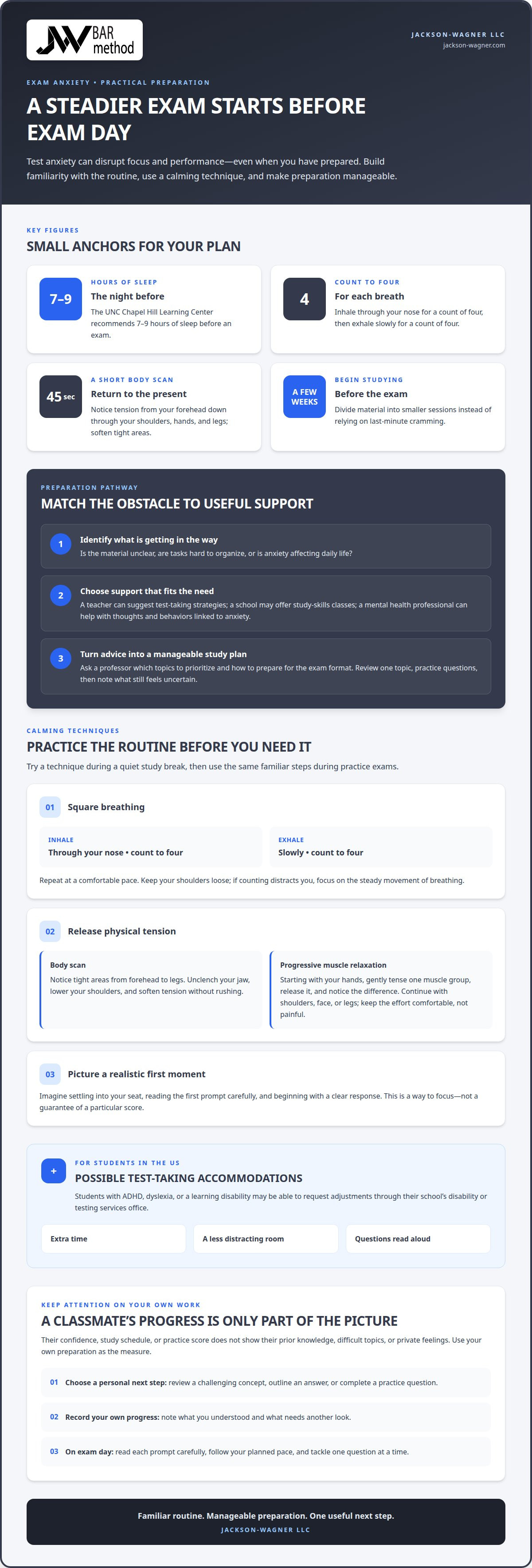
- Use academic or wellness support to address anxiety and strengthen your preparation; the University of North Carolina at Chapel Hill Learning Center recommends 7-9 hours of sleep the night before an exam.
- Focus on your own preparation and next steps instead of using classmates’ pace or confidence as a measure of your readiness.
- Practice a simple breathing or muscle-relaxation technique ahead of time so you have a familiar way to steady yourself during the exam.
- Rehearse exam-day activities, such as completing a practice paper under exam conditions, to make the setting and routine feel more familiar.
1. Academic and wellness support resources
Test anxiety can disrupt concentration and performance, even when you’ve prepared. Start by identifying what makes studying harder: unclear material, difficulty organizing tasks, or anxiety that affects daily life. Then choose support that addresses the specific obstacle. A teacher can suggest test-taking strategies, while a school may offer study-skills classes. A mental health professional can help you work through thoughts and behaviors linked to anxiety and may also teach study and organization skills.
Make preparation manageable. Begin studying a few weeks before the exam and divide the material into smaller sessions instead of cramming. Ask a professor during office hours which topics to prioritize and how to prepare for the exam format. Build those suggestions into a simple plan, such as reviewing one topic, practicing questions, then noting what still feels uncertain. Protect your rest, too: the University of North Carolina at Chapel Hill Learning Center recommends getting 7-9 hours of sleep the night before an exam.
In the US, students with ADHD, dyslexia, or a learning disability may be able to request test-taking accommodations, such as extra time, a less distracting room, or having questions read aloud. Contact your school’s disability or testing services office to learn how its request process works. Describe the barrier you experience and the adjustment that could help you demonstrate what you know. A teacher or academic adviser can help you identify the right campus office.
Medication or supplements aren’t a last-minute exam strategy to start on your own. Ask a healthcare professional whether medication fits your situation, and discuss possible side effects and interactions with other medicines or supplements. Don’t change a prescribed routine without medical advice. If anxiety is severe, persists, and interferes with everyday life, seek professional support. For a young person with these difficulties, a GP can be a starting point. Family can help by adjusting routines, reducing nonessential demands, and creating a quiet study space without adding pressure to achieve a particular score.
2. Avoiding comparisons with classmates
A classmate’s confidence, study schedule, or practice score gives only a partial picture. You can’t see how much prior knowledge they have, what material they find difficult, or how they’re feeling privately. Using their progress to judge your readiness can pull attention away from your own preparation. When someone says they’ve finished every practice question, return to a more useful question: what topic do you need to work on next?
Set a personal benchmark before conversations about the exam begin. For example, decide to review a challenging concept, outline an answer, or complete a practice question. Afterward, record what you understood and what needs another look. This gives you evidence of your own progress instead of a shifting impression based on classmates’ comments. Keep the record private if sharing it would invite unhelpful comparisons.
Notice what triggers comparisons. Group chats, study groups, and casual hallway conversations can turn into scorekeeping when students trade claims about how much they’ve studied. You don’t have to leave every discussion; steer it toward useful questions. Ask a classmate to explain a confusing concept, or suggest reviewing a specific topic together. If the conversation keeps increasing pressure, mute the chat while you study or take a break from that discussion.
After a practice test, review your own work before asking how others performed. Note which answers were clear, where you lost focus, and what you’ll try differently next time. A classmate’s higher score may reflect different strengths or experience, not your full potential. Use instructor feedback to identify a concrete next step, then return to that task instead of replaying other students’ results.
On exam day, focus on what you can control: read each prompt carefully, follow your planned pace, and tackle one question at a time. If comparison thoughts appear, name the next useful action and take it. Your goal isn’t to match a classmate’s routine; it’s to use your preparation effectively.
3. Breathing and muscle relaxation
Practice a calming technique before the exam, not just after anxiety rises. Repeating the steps makes them more familiar when your thoughts start racing. Choose one method and try it during a quiet study break. Notice whether it helps you return your attention to the task, then use the same method during practice exams. The aim is a simple routine you can remember without adding another complicated task to exam day.
For square breathing, inhale through your nose while counting to four. Then exhale slowly while counting to four. Repeat at a comfortable pace, keeping your shoulders loose instead of lifting them with each breath. If counting feels distracting, focus on the steady movement of breathing. Practice at your desk so the technique feels easy to use while seated in an exam room.
A short body scan can help bring attention back to the present. Set aside 45 seconds to notice tension from your forehead down through your shoulders, hands, and legs. When you find a tight area, soften it without rushing. For example, unclench your jaw and lower your shoulders before returning to the question in front of you.
Progressive muscle relaxation is another practical option. Starting with your hands, gently tense one muscle group, then release it and notice the difference. Move to your shoulders, face, or legs in turn. Keep the effort comfortable, not painful. Practicing this sequence during study sessions can help you notice where exam stress appears physically and respond by deliberately releasing tension.
You can also picture a positive, realistic outcome: settling into your seat, reading the first prompt carefully, and beginning with a clear response. This doesn’t guarantee a particular score; it’s a way to rehearse your next useful action. Pair the image with slow breathing or relaxed shoulders. Try the combined routine during practice, then use the steps that feel manageable before or during the exam.
4. Practicing exam-day activities
Make the exam feel more familiar by rehearsing its steps before test day. Complete a practice paper under exam conditions, using the same format and time limits when available. Practice reading directions, choosing a starting question, and moving on when you feel stuck. This turns an uncertain situation into a sequence of actions you’ve already tried. Rehearsing the process is one practical way to learn how to deal with exam day anxiety.
If possible, study in the test location or somewhere similar. Seeing the exam hall beforehand can make the room and route feel less unfamiliar. Practice your morning routine too: set out permitted materials, plan your travel, and decide what you’ll do before entering. A consistent routine helps you focus on preparation instead of last-minute decisions.
Choose familiar food and drink before the exam. Have a meal or snack you already know suits you, and drink water as you normally would. Avoid trying unfamiliar foods or drinks on test morning. The aim is to keep your routine predictable, not introduce a new source of uncertainty.
Protect sleep as part of your exam practice. The University of North Carolina at Chapel Hill Learning Center recommends getting 7-9 hours of sleep the night before an exam. In the morning, follow the routine you rehearsed, allow time for travel, and plan to arrive 10 to 15 minutes early. Use any waiting time to settle in rather than cram new material.
Run through a short rehearsal before the actual exam: wake up, eat your familiar breakfast, gather permitted supplies, and travel to the location. During a practice paper, sit upright and follow the approach you’ll use on test day. Note which steps cause confusion, then adjust your plan before the next rehearsal. If you’re still wondering how to deal with exam day anxiety, use practice sessions to identify which parts of your routine need more attention.
Preparing for a California Bar Exam? Explore structured exam preparation as part of a consistent practice plan.
Jackson-Wagner
Jackson-Wagner LLC offers structured preparation for candidates taking the California Bar Exam. A clear study framework can organize your preparation and help you practice exam tasks with purpose. A dedicated prep course can help you build a consistent study routine around the exam ahead.
Choose JW Bar Method Prep for the Full Exam or Attorney’s Exam, or an Accelerated Prep option for either exam. These programs focus on California Bar Exam preparation, not legal representation. A structured course can complement timed practice and a consistent pretest routine, helping you prepare with a clearer sense of what to work on.
If you’re preparing for the California Bar Exam and want a structured course, explore Jackson-Wagner LLC’s JW Bar Method programs.
Build confidence through your next step
Your next step in learning how to deal with exam day anxiety is to make preparation repeatable. Choose one action you can carry forward, such as reviewing a practice response or setting a steady study routine. Track what helps you stay focused, then adjust your approach if a particular step adds pressure instead of clarity. The aim isn’t to control every feeling. It’s to enter the exam knowing how you’ll respond when nerves arise.
For California Bar candidates, structured preparation can give ongoing study and practice direction. Jackson-Wagner offers preparation for the Full Exam and Attorney’s Exam, including standard and accelerated options. Choose the program that fits the exam you’re taking and the study structure you need. Consistent preparation gives each study session a purpose and helps clarify your next step.
Contact Jackson-Wagner LLC to discuss your California Bar Exam preparation. Keep moving forward with a plan that supports steady, focused work.
Frequently Asked Questions
What is test anxiety?
Test anxiety is distress connected to exams that can make it harder to show what you know. It may involve worry, difficulty concentrating, or physical tension before or during a test. Some nervousness before an exam is common; concern arises when anxiety becomes intense enough to disrupt preparation, daily routines, or performance. Not every worried thought means you have an anxiety disorder.
What are quick ways to calm anxiety on exam day?
Choose one small action that brings your attention back to the exam in front of you. Read the directions once, underline the task words if permitted, and identify what the first prompt requires. If worry spikes, pause briefly and notice your feet on the floor or the support of your chair. Then decide on one next step instead of trying to solve the whole test at once.
What breathing exercises help reduce test anxiety?
Slow, deliberate breathing can give you a simple focus point during a stressful moment. Use the square-breathing pattern you practiced before the exam, or take a comfortable inhale followed by a longer, unforced exhale. Keep your breath gentle rather than holding it or taking unusually deep breaths. If focusing on breathing makes you feel worse, stop and shift your attention to a neutral object or the next task.
How can I manage panic or a blank mind during a test?
Pause and make your next move small. Reread the prompt, write down a relevant term or issue you remember, and use it to begin organizing an answer. If nothing comes, set that item aside and return after attempting another question, if the exam instructions allow it. A brief reset can interrupt the feeling that one difficult moment defines the entire test.
When is exam anxiety severe enough to seek professional help?
Seek professional support when anxiety is severe, persists, and interferes with everyday life, including sleep, school, work, or relationships. A mental health professional can help identify what is driving the distress and discuss appropriate support. If you’re concerned about immediate safety, seek urgent help rather than waiting for the next exam or appointment. For a young person, a trusted adult can help arrange care.


