

Applying the Federal Rules of Evidence to a California criminal essay isn't just a mistake; it's a guaranteed way to bleed points you can't afford to lose. With a scaled passing score of 1,390 required for the 2026 California Bar Exam, your margin for error is razor thin. You must know exactly how to master california evidence distinctions to navigate the "Proposition 8 Two-Step" without flinching.
We know the confusion that sets in when you've memorized federal hearsay exemptions only to realize California classifies them as exceptions. It's stressful to worry that a single misapplied standard could land you in the 1,350 to 1,389 second-read band. This guide replaces that anxiety with professional empowerment, promising you a clear mental map of where the California Evidence Code diverges from the Federal Rules.
We'll break down the high-yield triggers for character evidence, clarify the nuances of impeachment through moral turpitude, and provide a streamlined study process that prioritizes the distinctions graders look for most. By the end of this guide, you'll have the confidence to secure every possible point on your 2026 exam.
Key Takeaways
- Navigate the "Proposition 8 Two-Step" by identifying which California Evidence Code rules survive the Truth-in-Evidence mandate in criminal proceedings.
- Learn how to master california evidence distinctions by reclassifying federal hearsay "exemptions" as state-specific "exceptions" to satisfy strict California grading rubrics.
- Identify the "moral turpitude" requirement for impeachment in criminal trials, a critical deviation from the mechanical felony rules found in the Federal Rules of Evidence.
- Master the terminology triggers that graders look for, such as the specific application of the CEC 352 balancing test versus its federal counterpart.
- Adopt an active-recall study strategy that uses comparative outlining to lock in high-yield distinctions without the cognitive fatigue of traditional passive lectures.
Why California Evidence Distinctions are the 'Make or Break' of the 2026 Bar Exam
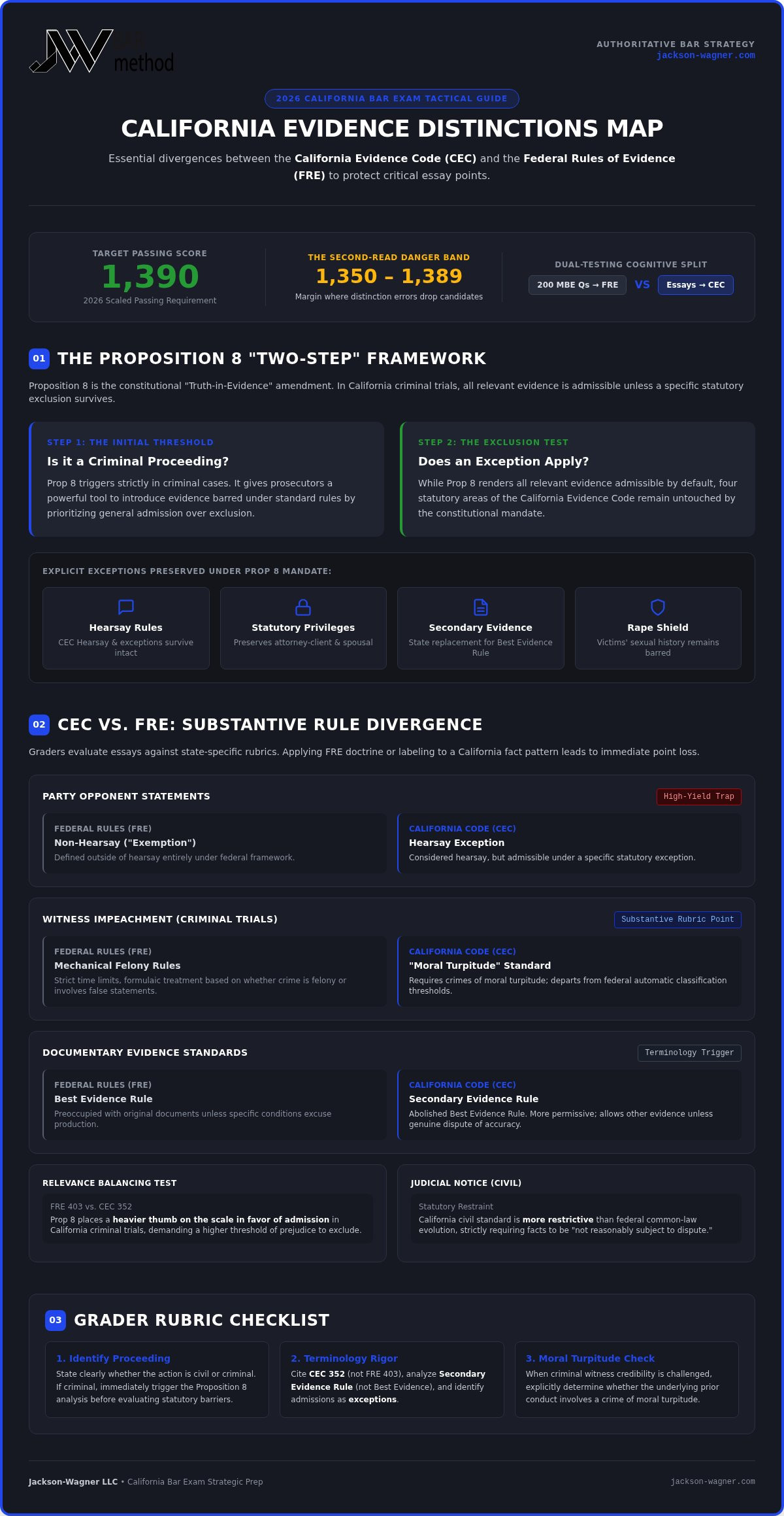
The California Bar Exam is notoriously rigorous, and the Evidence section is where many candidates lose their footing. A "California Distinction" refers to any specific instance where the California Evidence Code (CEC) deviates from the Federal Rules of Evidence (FRE). In 2026, Evidence remains a high-yield subject because it is frequently tested as a crossover with Criminal Procedure or Torts, making it a double-weighted opportunity for those who understand these nuances. Proposition 8, the "Truth-in-Evidence" amendment to the California Constitution, mandates that all relevant evidence is admissible in criminal proceedings, effectively overriding many traditional exclusionary rules unless a specific statutory exception applies.
The Prop 8 Filter: The First Question You Must Ask
Before you analyze a single objection on an essay, you must determine the nature of the case. Is it a criminal case? This is the essential threshold for any California Evidence essay because it triggers the Prop 8 filter. It is the most powerful tool in a California prosecutor's arsenal, often allowing evidence that would be barred under federal standards. However, Prop 8 is not absolute. The 2026 examiners expect you to know the specific areas where the CEC remains untouched:
- Hearsay rules and exceptions: The standard CEC hearsay framework still applies.
- Statutory privileges: Attorney-client and spousal privileges are preserved.
- The Secondary Evidence Rule: California's version of the Best Evidence Rule remains in force.
- Rape shield protections: Victims' sexual history remains generally inadmissible.
Prop 8 also fundamentally alters the "Legal Relevance" balancing test. While FRE 403 and CEC 352 both weigh probative value against unfair prejudice, the Truth-in-Evidence mandate places a heavier thumb on the scale in favor of admission in criminal trials, requiring a higher showing of prejudice to exclude relevant facts.
CEC vs. FRE: The Structural Differences
Learning how to master california evidence distinctions requires recognizing that the CEC is a strictly statutory body of law, whereas the FRE still retains traces of its common-law development. This structural difference manifests in practical ways, such as judicial notice. In California civil cases, the court's ability to take notice of facts is far more restrictive than the broader federal standard, requiring the fact to be "not reasonably subject to dispute."
For the 2026 exam, you will use the FRE for the 200 multiple-choice questions on the MBE, but you must pivot instantly to the CEC for the essay portion. This cognitive flexibility is what separates passing candidates from those caught in the second-read band of 1,350 to 1,389 points. Mastery isn't just about memorizing rules; it's about knowing which code is currently in play and why the terminology matters to the grader.
The 'Big Three' Divergences: Hearsay, Character Evidence, and Impeachment
While Proposition 8 provides the procedural filter for criminal cases, the substantive points on your essay will come from identifying specific code divergences. The most jarring difference for many students is the classification of party admissions. Under the Federal Rules of Evidence, an opposing party's statement is defined as non-hearsay. California rejects this categorization. In the California Evidence Code, admissions are considered hearsay but fall under a specific exception. This might seem like a semantic detail, but using the wrong label on a 2026 essay signals a lack of state-specific mastery to the grader.
Understanding how to master california evidence distinctions also requires a shift in how you handle document-based evidence. California has abolished the traditional "Best Evidence Rule" in favor of the Secondary Evidence Rule. While the federal standard remains preoccupied with original documents, California law is more permissive, generally allowing other evidence to prove the content of a writing unless a genuine dispute exists regarding the original's accuracy or admission would be unfair.
Hearsay Exceptions: The California Nuances
The definitions of spontaneous statements often trip up examinees. The FRE "Present Sense Impression" is broad, covering any statement describing an event while perceiving it. California's "Contemporaneous Statement" is significantly narrower; it only applies if the statement was made to explain or qualify the declarant's own conduct. Additionally, California's dying declaration exception is more expansive in scope but stricter in its requirements. While the FRE limits these declarations to civil cases and homicide prosecutions, California allows them in any legal proceeding. However, the declarant must actually be dead, a requirement the federal rules do not impose.
Character Evidence and Prior Bad Acts
California is notably more aggressive regarding propensity evidence in specific criminal contexts. CEC 1108 and 1109 allow the prosecution to introduce prior acts of sexual assault, domestic violence, child abuse, and elder abuse to show a defendant's propensity to commit the charged act. This goes beyond the federal baseline, which is largely limited to sexual assault and child molestation. If you're looking for a structured way to drill these specific triggers, the JW Bar Method Prep - Full Exam California Bar offers dedicated modules on these high-yield distinctions.
The "Mercy Rule" also carries a California twist. If a defendant introduces evidence of a victim's violent character, the prosecution can respond with evidence that the defendant has a similar violent character. This "eye for an eye" approach to character evidence is a frequent target for 2026 essay prompts, requiring you to balance the admission against CEC 352 prejudice concerns.
Tactical Framework: Spotting Distinctions on the 2026 Exam
Mastery of the rules is useless if you cannot identify them within a 1,000-word fact pattern. Spotting issues requires a "Trigger Word" system that alerts your brain to switch from the Multistate Bar Examination (MBE) mindset to the California essay mindset. For instance, when you see a witness who cannot remember a specific detail, your mind should instantly toggle between the federal "Recorded Recollection" and the California "Past Recollection Recorded." These subtle shifts in terminology are the breadcrumbs that lead to higher scores. In California, prior inconsistent statements are admissible for their truth even if not made under penalty of perjury. This is a massive departure from the federal requirement of a prior oath, and missing this distinction often results in a full point deduction on hearsay analysis.
Terminology also dictates your success in the "Legal Relevance" section of your essay. While the concepts are identical, you must cite the CEC 352 balancing test rather than FRE 403. Graders are trained to look for these specific code citations as evidence of your state-specific competence. When analyzing the California Evidence Code, you'll find that the burden of proof and specific privilege rules often turn on minute statutory details that federal common law might overlook. This is particularly true in crossover essays where Evidence meets Professional Responsibility or Criminal Procedure. You must be prepared to layer your analysis, applying the constitutional requirements first before filtering the facts through the CEC.
The 2026 Comparison Table Logic
Your study materials should focus on three primary technical areas where California remains stubborn. First, expert testimony in California still follows the Kelly standard, requiring that a new scientific technique be generally accepted in the relevant field. This is a more rigid threshold than the federal Daubert standard, which focuses on the judge as a gatekeeper of reliability. Second, spousal privileges in California are distinct; the "Spousal Testimonial Privilege" belongs to the witness-spouse in both civil and criminal cases, whereas federal law limits this to criminal proceedings. Finally, your list of self-authenticating documents is shorter in California. Don't assume a trade inscription or a business record is automatically authenticated without a proper foundation or a specific CEC exception.
Applying the 'California Distinction' Heading Strategy
Visibility is everything on a graded essay. We recommend using a dedicated sub-heading labeled "California Distinction" for every major evidentiary issue you identify. This forces the grader to see that you aren't just reciting general law. State the Federal rule briefly, then pivot immediately to the CEC standard to show contrast. This level of granular accuracy is what separates a 65 from a 75. For a deeper dive into why this level of detail is necessary, read our analysis on why precision beats volume during 2026 prep.
Study Methods for Mastering Distinctions Without Burnout
Traditional bar prep often fails because it treats every rule as equally important. It doesn't. Our JW Bar Method philosophy focuses on the 20% of rules that provide 80% of your points. By isolating these high-yield targets, you avoid the cognitive overload that leads to burnout. Learning how to master california evidence distinctions isn't about brute-force memorization of two separate codes. It's about recognizing where they collide and knowing exactly which one takes precedence in a California courtroom.
Start with the 'Comparative Outlining' method. Create a side-by-side map where the Federal Rules of Evidence sit on the left and the California Evidence Code sits on the right. This visual contrast highlights the "Divergence Triggers" we've already identified. Once your map is built, use Active Recall to test yourself on the 'Exceptions to the Exceptions.' Don't just memorize Proposition 8. Test your ability to list the specific areas, such as hearsay and privilege, where it doesn't apply.
High-stakes drills are your final layer of defense. You must practice with real California State Bar released questions to see how these distinctions are hidden in complex narratives. This is the only way to truly understand how to master california evidence distinctions in a timed environment. Graders aren't just looking for a rule statement; they want the specific terminology that proves you've transitioned out of the MBE mindset.
The 30-Day Distinction Sprint
Structure your final month with surgical precision to ensure you've mastered the most frequent essay topics before test day:
- Week 1: Relevance and Prop 8 integration. Focus on the threshold question of whether the case is criminal or civil.
- Week 2: Hearsay and its 14 major California deviations. Drill the differences between admissions and spontaneous statements.
- Week 3: Character, Impeachment, and Policy Exclusions. Master the moral turpitude standard for witness impeachment.
Strategies for the California Attorney's Exam
If you're an experienced practitioner, your biggest hurdle is "unlearning" the Federal defaults you use in your daily practice. The Attorney's Exam is an "Essays Only" format. This means there is no multiple-choice section to balance out a weak state-law performance. Focus your drills exclusively on the state-specific rubrics. For a full breakdown of these unique requirements, check our 2026 guide to licensure for out-of-state lawyers.
Ready to streamline your study process? Secure your spot in our JW Bar Method Accelerated Prep - Full California Bar Exam.
Accelerating Your Mastery with the JW Bar Method
The path to licensure in 2026 requires more than just a passing familiarity with the rules. It demands a surgical approach to the code. Traditional prep models bury you in 50-hour video lectures that fail to address the specific cognitive shifts required for the California Bar. We position ourselves as your modern mentor, offering a structured, pedagogical environment that replaces high-stakes anxiety with absolute confidence. Knowing how to master california evidence distinctions is the cornerstone of our methodology, ensuring you don't just recognize a rule, but apply it with the precision graders demand.
Our JW Bar Method Prep - Full Exam California Bar is specifically designed to streamline your Evidence study. We've eliminated the fluff that plagues legacy programs. For busy professionals, our JW Bar Method Accelerated Prep - Full California Bar Exam offers a condensed, high-impact track that respects your time while maximizing your score. We are so certain of our methodology's efficacy that we offer a bold financial guarantee. We assume the risk because we know our system works.
Structured Success for the Full Bar Exam
Our curriculum doesn't treat Evidence distinctions as a footnote. We integrate them into every practice essay and multiple-choice drill. One of the most common pitfalls for 2026 candidates is "Federal-bias," where candidates subconsciously apply FRE standards to state-law prompts. Our personalized feedback loops catch these errors early, training your brain to pivot instinctively to the CEC. By the time you reach the exam, you'll join the ranks of successful candidates who have locked in their mastery through our proprietary drills.
The Attorney’s Exam: A Dedicated Path
Practicing attorneys face a unique challenge; you must unlearn years of federal practice habits in a matter of weeks. The JW Bar Method Prep - Attorney’s Exam California Bar provides the gold standard for this transition. Since this is a one-day, essays-only exam, your ability to articulate how to master california evidence distinctions is the only thing standing between you and your new license. For those on a tighter schedule, the JW Bar Method Accelerated Prep - Attorney’s Exam California Bar offers a precision-targeted path that focuses exclusively on what you need to pass.
Eliminating the anxiety of the one-day exam starts with a proven strategy. For more insights on securing your success, read our definitive strategic guide to passing the California Bar Exam in 2026. We provide the structure. You provide the effort. Together, we secure your future in the California legal community.
Secure Your California License with Precise Evidence Mastery
Success on the 2026 Bar Exam doesn't belong to the student who memorizes the most rules; it belongs to the one who applies the correct code at the right time. By filtering every criminal fact pattern through Proposition 8 and reclassifying federal exemptions as California exceptions, you eliminate the "Federal-bias" that sinks so many applicants. You now have the tactical framework required for how to master california evidence distinctions, including the use of specific trigger words and dedicated headings to signal your state-law competence to the graders.
The proprietary JW Bar Method system turns this complexity into a structured, reliable path to licensure. Whether you are pursuing our specialized Full Bar or Attorney's Exam tracks, we provide a binary performance guarantee for absolute peace of mind. We assume the financial risk of your outcome because we are certain of our methodology's efficacy. Don't leave your career to chance with legacy prep models that favor volume over precision.
Master the California Bar Exam with the JW Bar Method and step into your 2026 testing center with the confidence of a prepared professional. Your future as a California attorney is within reach.
Frequently Asked Questions
What is the biggest difference between the CEC and the FRE for the 2026 Bar Exam?
The most significant structural difference is how each code categorizes out-of-court statements. Under the Federal Rules of Evidence, party admissions and prior witness statements are defined as non-hearsay exemptions. In contrast, the California Evidence Code classifies these as hearsay exceptions. This distinction is critical for essay grading, as mislabeling a statement as "non-hearsay" in a California prompt will result in point deductions. Additionally, Proposition 8 mandates the admission of all relevant evidence in criminal cases.
Does Proposition 8 apply to civil cases in California?
No, Proposition 8 only applies to criminal proceedings. Enacted via the California Constitution, the "Truth-in-Evidence" rule mandates that all relevant evidence is admissible in criminal trials unless a specific statutory exception applies. In civil litigation, the standard California Evidence Code rules remain the sole authority without the constitutional filter of Proposition 8. Examinees must always identify the nature of the case before applying evidentiary standards to avoid applying criminal-only rules to a civil fact pattern.
How does California's 'Moral Turpitude' standard for impeachment work?
In California criminal trials, a witness may be impeached with a prior felony conviction only if that crime involves moral turpitude, defined as a "readiness to do evil." This differs from the federal standard, which allows any felony involving dishonesty or false statements. California courts balance these convictions under CEC 352. For misdemeanors, while the conviction itself is inadmissible hearsay, the underlying conduct involving moral turpitude can be introduced via cross-examination under Proposition 8.
What is the Secondary Evidence Rule in California?
The Secondary Evidence Rule is California's statutory replacement for the traditional Best Evidence Rule. Under CEC 1520 through 1523, the content of a writing may be proved by secondary evidence, such as copies or testimony, unless a genuine dispute exists regarding the material terms of the writing or admission would be unfair. This is generally more permissive than the federal requirement for an original document, though it still prohibits oral testimony to prove content unless the original is lost.
Is the Daubert standard used in California State Bar exams?
No, California continues to use the Kelly standard for the admissibility of expert testimony involving new scientific techniques. While federal courts follow the Daubert standard, which focuses on the judge's assessment of reliability and methodology, California requires that a new technique be generally accepted within the relevant scientific community. On the 2026 exam, you must apply the Kelly standard for state-law essays while using Daubert only for the multiple-choice Multistate Bar Examination portion of the test.
Can I pass the California Attorney's Exam if I only know the Federal Rules?
It is virtually impossible to pass the California Attorney's Exam relying solely on the Federal Rules. Since this is an essays-only exam, graders specifically look for state-specific rule statements and citations. Applying federal standards to California prompts will result in failing scores on those questions. Our JW Bar Method Prep - Attorney’s Exam California Bar is specifically designed to help practitioners unlearn federal defaults and focus on the high-yield state distinctions necessary for a passing score.
How many hearsay exceptions are different in the California Evidence Code?
There are approximately 14 major hearsay deviations you must learn to understand how to master california evidence distinctions. Key differences include the "Contemporaneous Statement" exception, which is narrower than the federal "Present Sense Impression," and dying declarations, which California allows in all cases provided the declarant actually dies. Other critical variations involve statements of past physical condition and the admissibility of prior inconsistent statements, which California allows for substantive truth regardless of an oath.
Why is the 'JW Bar Method' more effective for learning distinctions than traditional courses?
The JW Bar Method is more effective because it utilizes active-learning drills rather than passive video lectures. Traditional courses often overwhelm students with volume, while we focus on the 20% of rules that generate 80% of the points. Our curriculum, including the JW Bar Method Prep - Full Exam California Bar, uses fill-in-the-blank drills to lock in rule recall. We are the only provider that offers a binary performance guarantee, reflecting our absolute confidence in our approach.


