
Why do seasoned practitioners with decades of elite experience frequently fail a test designed for law students? The reality is that meeting the california attorney's exam requirements has very little to do with your actual legal acumen and everything to do with pedagogical compliance. While California represents the largest legal market in the U.S. with over 180,000 attorneys, it remains one of the most difficult jurisdictions to enter because it demands you unlearn the intuitive shortcuts of a successful practice to master a rigid, academic grading rubric.
It's frustrating to face a 1390 passing score when you don't have the luxury of hundreds of hours to study like a 3L. You need a path to licensure that respects your professional time and replaces the anxiety of a high-stakes exam with a structured, modern strategy for success. This guide ensures you master the specific eligibility, testing, and administrative hurdles required to transition your legal practice to California in 2026. We will walk through the one-day exam criteria, the 86 scaled score MPRE necessity, and how to utilize a prep method like the JW Bar Method Prep to secure your results without sacrificing your current practice.
Key Takeaways
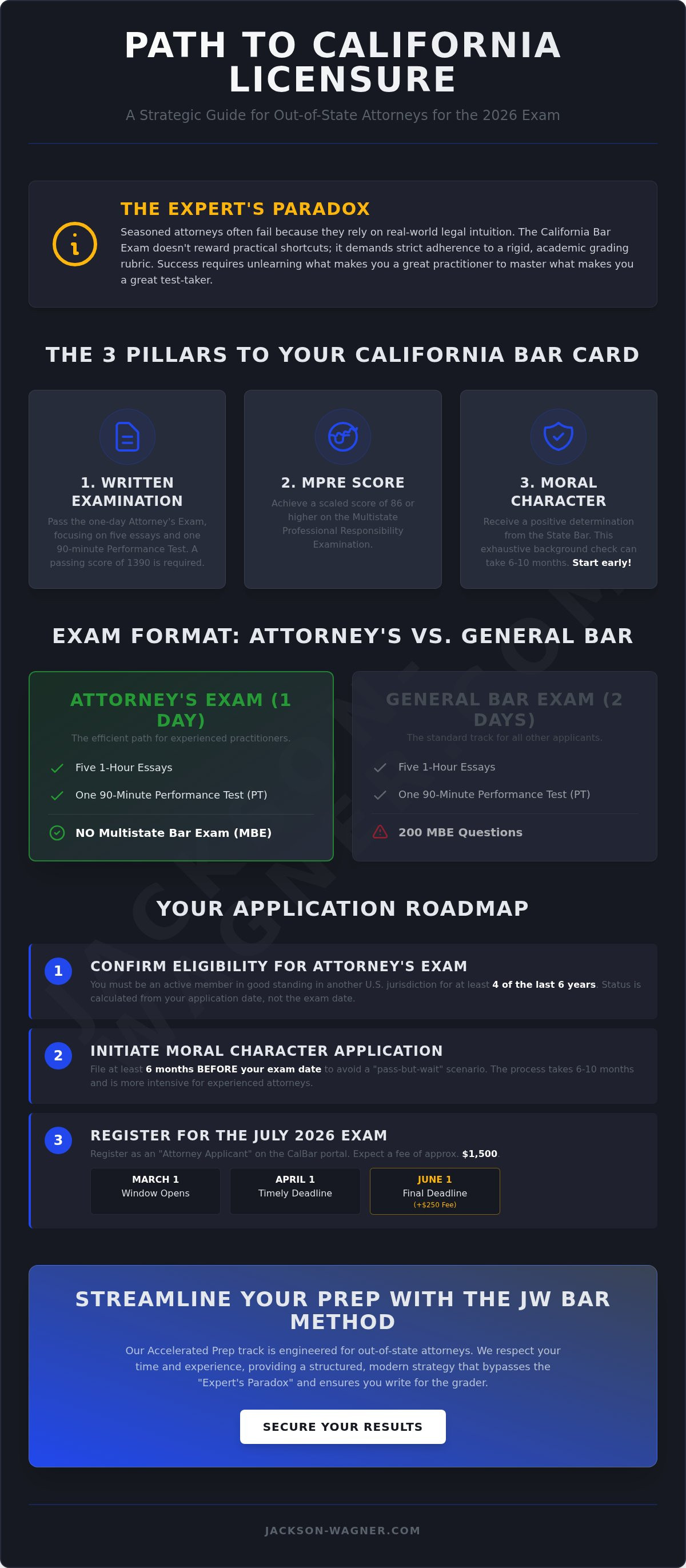
- Confirm your eligibility for the one-day exam by verifying you've been active and in good standing in another U.S. jurisdiction for at least four of the last six years.
- Avoid administrative delays by initiating your Moral Character application early, ensuring your background check doesn't stall your admission after you pass the written test.
- Understand the structural differences between the general bar and the attorney's version, focusing your energy on the five essays and the critical 90-minute Performance Test.
- Master the specific california attorney's exam requirements by overcoming the "Expert's Paradox" and learning to write for the Bar’s unique grading rubric rather than for a client.
- Streamline your study schedule with the JW Bar Method Accelerated Prep track, designed to respect your professional experience while providing a structured path to success.
Navigating the 2026 California Attorney’s Exam Eligibility Requirements
The State Bar of California maintains a rigorous gatekeeping process that rejects the concept of reciprocity. If you want to practice in the nation's largest legal market, you must prove your competence through examination. For experienced practitioners, the most efficient path is the one-day Attorney’s Examination. This condensed version of the General Bar Exam eliminates the Multistate Bar Examination (MBE) entirely, focusing solely on the written components. Qualifying for this track requires more than just a law license; you must meet specific california attorney's exam requirements that center on your recent practice history and administrative standing.
The 4-Year Active Status Rule Decoded
To bypass the two-day exam, you must demonstrate that you've been an active member in good standing of a United States jurisdiction for at least four years immediately preceding your application. The Bar is strict about "active" status. If you've spent significant time on "inactive" status or had gaps due to disciplinary suspensions, you may be forced into the general applicant pool. Calculation is based on the date you submit your application, not the date of the exam. You'll need to provide a Certificate of Good Standing from every jurisdiction where you are admitted, dated within 30 days of your California application. This ensures your record is current and unblemished before you are granted the privilege of the shortened testing format.
Registration Logistics for Out-of-State Practitioners
Your first step is creating an account on the CalBar Admissions portal as an "Attorney Applicant." This distinction is critical because student applicants face different fees and documentation requirements. For the July 2026 exam cycle, the application window opens on March 1, 2026. You must hit the timely filing deadline of April 1, 2026, to avoid unnecessary late fees. The final deadline is June 1, 2026, which carries a $250 penalty.
Expect to pay a registration fee of approximately $1,500 to the State Bar, which is significantly higher than the student rate but reflects the specialized processing required for out-of-state credentials. Additionally, all applicants must provide a Social Security number to comply with california attorney's exam requirements. If you're a foreign-licensed attorney without a US SSN, you must request an exemption form directly from the Office of Admissions before your registration can be finalized. Following these administrative steps precisely ensures you don't lose valuable study time to bureaucratic rejections.
The Multi-Step Path to Licensure: Beyond the Written Examination
Winning the battle against the written test is only a partial victory. To receive your bar card, you must satisfy three distinct pillars: the written examination, the Multistate Professional Responsibility Examination (MPRE), and a positive Moral Character determination. Many out-of-state lawyers focus solely on black letter law and neglect the administrative California Bar Admission Requirements that can delay licensure by nearly a year. You don't want to receive a passing notice in November 2026 only to find yourself unable to practice because your background investigation is still pending. Meeting all california attorney's exam requirements involves a coordinated effort between rigorous study and proactive paperwork.
Moral Character Determination: A Strategic Timeline
The State Bar's background investigation is exhaustive. It typically takes six to ten months to process. If you wait until after the exam to file, you're creating an artificial barrier to your own career. Seasoned attorneys often face more scrutiny than law students because they have longer professional histories to track. Red flags include out-of-state disciplinary records, even minor ones, and complex financial disclosures. You must provide a Certificate of Good Standing from every jurisdiction where you've ever been admitted. Coordinating these documents across multiple states takes time. Start this process at least six months before your intended exam date to avoid a "pass-but-wait" scenario that stalls your professional transition.
The MPRE and Professional Responsibility Standards
California requires a minimum scaled score of 86 on the MPRE. While you've likely practiced for years with an unblemished ethical record, the exam tests specific ABA Model Rules that may differ from your daily practice. Taking the MPRE early removes a significant psychological burden during your primary study window. It's one less hurdle to clear when you're deep into essay practice. Beyond ethics, you must certify compliance with family and child support obligations. California law is unforgiving here; any outstanding arrears can result in an immediate denial of licensure. Mastering these california attorney's exam requirements alongside the steps in How to Navigate the State Bar of California: A 2026 Guide to Licensure Success ensures your transition is seamless. To ensure your study time is spent as efficiently as your administrative filing, consider the structured approach of JW Bar Method Prep - Attorney’s Exam California Bar.
Analyzing the Attorney’s Exam Format vs. The General Bar Exam
The one-day format is a double-edged sword. While it spares you the 200 grueling multiple-choice questions of the MBE, it places the entire weight of your licensure on your written performance. Understanding the California Bar Exam requirements for out-of-state attorneys is the first step toward strategic survival. Your day is split into two distinct sessions. The morning consists of three one-hour essay questions. After a brief lunch, the afternoon session follows with two more essays and a final 90-minute Performance Test. This condensed schedule demands peak mental endurance; there is no recovery time if you stumble on a morning prompt.
The stakes are high. Every minute of the six-and-a-half-hour testing window counts toward your final scaled score. Because the Attorney's Exam is shorter, the cognitive load is more intense. You must pivot between legal subjects with precision. In 2026, the exam remains a test of pedagogical compliance rather than a measure of your years in the courtroom. You aren't just answering legal questions; you're proving you can follow the State Bar's specific organizational roadmap under extreme time constraints.
Why No MBE Changes Your Study Strategy
In the general bar, the MBE often acts as a statistical safety net for applicants who struggle with written expression. For those meeting the california attorney's exam requirements, that net is gone. Every point toward the 1390 passing score must come from your ability to spot issues and apply law on the page. You can't rely on your "gut feeling" for multiple-choice answers to pull up a mediocre essay score. This shift requires a deep dive into the 17 possible subjects, with a particular focus on California distinctions in areas like Evidence and Community Property. Success in 2026 depends on your ability to produce high-volume, high-accuracy output across five distinct legal scenarios.
Mastering the California Performance Test (PT)
Practicing attorneys often view the Performance Test as their strongest suit, yet it frequently becomes the "silent killer" of their applications. The PT is a closed-universe simulation where you're given a file and a library of "fake" law. Your professional experience can actually be a liability here. If you use real-world legal knowledge instead of the provided materials, you'll fail the rubric. The graders don't care if you're a partner at a top-tier firm; they care if you can follow instructions and organize a memo in 90 minutes. The PT is a test of organizational speed and rubric adherence. To master this specific skill set without wasting hundreds of hours, the JW Bar Method Prep - Attorney’s Exam California Bar provides the tactical framework necessary to unlearn practice habits and embrace the Bar's specific expectations.
Strategic Preparation for Practicing Attorneys: Choosing Your Review Method
The "Expert's Paradox" is the primary reason high-achieving lawyers fail the California Bar. You've spent years developing intuitive legal judgment, but the Bar doesn't reward intuition. It rewards a specific, mechanical adherence to a grading rubric. Meeting the california attorney's exam requirements in 2026 isn't about how much law you know; it's about how well you can perform a pedagogical dance. Traditional "Big Bar" providers are built for 3Ls with 12 hours a day to spare. As a practicing attorney, you don't have that luxury, and you don't need it. Volume-based studying is a legacy relic that prioritizes passive video watching over active, high-impact application.
Your choice of review method should be dictated by three factors: efficiency, specialized feedback, and a ruthless focus on California-specific law. You need a program that respects your billable hour requirements and filters out the noise. Statistics show that while experienced attorneys report 15-20% higher pass rates than general applicants, the failure rate remains high because practitioners try to use "real world" logic on an academic exam. Success requires a method that recognizes your experience while correcting the "bad habits" of a successful practice.
Why Legacy Bar Prep Fails Seasoned Practitioners
Legacy courses are designed as one-size-fits-all marathons. They force you to sit through hours of lectures on MBE subjects from a multistate perspective. If you are qualifying for the one-day exam, this is a catastrophic waste of time. These programs prioritize memorization of thousands of rules rather than the strategic application required for the written portions. You need to focus on how California law differs from the majority rule, not just the majority rule itself. Check out this analysis on Top California Bar Prep Programs 2026: Why Specialized Methods Outperform Legacy Courses for a deeper dive into these structural flaws.
The Case for Accelerated, Specialized Methods
Precision Prep is the only viable path for an attorney with a full-time practice. This means focusing on the 17 subjects through the lens of high-frequency testing patterns. You don't need to study every niche rule; you need to master the ones the Bar actually tests. Individualized essay grading is the most critical component of this process. You need feedback that mirrors the State Bar's actual rubric, showing you exactly where you lost points on organization or "lawyerly" analysis that didn't meet academic standards. Integrating this into your schedule requires a mobile-first, flexible curriculum. To see how a modern approach can fit into your 2026 transition, explore the JW Bar Method Accelerated Prep - Attorney’s Exam California Bar.
The JW Bar Method: Engineering Success for Out-of-State Attorneys
The JW Bar Method represents a radical departure from the passive, lecture-heavy models that dominate the bar review industry. We've engineered a system specifically for the legal professional who demands efficiency and measurable progress. Our approach doesn't just teach you the law. It trains you to identify the specific scoring triggers that California graders look for during their initial scan of an essay. By stripping away the academic fluff found in legacy programs, we allow you to focus exclusively on the high-frequency subjects that dictate your success. We replace the stress of high-pressure certification with a structured, modern, and reliable path to licensure.
Our methodology is disruptive because it treats bar preparation as a tactical exercise in pedagogical compliance. For a partner or senior associate, the goal isn't to become a legal scholar in 17 different subjects; the goal is to secure a 1390 scaled score and return to practice. The california attorney's exam requirements are clear, and our system is designed to meet them with surgical precision. We provide the tools to unlearn the intuitive shortcuts of daily practice and adopt the rigid, academic framework required by the State Bar.
Structured Precision for High-Stakes Results
The JW Bar Method Prep - Attorney’s Exam California Bar is built on the reality that your time is your most valuable asset. We focus entirely on the written requirements, ignoring the MBE noise that clutters other courses. One of the biggest obstacles for out-of-state lawyers is the "practitioner's bias," which is the tendency to write for a judge or client rather than a bar grader. Our proprietary feedback loop is designed to identify and correct this bias in real-time. We provide a structured roadmap that aligns your existing writing skills with the specific 2026 grading standards. For a deeper look at this tactical approach, read Passing the California Bar Exam in 2026: The Definitive Strategic Guide.
The Performance Guarantee Advantage
We believe a bar prep provider should act as a partner, not just a vendor. This is why the JW Bar Method includes a binary performance guarantee. We are so certain of our pedagogy that we assume the financial risk of your performance outcome. This level of bold reliability is unique in the industry. It ensures our goals are perfectly aligned with yours. If you follow the curriculum and meet the program requirements, we stand behind your results. This isn't just marketing language; it's a professional commitment to your success.
The JW Bar Method Accelerated Prep - Attorney’s Exam California Bar track is the most direct route to meeting all california attorney's exam requirements without sacrificing your billable hours. You've already built a successful career in another jurisdiction. Now, let us provide the modern, agile framework required to expand that success into California. Your 2026 licensure is a matter of strategic execution, not academic endurance. Schedule a strategy call today to evaluate your readiness and secure your path to the California Bar.
Mastering Your 2026 California Transition
Navigating the transition to California practice is a strategic maneuver that demands absolute precision. Success requires more than just legal acumen; it requires a systematic approach to the california attorney's exam requirements and a commitment to mastering the State Bar's specific grading rubric. By initiating your Moral Character application early and focusing your energy on the high-stakes written components of the one-day exam, you can secure your future in the nation's largest legal market without compromising your current practice.
The path to licensure doesn't have to be a marathon of academic fluff. You need a partner that assumes the financial risk of your performance and provides a roadmap tailored to your experience. With our proprietary JW Bar Method pedagogy and an exclusive focus on California licensure, we replace the anxiety of high-stakes testing with a reliable, structured path to success. Secure your California license with the JW Bar Method Accelerated Prep and leverage our industry-leading performance guarantee. You've already proven your competence in the courtroom; now it's time to prove it on the Bar's terms. We look forward to seeing you admitted in 2026.
Frequently Asked Questions
Can I take the California Attorney's Exam if I have been practicing for less than four years?
No, you don't qualify for the one-day format if you have less than four years of active experience. To be eligible for the Attorney's Examination, you must have been an active member in good standing of a United States jurisdiction for at least four years immediately preceding your application. If you don't meet this threshold, you must register as a general applicant and complete the full two-day California Bar Exam, including the Multistate Bar Examination (MBE).
What is the difference between the Attorney's Exam and the General Bar Exam in 2026?
The primary difference is the duration and the testing of multiple-choice questions. The Attorney's Exam is a one-day written test consisting of five one-hour essays and one 90-minute Performance Test. The General Bar Exam is a two-day test that includes those same written components plus the 200-question Multistate Bar Examination. For qualifying practitioners, the one-day option removes the need to study for the MBE entirely.
Do I need to take the MPRE again if I passed it in another state years ago?
You must have a scaled score of 86 or higher on the MPRE to satisfy the california attorney's exam requirements. While your previous score might have been sufficient for your current jurisdiction, California’s standard is strict. If your score was below 86 or if you cannot provide official verification from the NCBE, you'll need to sit for the MPRE again to be eligible for admission to the State Bar.
How long does the Moral Character determination take for out-of-state attorneys?
The State Bar typically requires six to ten months to complete a Moral Character investigation. Because you've practiced in other jurisdictions, the Bar must verify your standing and history across multiple agencies, which extends the timeline. It's vital to file your application at least six months before your exam date. This ensures your background check doesn't stall your licensure once your passing exam results are released.
Is the California Attorney's Exam easier than the General Bar Exam?
It's not necessarily easier; it's simply more concentrated. While experienced attorneys report pass rates roughly 15-20% higher than general applicants, the lack of an MBE means there's no safety net for a weak essay score. You must reach the 1390 passing score entirely through your written performance. This demands a higher level of precision and adherence to the California grading rubric than many practitioners anticipate.
What happens if I fail the Attorney's Exam but am still in good standing elsewhere?
Failing the exam doesn't impact your license or standing in your home jurisdiction. You remain an attorney in good standing in your current state. However, you won't be admitted to practice in California and must wait for a subsequent exam administration to try again. Your status as an out-of-state attorney remains unchanged, but you cannot represent clients in California courts or hold yourself out as a California lawyer.
Does California offer reciprocity or admission on motion for any other states?
California does not offer reciprocity or admission on motion for any jurisdiction. Every lawyer, regardless of their experience or home state, must pass an examination to practice law here. This policy reflects the State Bar’s commitment to ensuring every practitioner understands the unique California-specific laws and ethical standards that govern the nation's largest legal market.
How much does it cost to take the California Attorney's Exam in 2026?
The registration fee for attorney applicants is $1,500 for the 2026 cycle. This is the base cost to meet the california attorney's exam requirements and doesn't include the Moral Character application fee or laptop technology fees. If you miss the timely filing deadline, you'll also face late fees ranging from $50 to $250. Budgeting for these administrative costs early is essential for a smooth registration process.


