

Your professional precision isn't first tested by a complex Torts essay; it's tested by the California Bar application. Many applicants find themselves overwhelmed by the volume of documentation required, fearing that a single administrative oversight in the california bar exam application process will result in an "abandoned" status. It's a high-stakes environment where the distinction between Law Student Registration and the actual Examination Application can mean the difference between sitting for the 2026 exam or waiting another six months.
You've worked too hard to let bureaucratic confusion become a barrier to your career. We understand that the multi-month Moral Character Determination and the $745 filing fee create a unique brand of anxiety. This guide replaces that stress with a structured, modern roadmap to success. You'll gain a clear, non-bureaucratic checklist to master every hurdle, from the $153 laptop fee to the critical November and April timely filing deadlines. We're providing the exact strategic milestones you need to ensure your application is perfectly aligned with your study plan for successful licensure in 2026.
Key Takeaways
- Master the multi-stage licensure journey by understanding the 2026 technical requirements for ExamSoft and personal laptop usage to avoid exam-day disasters.
- Navigate the california bar exam application process with a precise chronological roadmap that covers everything from Law Student Registration to the final Oath of Office.
- Identify whether you qualify for the specialized Attorney’s Exam or the Full Bar Exam to ensure your application strategy aligns with your professional standing.
- Protect your licensure timeline by prioritizing the Moral Character Determination process and maintaining your ongoing duty to supplement information after submission.
- Sync your administrative milestones with your study schedule to build momentum and ensure paperwork never disrupts your focus on the material.
Navigating the California Bar Exam Application Process: A Strategic Overview
Viewing the california bar exam application process as a mere administrative task is a mistake that costs applicants months of their professional lives. This isn't a single form you fill out on a whim; it's a multi-stage licensure journey that demands the same level of precision as your legal analysis. The State Bar of California enforces a rigorous, multi-layered sequence of checkpoints that you must clear before you ever step foot into the examination hall.
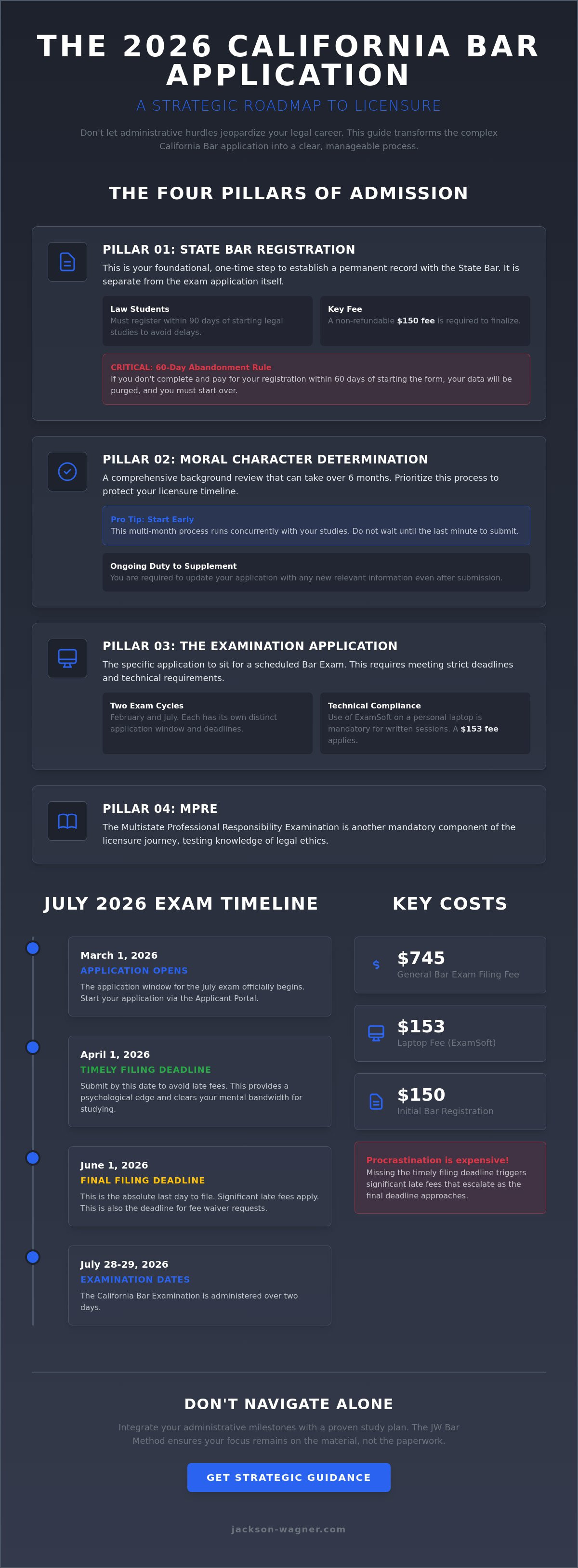
Your Applicant Portal serves as the central nervous system for this entire journey. It's the primary interface where you'll manage every aspect of the california bar exam application process, from initial registration to tracking the determination of your moral character. For the 2026 cycle, technical compliance is a prerequisite for success. You're required to use ExamSoft on your personal laptop for all written sessions. This involves a $153 laptop fee and a specific software certification window. If your hardware fails to meet the Bar's standards, your academic preparation won't matter.
The 2026 calendar is divided into two distinct administrative windows: the February cycle and the July cycle. Each has its own set of rigid deadlines that do not bend for personal circumstances. Approaching these windows with a reactive mindset is the fastest way to jeopardize your licensure timeline. You need to treat the application as the first phase of your exam prep, ensuring every document is sourced and every fee is paid well before the timely filing deadlines.
The Distinction Between Registration and Examination Application
Registration isn't the same as applying to sit for a specific exam. It's a one-time, lifetime requirement that establishes your record with the Bar. You can't launch an exam application until your registration is finalized and the $150 fee is processed. Law students must be aware of the 90-day rule. You're expected to register within 90 days of beginning your legal studies to avoid administrative complications that can delay your eventual exam eligibility.
2026 Deadlines and the Cost of Procrastination
Procrastination in this process is a strategic failure. For the July 2026 exam cycle, which takes place on July 28-29, the application becomes available on March 1, 2026. The timely filing deadline is April 1, 2026. Missing this window triggers significant late fees that escalate as you approach the final filing deadline on June 1, 2026. Early submission provides a psychological edge. It clears your mental bandwidth so you can focus entirely on your JW Bar Method Prep. If you're seeking a fee waiver for the 2026 cycle, remember that these requests also adhere to the strict final filing deadline of June 1.
The Four Pillars of the California Bar Admission Journey
Licensure in California isn't a sprint; it's a high-stakes obstacle course where administrative precision is just as vital as your knowledge of Evidence or Real Property. Each of the four pillars, Registration, the MPRE, the Moral Character Determination, and the Examination itself, functions as a mandatory milestone. Administrative failure in even one of these areas can derail your 2026 timeline. Falling behind in the california bar exam application process often leads to the "abandoned application" trap. If you fail to submit required documentation or fees within 60 days of your initial filing, the State Bar considers the application abandoned. Your fees are non-refundable; you're forced to start from zero.
Stage 1: State Bar Registration
Your journey begins with creating an account in the Applicant Portal. This establishes your permanent record with the Bar. U.S. law students generally need a simple certification of their law school studies, while foreign-educated applicants face a more rigorous path involving transcript evaluations and proof of educational equivalency. When you begin your official California Bar Examination application, the portal becomes your single source of truth. Remember the 60-day rule: if you don't finalize your registration and pay the $150 fee within two months of starting the online form, the system will purge your data.
Stage 2: The MPRE and Professional Responsibility
You can't practice law in California without proving your ethical competence through the Multistate Professional Responsibility Examination (MPRE). For 2026, the primary testing windows are March 24-25 and August 11-12. You need a scaled score of 86 or better to satisfy this requirement. These scores don't automatically appear in your file. You must ensure the NCBE sends your results directly to the State Bar. While you manage these administrative pillars, you can focus on the academic side with a structured California Bar prep method that aligns with these milestones.
Stage 3: The Moral Character Determination
The Moral Character application is the most time-intensive component of the entire process. The $745 fee covers an exhaustive background check that scrutinizes your criminal history, financial responsibility, and academic integrity across every jurisdiction where you've lived. It's a massive undertaking. The State Bar recommends submitting this application at least 8-10 months before you expect to be admitted. If you wait until after you've passed the bar exam to start this process, you could face a significant delay in receiving your license, even if you've already conquered the written exam.
Attorney Applicants vs. Law Students: Tailoring Your Path
Choosing the wrong path during the california bar exam application process can lead to unnecessary months of study and thousands in wasted fees. The State Bar distinguishes between those entering the profession and those already seasoned by years of practice. If you've been in active practice in good standing for at least four years in another U.S. jurisdiction, you qualify as an "Attorney Applicant." This status isn't just a title; it unlocks a specialized testing option that can significantly reduce your exam-day burden. However, this path requires a higher level of administrative scrutiny. You must provide original Certificates of Good Standing from every jurisdiction where you're admitted, and these documents must be dated within 30 days of your application submission to be valid.
The primary decision for out-of-state lawyers is whether to sit for the Full Bar Exam or the specialized Attorney’s Exam. The Full Bar Exam spans two days and includes the Multistate Bar Examination (MBE), while the Attorney’s Exam is a one-day marathon consisting only of the written portions. While the shorter format is appealing, it places 100% of the weight on your essay and performance test scores. You should analyze your testing strengths carefully. Review the detailed California Attorney Exam requirements to determine if your practice history justifies the more concentrated testing format.
Navigating the California Attorney’s Exam
The one-day Attorney’s Exam consists of five essay questions and one 90-minute Performance Test. It's a high-velocity assessment that demands California-specific precision. A common pitfall for experienced lawyers is relying on "general" legal principles rather than the specific distinctions of California law. Our JW Bar Method Prep - Attorney’s Exam California Bar is built for this transition. It's a modern, pedagogical approach that respects your time as a working professional while ensuring you don't fall into the trap of over-relying on your home state's rules. We focus on the high-impact areas that move the needle for experienced practitioners.
Registration for Foreign-Educated Attorneys
International applicants face a distinct set of hurdles within the california bar exam application process. If you're licensed outside the United States, you must provide a credential evaluation and verification of your law study directly from your home jurisdiction. A critical technical detail is the "Social Security Number Exemption." If you don't possess a U.S. Social Security Number, you must submit a specific request for an exemption through the Applicant Portal before your registration can be finalized. This step is mandatory; without it, the portal will prevent you from launching a specific examination application, potentially causing you to miss the 2026 filing windows.
Avoiding Procedural Failure: Critical Deadlines and Moral Character
The most devastating failure in the california bar exam application process doesn't happen in the testing hall; it happens in the background check. While most applicants obsess over their MBE scores, they often neglect the Moral Character Determination. This is the primary cause of licensure delays. Even if you pass the exam in July 2026, a pending or problematic moral character file will prevent you from being sworn in. A determination is valid for 3 years, so smart applicants initiate this process early in their law school career or at least 8 to 10 months before their anticipated oath date.
Your responsibility doesn't end once you hit submit. You have an ongoing "Duty to Supplement." This means you're legally required to notify the Bar of any changes to your record, such as a new employment status, a traffic citation, or a change of address, within 30 days of the event. Failing to disclose these updates is often viewed as a lack of candor, which is a red flag in itself. To stay ahead of these administrative traps, you should learn how to navigate the State Bar of California with professional precision.
The Moral Character Deep-Dive
The State Bar's investigation is exhaustive. They look for patterns of behavior that suggest a lack of integrity or financial responsibility. Common red flags include significant unpaid debt, past-due student loans, or prior academic discipline. If you have a "positive" determination, your file moves through quickly. However, any ambiguity can trigger an "abbreviated" determination or a full investigation. The best strategy is proactive disclosure. Providing a detailed, honest explanation of past mistakes alongside evidence of rehabilitation often prevents the Bar from digging deeper and stalling your application for months.
Testing Accommodations (TA) Requests
If you require testing accommodations under the Americans with Disabilities Act (ADA), you can't afford to wait. For the 2026 exams, the State Bar enforces strict deadlines that often mirror the timely filing dates for the exam itself. You must provide comprehensive medical documentation that proves the existence of a disability and explains why the specific accommodation is necessary. We recommend filing your TA request concurrently with your initial filing in the california bar exam application process. Waiting until the final filing deadline leaves you zero room for the inevitable back-and-forth that occurs when the Bar requests additional medical evidence.
Maximize your chances of success by choosing a prep method that accounts for your unique testing needs. Explore our JW Bar Method Prep - Full Exam California Bar to ensure your academic strategy is as robust as your administrative one.
From Application to Licensure: Integrating Preparation with Administrative Success
Success in the california bar exam application process is the foundational layer of your academic performance. You shouldn't view administrative deadlines as distractions from your casebooks. Instead, use them as strategic triggers for your study phases. When you pay your $153 laptop fee or complete the software certification, let it signal a pivot in your focus toward the written components of the exam. This integration ensures that you aren't scrambling with technical support while you should be refining your approach to Professional Responsibility or Community Property. Total administrative precision is the first step toward total exam-day confidence.
The JW Bar Method is designed to solve the volume versus precision dilemma. We understand that the sheer amount of material can feel overwhelming, especially when you're also managing the multi-stage 2026 licensure requirements. By aligning your study momentum with the Bar's administrative milestones, you create a steady, structured progression toward your goals. To fully capitalize on this synergy, you need to understand the nuances of Passing the California Bar Exam in 2026.
The JW Bar Method Advantage
Our programs address the specific needs of different applicant classes. Whether you're enrolled in the JW Bar Method Prep - Full Exam California Bar or the specialized track for experienced lawyers, we provide the structure you need to succeed. Our binary performance guarantee acts as a powerful brand anchor; it replaces high-pressure anxiety with a reliable, modern path to licensure. For busy professionals, our accelerated prep tracks fit seamlessly into the same 2026 administrative windows you're already managing. We assume the risk so you can focus on the results.
Final Steps: The Exam and the Oath
The journey doesn't end when the clock stops on July 29, 2026. Results for the July cycle are released on November 6, 2026. Once you pass, the State Bar performs a final clearance of your Moral Character file. If your paperwork is in order and you've achieved a scaled score of 86 or better on the MPRE, you'll proceed to the Oath of Office. This is the moment your professional career officially launches. By aligning your california bar exam application process with a results-oriented study plan, you ensure that nothing stands between you and your license. It's time to move beyond legacy study models and embrace a more efficient way to practice law.
Master the California Bar Exam with the JW Bar Method and secure your future in the nation's largest legal market.
Take Command of Your 2026 Licensure Strategy
Mastering the california bar exam application process is the first definitive step toward your legal career in the nation's largest market. You've learned that administrative errors aren't just inconveniences; they're strategic failures that can delay your licensure by months. By prioritizing the Moral Character Determination early and selecting the testing track that matches your professional experience, you remove the bureaucratic friction that stalls so many talented applicants. Success requires a dual focus on procedural accuracy and academic rigor.
Don't let legacy study models or administrative confusion dictate your future. The proprietary JW Bar Method offers accelerated learning and specialized tracks for both Full and Attorney Exams; it ensures your preparation is as precise as your application. Our performance-driven guarantee provides the professional peace of mind you need to focus entirely on the material. This structured approach replaces high-stakes anxiety with a reliable path to licensure. Secure Your 2026 Success with the JW Bar Method. You've put in the work to get here; now it's time to claim your seat at the bar with total confidence.
Frequently Asked Questions
How long does the California Bar application process typically take?
The timeline for the california bar exam application process spans approximately 8 to 10 months from initial registration to final licensure. While the examination application itself only takes a few weeks to process, the Moral Character Determination is the primary bottleneck. You should start the process early in your final year of law school to ensure your background check is finalized before your exam results are released in May or November.
Can I take the California Bar Exam before my Moral Character Determination is complete?
Yes, you can sit for the examination while your Moral Character Determination is still pending. The State Bar allows you to complete the written and multiple-choice portions of the exam before they finalize your background investigation. However, you won't be eligible for the Oath of Office or receive your law license until the Bar issues a positive determination of your moral character. This investigation is a separate prerequisite for admission.
What is the difference between a Law Student and an Attorney Applicant in California?
A Law Student applicant is typically a first-time taker who has recently completed their legal education. An Attorney Applicant is someone who has been in active practice in good standing for at least four years in another U.S. jurisdiction. Attorneys may choose to take the one-day Attorney's Examination, while students must take the full two-day General Bar Exam. Each path has distinct fee structures and documentation requirements.
What are the 2026 fees for the California Bar Examination?
For the 2026 cycle, General Applicants pay an exam fee of $878, while Attorney Applicants pay $1,650. These costs are separate from the $150 Law Student Registration fee and the $745 Moral Character Determination fee. If you choose to use a laptop for the written sessions, you'll also incur a mandatory $153 laptop fee for the ExamSoft software license. All fees are subject to strict non-refundable policies after 60 days.
Is the 2026 California Bar Exam conducted online or in-person?
The 2026 California Bar Exam is conducted in-person at designated testing centers across the state. While you'll use a personal laptop and ExamSoft software to complete the written portions, you must be physically present at the test site. Remote testing is not currently an option for the 2026 administration. Ensure your hardware is certified and your software is properly installed well before your February or July test date.
What happens if my California Bar application is "deemed abandoned"?
Your application is deemed abandoned if you fail to provide required documentation or fees within 60 days of your initial filing. Once an application reaches this status, all fees paid are non-refundable and the file is permanently closed. You'll be forced to start the california bar exam application process from the beginning. This includes paying all registration and examination fees a second time, adding significant costs and delays to your career.
How many times per year is the California Bar Exam administered?
The State Bar of California administers the exam twice per year. The 2026 sessions are scheduled for February 24-25 and July 28-29. Each cycle has its own specific filing windows, with applications typically opening four to five months before the exam date. Missing the timely filing deadline for either session results in significant late fees. You must adhere to the rigid administrative calendar to secure your seat.
Do I need a Social Security Number to apply for the California Bar?
You generally need a Social Security Number (SSN) to register, but international applicants can request a specific exemption. If you don't have a U.S. SSN, you must submit an Application for Business Tax Registration Number or a Social Security Number Exemption request through the Applicant Portal. You must finalize this exemption before the Bar will allow you to sit for the examination. This is a critical step for foreign-educated attorneys.


