

The State Bar of California is not just an academic hurdle; it's a high-stakes administrative gauntlet that disqualifies the unprepared long before they ever see an essay prompt. With a general pass rate of approximately 40%, the margin for error is non-existent. You understand that the $677 application fee is only the beginning of a grueling financial and bureaucratic marathon. Managing the State Bar of California's requirements often feels like fighting a maze of bureaucracy while the clock ticks toward the February 24, 2026, exam date.
At Jackson-Wagner LLC, we've built this expert-led guide to replace that anxiety with a structured, matchless roadmap to licensure success. You'll gain total command over the registration process, the $551 Moral Character timeline, and the strategic advantages of the Attorney’s Examination if you have four years of active practice. This breakdown provides a clear preview of every 2026 deadline and fee, ensuring you meet the gatekeeper’s demands with absolute confidence. It’s time to move past the confusion of traditional programs and adopt a modern, results-oriented path to your California law license.
Key Takeaways
- Secure your standing by navigating the State Bar Applicant Portal with precision to meet strict 2026 registration deadlines.
- Evaluate the strategic differences between the two-day General Bar Exam and the one-day Attorney’s Examination to choose your most efficient path to practice.
- Align your schedule with the state of california state bar requirements for Moral Character and MPRE scores to prevent bureaucratic bottlenecks.
- Discover why a specialized "California Way" of writing is mandatory for overcoming the exam's historically low pass rates and achieving success.
- Learn how to manage the administrative maze of licensing while maintaining a paced, results-oriented study format that guarantees readiness.
What is the State Bar of California? Understanding the Gatekeeper
The State Bar of California functions as the official administrative arm of the California Supreme Court. It's not a voluntary professional association. It's a mandatory, integrated bar. This means that every one of the 197,000 active attorneys in the state must maintain membership to practice law legally. While other states often separate their professional associations from their regulatory bodies, California consolidated these functions until a significant split in 2018. Today, the state of california state bar focuses strictly on licensing, regulation, and discipline, while the California Lawyers Association handles voluntary education and lobbying.
This gatekeeper status is why the standards for entry are notoriously high. California remains one of the few jurisdictions that rejects reciprocity entirely. It doesn't matter if you've practiced for twenty years in New York or Texas; the Bar requires you to prove your competence through their specific testing modules. The difficulty isn't just a rumor. It's a calculated standard of public protection. While some states boast pass rates over 70%, California’s general bar exam pass rate historically hovers around 40%. This creates a high-stakes environment where administrative precision is as vital as legal knowledge.
The Role of the Supreme Court of California
The Supreme Court of California holds the ultimate authority over your legal career. The State Bar acts as the vetting machine, but the Court officially admits you to practice. This hierarchy is why your final swearing-in ceremony is a judicial act rather than a clerical one. When the Bar finishes its review of your exam scores and Moral Character Determination, it sends a recommendation to the Court. Understanding this distinction helps you realize that the Bar’s requirements are effectively the Court’s orders. You aren't just passing a test; you're qualifying for an appointment by the highest judicial power in the state.
The Committee of Bar Examiners (CBE)
The Committee of Bar Examiners (CBE) is the tactical body within the state of california state bar that directly impacts your daily life as an applicant. They oversee the development of the exam, set the passing scores, and manage the Applicant Portal where you'll track your progress. The CBE is responsible for enforcing the $677 general application fee and the strict March 1, 2026, filing window for the July exam. They have the authority to determine exam formats and ensure every applicant meets the minimum standards of competence. Every deadline they issue is a non-negotiable step toward your licensure that requires perfect compliance.
How to Navigate the Admissions Process: A Step-by-Step Guide
Achieving licensure requires more than just legal acumen. It demands meticulous administrative execution. The California Bar Admissions process is a sequence of rigid deadlines and specific documentation. Missing a single window can delay your career by six months. You must treat these steps with the same precision you apply to a complex litigation file.
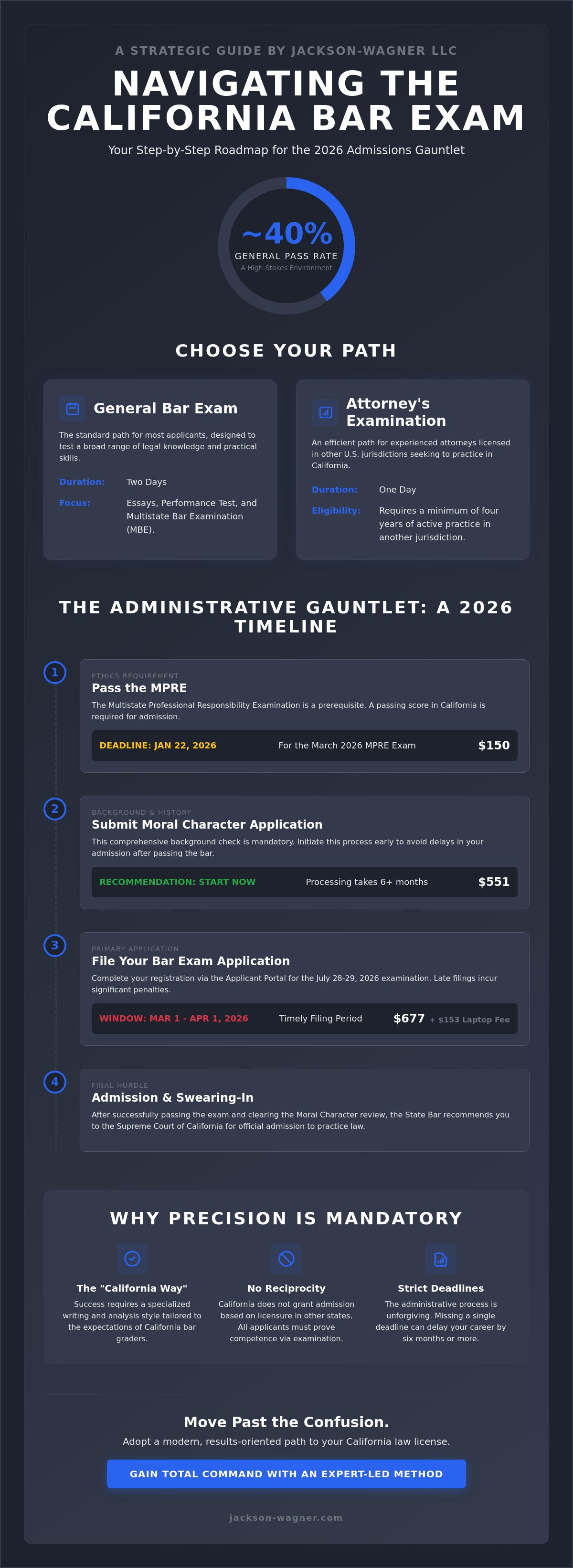
Your journey begins with the Applicant Portal. This digital dashboard is your primary command center for the state of california state bar. You must first register as an applicant before you can apply for the exam itself. Law students typically complete this in their first year, but out-of-state attorneys must ensure their registration is active before the exam filing window opens. For the July 28-29, 2026, exam, the timely filing window opens on March 1 and closes on April 1, 2026. General applicants pay a $677 fee, while those using a computer must add a $153 laptop fee. Late filings incur significant penalties, so mark these dates in red.
Parallel to your exam application, you must initiate the Moral Character Determination. This $551 application is a deep dive into your history. It often takes six months or longer to process. If you wait until after you pass the exam to start, you'll face a frustrating delay in your swearing-in ceremony. Finally, don't forget the $150 MPRE registration fee. For the March 2026 MPRE, you must register by January 22, 2026. As you manage these logistical hurdles, ensure your academic preparation is equally rigorous by choosing an expert-led study method designed for the modern professional.
Registering as an Applicant
The requirements for initial registration depend on your status. Students must provide law school transcripts, while out-of-state attorneys must submit a certificate of good standing from every jurisdiction where they've been admitted. These administrative fees are strictly non-refundable. If you realize later that you don't meet the eligibility requirements, the state of california state bar won't return your payment. Efficiency starts with knowing exactly which category you fall into before you click submit.
Using the Applicant Portal Effectively
The portal is more than just a payment gateway. Use it to track your Moral Character status and manage testing accommodations. If you require specific equipment or extra time, you'll submit your supporting medical documentation here. Check your dashboard weekly. The Bar communicates exclusively through this system, and keeping your contact information updated is the only way to ensure you receive your result notification on May 1 or November 6, 2026.
Choosing Your Path: General Bar Exam vs. Attorney Examination
Deciding which exam to sit for is your first strategic move. The state of california state bar offers two distinct routes to licensure, but the right choice depends on your professional history and testing strengths. Most applicants face the General Bar Exam, a two-day endurance test. However, if you've been an active member in good standing of another U.S. jurisdiction for at least four years immediately preceding your application, you qualify for the Attorney’s Examination. This isn't just a shorter test; it's a completely different tactical challenge.
The financial stakes vary between these paths. The General Bar Exam carries a $677 application fee, while the Attorney’s Examination costs $224. While the lower price and shorter duration of the one-day exam are tempting, don't make the mistake of assuming it's easier. Success in California requires more than just a passing knowledge of the law. It demands a specific, high-precision writing style that traditional programs often fail to teach. You can review the official eligibility requirements through the State Bar of California admissions portal to confirm your status before committing to a study plan.
General Bar Exam Structure
The General Bar Exam is a two-day gauntlet. Day one consists of five one-hour essays and one 90-minute Performance Test. Day two is dedicated to the Multistate Bar Exam (MBE), featuring 200 multiple-choice questions. Scoring is weighted 50% on your written performance and 50% on the MBE. For many, the MBE serves as a vital safety net. If your essay writing falters under pressure, a stellar MBE score can bridge the gap to a passing total. This route is mandatory for law students and attorneys with fewer than four years of practice.
The Attorney Exam Advantage
The Attorney’s Examination strips away the MBE entirely. You'll complete the five essays and the Performance Test in a single, high-intensity day. Statistically, this route appears more favorable. The pass rate for the Attorney's Examination is approximately 60%, which is 20% higher than the general exam's 40% average. However, this advantage comes with a catch. Without the MBE to balance your score, your writing must be flawless. If you're a practitioner who hasn't written a formal legal essay in years, or if you've always excelled at multiple-choice questions, the two-day General Bar Exam might actually be your safer bet. Success here requires a matchless command of the "California Way" of writing, regardless of which path you choose.
Fulfilling the Moral Character and Ethics Requirements
Passing the exam is only half the battle. The state of california state bar requires a rigorous vetting process known as the Moral Character Determination (MCD). This isn't a mere formality. It's a comprehensive investigation into your past to ensure you possess the integrity required for legal practice. Central to this process is the "duty of candor." You must disclose everything. The Bar prioritizes honesty over a perfect record. Omissions are often treated more severely than the original incidents themselves because they suggest a lack of current integrity.
As part of your application, you'll undergo "Positive Fingerprint Identification." This involves submitting Live Scan fingerprints to the Department of Justice and the FBI. The $551 application fee covers the administrative cost of this deep dive. If you've lived outside of California or the United States in the last few years, the verification process becomes even more complex. Total transparency is your only viable strategy for success. Any attempt to hide past mistakes will likely be uncovered during this investigation, potentially resulting in a permanent bar from admission.
The Timeline Trap: Start 8 Months Early
Don't wait for your exam results to begin your MCD. The state of california state bar typically takes 6 to 10 months to process these applications. If your background check is still pending when you receive your passing score, you'll be blocked from the swearing-in ceremony. You'll need a meticulous record of your life history, including:
- Every residence you've held for the last 10 years.
- Complete employment history, including contact details for every supervisor.
- Records of any litigation, credit issues, or administrative discipline.
- Detailed information regarding any criminal history, no matter how minor.
The MPRE and Professional Responsibility
Ethics testing is the final pillar of licensure. You must achieve a minimum scaled score of 86 on the Multistate Professional Responsibility Examination (MPRE). In California, this score remains valid for only a specific window, so timing your registration is critical. For the March 2026 MPRE, the registration deadline is January 22, 2026, with a fee of $150. To ensure your preparation matches the intensity of the exam, consult our guide on Passing the California Bar Exam in 2026: The Definitive Strategic Guide. Once you've mastered the ethics requirements, you can focus entirely on your core study plan. If you're ready to secure your future with a guaranteed path to success, enroll in our JW Bar Method Prep today.
Executing Your Study Strategy: Why Precision is Mandatory
Following the administrative rules of the state of california state bar is merely the price of admission. It ensures your seat is reserved for the 2026 exam cycle, but it does nothing to guarantee your name appears on the pass list. The reality of this exam is that it rewards surgical precision, not just broad legal knowledge. Most applicants fail because they treat their preparation as a passive academic exercise. They watch endless hours of video and hope for the best. In California, hope isn't a strategy. You need a structured, aggressive approach that prioritizes the "California Way" of writing over generic, one-size-fits-all bar prep methods.
Traditional, high-volume courses often lead to failure because they focus on the wrong metrics. They celebrate how many thousands of multiple-choice questions you've answered while ignoring the nuanced essay structure the CBE demands. The examiners aren't looking for a law student's summary; they're looking for an attorney's analysis. This requires a transition from basic IRAC to a sophisticated, professional-level application of law to fact. Jackson-Wagner LLC was built to bridge this gap, offering a modern alternative to the bloated, inefficient programs that have dominated the industry for decades.
Mastering California-Specific Law
Success requires you to pivot quickly between multistate principles and California-specific nuances. Subjects like Community Property, Professional Responsibility, and California Evidence have distinct rules that can trap the unwary. You must develop issue spotting at a professional level, identifying the subtle triggers that lead to high-point sub-issues. Generic prep often glosses over these distinctions, but the California exam is won or lost in the details. Precision in rule statements is the non-negotiable anchor that distinguishes a passing essay from a failing one.
The Jackson-Wagner LLC Guarantee
We don't just provide study tools; we provide a partner in your success. Our "Pass or Your Money Back" commitment is a mark of absolute confidence in our expert-led methodology. It replaces the high-stakes anxiety of the exam with a sense of bold reliability and professional empowerment. The accelerated prep format designed by Jackson-Wagner LLC is specifically engineered for the practicing attorney or the busy professional who requires flexibility without compromising on depth. You get a paced format, automated feedback, and learning objectives that ensure every hour of study moves you closer to licensure. Stop settling for traditional programs that waste your time. Master the State Bar of California with the JW Bar Method.
Secure Your Future in the California Legal Market
Success within the state of california state bar ecosystem requires more than just academic stamina. It demands a strategic mastery of administrative deadlines and a precise writing style that traditional programs simply don't provide. You've seen that starting your Moral Character Determination early is essential to avoid frustrating licensure delays. You also understand that choosing the right exam route is a tactical decision that can significantly impact your results.
We're ready to partner with you through our accelerated tracks specifically engineered for modern legal professionals. Jackson-Wagner LLC is exclusively focused on California licensure, ensuring every learning objective is optimized for this unique jurisdiction. We're so confident in our matchless methodology that we offer a bold Pass or Your Money Back financial guarantee. It's time to replace the high-stakes anxiety of the bar exam with a structured, reliable path to success. Join the Ranks of California Attorneys with the JW Bar Method and secure your professional standing today. You have the drive to succeed; we have the proven method to get you there.
Frequently Asked Questions
How long does it take to get licensed by the State Bar of California?
It typically takes between six and ten months to complete the entire administrative and academic cycle. This timeline accounts for the processing of your Moral Character Determination and the three-month wait for exam results. If you sit for the February 2026 exam, you won't receive your results until May 1, 2026, making early application filing a vital step for your career timeline.
Can I take the California Bar Exam if I am an undocumented immigrant?
Yes, you can be admitted to the state of california state bar regardless of your immigration status. Since the passage of Senate Bill 1159 in 2014, California has allowed undocumented immigrants who meet all other requirements to obtain a law license. You still must provide a Social Security number or an Individual Taxpayer Identification Number (ITIN) to complete your registration in the Applicant Portal.
What is the passing score for the California Bar Exam in 2026?
The required passing score for the 2026 California Bar Exam is a scaled total of 1390. This score is aggregated from your performance on the five essays, one Performance Test, and the 200-question MBE. Achieving this benchmark requires a level of precision that generic programs often fail to deliver, especially given the historically low average pass rate of 40% for general applicants.
How many times can you take the California Bar Exam?
California does not currently limit the number of times you can sit for the bar exam. While some jurisdictions impose a three-attempt cap, the state of california state bar allows you to reapply for every administration. However, each attempt requires a new $677 application fee and a fresh commitment to rigorous preparation to overcome the exam's significant difficulty level.
Do I need to be a resident of California to join the State Bar?
No residency requirement exists for admission to practice law in California. You can live in any state or country while maintaining active status, provided you meet all licensing and ethical standards. This flexibility makes California a primary destination for international practitioners and out-of-state attorneys who wish to expand their practice without relocating to San Diego or elsewhere in the state.
What happens if I fail the Moral Character Determination?
Failing the Moral Character Determination means the Committee of Bar Examiners has found you currently unfit to practice law. You'll receive a written explanation of the adverse findings and have the right to appeal the decision. These appeals are heard in the State Bar Court, which is the only independent professional court of its kind in the United States dedicated to ruling on attorney discipline and admissions.
Is the California Attorney Exam easier than the General Bar Exam?
The Attorney's Examination has a higher pass rate of approximately 60%, but it isn't necessarily easier. It removes the MBE safety net, meaning your score depends entirely on your essay writing and the Performance Test. If you aren't a high-precision writer, the two-day general exam might actually be the safer strategic choice because the multiple-choice section can balance a lower essay score.
How much are the registration fees for the State Bar of California?
Total registration fees for a first-time applicant typically exceed $1,300. This includes the $677 general application fee, $551 for moral character, $153 for laptop use, and $150 for the MPRE. These costs are non-refundable and must be paid through the Applicant Portal. Managing these expenses is part of the administrative marathon every applicant must finish before their swearing-in ceremony.


