
With an overall pass rate of just 30.8 percent for the February 2026 administration, the California Bar Exam remains the most formidable barrier to entry in the American legal profession. You already know that traditional, high-volume memorization isn't enough to secure a 1390 scaled score while balancing a career or family obligations. The volume of material is overwhelming. Generic prep courses often fail to address the specific nuances that lead to the 12.4 percent pass rate seen among repeat takers in July 2025.
We at Jackson-Wagner LLC promise to replace this anxiety with a precision-based roadmap to master the exam on your first attempt in 2026. This guide delivers a structured, expert-led strategy designed for the modern legal professional who demands efficiency over rote exhaustion. You'll learn how to navigate the 200-question MBE and the five-essay written portion using a methodology that prioritizes strategic mastery. Success isn't about working harder; it's about working with matchless precision.
Key Takeaways
- Identify the specific 2026 exam dates and core components to ensure your preparation schedule is mathematically optimized for success.
- Learn how to navigate the 50/50 scoring split between the written and MBE sections to maximize your total scaled score.
- Discover why traditional "volume-based" study models often lead to failure on the california bar exam and how to adopt a precision-focused alternative.
- Implement a strategic three-phase roadmap that prioritizes high-yield subjects and realistic simulation over generic, low-impact memorization.
- Explore how an accelerated, expert-led prep system can provide the professional empowerment needed to pass on your first attempt in 2026.
What is the California Bar Exam? 2026 Overview
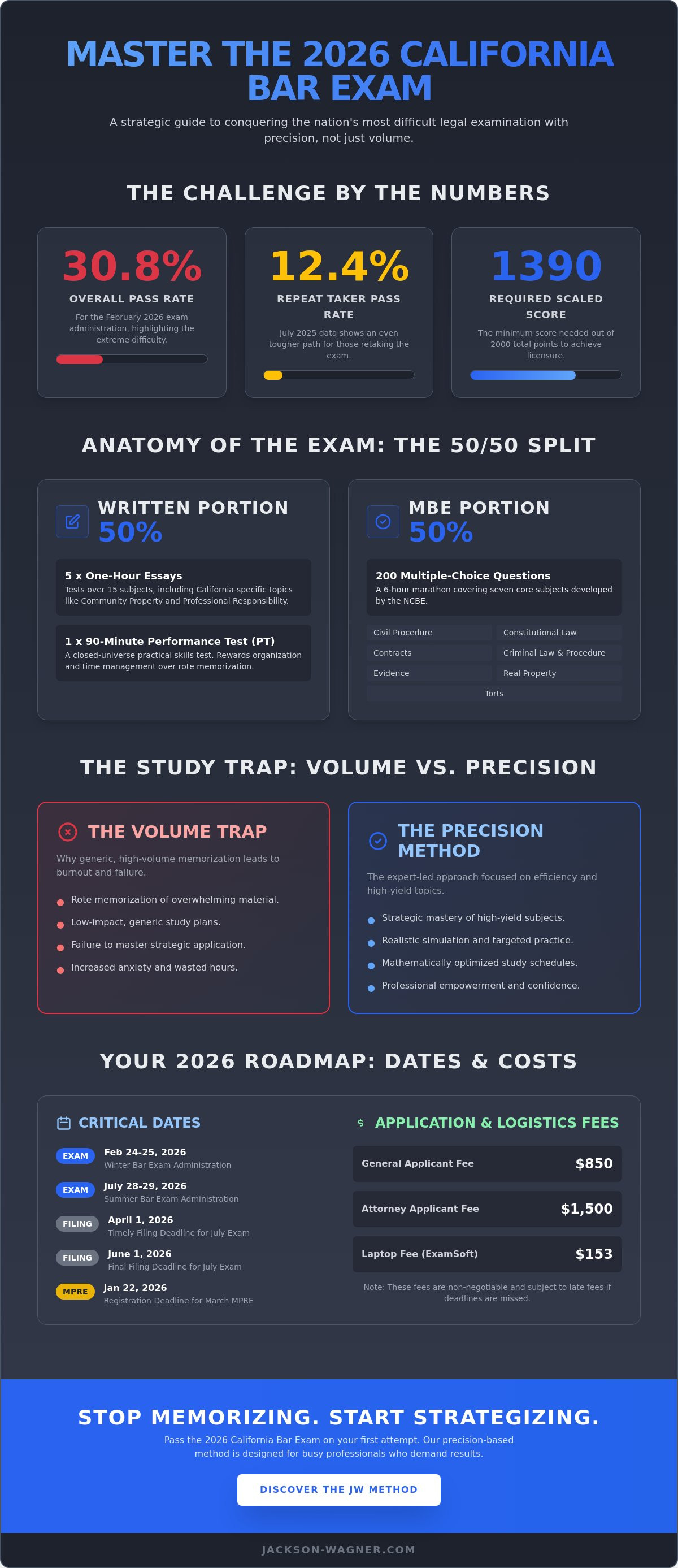
The california bar exam serves as the ultimate licensure test for any professional seeking to practice law in the state. Administered by the State Bar of California, it's widely regarded as the most difficult legal examination in the country. For the 2026 cycle, the summer administration is scheduled for Tuesday, July 28, and Wednesday, July 29. The winter administration will occur on February 24 and 25. This two-day format transition has solidified the exam's reputation for extreme rigor; it demands a minimum scaled score of 1390 out of 2000 to pass.
Candidates typically fall into two categories. The General Bar Exam is required for most law school graduates. It consists of five one-hour essay questions, one 90-minute Performance Test, and the 200-question Multistate Bar Examination (MBE). Alternatively, the California Attorney’s Exam is available to lawyers who've been in good standing in another US jurisdiction for at least four years. This version omits the MBE but requires the same written excellence as the general test. With a February 2026 pass rate of just 30.8 percent, precision is your only path to success.
2026 Deadlines and Eligibility Requirements
Meeting the State Bar's strict timeline is non-negotiable. For the July 2026 exam, the timely filing deadline is April 1, 2026, while the final filing deadline is June 1, 2026. Attorney applicants pay a fee of $1,500, while general applicants pay $850. You must also clear the moral character application process and secure a scaled score of 86 on the MPRE. MPRE registration for the March 24-25 exam closes on January 22, 2026. If you're targeting the August 11-12 MPRE, your deadline is June 11, 2026.
The Logistics of the 2026 Administration
The 2026 california bar exam will be conducted in person at various testing centers. You're required to provide your own laptop for the written portions, which must be equipped with ExamSoft. This software allows you to upload your essays and Performance Test securely. The laptop fee is $153, and you must register your device within the mandatory window to avoid late fees. Because the exam is entirely in person, planning your travel and lodging near the testing site is as critical as your study schedule. Don't let logistical oversights derail your professional future.
The Anatomy of the Exam: Scoring and Components
The california bar exam isn't just a test of knowledge; it's a test of architectural strategy. To secure your license in 2026, you must reach the "Magic 1390." This is the minimum scaled score required out of a possible 2000 points. The State Bar of California splits the weighting exactly 50/50 between the written portion and the Multistate Bar Examination (MBE). This means your ability to analyze complex fact patterns is just as vital as your ability to identify the correct answer among subtle distractors in a multiple-choice set. For the most current technical details on these requirements, you should consult the Official California Bar Examination Information. One critical component often misunderstood is the Performance Test, which is a 90-minute closed-universe practical skills drill designed to simulate real-world legal tasks.
The MBE: 200 Questions of Precision
The National Conference of Bar Examiners (NCBE) develops the MBE, a grueling 200-question marathon that spans the second day of testing. It covers seven core subjects: Civil Procedure, Constitutional Law, Contracts, Criminal Law and Procedure, Evidence, Real Property, and Torts. Success here doesn't require a perfect raw score. Because the exam is scaled to account for difficulty variations between different administrations, a raw score of approximately 65 to 70 percent typically translates into a passing scaled score. You don't need to know every obscure rule; you need to master the high-yield principles that appear most frequently. If you want to refine your approach, exploring an accelerated prep method can help you focus on these high-impact targets.
The Written Components: Essays and the PT
The written half of the california bar exam is where many candidates lose their momentum. It features five one-hour essays that can pull from over 15 potential subjects. These include California-specific topics like Community Property, Professional Responsibility, and Wills and Trusts. You must be prepared to distinguish between general common law and California's unique statutory requirements. The 90-minute Performance Test is frequently the most underrated point-earner on the entire exam. Since it provides all the necessary law and facts within a provided "file" and "library," it rewards students who have mastered structural organization and time management over rote memorization. Mastering the PT is often the fastest way to bridge the gap to a 1390.
Why Traditional Prep Fails: The Volume vs. Precision Trap
Traditional programs often trick you into believing that success is a matter of sheer volume. They demand 12-hour study days and the consumption of 1,000-page outlines that no human can truly master in a single summer. This "kitchen sink" approach is designed to protect the prep company, not the student. By burying you in every possible rule, they hope something sticks. But the california bar exam rewards strategy, not stamina. The #1 objection we hear is the fear that you must know every obscure rule to pass. This is a dangerous myth that leads to burnout and cognitive overload.
The goal is "Minimum Competence," a specific standard defined by The State Bar of California to ensure you can practice law safely and effectively. Perfectionism is a liability in this environment. When you try to memorize everything, you master nothing. This creates a massive psychological toll on high-achieving professionals who feel like they are failing if they don't complete every task in a generic, bloated checklist. You don't need to be a walking encyclopedia to reach a 1390 scaled score; you need to be a precision-focused practitioner.
Passive vs. Active Learning in Bar Prep
Passive learning is the silent killer of bar scores. Watching 40 hours of video lectures feels productive, but it's the least effective way to retain complex law. You don't need to hear a lecturer read an outline; you need to practice issue spotting. This is the skill of identifying which legal principles are triggered by a specific set of facts. By using active recall and spaced repetition, you can master California-specific nuances, such as Community Property or Professional Responsibility, without wasting weeks on low-yield material. Mastery comes from doing, not just watching.
The Working Professional’s Dilemma
Standard 10-week schedules are practically impossible for full-time attorneys or parents. These programs assume you have 60 hours a week to dedicate to study, which is a luxury most modern professionals don't have. It's a persistent myth that you must quit your job to pass the california bar exam. Success actually comes from high-impact sprints that focus on execution rather than just reading. By condensing your study into organized, expert-led modules, you can maintain your professional obligations while building the skills necessary to win on exam day. Efficiency is your greatest competitive advantage.
A Strategic Roadmap for 2026 Success
Passing the california bar exam requires a transition from passive consumption to tactical execution. Our three-phase framework; Foundation, Execution, and Simulation; is designed to build your skills in a logical, paced format that respects your professional time. Unlike traditional programs that treat every rule as equally important, this roadmap prioritizes high-yield subjects. You'll track your progress through measurable weekly learning objectives, ensuring you never waste a single study session on low-impact material. For those qualifying for the JW Bar Method Prep - Attorney’s Exam California Bar, this roadmap becomes even more streamlined, focusing exclusively on the written day requirements.
Phase 1: Foundations and Rule Mastery
The first phase is about building "lean" outlines. You don't need a 100-page document for Torts; you need a concentrated attack sheet that prioritizes the elements of every claim. During these initial weeks, allocate 60 percent of your time to the seven MBE subjects. Even if you're an attorney applicant exempt from the multiple-choice section, these subjects form the backbone of the essay portion. Start writing at least one practice essay every week from day one. This builds the muscle memory needed to handle the pressure of the actual 2026 administration.
Phase 2: The Execution Sprints
Once the foundation is set, you must increase your multiple-choice volume to 30-50 questions per day. It's critical to use licensed NCBE questions rather than simulated ones to ensure you're calibrated to the actual exam's logic. In this phase, you'll master the "IRAC" format specifically for California essays. Graders aren't looking for legal treatises; they're looking for clear issue spotting and a logical application of rules to facts. You'll also begin timed drills for the 90-minute Performance Test, treating it as a high-stakes practical exercise rather than an afterthought.
Phase 3: Full-Scale Simulations
The final phase replicates the exact conditions of the 2026 california bar exam. You'll conduct at least two full-day simulated exams to build the mental stamina required for the two-day marathon. Analyze the "Selected Answers" provided by the State Bar to understand what differentiates a mediocre response from a top-tier one. This isn't about learning new law; it's about refining your "attack sheets" for the most complex California subjects like Community Property and Professional Responsibility. By the time you reach the testing center, the process will feel like a routine execution of a well-rehearsed plan.
The JW Bar Method: A Disruptive Approach to Licensure
The JW Bar Method represents a fundamental shift in how candidates approach the california bar exam. While traditional programs rely on an outdated academic model, we've built a system rooted in precision and professional empowerment. We don't believe in the 600-hour "kitchen sink" approach. Instead, we utilize expert-led drills and automated feedback to ensure every minute of your study time is productive. This isn't just another study tool; it's a results-oriented partnership. Success in 2026 requires more than a generic outline. It requires a methodology that adapts to your specific weaknesses and optimizes your strengths.
Whether you're a recent graduate or an experienced practitioner, we provide specialized tracks to meet your needs. The JW Bar Method Prep - Full Exam California Bar covers every pillar of the two-day administration, while the JW Bar Method Prep - Attorney’s Exam California Bar is tailored for those focusing solely on the written day. By replacing passive lectures with active learning objectives, we help you master the law with matchless efficiency. We've removed the fluff to focus on what actually moves the needle toward a passing score.
Accelerated Prep for Busy Professionals
Our methodology condenses the standard, bloated curriculum into optimal learning modules. This paced format is specifically designed for professionals who can't afford to quit their jobs or ignore family obligations. We focus on high-impact subjects that actually appear on the california bar exam, stripping away the peripheral noise that leads to cognitive overload. Our success stories include numerous attorneys who passed on their first attempt by following our execution-heavy sprints rather than marathon reading sessions. We've proven that a structured, modern approach beats rote memorization every time.
The Financial Guarantee: Your Success is Our Risk
The most defining aspect of our brand is the PASS OR YOUR MONEY BACK ultimatum. This isn't a marketing gimmick; it's a bold financial guarantee that distinguishes Jackson-Wagner from every other provider in the industry. Traditional programs take your money regardless of your outcome. We believe the risk should be on the provider, not the student. This ultimatum forces our curriculum to be more effective, more organized, and more reliable than any "safe" competitor. If our methodology doesn't lead you to a passing score, we don't deserve your investment. It's time to stop fearing the exam and start executing a plan that works.
Secure your 2026 seat with the JW Bar Method
Take Command of Your 2026 Legal Career
Mastering the california bar exam requires moving beyond the kitchen sink mentality of traditional prep. You've learned that success hinges on identifying high-yield subjects and understanding the 50/50 weighting of the 2026 administration. By focusing on precision rather than sheer volume, you can protect your professional time while building the mastery needed to reach a 1390 scaled score. Our specialized tracks for working attorneys and general applicants ensure that your study remains focused, organized, and effective.
Don't settle for a generic program that doesn't have skin in the game. Jackson-Wagner offers accelerated modules and expert-led drills designed specifically for the modern learner. We're so confident in our methodology that we provide a bold financial guarantee. It's time to replace anxiety with a structured, reliable path to success. Our specialized focus exclusively on California licensure means you're getting the most relevant training available.
Master the California Bar with the JW Bar Method: Pass or Your Money Back
You have the drive to succeed. We have the roadmap to get you there.
Frequently Asked Questions
What is the pass rate for the California Bar Exam?
The overall pass rate for the February 2026 administration was 30.8 percent, while first-time takers saw a higher success rate of 43.9 percent. These figures represent a slight decline from previous years. In contrast, the July 2025 exam yielded a 54.8 percent overall pass rate. Understanding these fluctuations is vital for setting realistic expectations and choosing a precision-based study method that prioritizes high-yield subjects over traditional rote memorization.
How much does it cost to take the California Bar Exam in 2026?
General applicants for the 2026 california bar exam pay a registration fee of $850, while attorney applicants are required to pay $1,500. Additionally, you must account for the $153 ExamSoft laptop fee and approximately $150 for the MPRE registration. These costs don't include travel or lodging for the in-person administration. Planning for these expenses by the April 1 timely filing deadline ensures you avoid late fees and logistical stress.
Can I take the California Bar Exam if I am already an attorney in another state?
You can take the exam as an out-of-state attorney, but California does not offer reciprocity with any other jurisdiction. If you've been in good standing for at least four years, you may qualify for the one-day Attorneys' Examination, which omits the multiple-choice portion. Attorneys with less than four years of experience must sit for the full two-day General Bar Exam. This path requires a specialized strategy to master California-specific law quickly.
How long should I study for the California Bar Exam?
Most candidates require approximately 400 to 600 hours of study, typically spread over a 10-week period. However, the quality of your study matters more than the quantity of hours. Working professionals often find success using accelerated, high-impact sprints that focus on active recall and execution rather than passive video watching. By condensing fluff into organized modules, you can achieve the necessary 1390 scaled score without sacrificing your career or family obligations.
What is the difference between the General Bar Exam and the Attorney’s Exam?
The General Bar Exam is a two-day test consisting of 200 multiple-choice questions and a written portion with five essays and one Performance Test. The Attorneys' Examination is a one-day version that includes only the written components. Only lawyers who've practiced in another US jurisdiction for at least four years are eligible for the one-day track. Both versions require a 1390 scaled score to pass, making precision in the written section absolutely critical.
Is the California Bar Exam moving to a remote format in 2026?
No, the 2026 california bar exam will be administered entirely in person at designated testing sites across the state. This represents a return to traditional testing protocols following the temporary shift to remote exams in previous years. You'll need to use your own laptop with ExamSoft installed for the written portions. Preparing for the physical environment of a testing center is a key part of the simulation phase in any modern prep program.
What happens if I fail the California Bar Exam on my first attempt?
If you fail, you can retake the exam in the next available administration, but the statistics for repeat takers are challenging. In July 2025, the pass rate for repeaters was only 12.4 percent. This disparity highlights the need to pivot from traditional programs to a more precision-focused methodology. Analyzing your score report to identify specific weaknesses in the MBE or written sections is the first step toward a successful second attempt in 2026.
Do I need to take the "Baby Bar" (FYLSX) before the full exam?
You only need to take the First-Year Law Students' Examination, or "Baby Bar," if you are attending an unaccredited law school or lack two years of college work before starting law school. Most students at ABA-approved or California-accredited schools move directly to the full licensure exam after graduation. If you are required to take the FYLSX, you must pass it within three administrations of becoming eligible to receive credit for all your law school studies.


