

With only 23.1% of repeat takers passing the February 2026 General Bar Exam, the margin between legal licensure and another grueling study cycle is thinner than most applicants realize. You've likely spent the weeks leading up to the May 1 or November 6 release dates dissecting every essay and MBE question in your head; it's natural to feel anxious about how a few scaled points might define your professional future. This guide provides a comprehensive california bar exam score report explained to help you master the 50/50 weighting split and the diagnostic steps required to interpret your 2026 results with absolute precision.
We'll break down why the 1390 passing threshold is the only number that matters, how the second-read process functions for scores between 1350 and 1390, and the specific metrics you must analyze to identify performance gaps. Whether you're celebrating a pass or planning a strategic pivot, you'll gain a clear roadmap for your next steps toward the California Bar. From understanding your percentile rank to leveraging raw data for a more effective study plan, it's time to replace ambiguity with a structured, modern path to success.
Key Takeaways
- Secure your results efficiently through the Applicant Portal by mastering the 2026 release cycle and retrieval protocols.
- Navigate the 1390 benchmark and the 50/50 weighting split with our california bar exam score report explained to understand exactly where your performance stands.
- Finalize your path to licensure by completing the post-result checklist, including Moral Character requirements and the Virtual Oath Packet.
- Transform a narrow miss into a future pass by conducting a diagnostic analysis of your raw scores to identify specific proficiency gaps in the MBE or written sections.
- Develop a results-oriented plan for your next attempt by leveraging modern pedagogical tools designed for the Full Exam or the Attorneys' Exam.
Accessing the State Bar of California Results in 2026
The wait for bar results is a period of high-stakes anticipation that requires a calm, professional approach. For the 2026 cycle, the schedule is definitive. Applicants who completed the February 2026 General Bar Exam or Attorneys’ Examination will receive their results on May 1, 2026. Those sitting for the July 2026 administration must wait until November 6, 2026. The State Bar of California manages this process through a secure Applicant Portal, ensuring that your status remains confidential until the official public list is released. Having your california bar exam score report explained begins with a seamless retrieval process that avoids the common pitfalls of results day.
The "6:00 p.m. Rule" is a consistent fixture of the California Bar. Results are released no later than 6:00 p.m. Pacific Time on the scheduled Friday. It's a staggered release. You might see peers on social media announcing their success while your portal still shows "Pending." This is normal. The system processes thousands of individual files simultaneously. Your private result in the portal is your official notice; the public pass list is a secondary formality that follows several days later. This delay protects your privacy, giving you the opportunity to process your results before they are searchable by the general public or prospective employers.
The 2026 Results Release Timeline
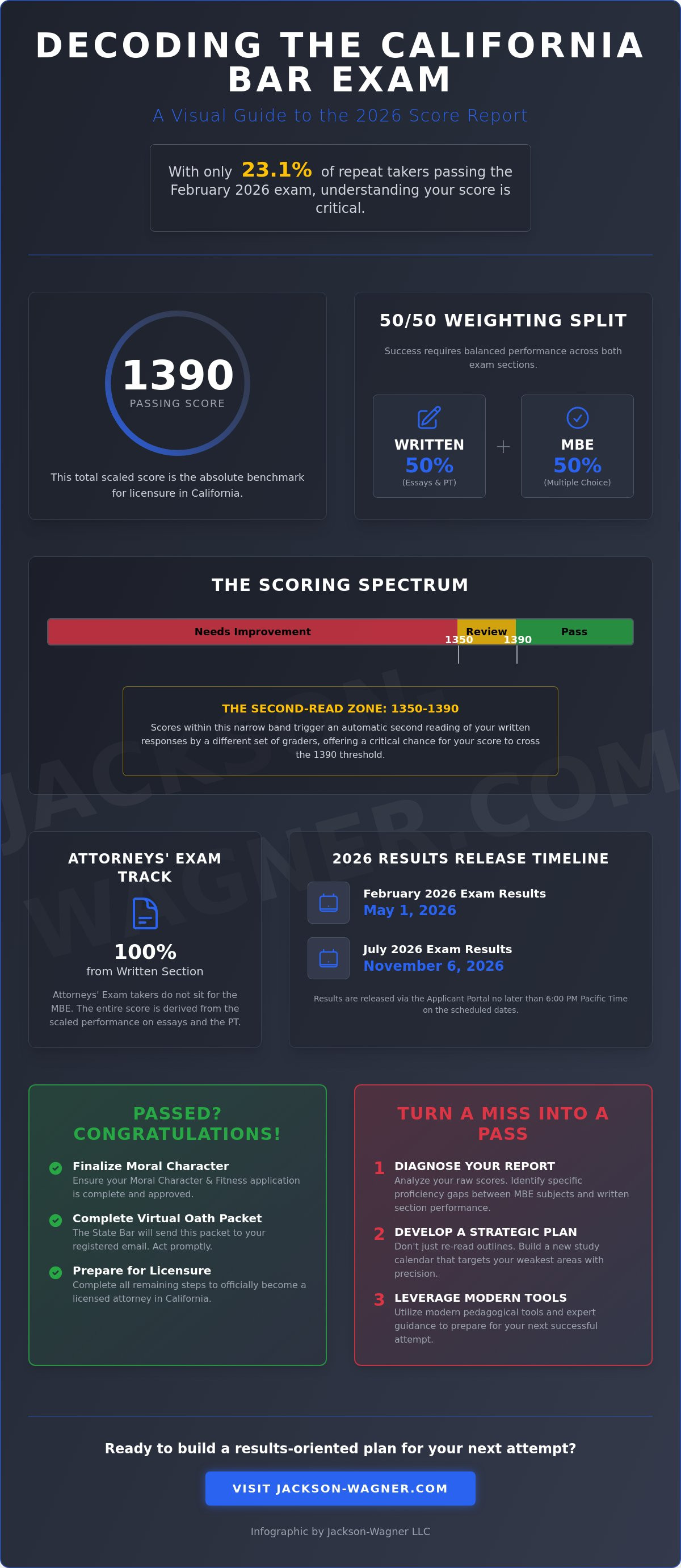
The timeline for 2026 is rigorous and leaves no room for ambiguity. Mark your calendar for May 1 or November 6. These dates apply to both the General Bar Examination and the Attorneys’ Examination. You should ensure your portal credentials are active and verified at least one week before these dates. High traffic during the release window can cause significant lag. By logging in early and keeping your browser session active, you minimize the risk of being locked out during the peak 6:00 p.m. surge.
Troubleshooting Portal Access
Technical friction is common when thousands of applicants attempt to access the portal at once. If you encounter a "Server Busy" error, wait five minutes before attempting to reload. Constantly refreshing your browser can trigger security protocols that temporarily block your IP address. It's also vital to verify that your contact information is current. The State Bar uses this data to send the Virtual Oath Packet to successful applicants. If you don't see a notification within two hours of the release, check your spam folder or look for a direct link within the portal's "Status" tab. This proactive management ensures you don't miss the critical next steps for your licensure.
Decoding the Score: How the California Bar Exam is Graded
Understanding the mechanics of your result is the first step toward professional mastery. The 1390 benchmark is the absolute line of demarcation for licensure in 2026. This isn't a percentage; it's a total scaled score derived from two distinct halves of the examination. When you view your california bar exam score report explained, you'll see a 50/50 weighting split between the Multistate Bar Examination (MBE) and the written portion. This balance ensures that neither pure memorization nor writing proficiency alone can carry an applicant to success. You must demonstrate competence across both modalities to reach the required threshold.
The State Bar uses a complex statistical normalization process to ensure fairness across different exam administrations. Raw scores, which are simply the number of points earned on a specific question, are converted into scaled scores. This adjustment accounts for variations in difficulty between the February and July exams, ensuring that a 1390 in one cycle represents the same level of proficiency as a 1390 in another. You can find the specific details on how the California Bar Exam is graded through the official portal. This scaling is essential because it protects the integrity of the license against fluctuations in test difficulty.
Attorneys taking the one-day track face a unique challenge. Since they don't sit for the MBE, their entire score is derived from the written portion. This means there's no room for error in essay analysis or PT organization. Every point in the written section is scaled to the same 1390 standard, making the california bar exam score report explained even more vital for these seasoned professionals. They must understand where their specific jurisdictional analysis might have faltered compared to the General Bar Exam pool. For those who need to close a significant point gap, the JW Bar Method Prep provides the structured framework required to hit the 1390 mark with confidence.
The Written Component: Essays and Performance Test
The written component consists of five one-hour essay questions and one 90-minute Performance Test (PT). Graders evaluate these based on a specific rubric, but the PT is weighted more heavily than a single essay. In fact, the PT counts for two essay scores. To benchmark your performance, compare your answers to the 'Selected Answers' published by the State Bar. These represent high-scoring models that illustrate the depth of analysis required. If you're looking for a deeper dive into preparation, review our guide on Passing the California Bar Exam in 2026.
The MBE and Scaling Factors
The MBE consists of 200 multiple-choice questions, with 175 scored and 25 pretest items. Your raw score is scaled based on the national mean, which means your individual performance is measured against the entire country's test-taking pool. The California Supreme Court maintains authority over these scoring adjustments to ensure they reflect the standard necessary for practice. In 2026, these adjustments continue to reflect the rigorous standards expected of California lawyers. If your score report shows a weakness here, it often indicates a need for a more structured pedagogical approach that prioritizes the mechanics of the MBE over legacy study methods.
Analyzing 2026 Pass Rates and Statistical Trends
The February 2026 General Bar Exam results highlight a stark reality for repeat takers and a challenging landscape for all applicants. With an overall pass rate of 30.8%, the competition for licensure remains exceptionally fierce. First-time takers achieved a 43.9% success rate, while repeaters faced a much steeper climb with only a 23.1% outcome. These figures represent a significant shift from the July 2025 benchmark, where the overall pass rate stood at 54.8%. This volatility is a critical component of having your california bar exam score report explained, as it provides the competitive context for your individual performance. When you see your score, you aren't just looking at a number; you're looking at your position within a highly filtered professional pool.
Seasoned lawyers sitting for the February 2026 Attorneys' Examination maintained a stronger edge, posting a 57.0% pass rate. This disparity often stems from the specialized focus of the one-day track and the advanced analytical skills developed through years of practice. For those in the General Bar Exam track, the historical fluctuation between February and July administrations continues to be a factor. July exams typically see higher pass rates because they include a larger cohort of recent graduates from ABA-accredited law schools. Understanding the California Bar Exam Grading Process is essential to see how these broader trends influence the scaling of your raw points into that final 1390 target.
Demographic and School Performance
Success rates in 2026 continued to vary significantly across different law school accreditation types. Graduates from California-accredited and unaccredited schools often face different statistical outcomes compared to their counterparts from ABA-approved institutions. Recent technological adjustments in the testing environment have also played a role in how scores are recorded and processed. To navigate these complexities, many applicants are moving away from legacy study models. If you want to understand why a targeted, pedagogical approach is now required for success, explore our analysis on the Best Bar Exam Preparation Service 2026.
Scoring Adjustments and Remedial Measures
The 2026 cycle included specific "Special Session" scoring adjustments authorized by the California Supreme Court to maintain the exam's psychometric integrity. These adjustments ensure that the difficulty of the 2026 questions is correctly balanced against previous years, like the 2024 and 2025 administrations. The Court’s role in setting final pass parameters is the ultimate safeguard of professional standards. Preliminary analyses of the 2026 pool suggest that while written proficiency remained stable, MBE performance saw more significant fluctuations. This data confirms that a california bar exam score report explained with precision is your best tool for identifying whether your specific "gap" was a matter of legal knowledge or test-taking mechanics.
Post-Result Procedures: From Pass List to Licensure
Seeing "Pass" on your status screen is the definitive moment of professional transition. However, the california bar exam score report explained in earlier sections is only the first half of the equation. Licensure isn't automatic; it's a multi-step administrative process that requires the same precision you applied to your MBE preparation. Once you've secured a 1390 or higher, the State Bar of California initiates a secondary verification process. This ensures every applicant on the pass list has satisfied the extrinsic requirements for admission, including the moral character determination and the professional responsibility score.
Your timeline for enrollment is critical. Successful applicants typically receive their official notification along with instructions for the next steps within days of the results release. You must be prepared to handle the financial obligations of "Active" status immediately if you intend to practice. Enrollment fees are a mandatory part of maintaining your license, and missing the initial filing window can delay your official start date. It's vital to move quickly from the excitement of the result to the logistical reality of becoming an officer of the court.
Moral Character and MPRE Requirements
Licensure requires a scaled score of 86 or better on the Multistate Professional Responsibility Examination (MPRE). If your ethics score is still pending or has expired, you cannot be sworn in, regardless of your bar exam performance. Similarly, your Moral Character Determination must be valid at the time you take the oath. These determinations generally last for 36 months. If yours is nearing expiration, you must file an extension immediately to avoid a gap in eligibility. For a detailed breakdown of these secondary hurdles, consult our California Bar Admission Requirements 2026.
The Virtual Oath Packet and Enrollment
The 2026 Virtual Oath Packet represents a significant shift toward a fully digital onboarding experience. You'll download this documentation directly through the Applicant Portal using secure login protocols. You no longer need to wait for physical mail to begin your career. You must find an authorized official, such as a judge or a notary public, to administer the attorney’s oath. Once the signed documentation is uploaded and processed, the State Bar will issue your official bar number and licensure card. This typically takes two to four weeks. If you're an attorney applicant who reached this stage through the JW Bar Method Prep, your transition to California practice is now a matter of administrative finality.
Timing your enrollment is a strategic choice. If you're not planning to practice law immediately, you might consider "Inactive" status to reduce your annual fees. However, most successful applicants opt for "Active" status to begin their professional journey without delay. Ensure you have the necessary funds set aside for these initial fees, as they're not included in your original application costs. By handling these post-result procedures with professional precision, you cement your place in the California legal community.
Strategic Recovery: Turning a Score Report into a Future Pass
A result below 1390 is not a reflection of your potential as a lawyer; it's a specific data point indicating a breakdown in test-taking mechanics. To move forward, you must treat your california bar exam score report explained in the previous sections as a diagnostic blueprint rather than a final judgment. The State Bar allows unsuccessful applicants to download their essay and Performance Test answers for a limited window after results are released. This is the most valuable asset in your recovery strategy. By analyzing exactly where your analysis fell short of the grader's expectations, you can pivot from generic study habits to a high-precision plan that addresses your unique performance gaps.
Identifying the "Gap" is your first priority. If your MBE scaled score was competitive but your written score dragged your average down, your issue isn't legal knowledge. It's application, timing, or organizational structure. Conversely, a strong written performance paired with a sub-1300 MBE suggests a need for better pattern recognition in multiple-choice questions. The JW Bar Method Advantage lies in this exact surgical approach. We don't believe in the legacy "volume-first" model that burns through thousands of questions without intent. Instead, we focus on the pedagogical structures that ensure every hour of study directly contributes to closing your specific point deficit.
Reviewing Your Graded Essays
Unsuccessful applicants have a strict deadline to download their graded work, typically within several weeks of the May 1 or November 6 release dates. Once you have your essays, compare them side-by-side with the "Selected Answers" published by the State Bar. Look for differences in issue spotting depth and rule synthesis. Generic prep tools often fail here because they provide one-size-fits-all feedback. You need to understand why your specific phrasing didn't trigger the points required for a passing grade in the 2026 cycle.
Accelerated Prep for the Next Cycle
For those balancing a full-time legal career, the JW Bar Method Accelerated Prep - Attorney’s Exam California Bar offers a streamlined path to 1390. This track is specifically designed for seasoned professionals who cannot afford to waste time on inefficient study methods. Whether you are targeting the July 28-29, 2026, exam or the February 23-24, 2027, cycle, your immediate action plan must include these steps:
- Request your raw scores: Access your full data set through the Applicant Portal immediately.
- Download your answers: Secure your graded essays before the State Bar's retrieval window closes.
- Analyze the MBE mean: Determine how your scaled score compares to the 2026 national average.
- Secure your next seat: Check the California Bar Exam Application Deadline 2026 to avoid late filing fees.
Starting your recovery now ensures that your next score report is the final one you'll ever need to read. By replacing high-pressure anxiety with a structured, modern, and reliable path to success, you reclaim control over your professional future. Our JW Bar Method Prep - Full Exam California Bar is built for this level of precision, ensuring you don't just study harder, but study with the professional precision required for licensure.
Master Your Path to California Licensure
Master the data behind your results to shift from uncertainty to absolute professional control. You now have the california bar exam score report explained through the lens of the 1390 benchmark and the 2026 scaling mechanics. Whether you're navigating the Virtual Oath Packet or conducting a surgical diagnostic of your essay responses, the path forward requires a shift from legacy study habits to modern pedagogical precision. High-stakes certification doesn't have to be a source of constant stress when you have a structured, results-oriented roadmap.
We provide the only prep solution exclusively focused on California licensure, featuring accelerated tracks specifically designed for working professionals. Our binary performance guarantee ensures that we share the risk of your outcome, reflecting our absolute confidence in the JW Bar Method. It's time to replace the anxiety of high-pressure testing with a reliable, structured framework for success. Secure Your Pass with the JW Bar Method and take the final step toward your legal career. You have the tools and the strategy; now it's time to execute.
Frequently Asked Questions
What time are the California Bar results released in 2026?
Results are released no later than 6:00 p.m. Pacific Time on the scheduled Friday dates. For February 2026 test-takers, the release date is May 1, 2026. Applicants who sit for the July 2026 administration will receive their results on November 6, 2026. You should log in to the Applicant Portal early to ensure your credentials are active before the high-traffic window begins.
What is the passing score for the California Bar Exam?
A total scaled score of 1390 is required to pass the examination in 2026. This score is derived from a 50/50 weighting split between the written portion and the Multistate Bar Examination (MBE). Achieving this benchmark signifies that you have met the minimum competency standards required for legal practice in California.
How do I access my individual score report if I did not pass?
You can access your results directly through the State Bar of California’s secure Applicant Portal. Unsuccessful applicants will find their california bar exam score report explained through a breakdown of raw and scaled scores for each section. This digital report is essential for conducting a diagnostic analysis of your performance gaps before planning a retake.
When will the 2026 Pass List be made public for firms to see?
The public pass list is typically published on the Sunday morning following the private Friday release. For the 2026 cycles, expect the public names to be searchable on May 3 and November 8, respectively. This delay allows successful applicants several days to notify family and employers before their status becomes public record.
Can I appeal my California Bar Exam results if I am close to 1390?
No, the State Bar of California does not have a process for appealing exam results. To ensure accuracy, any applicant with a score between 1350 and 1390 automatically undergoes a second read of all written answers by a different set of graders. Once the final results are released on the portal, the scores are considered definitive and cannot be contested.
What is the Virtual Oath Packet and when do I receive it?
The Virtual Oath Packet is the digital enrollment documentation required to finalize your admission to the bar. Successful applicants who have satisfied all other requirements, such as Moral Character and the MPRE, will receive a link to download this packet shortly after the results are announced. You must complete these documents and take the attorney's oath before an authorized official to receive your bar number.
How long are my California Bar Exam results valid for admission?
Passing results remain valid for admission for a period of five years from the date of the examination. During this five-year window, you must ensure your Moral Character Determination remains active and that you have achieved a scaled score of 86 or better on the MPRE. If you fail to satisfy all requirements within this timeframe, your passing score will expire.
What were the pass rates for the 2026 Attorneys’ Examination?
The pass rate for the February 2026 Attorneys' Examination was 57.0%. This is significantly higher than the General Bar Exam's overall pass rate of 30.8% for the same period. The disparity often reflects the specialized experience of licensed attorneys who only need to complete the written portion of the exam to secure California licensure.


