

What if the biggest threat to your legal career isn't the difficulty of the exam itself, but a missed filing date or a misunderstood administrative hurdle? Mastering the california bar admission requirements is a complex project management challenge that demands more than just legal knowledge. You've likely felt the weight of the eight to ten month Moral Character review period or the looming anxiety of the 2026 exam format changes. It's a high-stakes environment where a single oversight can delay your licensure by an entire year.
We understand that the path to the bar feels like a gauntlet of rising fees and shifting deadlines. This authoritative guide provides a strategic roadmap to navigate every academic and administrative requirement with absolute precision. You'll gain a clear checklist for the $119 registration fee, the 1390 passing score threshold, and the essential MPRE registration deadlines for the March and August 2026 test dates. By the end of this article, you'll have the structure and confidence needed to secure your license and move past the stress of the application process.
Key Takeaways
- Identify the primary regulatory bodies and educational pathways, including the JD requirements and the non-traditional Law Office Study Program.
- Navigate the complex Moral Character investigation with a clear understanding of the ethics review scope and how to address past history effectively.
- Implement a precision-timed roadmap to meet all california bar admission requirements, whether you are following a 24-month student plan or a 6-month attorney fast-track.
- Discover why administrative compliance is only the baseline and how to adopt a results-oriented preparation strategy that outperforms legacy industry standards.
- Transform your approach from high-pressure anxiety to a structured, reliable path toward successful licensure in 2026.
The State Bar of California Admission Framework: An Overview
The State Bar of California functions as the administrative arm of the Supreme Court, serving as the ultimate gatekeeper for legal practice in the state. In 2026, the Committee of Bar Examiners (CBE) continues to manage the rigorous standards you must meet to secure licensure. Navigating the california bar admission requirements starts with understanding that admission is a multi-year regulatory journey, not a single event. It's essential to recognize the State Bar as the primary authority that dictates your eligibility, background fitness, and examination standards. This framework ensures that every licensed attorney possesses the requisite legal knowledge and ethical standing to serve the public.
One common point of confusion is the distinction between registration and the actual bar application. Registration is your formal declaration of intent to seek admission, whereas the bar application is the specific request to sit for an upcoming exam. You cannot apply for the exam or the moral character determination until your initial registration is processed and approved. Treating these as separate, chronological hurdles is vital for maintaining a clean timeline toward your 2026 goals.
Initial Registration: Law Students vs. Attorney Applicants
Registration is the foundational step for any prospective applicant. It is a mandatory, one-time process that creates your official record with the Office of Admissions. Law students should ideally register during their first year of study. This early action provides a strategic advantage; it allows the Bar to track your progress and enables you to start the lengthy moral character process sooner. Practicing attorneys from other states or foreign jurisdictions face a different set of hurdles. While they skip the law student registration timeline, they must still register as an "Attorney Applicant" before they can file for the California Bar Examination. Current law student registration fees are $119, and failing to complete this step prevents you from accessing any specific exam applications.
The Admissions Account: Your Central Compliance Hub
Your online Admissions Account is the digital command center for your entire licensure process. This portal replaces legacy paper-based tracking with a real-time compliance dashboard. To set this up, you'll need verified identification, your Social Security number or an equivalent, and a detailed educational history. Once active, the Status Screen becomes your most critical tool. It tracks every requirement, from MPRE scores to Moral Character status. Don't rely on external checklists; the Status Screen is the only official source of truth for your file. Checking this account weekly ensures you catch administrative flags before they turn into career-delaying obstacles. Successful applicants treat this hub as a project management tool, ensuring every document is verified well before the final california bar admission requirements are due.
Educational and Testing Mandates: The Core Pillars
Success starts with a firm educational foundation. Most applicants satisfy the california bar admission requirements by earning a Juris Doctor (JD) degree from a law school approved by the American Bar Association (ABA) or accredited by the Committee of Bar Examiners. However, California remains one of the few jurisdictions that provides alternative pathways. The "Law Office Study Program" allows you to substitute traditional law school with four years of supervised legal study under a judge or a lawyer with at least five years of active practice. Regardless of your chosen path, the California Bar Admissions guidelines require a verified record of legal education before you can move toward the final examination phase.
Administrative compliance is just the first step; the true hurdle is demonstrating academic proficiency. For first-time takers and most out-of-state applicants with less than four years of active practice, this means conquering the General Bar Examination. If you're feeling overwhelmed by the sheer volume of material, choosing a structured approach like the JW Bar Method Prep - Full Exam California Bar can replace anxiety with a methodical path to the 1390 passing score.
The California Bar Examination (General vs. Attorneys’ Exam)
The 2026 General Bar Exam is a two-day marathon held on February 24–25 and July 28–29. It consists of the Multistate Bar Examination (MBE) and five California-specific essays plus one Performance Test. Qualified attorneys who've been in good standing in another U.S. jurisdiction for at least four years may skip the MBE and sit for the one-day Attorneys’ Examination. Both exams require a scaled score of 1390 out of 2000 to achieve licensure. This "cut score" remains one of the most demanding in the nation, making precision in your study process non-negotiable.
Standardized Testing: MPRE and First-Year Exams
Professional responsibility is a separate mandate. You must achieve a scaled score of 86 or higher on the Multistate Professional Responsibility Examination (MPRE). In 2026, the MPRE is scheduled for March 24–25 and August 11–12, with registration deadlines falling on January 22 and June 11, respectively. Additionally, students in unaccredited schools or the Law Office Study Program must pass the First-Year Law Students’ Examination (FYLSX), commonly known as the "Baby Bar," after their first year of study to receive credit for further legal education. Missing these specific windows can delay your admission by six months or more, so mark your calendar early.
Moral Character Determination: Navigating the Ethics Review
The Moral Character determination is often the most anxiety-inducing phase of the california bar admission requirements. It is a comprehensive investigation into your honesty, integrity, and reliability. Unlike a standard employment background check, the State Bar scrutinizes your entire adult life to ensure you possess the fitness to practice law. Many applicants fear that minor past mistakes, such as a decade-old misdemeanor or a period of financial instability, will lead to an automatic rejection. This is rarely the case. The Bar is looking for patterns of behavior and, more importantly, your current rehabilitation and candor.
Honesty is the absolute baseline for this process. The duty of candor requires you to disclose every requested detail, even if you believe a record was expunged or is irrelevant. Non-disclosure is frequently treated as a more severe character flaw than the original incident itself. The State Bar of California Admission Framework explicitly prioritizes transparency. If you are unsure whether to include an item, the rule is simple: disclose it. The committee values your ability to take responsibility for past actions more than a perfectly clean record.
The Disclosure Process: What the Bar Looks For
The investigation focuses on three primary pillars: criminal history, financial responsibility, and civil litigation. You'll need to provide court records and police reports for any incidents, regardless of the outcome. Financial responsibility involves looking for evidence of fraud or a persistent disregard for legal debt obligations. To document rehabilitation, prepare detailed statements explaining the circumstances and the steps you've taken to improve since the event. References and past employers are contacted to verify your professional conduct, so ensure your contact list is current and accurate before submission.
Strategic Timing for Your Moral Character Application
The processing time for a Moral Character determination is extensive, typically taking eight to ten months. Some cases involving complex histories or missing documentation can take even longer. We recommend filing your application during your second year of law school or at least 10 months before your intended swearing-in date. A positive determination is valid for 36 months, so there's no penalty for early submission. Before starting the form, gather your historical data, including every residence since age 18 and a full 10-year employment history. Taking this proactive approach ensures that administrative delays don't block your path to meeting the final california bar admission requirements.
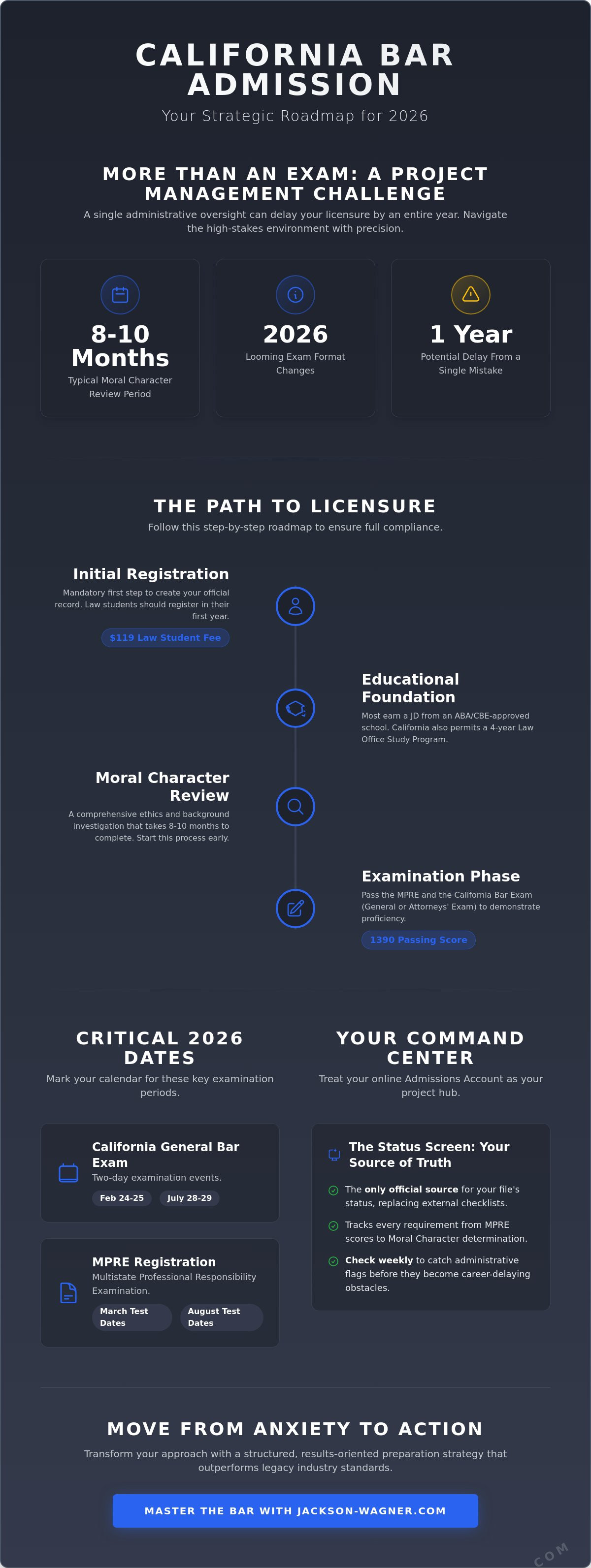
Step-by-Step: Managing Your Admission Timeline
Managing the california bar admission requirements requires a high-level project management mindset. For law students, this is a 24-month countdown that begins in the first year of study. For out-of-state attorneys, it's a high-intensity 6-month "Fast Track" where administrative speed is just as critical as academic preparation. Success depends on hitting specific windows with absolute precision. For example, the California Bar Exam application deadline 2026 for the July session has a timely filing window from March 1 to April 1, 2026. Missing these marks results in significant late fees or, worse, a deferred career.
Phase 1: Registration and Early Compliance
Your journey begins with formal registration. Students should pay the $119 law student registration fee during their 1L year to establish their record with the State Bar. During your second year, focus on the MPRE. For 2026, you must register by January 22 for the March exam or June 11 for the August session. Simultaneously, start gathering your history for the Moral Character application. You'll need every address, employer, and legal interaction since age 18. Having these details ready prevents the panic that often derails applicants during their final year of study.
Phase 2: The Application and Examination Cycle
By the start of your 3L year, you must file your Moral Character application. Since the review process can take eight to ten months, this early filing ensures you're cleared by the time you receive your bar results. Next, file your exam application within the designated windows. For the February 2026 exam, the timely filing window closes on November 1, 2025. Once the paperwork is handled, transition into an intensive study program like the JW Bar Method Accelerated Prep - Full California Bar Exam to ensure your academic performance matches your administrative precision.
The final mile involves the oath of office and your initial licensing fees. Once you receive your passing results, you must take the attorney's oath and pay the 2026 annual license fee, which is $598 for active status. Only after these final steps are recorded by the State Bar are you legally authorized to practice law in California. This structured approach replaces the traditional stress of high-pressure certification with a reliable, modern path to success. By treating the california bar admission requirements as a series of strategic milestones, you move from eligibility to licensure with total confidence.
Strategic Preparation: Moving from Eligibility to Licensure
Understanding the administrative side of the california bar admission requirements is your baseline. It's the technical entry fee for your legal career. However, many candidates mistake eligibility for readiness. Meeting the regulatory mandates gets you into the exam room, but it doesn't get you onto the roll of attorneys. You must pivot from a compliance mindset to a performance mindset immediately after your paperwork is approved. Licensure is a project management challenge where the final deliverable is a passing score of 1390.
Legacy prep models often fail the modern California applicant because they rely on passive, high-volume lecture formats that don't mirror the high-stakes environment of the 2026 exam. Learning the law is a generic academic exercise; mastering the exam is a specialized professional skill. The distinction is critical. One involves broad memorization, while the other requires the tactical application of rules under extreme time pressure. If you treat the exam like a law school final, you're already behind the curve. Success in 2026 demands a structured, modern approach that prioritizes efficiency over legacy industry standards.
Precision Prep: The JW Bar Method Advantage
We built the JW Bar Method to address the specific pedagogical needs of students who require flexibility and results. Our approach focuses on structured and accelerated learning that strips away the fluff of conventional education. By assuming the financial risk of your performance outcome through our signature guarantee, we act as a partner in your success rather than just a content provider. This bold reliability replaces the stress of high-pressure certification with a reliable path to licensure. For a deeper dive into the mechanics of the test itself, read our definitive guide on Passing the California Bar Exam in 2026.
Next Steps: Securing Your Professional Future
View the bar exam not as a hurdle to be feared, but as the final professional milestone to be conquered. Your licensure is the culmination of years of effort, and your preparation should reflect that magnitude. Don't settle for legacy industry standards that treat you like a number in a crowded classroom. Take the next step by choosing a program like the JW Bar Method Prep - Full Exam California Bar to ensure your transition from applicant to attorney is seamless. If you still need help managing the california bar admission requirements or administrative logistics, explore How to Navigate the State Bar of California for further guidance on your path to success.
Secure Your Path to the California Bar
Navigating the california bar admission requirements doesn't have to be a source of constant anxiety. By mastering the 24-month timeline and treating the Moral Character determination as a proactive project, you've already cleared the most significant administrative hurdles. Remember that eligibility is only the starting point. The real challenge lies in transforming that eligibility into a successful score on the 2026 exam. You need a partner that is as invested in your success as you are, providing the tools to move from a candidate to a colleague.
The proprietary JW Bar Method provides a structured, accelerated learning environment designed to outperform legacy educational models. Whether you are sitting for the Full Exam or the Attorney’s Exam, we offer specialized programs backed by a binary performance guarantee. Jackson-Wagner LLC assumes the financial risk because we are certain of our methodology. It's time to replace the stress of high-pressure certification with a reliable path to success. Master the California Bar with the JW Bar Method, Guaranteed. Your legal career is within reach. Take control of your future and step into the courtroom with the confidence of a licensed professional.
Frequently Asked Questions
How long does the California Bar admission process take from start to finish?
For most applicants, the journey takes between eight months and three years. Law students typically begin by registering in their first year of study. The moral character determination alone requires eight to ten months for processing. Because you must also pass the MPRE and the General Bar Exam, the timeline is a long-term project. Starting early is the only way to ensure your license is active immediately after graduation.
Can I take the California Bar Exam if I graduated from a foreign law school?
Yes, foreign-educated applicants are eligible if they meet specific educational mandates. You must either be admitted to practice law in a foreign jurisdiction or complete a year of legal education at an ABA-approved or California-accredited law school. This year must include specific subjects covered on the bar exam. The State Bar requires a detailed evaluation of your foreign credentials to confirm you meet the california bar admission requirements for international candidates.
What happens if my Moral Character application is delayed?
A delay in your moral character determination prevents you from being sworn in as an attorney, even if you pass the bar exam. Your application remains in "pending" status until the committee completes its investigation. This is why we recommend filing at least ten months before your intended admission date. If the process stalls, you must wait for a positive determination before you can legally practice law or use the title of attorney.
Do I need to live in California to be admitted to the State Bar?
No residency requirement exists for admission to the State Bar of California. You can complete the entire application process and sit for the examination while living in another state or country. Once admitted, you're eligible to practice law in California regardless of where you reside. Many out-of-state attorneys maintain their California license to handle federal cases or serve clients with California-based legal needs while living elsewhere.
What is the "cut score" for the California Bar Exam in 2026?
The passing score for the California Bar Exam is 1390 out of a possible 2000 points. This scaled score applies to both the General Bar Exam and the Attorneys’ Exam. It remains one of the highest "cut scores" in the United States, demanding a sophisticated and structured approach to your studies. Achieving this score requires high performance across both the Multistate Bar Examination and the written essay portions of the test.
Can I practice law in California while my application is pending?
You cannot practice law or represent yourself as a lawyer in California until you are formally admitted and sworn in. Practicing without a license is a serious violation that can disqualify you from future admission. While your application is pending, you may work as a law clerk or legal assistant under the supervision of a licensed attorney. However, you cannot sign legal documents, appear in court, or give independent legal advice to clients.
Is the MPRE score from another state transferable to California?
Yes, California accepts MPRE scores earned in other jurisdictions if they meet the minimum score requirement. You must achieve a scaled score of 86 or higher to satisfy the california bar admission requirements for professional responsibility. You're responsible for requesting that the National Conference of Bar Examiners (NCBE) officially reports your score to the State Bar of California. Scores are valid indefinitely in California, provided they meet the current threshold.
How much are the total fees for California Bar admission in 2026?
Prospective attorneys should budget approximately $1,650 to $2,000 for standard administrative fees. This total includes the $119 registration fee, the $677 examination fee, and the $153 laptop fee. The Moral Character application fee ranges from $551 to $900 depending on your specific background and current updates. Additionally, the MPRE registration costs roughly $150. These figures don't include study materials or the initial $598 annual license fee due upon admission.


