
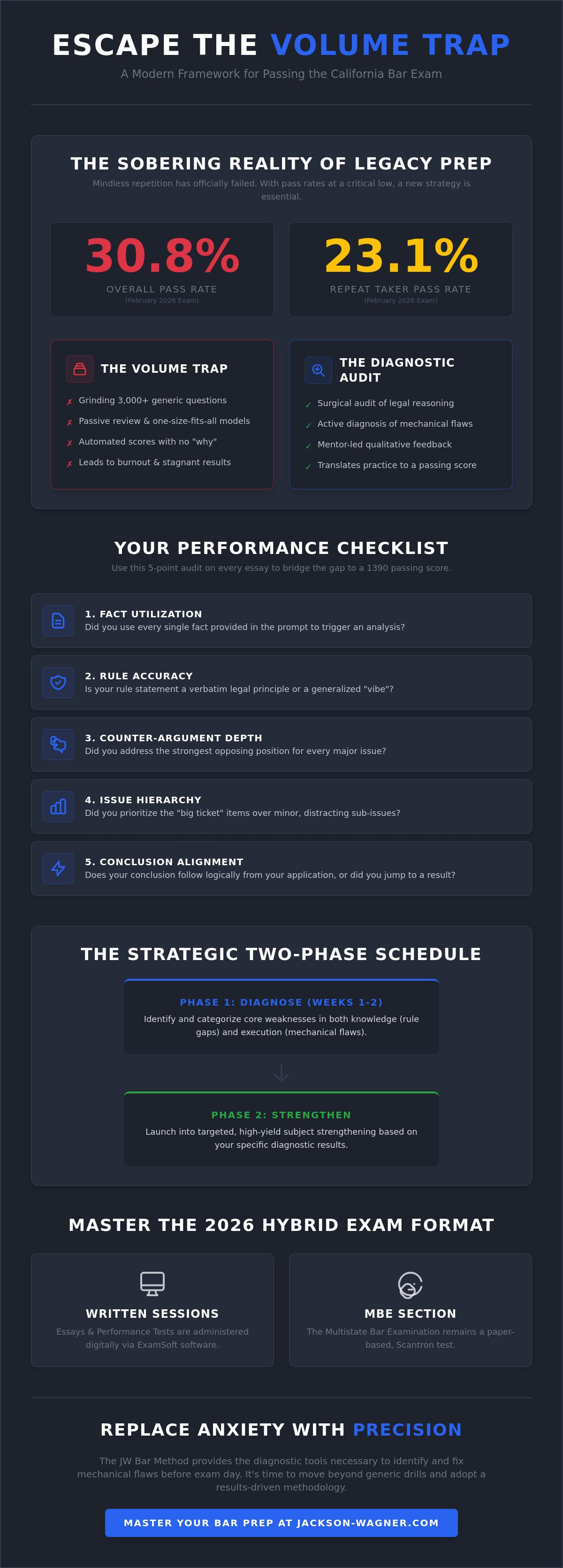
The "Volume Trap" is the most dangerous illusion in bar prep. You might think that grinding through 3,000 multiple-choice questions guarantees a passing score, but for many, it only leads to burnout and stagnant results. With the overall pass rate for the February 2026 exam sitting at a sobering 30.8 percent, it's clear that mindless repetition isn't the answer. You're likely feeling the weight of the unique California essay requirements and the ambiguity of self-grading performance tests. Your california bar exam practice needs to evolve from a marathon of quantity into a surgical audit of your legal reasoning.
We're here to replace that high-stakes anxiety with a structured, modern path to success. You'll master the diagnostic framework needed to audit your performance and pass the California Bar Exam with precision. This guide provides a clear checklist to measure mastery, allowing for an accelerated timeline and the confidence that your practice scores will translate to a passing grade on exam day. We'll break down how to move beyond legacy study habits and adopt a results-driven methodology for the July 2026 exam.
Key Takeaways
- Stop the "Volume Trap" by transitioning from passive review to an active diagnostic framework that prioritizes precision over quantity.
- Implement a 5-point mechanics checklist for every essay to ensure your performance translates into a passing 1390 score.
- Optimize your california bar exam practice by mastering high-yield crossover prompts where multiple legal subjects collide.
- Follow a two-phase strategic schedule that identifies core weaknesses in weeks 1-2 before launching into targeted subject strengthening.
- Discover why a results-oriented, mentor-led approach outpaces legacy prep models by focusing on surgical performance audits.
The Evolution of California Bar Exam Practice in 2026
The 2026 bar exam environment is unforgiving. With the overall pass rate for the February 2026 exam hitting a sobering 30.8 percent, the old "volume-based" strategy has officially failed. Success now requires a pivot toward active diagnostic practice. This means every hour spent on california bar exam practice must identify a specific mechanical flaw in your legal reasoning. Passive review, where you simply read outlines and hope for the best, won't get you to the mandatory 1390 passing threshold. You need a system that audits your performance in real time.
The State Bar of California demands a tier of analytical precision that other jurisdictions simply don't. You aren't just reciting law; you're performing a surgical application of facts to rules under intense pressure. This is where the JW Bar Method modernizes the study process. By focusing on the "how" of the exam, courses like the JW Bar Method Prep - Full Exam California Bar replace generic study with a structured, reliable path to results. It's a disruptive approach for a disruptive era in legal licensure.
The Problem with Legacy Bar Prep Programs
Legacy "big-box" courses are built on a one-size-fits-all model. They rely on generic MBE drills that often ignore the specific nuances of California's "crossover" essays. Automated grading systems provide a score, but they lack the qualitative feedback needed to fix deep-seated writing habits. Candidates in 2026 need more than a percentage. They need to know why their analysis failed to trigger the grader's rubric. This is why an agile approach is the only way to avoid the repeater cycle. For example, repeat taker pass rates for the February 2026 exam dropped to 23.1 percent, proving that doing the same thing twice doesn't work.
The 2026 State Bar Format: What Has Changed
The format remains a grueling two-day experience. For the July 2026 exam, you'll face the written sessions using ExamSoft software, while the MBE section remains a paper-based Scantron test. This hybrid environment forces you to switch mental gears between digital typing and physical bubbling. You must transition from law school theory to bar exam mechanical application. It's no longer about what the law "is" in a vacuum. It's about how you use it under the clock on February 24-25 or July 28-29. Mastery of the digital testing environment is now just as critical as mastery of the law itself.
The Diagnostic Audit: Your Performance Checklist
Stop staring at your raw scores. A 65 on a practice essay or a 70 percent on an MBE set is just a data point; it doesn't tell you how to improve. To bridge the gap to a passing 1390, you must treat your california bar exam practice as a series of surgical audits. High-stakes licensure isn't won by those who do the most questions. It's won by those who understand exactly why they missed the mark. You need to categorize every error as either a failure of knowledge or a failure of execution. If you don't know the rule, that's a study problem. If you knew the rule but didn't see the issue, that's a mechanical problem.
The official California Bar Examination information outlines a rigorous two-day testing structure that leaves zero room for "vague" analysis. You must track your "Issue Spotting" accuracy separately from your "Rule Statement" precision. Use this 5-point checklist for every practice submission to ensure your performance meets the State Bar's standards:
- Fact Utilization: Did you use every single fact provided in the prompt to trigger an analysis?
- Rule Accuracy: Is your rule statement a verbatim legal principle or a generalized "vibe"?
- Counter-Argument Depth: Did you address the strongest opposing position for every major issue?
- Conclusion Alignment: Does your conclusion follow logically from your application, or did you jump to a result?
- Issue Hierarchy: Did you prioritize the "big ticket" items over minor, distracting sub-issues?
For those ready to move beyond generic drills and embrace a more sophisticated approach, the JW Bar Method Prep - Full Exam California Bar from Jackson-Wagner LLC provides the diagnostic tools necessary to identify these mechanical flaws before exam day.
The Essay Mastery Checklist
Mastery is defined by efficiency. You should aim to identify every major and minor issue within the first 15 minutes of an essay block. Your rule statements must be concise enough to leave 40 minutes for deep, fact-heavy application. Conduct an "Application Audit" after every session. If you left a fact on the table, you left points on the table. California graders look for how you manipulate the facts, not just how well you've memorized a supplement.
MBE Mechanical Verification
On the MBE, you have exactly 1.8 minutes per question. You must analyze your "near-miss" questions; these are the items where you narrowed it down to two choices and picked the wrong one. Were you seduced by a "distractor" that was a correct statement of law but irrelevant to the specific facts? Distinguish between substantive law gaps and reading comprehension errors. If you're consistently missing questions in the final 20 minutes of a set, your issue is likely mental endurance rather than legal knowledge.
Mastering the Three Pillars of California Practice
Passing the California Bar isn't about being a generalist. It's about being a specialist in three distinct arenas: the Multistate Bar Examination (MBE), the California Essays, and the Performance Test (PT). Your california bar exam practice must reflect this reality by treating each pillar as a unique skill set that requires a specific mechanical approach. While the MBE tests your ability to navigate nuanced legal traps, the essays demand a surgical application of law to complex fact patterns. The PT acts as the "secret weapon" that often bridges the gap between a near-miss and a passing score of 1390.
Precision in the top seven MBE subjects is non-negotiable. You can't afford to be "familiar" with Civil Procedure or Constitutional Law; you must be precise. This same standard applies to the written portion. The Official California Bar Examination Information highlights that the written section accounts for 50 percent of your total score. Successful candidates recognize that PT skills actually improve their Essay IRAC structure. The ability to extract relevant facts from a library and organize them into a cohesive legal memorandum is exactly what graders look for in a high-scoring essay response.
Strategic Essay Drills
Don't waste every study session writing full-length answers. Use 10-minute "Issue Spotting" bursts to train your brain to see the crossover prompts where subjects like Torts and Remedies collide. Memorizing California-specific distinctions in Evidence and Professional Responsibility is essential for securing those final points. You can use this guide on How to Master the California Bar Examination to refine your roadmap and ensure your drills align with 2026 standards.
The Performance Test (PT) Framework
The 90-minute PT is a sprint, not a marathon. You need a rigid checklist for timing: 45 minutes for research and 45 minutes for drafting. For those enrolled in the JW Bar Method Prep - Attorney’s Exam California Bar, this section is often the biggest hurdle. Experienced lawyers frequently struggle with the PT because it requires a specific "exam" style of writing rather than real-world practice. Mastery involves learning to extract "File" and "Library" data with professional efficiency, ensuring every legal authority cited is applied directly to the client's problem.
The 2026 Strategic Practice Schedule
A generic, ten-week calendar is a legacy relic that fails to account for individual mechanical weaknesses. To secure a 1390 on the 2026 exam, your california bar exam practice must be divided into three distinct, data-driven phases. This isn't about checking boxes on a syllabus; it's about shifting your schedule based on what the diagnostic data tells you. If your Property scores are lagging, your schedule should pivot immediately to address that gap rather than moving blindly to the next subject on a pre-printed list.
Phase 1 involves a two-week Baseline Audit. During this period, you'll identify the core subjects where your "Issue Spotting" and "Rule Statement" precision are failing. Phase 2 spans weeks 3 through 6, focusing on Targeted Strengthening. This is where you drill low-scoring subjects until they meet the required threshold. Finally, Phase 3 consists of High-Stakes Simulation in weeks 7 and 8. You'll replicate the full-length experience of the February 24, 25 or July 28, 29 test dates to build the mental endurance required for two days of intense testing.
For those on the "Accelerated Track," particularly practicing attorneys, the traditional timeline is often impossible. The JW Bar Method Accelerated Prep - Attorney’s Exam California Bar is specifically designed for these high-stakes scenarios. It condenses the diagnostic process into a four-week sprint, focusing on the written sessions and the Performance Test. This approach prioritizes professional efficiency over the "Volume Trap" of legacy programs. If you're ready to bypass the fluff and focus on a results-oriented curriculum, you can enroll in our Accelerated Prep course today.
Weekly Practice Milestones
Success is built on non-negotiable targets. You should aim for a specific MBE volume that allows for deep review, coupled with at least three full-length essay audits per week. Every Sunday, conduct a "Sunday Review" to audit the entire week's diagnostic data. This isn't just a tally of right and wrong; it's a mechanical check of why you missed specific points. Adjust your upcoming week’s schedule based on these real-time performance metrics to ensure you're always working on your highest-yield weaknesses.
Simulation Day Requirements
You can't expect to perform on exam day if you haven't practiced in a replicated environment. This means using the exact 2026 testing software, sitting at a cleared desk, and managing the noise levels of a proctored room. Understanding the digital testing requirements is vital, especially since the written sessions are computer-based while the MBE remains a paper-based Scantron test. Reading Passing the California Bar Exam in 2026 provides the essential foundation for building this simulation schedule and managing the high-pressure anxiety of three-hour testing blocks.
The JW Bar Method Advantage: Precision Over Volume
Legacy bar prep is a bloated industry. It relies on the false promise that more is better, forcing you into a mindless cycle of thousands of questions that don't move the needle on your score. The JW Bar Method is the modern alternative. We replace the stress of high-pressure certification with a structured, pedagogical approach that focuses on surgical precision. This is why our california bar exam practice isn't a volume-based marathon. It's a diagnostic audit designed to ensure you reach the 1390 passing threshold without the burnout of traditional programs. With the February 2026 Attorneys' Examination pass rate at 57.0 percent, the demand for a more efficient, targeted approach has never been higher.
We act as a disruptive mentor in your study process. Unlike legacy courses that offer generic support, we provide results-oriented guidance specifically for the rigorous California standards. We are so certain of our efficacy that we assume the financial risk of your outcome through a binary performance guarantee. Whether you choose the JW Bar Method Prep - Full Exam California Bar or the JW Bar Method Prep - Attorney’s Exam California Bar, you're entering a partnership that prioritizes your success over industry-standard filler. We also offer the JW Bar Method Accelerated Prep - Full California Bar Exam and the JW Bar Method Accelerated Prep - Attorney’s Exam California Bar for those who need to master the curriculum on a compressed timeline.
Why Precision Beats Volume
Our data shows that students who focus on the mechanics of their errors pass at higher rates than those who simply grind through question banks. We've seen candidates succeed by doing fewer, more targeted questions because they spent more time auditing the "why" behind every wrong choice. This approach provides a psychological benefit; it replaces the anxiety of the unknown with a reliable path to success. You can integrate our tools into your daily diagnostic audit to track your progress in real-time, ensuring every hour of california bar exam practice is high-yield.
Final Preparation: The Home Stretch
The 48-hour window before the 2026 exam is about shifting from learning to executing. You've done the work, audited the mechanics, and refined your IRAC structure. Now, it's time to move with absolute confidence. Ensure your laptop is ready for the digital sessions and your mental endurance is peaked for the three-hour blocks on February 24 or July 28. You aren't just taking a test; you're demonstrating professional mastery. Secure your spot in the JW Bar Method Prep Program and take the final step toward your license with a partner that guarantees results.
Execute Your Path to Licensure
Success on the 2026 exam isn't an accident of effort. It's the result of a deliberate, diagnostic strategy. You've learned that volume is a trap and that your california bar exam practice must focus on mechanical audits rather than raw question counts. By mastering the synergy between the Performance Test and crossover essays, you're positioning yourself far above the 30.8 percent overall pass rate seen in early 2026. You now have the framework to audit your performance with surgical precision and reach the mandatory 1390 passing score.
The JW Bar Method provides the modern, mentor-led alternative to legacy prep. We offer specialized programs for both the Full Bar and the Attorney’s Exam, including accelerated options for those on a compressed timeline. Our proprietary methodology is backed by a performance-based financial guarantee; we assume the risk because we're certain of our results. It's time to replace anxiety with a structured, reliable roadmap to success. Master the California Bar with the JW Bar Method today and step into the examination room with absolute confidence. You have the tools to succeed.
Answers for Your 2026 Preparation
How many practice questions should I do per day for the California Bar?
Quality beats quantity every time. You should aim for 30 to 50 high-quality MBE questions per day, provided you spend as much time reviewing the explanations as you did answering them. Your california bar exam practice is about identifying mechanical flaws, not just hitting a daily quota. If you're doing 100 questions but missing the same legal traps, you're reinforcing bad habits instead of building mastery.
Is the California Attorney’s Exam practice different from the Full Bar Exam?
Practicing for the Attorney’s Exam requires a total focus on the written portion because you're exempt from the MBE section. You must master the five essays and the 90-minute Performance Test with surgical precision. Since you don't have multiple-choice questions to buffer your score, your essay analysis must be deeper and your rule statements more accurate. We offer the JW Bar Method Prep - Attorney’s Exam California Bar specifically to address these unique written requirements.
How do I use past California Bar essay questions effectively?
Don't just write out full answers for every session. Use past questions for 15-minute issue-spotting drills to train your brain to see crossover subjects quickly. After spotting the issues, compare your rule statements against the model answers provided by the State Bar. This mechanical audit helps you identify if your rule statements are too vague or if you're missing minor sub-issues that are essential for a high-scoring response.
What is a passing score for the MBE in California in 2026?
The State Bar of California requires a minimum scaled score of 1390 out of 2000 to pass the General Bar Exam. There isn't a separate passing score for the MBE alone; your performance on the multiple-choice section is combined with your written scores. To reach that 1390 threshold, you should aim for a raw MBE score that consistently tracks above 65 to 70 percent in your diagnostic drills.
Can I pass the California Bar Exam while working full-time using an accelerated program?
Yes, you can succeed while working if you abandon the legacy "volume" model for a precision-based approach. The JW Bar Method Accelerated Prep - Full California Bar Exam is designed for professionals who need an efficient, high-yield curriculum. By focusing on your specific diagnostic weaknesses rather than a generic syllabus, you can condense months of study into a targeted four-week sprint without sacrificing the quality of your preparation.
What are the most commonly tested subjects on the California Bar essays?
Professional Responsibility is tested on nearly every exam, making it a non-negotiable subject for mastery. Other high-frequency subjects include Torts, Contracts, Real Property, and Constitutional Law. You should also prepare for crossover prompts where subjects like Community Property and Wills or Evidence and Criminal Law collide. Modern california bar exam practice involves preparing for these integrated scenarios rather than studying subjects in total isolation.
How should I grade my own performance tests during practice?
Grade your PTs based on your ability to follow the "Task Memo" and utilize every fact in the "File." You aren't being tested on outside law; you're being tested on your ability to use the provided "Library" to solve a client's problem. Check your timing to ensure you spent exactly 45 minutes researching and 45 minutes drafting. If you missed a specific document or case in the library, your diagnostic audit should identify why you overlooked it.
Does the JW Bar Method offer a guarantee for the 2026 exam?
Yes, we stand behind our results-oriented methodology with a binary performance guarantee. We act as a partner in your success, assuming the financial risk of your outcome. If you complete the course requirements but don't pass the exam, we provide a money-back guarantee. This commitment distinguishes our student-centric model from legacy providers who offer generic support without any accountability for your final score.


