

The california bar examination isn't a test of how much law you can memorize; it's a high-stakes exercise in strategic information management that most candidates approach with an outdated rulebook. You've likely felt the crushing weight of legacy prep courses that bury you in thousands of pages of static outlines while you try to balance a demanding professional life. It's understandable why pass rate fluctuations, which have historically dipped as low as 13.9%, create such intense anxiety for even the most dedicated students.
We understand that you don't need more information; you need a precise execution plan. This guide provides a comprehensive, step-by-step roadmap to navigating the 2026 requirements, from the February 24 and July 28 administration dates to the 1390 passing score threshold. We'll outline a high-precision study strategy that prioritizes efficiency over exhaustion. You'll gain a clear understanding of the 2026 format, a repeatable method for essay and MBE mastery, and the confidence of a performance guarantee backed by our modern, results-driven methodology.
Key Takeaways
- Identify the specific mechanics of the two-day 2026 gauntlet, including the precise breakdown of the five-essay written portion and the 90-minute Performance Test.
- Develop a diagnostic-driven study timeline that allows you to choose between a 12-week deep dive or a high-intensity accelerated track based on your current performance baseline.
- Discover why traditional "big-box" courses often fail by focusing on the volume of information rather than the strategic issue-spotting required to pass the california bar examination.
- Master the "Triple Threat" of the exam by learning to navigate the MBE trap where selecting the best answer requires more than just basic legal knowledge.
- Secure your professional future with a disruptive, results-oriented methodology that replaces academic stress with a structured path and a binary performance guarantee.
Understanding the 2026 California Bar Examination Structure
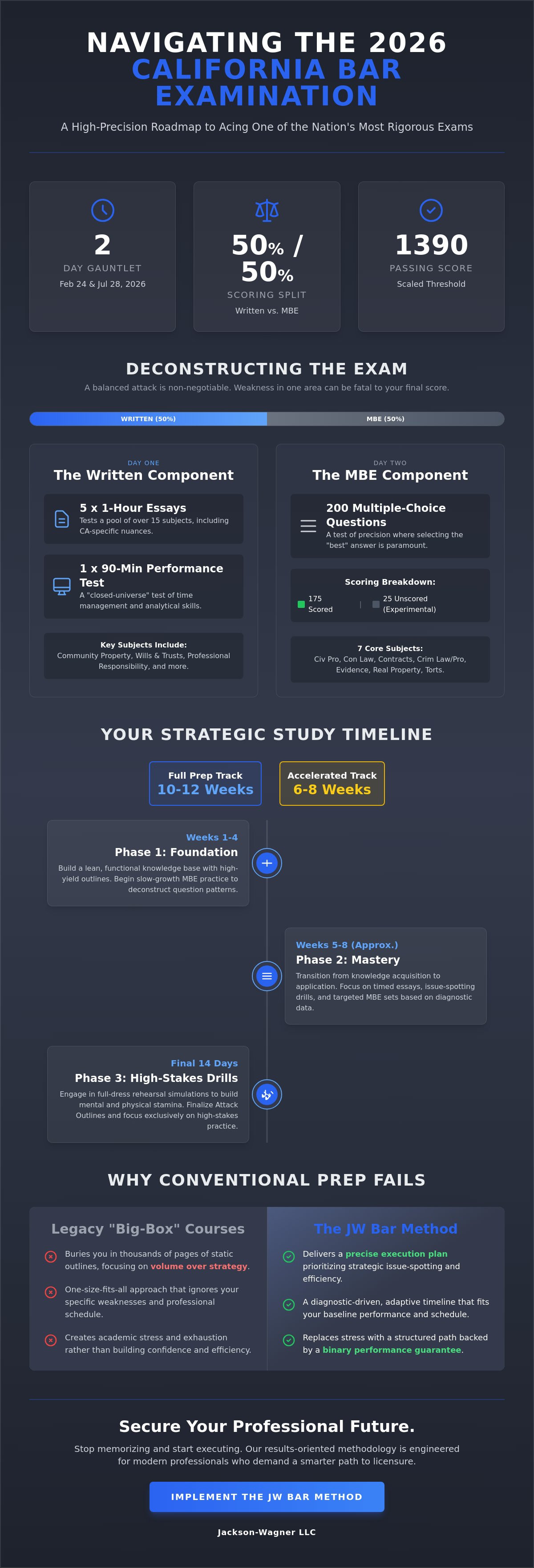
Success starts with a cold, analytical look at the battlefield. The 2026 california bar examination is a two-day professional licensing gauntlet designed to test your mental endurance as much as your legal knowledge. Administered by the State Bar of California, this exam remains one of the most rigorous in the nation. It's a binary outcome. You either meet the 1390 scaled score requirement or you don't. There's no middle ground and no partial credit for effort.
The scoring utilizes a perfect 50/50 split. Your written performance, comprising five essays and one Performance Test, counts for half your grade. The other half comes from the Multistate Bar Examination (MBE). This balance means you can't hide behind a strong multiple-choice score if your writing is weak. You also can't rely solely on your analytical prose to survive a poor MBE showing. You need a high-precision strategy that addresses both disciplines with equal intensity.
The Written Component: Essays and Performance Test
Day one is a marathon of production. You'll tackle five one-hour essays that can pull from a pool of over 15 distinct legal subjects. These include California-specific nuances like Community Property, Wills, and Professional Responsibility. Following the essays, you'll face the 90-minute Performance Test. This is a "closed-universe" exercise where you're given a file and a library. You don't need outside law, but you do need elite time management skills. For 2026, the exam continues its digital delivery via ExamSoft. This requires a reliable laptop and a technical comfort level that legacy prep often ignores.
The Multistate Bar Examination (MBE) Dynamics
Day two shifts to the MBE. This is a 200-question multiple-choice set provided by the NCBE. Seven core subjects form the basis of the test: Civil Procedure, Constitutional Law, Contracts, Criminal Law and Procedure, Evidence, Real Property, and Torts. The execution is brutal. Only 175 questions are scored. The remaining 25 are unscored experimental items used for future testing. The MBE is the "silent killer" for many applicants. It demands a high-precision selection of the "best" answer, often between two legally correct options. It's where fatigue sets in and where a lack of strategic method becomes fatal to your score. You shouldn't just know the law; you must master the test's internal logic.
To navigate this structure, you need a plan that accounts for the 1390 passing score threshold. This isn't just about studying harder. It's about studying smarter by allocating your time based on the high-weight sections that actually move the needle on your final score.
How to Build a Strategic 2026 Study Timeline
A generic calendar is the fastest route to failure. Before you open a single book, you must conduct a baseline diagnostic to identify your specific subject-matter weaknesses. This data-driven start ensures you aren't wasting hours on Torts if your real struggle lies in Community Property. For the 2026 cycle, candidates should allocate 10 to 12 weeks for a full prep track or 6 to 8 weeks if opting for an accelerated path. This decision depends entirely on your professional bandwidth and your initial diagnostic performance. If you're balancing a full-time career, the JW Bar Method Accelerated Prep provides the necessary flexibility without sacrificing depth.
Your schedule must be rigid yet intelligent. Implement a phased approach that moves from Foundations to Mastery and finally to High-Stakes Drills. This progression mirrors the actual California Bar Examination structure, ensuring your brain is conditioned for the specific demands of each day. You should also schedule mandatory simulation days. These aren't just practice sessions; they're full-dress rehearsals designed to build the physical and mental stamina required for the two-day gauntlet. By the final 14-day sprint, your focus should shift exclusively to finalizing Attack Outlines that condense complex rules into executable triggers. These lean documents will be your primary tools during the final hours before the exam.
Phase 1: The Foundation (Weeks 1-4)
The first month is about building a lean, functional knowledge base. You'll focus on substantive law mastery through high-yield outlines rather than bloated legacy texts that offer diminishing returns. This is also when you begin slow-growth MBE practice to deconstruct the NCBE's question patterns without the pressure of a timer. The Foundation Phase is the critical period where rule-memorization transitions to active rule-application. You aren't just reading the law; you're learning how the examiners use it to create traps. Success in this phase requires absolute honesty about what you don't know.
Phase 2: The Execution (Weeks 5-8)
During this stage, the training wheels come off. You must transition to timed essay practice and full-length MBE sets to simulate the pressure of the california bar examination. During this phase, you'll integrate the state of california state bar requirements into your ethics review. Pay special attention to the Professional Responsibility essay. It's tested almost every session and represents a non-negotiable area for point acquisition. High-precision execution here separates those who pass from those who fall just short of the 1390 mark. You're no longer just learning; you're performing under constraints that mimic the July or February environment.
Mastering the Triple Threat: Essays, MBE, and PT
The california bar examination isn't a single hurdle; it's a three-front war. You're fighting the clock, the complexity of the law, and your own mental fatigue. Success requires shifting gears between the creative analysis of essays, the rigid logic of the MBE, and the organizational speed of the Performance Test (PT). You can't just study for "the bar." You have to study for three distinct tests that happen to share a single name. Mastering this "Triple Threat" requires a specific pedagogical execution that legacy prep courses often fail to provide.
Graders in California live and die by the IRAC format. If you deviate from the Issue, Rule, Analysis, Conclusion structure, you're making them work too hard to find your points. Your issue spotting must be surgical. California prompts are intentionally cluttered with "red herrings" designed to waste your time. On the PT side, composure is your greatest asset. We advocate for a disciplined 45/45 split: 45 minutes for deep reading and outlining, followed by 45 minutes of aggressive drafting. This prevents the common disaster of running out of time before reaching the conclusion. Reviewing Official California Bar Examination Information helps you stay grounded in the actual subjects tested, ensuring your practice matches the real-world difficulty of the 2026 cycle.
Tactical Essay Writing for California
Visual organization is your secret weapon. Bar graders spend less than three minutes on each essay, making visual organization paramount. If they can't find your rule statement in five seconds, you've already lost them. Use punchy, descriptive headings to signal your points. Your "Fact-to-Law" ratio must remain skewed toward application. Your analysis should be twice as long as your rule statement. Don't just state that a contract exists; explain which specific words in the prompt created the offer and acceptance. This level of granularity is what earns the 1390 passing score.
MBE Precision and Statistical Analysis
The "MBE Trap" is a psychological hurdle. Many students select an answer because it "looks right," only to realize it's a carefully crafted distractor. These answers are often legally correct in a vacuum but factually inapplicable to the prompt. You need to move beyond 60% accuracy and aim for the 75%+ "Safety Zone" during practice to ensure a cushion for the written day. High-stakes drills build the reflexive speed required to process 200 questions without mental collapse. We don't just teach you the law; we teach you the statistical reality of how questions are built to deceive you.
Why Conventional Prep Fails Modern Professionals
The most common objection we hear is a simple one: "I've already paid for a big-box course." This is often the first step toward a failing score. Legacy models rely on a "Volume Trap" that buries you under 2,000 pages of outlines and hundreds of hours of static video. This isn't preparation; it's an information dump that ignores how your brain actually learns under pressure. You don't need to know every obscure legal nuance to pass the california bar examination. You need to know how to execute the specific rules that the examiners actually test.
Passive learning is the enemy of retention. Watching lectures creates an illusion of competence that vanishes the moment you face a blank essay screen. This "completion bias" makes you feel productive while your actual skill level remains stagnant. Mass-market courses offer zero individualized feedback, leaving you to guess why your analysis isn't hitting the 1390 scaled score threshold. You're just a data point in their database. Our methodology replaces this with active mastery, forcing you to produce work that is critiqued against professional standards from day one.
The Problem with 'One-Size-Fits-All' Pedagogy
A 3L student has 50 hours a week to study. An attorney taking the california bar exam usually has less than half that. Legacy courses ignore this professional reality. They value time spent over skills gained. If you're checking off boxes just to reach a 100% completion rate, you're practicing compliance, not law. This rigid approach also ignores the intense anxiety factor inherent in the California licensure process. You need a mentor who assumes the financial risk of your performance, not a library of outdated PDFs.
Precision Over Volume: The Efficiency Shift
Efficiency is the only way to survive the 2026 cycle. High-yield law focuses on the 20% of rules that earn 80% of the points. This is why the best bar exam preparation service prioritizes output over input. For those working full-time, our Accelerated Prep tracks remove the fluff. You focus on the mechanics of the score rather than the history of the law. Stop drowning in paper and start executing with the precision of a results-driven professional. If you're ready for a disruptive alternative to the big-box failure rate, it's time to explore our binary performance guarantee.
Implementing the JW Bar Method for 2026 Success
The path to licensure shouldn't be a gamble. While legacy providers offer you a library and a prayer, the JW Bar Method provides a disruptive, results-oriented alternative designed for the modern professional. We don't just sell content; we sell a specific, measurable outcome. Our approach is built on the reality that the california bar examination is a technical challenge that requires a technical solution. By stripping away the academic fluff and focusing on the mechanics of the 1390 passing score, we've created a system that prioritizes your time and your sanity.
Trust is earned through skin in the game. This is why we anchor our programs with a Binary Performance Guarantee. It's a simple, powerful promise: if you follow our structured curriculum and don't pass, we assume the financial risk. This level of bold reliability is unique in the industry. It transforms our relationship from a mere transaction into a professional partnership. We're so certain of our pedagogical efficacy that we're willing to back your performance with our own bottom line. You aren't just another student; you're a future colleague whose success is inextricably linked to our own.
We offer specialized tracks to meet your specific licensing needs. The JW Bar Method Prep for the Full Exam is designed for general applicants facing the complete two-day gauntlet. For qualifying practitioners, our Attorney's Exam tracks focus exclusively on the written day, bypassing the MBE entirely. Both versions are available in Standard and Accelerated formats, allowing you to tailor your intensity based on the study timelines we discussed earlier. Whether you're a first-time taker or a seasoned attorney moving to California, our methodology scales to your experience level.
A Mentorship Approach to Licensure
We act as a highly competent mentor rather than a passive resource. Our focus on Structured Learning Environments ensures maximum retention by guiding you through a steady, logical progression of skills. We don't believe in the "Volume Trap" of 2,000-page outlines. Instead, we provide lean, high-yield tools that tell you exactly what to write to satisfy a California grader. Our exclusive focus on this state makes us the definitive authority on the 2026 exam cycle. We understand the nuances that out-of-state providers simply miss.
Next Steps for Your 2026 Candidacy
The clock for the 2026 cycle is already ticking. If you're targeting the July 28 and July 29, 2026 exam dates, your preparation window is narrowing. You must choose between our Standard programs for a deep dive or our Accelerated tracks if you require a high-intensity sprint. Don't leave your career to chance or outdated "big-box" methods that treat you like a number. It's time to embrace a modern evolution in bar prep. Secure your 2026 Bar Prep and our Performance Guarantee here.
Take Command of Your Legal Career
Success on the 2026 california bar examination requires more than just effort; it demands a strategic shift from passive absorption to active, high-precision execution. You've seen how legacy volume-based models fail modern professionals by ignoring the specific mechanics of the 1390 passing score. By prioritizing high-yield law and mastering the "Triple Threat" of essays, the MBE, and the Performance Test, you can navigate this two-day gauntlet with absolute certainty. Our specialized California-only curriculum and accelerated tracks are designed specifically for the modern learner who requires efficiency without compromise.
You don't have to carry the risk of licensure alone. With our exclusive Binary Performance Guarantee, we stand as a partner in your success, ensuring your investment is protected by our own commitment to your results. It's time to replace the anxiety of traditional prep with a structured, modern path that values your time and your professional future. Master the California Bar with the JW Bar Method Guarantee today. You have the talent and the drive; we provide the roadmap to ensure you reach the finish line.
Frequently Asked Questions
How much does the California Bar Examination cost in 2026?
General applicants pay $878.00, while attorney applicants pay $1,650.00 for the 2026 cycle. You should also account for the $153.00 laptop fee and potential late fees of $50.00 to $250.00 if you miss the initial filing deadlines. These costs are non-negotiable and set by the State Bar to cover administrative and digital testing expenses. Planning for these fees early ensures your application process remains smooth and professional.
Can I take the California Bar Exam if I am already an attorney in another state?
Yes, you must take the california bar examination because California does not offer reciprocity with any other jurisdiction. Even seasoned practitioners from other states are required to pass the exam to secure licensure here. If you've been in good standing for at least four years, you may qualify for the shorter Attorney's Exam track. This allows you to bypass the MBE and focus exclusively on the written portions of the test.
What is the passing score for the California Bar Exam in 2026?
The minimum passing score is a scaled 1390 out of 2000 possible points. This score is derived from a 50/50 weighting between your written performance and your MBE results. Achieving this mark requires high-precision execution across both days of the 2026 gauntlet. Your strategy must prioritize both sections equally to ensure you reach this threshold without falling into the "volume trap" of legacy prep courses.
How many times can you take the California Bar Exam?
California does not currently limit the number of times an applicant can sit for the bar exam. While there is no cap on attempts, each failure requires a full re-application and payment of all relevant fees. Most successful candidates focus on a disruptive, results-oriented strategy to ensure they pass within their first or second attempt. Repeatedly taking the exam without changing your methodology is a recipe for burnout and financial drain.
Is the 2026 California Bar Exam online or in-person?
The 2026 examination is administered electronically using ExamSoft software, typically at designated testing centers. While the delivery is digital, you're still required to attend the physical location on the scheduled Tuesday and Wednesday dates. This modern format ensures a standardized environment for all candidates. You'll need to ensure your laptop meets all technical requirements and that you've paid the mandatory $153.00 laptop fee during registration.
What happens if I fail the California Bar Exam on my first try?
If you don't pass on your first try, you'll receive a detailed score report to help identify your specific weaknesses. You can then re-register for the next available session, either in February or July. We recommend using this data to pivot toward a more structured, mentorship-based prep method that addresses the gaps in your previous performance. Failing once is a setback, but it's also a data-gathering opportunity for a more precise second attempt.
What is the difference between the Full Bar Exam and the Attorney's Exam?
The Full Bar Exam is a two-day test including essays, a Performance Test, and the MBE, whereas the Attorney's Exam consists only of the first day's written components. To qualify for the Attorney's Exam, you must be an active member in good standing in another U.S. jurisdiction for at least four years. This shorter path recognizes your professional experience by removing the multiple-choice requirement. It's a specialized track that requires a different, writing-heavy study focus.
How long are the results valid for the California Bar Examination?
Your passing score on the california bar examination is generally valid for five years for the purpose of admission to the State Bar. You must complete all other requirements, such as the MPRE and moral character determination, within this window. If you don't secure admission within five years, you may be required to retake the examination. This timeline ensures that your legal knowledge remains current and professional before you officially enter practice.


