

The 2026 California Bar essays aren't a test of your memory; they're a high-stakes assessment of your ability to integrate complex legal theories under extreme pressure. You already know that memorizing thousands of rules won't save you when the clock starts ticking and a "surprise" crossover topic appears on your screen. The crushing weight of information overload across 13 distinct subjects, combined with the rigid one-hour time limit per essay, is enough to paralyze even the most dedicated students. You feel the pressure of the February 24 or July 28 exam dates approaching, and you need a plan that actually works.
This guide will strip away the noise and provide you with a definitive strategic roadmap to master the california bar exam essay topics 2026. We'll replace your anxiety with a structured, modern path to success that prioritizes results over legacy study habits. You'll gain a clear understanding of the 13 essential subjects, identify the high-frequency crossover patterns you must recognize, and learn a precise methodology for high-scoring writing. We'll move from the high-level strategy of subject integration to the granular details of the 1390 scaled score requirement, ensuring you're prepared for whatever the examiners throw your way.
Key Takeaways
- Identify the 13 essential california bar exam essay topics 2026 and learn to distinguish between California-specific rules and general law.
- Master high-frequency crossover patterns to ensure you aren't blindsided by questions that integrate multiple subjects into a single prompt.
- Overcome the 60-minute time constraint by understanding the Day 1 exam structure and the strategic flow of the essay portion.
- Shift your focus from rote memorization to high-scoring application through the IRAC method, where the analysis section accounts for 60% of your total points.
- Streamline your study process by utilizing a surgical methodology that replaces traditional 600-page outlines with targeted, high-impact preparation.
The Structure of the 2026 California Bar Exam Essay Portion
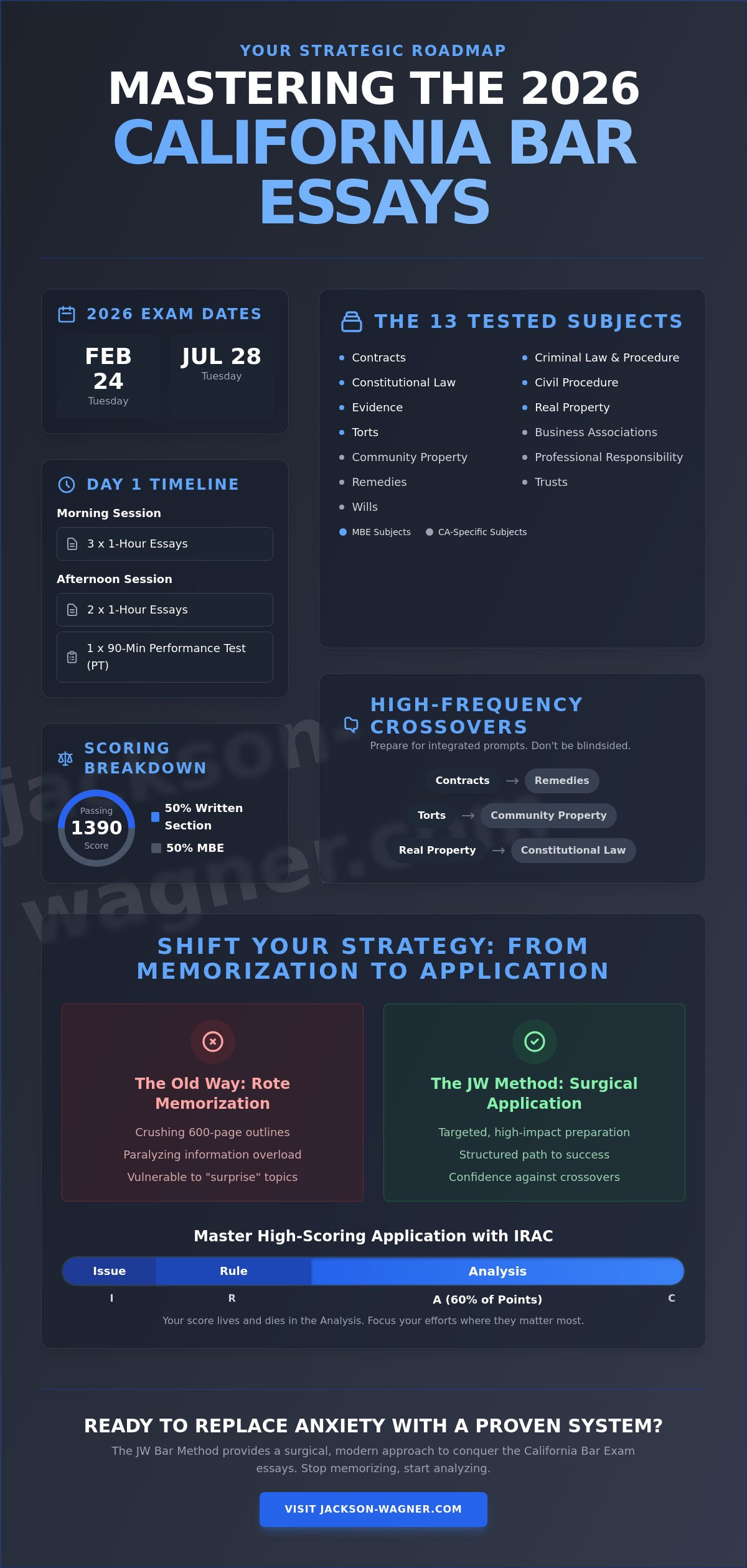
Success on the California Bar Exam requires more than just legal knowledge; it demands a mastery of the clock. On Tuesday, February 24, or Tuesday, July 28, 2026, you'll face the written portion of the exam. This day is a marathon of analytical precision. The morning session consists of three one-hour essays. After a lunch break, you'll return for two additional one-hour essays and one 90-minute Performance Test (PT). The State Bar of California weights the written section as 50% of your total score, making it equal in importance to the Multistate Bar Examination (MBE). To reach the 1390 passing threshold, your execution during these six and a half hours of testing must be flawless.
Time management is the silent killer of bar scores. The clock is relentless. When you're deep in the weeds of complex california bar exam essay topics 2026, it's easy to lose track of the minutes. Don't lose focus. Every second you spend over the 60-minute mark on one essay is a second stolen from your ability to spot issues in the next. You don't have the luxury of "perfect" writing. Precision is everything. You need a structured, modern approach that allows you to identify issues, state rules, and apply facts with surgical speed. This isn't about being a great writer; it's about being a high-scoring analyst.
The Written Component Breakdown
The five essay questions are designed to test both your substantive legal knowledge and your ability to perform under pressure. While the essays focus on the 13 authorized subjects, the PT is a closed-universe simulation of a real-world legal task. You'll receive a file and a library, and you must produce a specific legal document, such as a memo or a brief, within 90 minutes. This portion of the exam doesn't require outside knowledge but demands exceptional organization and reading comprehension. Your goal is to accumulate enough raw points across these six tasks to meet the scaled score requirements.
2026 Exam Logistics and Expectations
The 2026 exam remains an in-person, laptop-based event administered via ExamSoft. Expect to pay a $153 laptop fee to use your own device. It's vital to internalize the "Scope of the Exam" document provided by the Bar. It outlines exactly what's fair game. However, don't let "wildcard" topics derail your confidence. Historical frequency is a guide, not a guarantee. Stay agile. A disruptive prep strategy prepares you for the unexpected by focusing on core principles that apply across multiple california bar exam essay topics 2026. By mastering the structure first, you ensure that your legal knowledge isn't wasted by a lack of time or poor planning.
The 13 Tested Subjects for the 2026 Essay Portion
The State Bar of California authorizes 13 distinct subjects for the essay portion of the exam. You must master every one of them to survive Day 1. These aren't just labels; they represent specific analytical frameworks that the examiners use to measure your legal competence. You'll face a mix of Multistate subjects and California-specific law. Knowing when to apply the California Evidence Code instead of the Federal Rules of Evidence is the difference between a passing score and a failing one. Precision in your rule statements is your greatest weapon against the 1390 passing threshold.
Your preparation must account for the fact that seven of these subjects also appear on the MBE. However, their appearance as california bar exam essay topics 2026 requires a much higher level of issue spotting and nuanced analysis. You aren't just picking the "best" answer; you're building a logical argument from the ground up.
Core Substantive Law Subjects
Contracts, Torts, and Real Property form the foundation of the written exam. While these are also tested on the MBE, you'll often see them paired with other subjects in complex crossover prompts. Criminal Law and Procedure essays frequently focus on the intricacies of the Fourth, Fifth, and Sixth Amendments. Don't get caught in the trap of generic analysis. Constitutional Law prompts often demand a sophisticated understanding of the First Amendment or the Equal Protection Clause. Each of these subjects requires you to move beyond basic definitions and into deep, fact-heavy application.
California-Specific Subjects
This is where legacy prep programs often fail. You must be precise with California law. Community Property requires you to characterize assets as separate, community, or quasi-community within the specific California context. Wills and Succession aren't just about general principles; they require knowledge of the California Probate Code. Business Associations encompasses Corporations, Partnerships, and Agency. To streamline this process, many students find that modern prep methods are more effective than drowning in outdated, 600-page outlines.
The "Must-Know" Subjects: Professional Responsibility and Remedies
Professional Responsibility is the only subject you can bet on appearing in every single exam cycle. It's often tested as a standalone essay or a significant crossover. You must master the distinctions between the ABA Model Rules and the California Rules of Professional Conduct. Remedies is what we call a "parasitic" subject. It rarely stands alone. Instead, it attaches itself to Torts or Contracts. If you miss the Remedies issue in a Breach of Contract prompt, you've already lost a significant portion of the available points. Mastering these california bar exam essay topics 2026 is not about rote memorization; it's about knowing how the Bar combines them to test your legal mind.
Beyond the List: Identifying High-Frequency Crossover Topics
A crossover essay is the State Bar’s most effective tool for weeding out students who rely on rote memorization. It isn't enough to know the rules of Torts in a vacuum. You must understand how those rules collide with Remedies when a plaintiff seeks an injunction instead of just money damages. These integrated prompts force you to pivot between distinct legal frameworks within the same 60-minute window. Mastering the california bar exam essay topics 2026 means developing a radar for these collisions before they derail your analysis. The examiners use these patterns to test your depth of understanding; they want to see if you can spot the subtle issues that only appear when two areas of law intersect.
Structure is your lifeline during a crossover. When multiple subjects are triggered, your essay must remain organized and surgical. You don't have time for rambling transitions. You need a methodology that allows you to address the primary subject while seamlessly weaving in the secondary issues. This approach ensures you capture the maximum number of points without sacrificing the clarity of your analysis. By anticipating these pairings, you move from a defensive posture to an offensive one.
The Most Common Subject Pairings
- Torts + Remedies: This is a staple of the exam. You'll first evaluate liability for a specific harm, such as negligence or strict liability, then immediately transition into whether legal damages or equitable relief, like a preliminary injunction, is appropriate.
- Contracts + Remedies: Expect to analyze a commercial dispute where a breach is clear, but the remedy is contested. You'll need to weigh expectation damages against the possibility of specific performance.
- Business Associations + Professional Responsibility: This combination tests your ability to identify the "true" client. Ethical duties often shift when you're representing a corporation versus its individual directors.
Advanced Crossover Patterns to Watch
As you refine your strategy for the california bar exam essay topics 2026, stay alert for more complex integrations. In Community Property and Wills crossovers, the death of a spouse often triggers a complex re-characterization of assets that determines how the estate is distributed. Constitutional Law and Real Property frequently collide in "Takings" essays, where you must analyze zoning regulations through the lens of the Fifth Amendment. Finally, Evidence and Civil Procedure pairings often focus on the tension between discovery rules and what is actually admissible at trial. These advanced patterns are where high-scoring students separate themselves from the rest of the pack. You don't just need to know the law; you need to know how it fits together.
2026 Essay Preparation: Moving from Memorization to Application
Rote memorization is a trap that leads to failure. While legacy prep programs encourage you to swallow 600-page outlines, the 2026 California Bar Exam demands a more sophisticated, analytical approach. You aren't being tested on your ability to recite law; you're being tested on your ability to use it. The IRAC method (Issue, Rule, Analysis, Conclusion) remains the non-negotiable standard for success. However, most students spend too much time on the "Rule" and not enough on the "Analysis." In the eyes of a grader, the analysis section is where 60% of your points are earned. If you can't apply the facts to the law with surgical precision, your rule statement won't save you.
Developing issue spotting as a reflex is your primary goal. When you look at a fact pattern involving california bar exam essay topics 2026, the legal issues should jump off the page. This isn't a conscious effort; it's a trained response. You must reach a level of familiarity where "distractor" facts are immediately filtered out, leaving only the substantive triggers that lead to points. Success is about efficiency, not exhaustion.
Strategic Outlining for 60-Minute Essays
The 15-minute rule is your most powerful tool. You must spend the first quarter of your hour reading the prompt, mapping the issues, and creating a skeletal outline before you type a single sentence. This prevents the "panic-writing" that leads to disorganized, low-scoring answers. Use clear, bold headings to guide the grader through your logical progression. A well-organized essay signals competence before the grader even reads your first paragraph. When you encounter distractor facts, acknowledge them briefly if necessary, but don't let them derail your 60-minute timeline.
Precision in Rule Statements
The JW Bar Method approach to rule memorization prioritizes high-impact, condensed rule blocks over exhaustive, low-yield outlines. You don't need every nuance; you need the buzzwords that graders are trained to look for. If you forget the exact wording of a black letter rule, don't freeze. Pivot immediately. State a logical version of the rule and proceed to a deep, fact-heavy analysis. The Bar rewards the ability to reason through a problem even more than a perfect recitation of the California Probate Code. To master this level of precision and move beyond the stress of information overload, enroll in the JW Bar Method Accelerated Prep today. We replace the anxiety of the unknown with a structured, modern methodology designed for the results-driven learner.
Mastering Essay Precision with the JW Bar Method
Legacy bar prep is a relic of a slower era. It buries you under 600-page outlines and hundreds of hours of generic video lectures that treat every student like a number. The JW Bar Method is different. We identify the most likely california bar exam essay topics 2026 with surgical precision, focusing only on the high-yield rules and crossover patterns that actually appear on the exam. You don't have time to waste on low-probability nuances. Our approach is designed for the results-driven candidate who demands efficiency and a structured path to success. We've stripped away the noise to ensure your study hours translate directly into points on Day 1.
The "Accelerated Prep" advantage means you'll pass the bar without drowning in outdated materials. We replace volume with precision. Instead of memorizing every possible variation of a rule, you'll master the "buzzwords" and analytical frameworks that graders are trained to reward. We're so certain of our methodology that we assume the financial risk of your outcome. Our binary performance guarantee serves as a powerful anchor for your preparation; we're your partners in this process, and our success is tied directly to yours. We empower you to replace the stress of high-pressure certification with a modern, reliable roadmap.
Success also requires a clear understanding of the administrative landscape. Integrating your essay practice with an understanding of how to navigate the state bar of california ensures you're prepared for the logistics of licensure as well as the exam itself. From the 1390 scaled score requirement to the specific laptop fees, we provide the clarity you need to stay focused on your performance.
The JW Bar Method Advantage
- Strategic Focus: We prioritize the 13 authorized subjects based on historical frequency and predicted 2026 trends, ensuring you're never blindsided by a "wildcard" prompt.
- Pressure-Tested Drills: Our curriculum includes structured drills that simulate the exact one-hour time limit you'll face on Tuesday, February 24, or Tuesday, July 28, 2026.
- Expert Grading: You'll receive feedback that mirrors the actual standards of the State Bar of California, focusing on the analysis section where 60% of your points are earned.
Next Steps for 2026 Candidates
Your path to licensure depends on your specific goals. Candidates can choose between our Full Exam and Attorney’s Exam tracks, both of which utilize the same high-impact methodology. Don't wait for the application window to open in October or March to begin your journey. You can start your preparation today by reviewing our definitive strategic guide for 2026 success. This is the moment to move from information overload to professional empowerment. Secure your spot in the JW Bar Method Prep Program and take control of your future with a methodology built for the modern legal professional.
Secure Your Future on the 2026 California Bar Exam
The path to licensure is paved with analytical precision, not just volume. You've seen how the 13 authorized subjects and complex crossover patterns define the written portion of the exam. Success requires a shift from passive memorization to active, high-stakes application. By focusing on the analysis section and mastering the 60-minute time limit, you position yourself to meet the 1390 passing threshold. This strategic approach ensures that you aren't just another candidate; you're a prepared professional ready to tackle the california bar exam essay topics 2026 with absolute confidence.
Our proprietary JW Bar Method offers a precision-focused pedagogy designed for high-achievers who value efficiency. Through our Accelerated Prep, we've stripped away the legacy bloat of 600-page outlines to focus on what matters. We're so confident in our results-driven curriculum that we offer a bold Performance Guarantee; we assume the risk of your success. Stop managing your anxiety and start managing your results. Join the JW Bar Method and Pass the 2026 California Bar Exam. You have the talent and the drive; we provide the structured roadmap to ensure you cross the finish line.
Frequently Asked Questions
What are the most common essay topics on the California Bar Exam?
Professional Responsibility is the most frequently tested subject on the exam, appearing in nearly every cycle. Other high-frequency california bar exam essay topics 2026 include Torts, Contracts, and Civil Procedure. These subjects are staples because they allow examiners to test a broad range of foundational legal principles and complex analytical skills.
How many essays are on the California Bar Exam 2026?
The 2026 exam features five distinct one-hour essay questions. You'll complete these on the first day of the examination. The schedule includes three essays in the morning session, followed by two essays and one 90-minute Performance Test in the afternoon session.
Is Professional Responsibility always on the California Bar Exam?
Professional Responsibility is tested on almost every administration of the California Bar Exam. It frequently appears as a standalone essay, but it's also a common "crossover" subject paired with Business Associations or Evidence. You must be prepared to apply both the ABA Model Rules and the California Rules of Professional Conduct.
Can I pass the California Bar Exam if I fail one essay?
You can still pass the exam even if you receive a low score on one essay. Licensure is determined by a total scaled score of 1390, which combines your performance on the written portion and the MBE. High scores in other sections can effectively offset a single weak performance in the essay portion.
How long should each essay be on the California Bar Exam?
There's no mandatory word count for a passing essay. Your goal is to provide a complete IRAC analysis for every issue spotted within the 60-minute time limit. Focus on the quality and depth of your analysis rather than simply trying to reach a specific page length or word total.
What is a crossover essay on the California Bar?
A crossover essay is a single question that incorporates issues from two or more of the 13 tested subjects. For example, a fact pattern might require you to analyze a breach of contract and then determine the appropriate remedies. These questions test your ability to navigate multiple legal frameworks simultaneously.
How does the State Bar of California grade the essays?
Graders use a raw scale, typically between 40 and 100, to evaluate your issue spotting and analytical depth. These raw scores are then converted to a scaled score to account for variations in exam difficulty. Graders specifically look for a clear IRAC structure and a robust analysis section that uses the provided facts.
What is the best way to study for California Bar essays?
The most effective method is timed practice using actual past exam questions. This builds the "muscle memory" needed to identify california bar exam essay topics 2026 quickly and apply rules under pressure. Shift your focus from passive reading of outlines to active writing and self-grading against high-scoring sample answers.


