

Your study group is not a social club; it is a tactical unit designed to stress-test your legal knowledge under the weight of the nation's most rigorous exam. Most candidates treat these sessions as a casual way to stave off the crushing isolation of prep, but that is a costly mistake. When you leverage specific bar exam study group benefits correctly, you stop being a passive consumer and start behaving like a practitioner. You likely already feel the anxiety of the California Bar's unique rigor and the burnout that comes from explaining complex legal concepts to an empty room. It's a high-stakes environment where a lack of accountability can be fatal to your professional goals.
This article shows you how a structured group transforms the grueling prep process into a tactical advantage for passing the California Bar Exam. We'll explore how the JW Bar Method Prep - Full Exam California Bar curriculum provides the framework for faster rule mastery and clearer essay structures. You'll discover how to build emotional resilience and turn your peers into force multipliers. We're moving past legacy study habits and into a modern, results-driven methodology that ensures you don't just survive the process, but dominate it.
Key Takeaways
- Shift your mindset from social support to tactical execution by forming a collaborative unit focused on rule application and collective accountability.
- Utilize the 'Protege Effect' to deepen your understanding, recognizing that teaching legal concepts is the most efficient way to achieve deep mastery.
- Maximize the bar exam study group benefits by identifying the specific moments when collaborative study outpaces solo effort and prevents the spread of exam-related anxiety.
- Implement a high-performance framework by selecting members based on complementary competence and adhering to a rigorous, zero-fluff meeting agenda.
- Align your group with the JW Bar Method Prep - Full Exam California Bar to provide the structured curriculum needed to transform peer discussion into a reliable path to licensure.
The Strategic Value of Bar Exam Study Groups
The bar exam is widely regarded as one of the most challenging professional licensing examinations in the country. To conquer it, you must move beyond the "solo student" mindset. A tactical study group isn't a coffee date; it's a high-performance collaborative unit. These groups focus exclusively on rule mastery and the surgical application of legal principles. This is your strategic force multiplier. By shifting from isolation to collective accountability, you replace high-stakes anxiety with structured, measurable execution. The bar exam demands more than simple memorization; it requires the ability to explain and defend legal positions under extreme pressure. You need a system that challenges your assumptions daily.
Combating the 'Bar Exam Bubble'
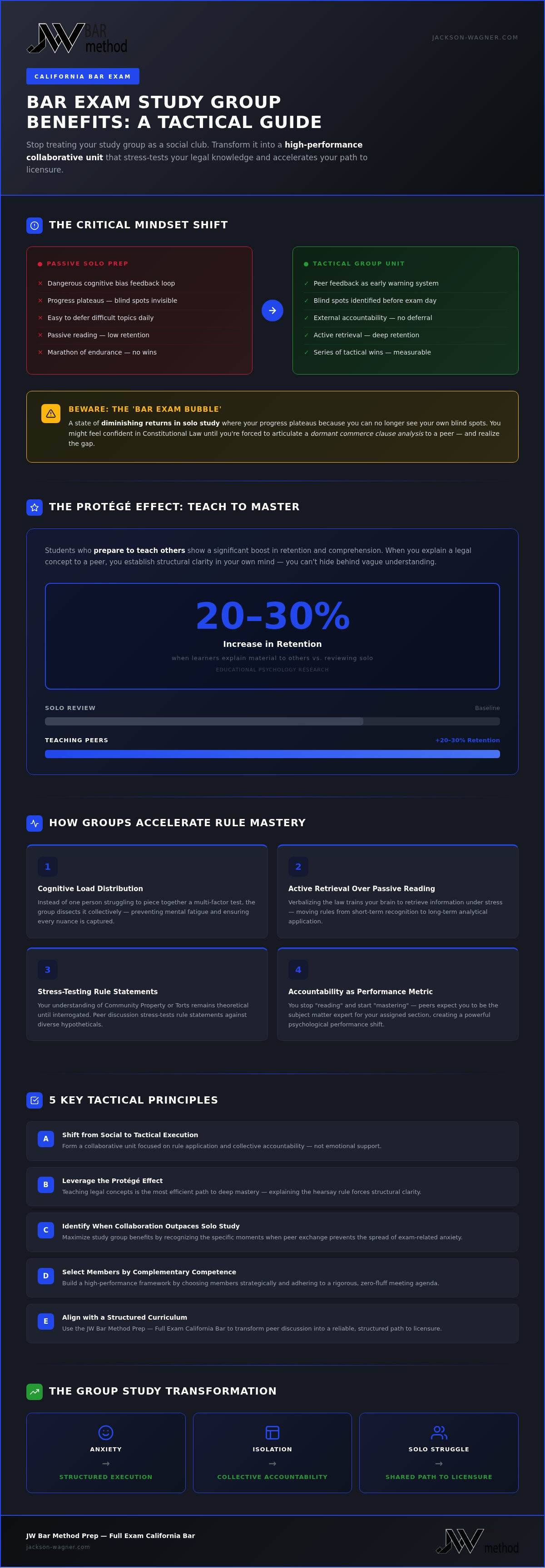
Solo preparation often leads to a dangerous feedback loop of cognitive biases. The 'Bar Exam Bubble' is a state of diminishing returns in solo study where your progress plateaus because you can no longer see your own blind spots. You might feel confident in your knowledge of Constitutional Law until you're forced to articulate a dormant commerce clause analysis to a peer. This is where bar exam study group benefits become undeniable. Peer feedback serves as an early warning system, identifying weak areas and conceptual errors before they manifest as failed essay scores on exam day.
Accountability as a Performance Metric
You'll find that external pressure is a powerful motivator. In a solo environment, it's easy to push a difficult topic to the next day, but in a tactical group, your peers expect you to be the subject matter expert for your assigned section. This creates a psychological shift: you stop "reading" and start "mastering" the material. You must be ready to explain the nuances of the law to others who will challenge your reasoning. Jackson-Wagner LLC provides the rigorous structure these groups need to stay on track. By following a curriculum designed for precision, your group sessions become high-intensity training drills. Explaining a concept to a peer is the fastest way to cement that rule in your own long-term memory. This level of accountability transforms the prep process from a marathon of endurance into a series of tactical wins. It turns a solitary struggle into a shared, reliable path toward professional licensure.
Cognitive Science: How Groups Accelerate Rule Mastery
Success on the California Bar Exam isn't about how many hours you sit in front of a book; it's about how effectively your brain encodes that information. Passive reading is the enemy of retention. To achieve true rule mastery, you must engage in active retrieval. This is where bar exam study group benefits transition from social convenience to cognitive necessity. By distributing complex rule synthesis across multiple minds, you leverage cognitive load theory to prevent mental fatigue. Instead of one person struggling to piece together a multi-factor test, the group dissects it collectively. This ensures every nuance is captured and understood before you move to the next topic.
Verbalizing the law is the only way to build the muscle memory required for the high-pressure essay portion of the exam. When you speak a rule statement aloud, you're training your brain to retrieve that information under stress. This process moves the law from your short-term recognition to your long-term analytical application. It's a structured approach that mirrors the actual work of a practitioner, ensuring you're ready to perform when the clock is running. If you want to maximize this efficiency, the JW Bar Method Prep - Full Exam California Bar provides the perfect curriculum to facilitate these high-level peer exchanges.
The Protege Effect in Bar Prep
Teaching a concept is the fastest way to learn it. This phenomenon, known as the Protege Effect, suggests that students who prepare to teach others show a significant boost in retention and comprehension. When you explain the hearsay rule or the intricacies of the dormant commerce clause to a peer, you're forced to establish structural clarity in your own mind. You can't hide behind vague understanding when someone is asking you for a clear definition. This act of teaching identifies hidden gaps in your knowledge that passive reading simply ignores. Research in educational psychology often points to a 20 to 30 percent increase in retention when learners explain material to others rather than just reviewing it solo.
Stress-Testing Your Rule Statements
Your understanding of California Community Property or Torts remains theoretical until it's interrogated. A high-performing study group uses discussion to stress-test rule statements against diverse hypotheticals. Hearing different perspectives on the same fact pattern prevents the tunnel vision that often plagues solo studiers. You move away from rote memorization and toward the analytical application that California graders demand. By debating how a specific rule applies to a complex scenario, you develop the agility needed to handle the curveball questions that define the California Bar. This collective interrogation ensures your knowledge is not just broad, but exceptionally deep.
Solo Prep vs. Study Groups: A Strategic Analysis
Strategic preparation requires a clear understanding of the 'Time-Value' of your effort. Solo study is the foundation of individual competence, while group work serves as the ultimate diagnostic tool. You must recognize that bar exam study group benefits only materialize when the group is used for synthesis rather than initial learning. If you use a group to learn a rule for the first time, you are wasting the collective's time. Instead, use the group to stress-test your existing knowledge. This approach is particularly vital for those enrolled in the JW Bar Method Prep - Attorney’s Exam California Bar, where professional time management is a critical factor in your success.
You must also guard against the 'Anxiety Contagion.' This occurs when a group lacks a structured agenda and devolves into a shared panic session about the exam's difficulty. High-performing candidates use group debate to sharpen their analytical edges, not to vent. They treat every meeting as a professional briefing. This ensures the group remains a source of empowerment rather than a drain on your emotional resilience. By maintaining this professional boundary, you preserve the tactical focus necessary for high-stakes licensure.
When to Study Alone
Deep work is non-negotiable. This phase is for your initial encounter with the california bar exam syllabus and the grueling memorization of black-letter law. You need periods of absolute silence to internalize complex rules and reflect on their nuances. Without this individual reflection, group interaction becomes shallow and unproductive. Solo prep is where you build the raw material that the group will later refine. You don't want to be the member who slows down the unit because you haven't done the foundational work.
When to Pivot to the Group
Once you have a functional grasp of the rules, you must simulate the high-pressure environment of the state of california state bar exam. This is the time for issue-spotting drills and practice essay grading. Comparing your work against model answers and JW Bar Method templates within a group setting reveals patterns of error you would never spot alone. This is where the most significant bar exam study group benefits are realized. This pivot ensures that your rule mastery translates into the specific performance metrics the California Bar requires. It turns your preparation from a theoretical exercise into a tactical advantage.
Building a High-Performance Study Group: 5 Tactical Steps
Most students fail to realize that their choice of study partners is a professional decision, not a social one. To unlock the full bar exam study group benefits, you must build a unit that functions like a high-stakes litigation team. This means prioritizing competence over comfort. If your group spends the first twenty minutes discussing their weekend or their fears, you're losing valuable cognitive ground. A tactical study group requires a structure that prevents time-wasting and maximizes rule application. You need a system that ensures every member is contributing to the collective's mastery. To achieve this, follow these five tactical steps:
- Select for Complementary Competence: Partner with those who excel in subjects where you struggle.
- Establish a Zero-Fluff Agenda: Every minute of the meeting must have a pre-defined purpose.
- Rotate the Lead Instructor Role: Force every member to teach a topic to trigger the Protege Effect.
- Implement a Strict No-Anxiety Policy: Ban "venting" sessions to maintain a professional, results-oriented focus.
- Use Standardized Materials: Ensure everyone is speaking the same legal language by using a singular, high-precision curriculum.
The Selection Process: Professionalism over Friendship
Legacy advice suggests studying with law school friends, but friends are often the least effective partners. They're less likely to hold you accountable and more likely to indulge in distractions. You should look for partners who bring a "Value Check" to the table. If you are a master of Torts but struggle with Evidence, find an Evidence expert. Set clear, non-negotiable expectations for attendance and preparation from day one. If a member arrives unprepared, they aren't just hurting themselves; they're degrading the performance of the entire unit. Professionalism is the only way to ensure the group remains a force multiplier rather than a social crutch.
Structuring the Meeting for Maximum ROI
Adopt the 60/30/10 Rule to maintain high intensity throughout your sessions. Spend 60 minutes on high-stakes testing or issue-spotting, 30 minutes on collaborative dissection of those answers, and 10 minutes planning the next tactical objective. You should use the best bar exam preparation service materials as your group's anchor to ensure everyone is operating from the same high-precision rule statements. Ending every session with a "Mastery Check" on a specific California topic ensures that no one leaves the room with lingering confusion. If you're ready to lead your group with a curriculum designed for absolute precision, explore the JW Bar Method Prep - Full Exam California Bar today.
Scaling Success with the JW Bar Method
A study group is only as effective as the curriculum it follows. Without a professional framework, even the most dedicated students risk recycling ignorance and reinforcing conceptual errors. The JW Bar Method provides the rigid structure that collaborative units often lack, ensuring that every discussion is anchored in surgical precision rather than peer-led guesswork. Our methodology rejects the legacy approach of sheer volume in favor of mastery over the most high-yield rules. By aligning your group with a results-oriented mentor, you replace the high-stakes anxiety of the unknown with a steady, structured progression toward licensure. This is how you maximize bar exam study group benefits while maintaining the intensity required for the California Bar.
Using our accelerated prep tracks allows you to stay ahead of your group's curve, positioning you as a high-value contributor during synthesis sessions. When you've already mastered the core principles through our streamlined modules, you can lead the group through complex issue-spotting drills with total confidence. This proactive approach ensures that your collaborative time is spent on high-level analysis rather than basic rule acquisition. It's a modern, student-centric strategy that positions our brand as a partner in your success, giving you the security to focus entirely on execution.
Integrating Structured Prep with Collaborative Study
The JW Bar Method Prep - Full Exam California Bar serves as your tactical blueprint for the entire study period. Most successful groups operate on a 10-week timeline, and our curriculum is designed to fit perfectly within that window. By using expert-vetted content, your group avoids the common pitfall of debating incorrect rule statements found in legacy outlines. You'll spend your testing blocks working with materials that mirror the rigor of the actual exam. This integration ensures that your group's output is consistently high-quality, turning every meeting into a measurable step toward your professional goals.
The Final Push: Group Drills for the California Bar
As you enter the final weeks of preparation, the focus must shift to high-intensity simulations. For those utilizing the JW Bar Method Prep - Attorney’s Exam California Bar, group drills are an essential way to mirror the specific time constraints and issue density of the attorney's track. Leveraging our precision-focused templates during these final sessions allows your group to spot nuances that solo studiers often miss. You'll refine your essay structures and sharpen your rule application against the highest standards in the industry. Precision beats volume every time. Ready to lead your group to success? Explore the JW Bar Method Prep Programs and take control of your path to licensure.
Take Command of Your Path to Licensure
Transforming your study group into a high-performance tactical unit is the difference between surviving the California Bar and dominating it. By leveraging the bar exam study group benefits we've discussed, you move past the isolation of solo study and into a results-oriented environment where rule mastery is the only metric that matters. You've learned that teaching concepts to peers is the fastest way to cement legal principles; a strict, zero-fluff agenda is mandatory for maintaining professional focus. Success on the nation's most rigorous exam requires more than just effort. It requires a structured, modern methodology that replaces anxiety with absolute competence.
Don't leave your performance to chance or the whims of an unorganized group. The proprietary JW Bar Method provides the surgical precision you need to excel. Whether you're a first-time taker or a busy professional requiring accelerated prep, our pedagogical approach ensures you're practicing with the most high-yield content available. It's time to replace the stress of high-pressure certification with a reliable path to success. Master the California Bar with the JW Bar Method today. You have the tools, the strategy, and the drive. Go secure your future as a California attorney.
Frequently Asked Questions
Are study groups effective for the California Bar Exam?
Study groups are exceptionally effective for the California Bar Exam when they function as tactical units for active recall. These groups serve as a diagnostic tool to identify hidden blind spots in your knowledge of California-specific law. By verbalizing rule statements, you build the muscle memory required for the high-pressure essay portion. This collaborative environment provides a necessary layer of accountability that solo study often lacks, ensuring you remain disciplined throughout the grueling prep process.
How many people should be in a bar exam study group?
An ideal tactical study group consists of three to four members. This size is large enough to provide diverse perspectives on complex fact patterns but small enough to maintain strict professional rigor. When a group exceeds four people, it often devolves into a social club, and individual accountability begins to diminish. You need a unit where every member is required to contribute as a subject matter expert for their assigned topics to ensure high-intensity participation.
What are the common pitfalls of bar exam study groups?
The most common pitfalls include a lack of a structured agenda and the spread of anxiety contagion. Many groups fail because they prioritize social affinity over complementary competence. Without a zero-fluff meeting plan, sessions often drift into unproductive venting or shallow review. To maximize bar exam study group benefits, you must enforce a professional boundary that bans distraction and focuses exclusively on high-yield rule mastery and the surgical application of legal principles to California essay prompts.
Can out-of-state lawyers benefit from a study group for the Attorney's Exam?
Out-of-state lawyers specifically benefit from group debate when preparing for the California Attorney's Exam. While these candidates already possess legal experience, they often struggle with the state's unique procedural rules and community property laws. A study group allows practitioners to stress-test their understanding of these nuances against the JW Bar Method Prep - Attorney’s Exam California Bar curriculum. This collaborative approach helps bridge the gap between existing expertise and the specific demands of California licensure.
How do I find a study group if I am studying for the bar while working?
Finding a group while working requires a focus on flexibility and shared professional standards. Look for other working professionals through online forums or your bar prep platform who require an accelerated timeline. Virtual study groups are highly effective for those with limited commuting time. You should prioritize partners who respect the time-value of study sessions. The JW Bar Method Accelerated Prep - Full California Bar Exam is designed for this high-intensity schedule, providing the structure your group needs.
Should we use a specific prep course like the JW Bar Method in our group?
Utilizing a standardized curriculum like the JW Bar Method Prep - Full Exam California Bar is critical for group success. It ensures every member uses the same high-precision rule statements and issue-spotting templates. Without a unified source of truth, groups often waste time debating conflicting information from legacy outlines. By anchoring your sessions in our proprietary methodology, you ensure that your collaborative drills are grounded in expert-vetted content that prioritizes mastery over sheer volume.
What happens if my study group is too distracting?
If your group becomes too distracting, you must address the lack of professional rigor immediately. A tactical unit requires every member to arrive fully prepared and focused. If the distraction persists after a check on group expectations, it's time to leave and find a more serious cohort or pivot back to solo study. Your licensure is too valuable to sacrifice for social comfort. High-performing candidates recognize when a group has become a liability rather than a force multiplier.
How often should a bar study group meet?
A high-performance study group should meet once or twice per week. Meeting more frequently often cuts into the deep work required for initial rule acquisition and individual memorization. These sessions should be reserved for high-level synthesis, practice essay grading, and issue-spotting drills. By limiting meetings to these strategic intervals, you ensure that every session delivers maximum ROI. This rhythm allows you to realize the full bar exam study group benefits without sacrificing necessary solo preparation time.


