

Failure on the California Bar is rarely a lack of effort; it's a failure of legacy methodology that prioritizes volume over precision. You've likely poured hundreds of hours into a generic prep course, only to feel crushed by a result that doesn't reflect your intelligence or work ethic. The financial and professional pressure to pass immediately is intense, and the confusion over why your previous effort didn't translate to a passing score can be paralyzing. It's time to stop blaming your discipline and start questioning your tools.
This guide transforms your previous experience into a strategic roadmap for success. You'll learn exactly how to approach studying the second time around by replacing outdated study habits with a modern, structured methodology designed specifically for repeaters. We'll break down the shift from passive memorization to active, tactical application. By the end of this article, you'll have a clear, actionable plan that replaces high-stakes anxiety with a reliable path to your California licensure. Forget the generic advice that failed you before; we're building a new foundation for the result you deserve.
Key Takeaways
- Analyze your California Bar score report as a data map to pinpoint exactly where your previous strategy fell short.
- Master how to approach studying the second time around by shifting your focus from massive volume to high-precision application.
- Choose between accelerated 30-day or 60-day tracks to integrate rigorous preparation with your professional responsibilities.
- Overcome the psychological traps of retaking by reframing failure as a pedagogical data point for your next attempt.
- Replace generic, legacy study models with a modern curriculum built specifically for the needs of repeating candidates by Jackson-Wagner LLC.
The Post-Mortem: Auditing Your Previous California Bar Performance
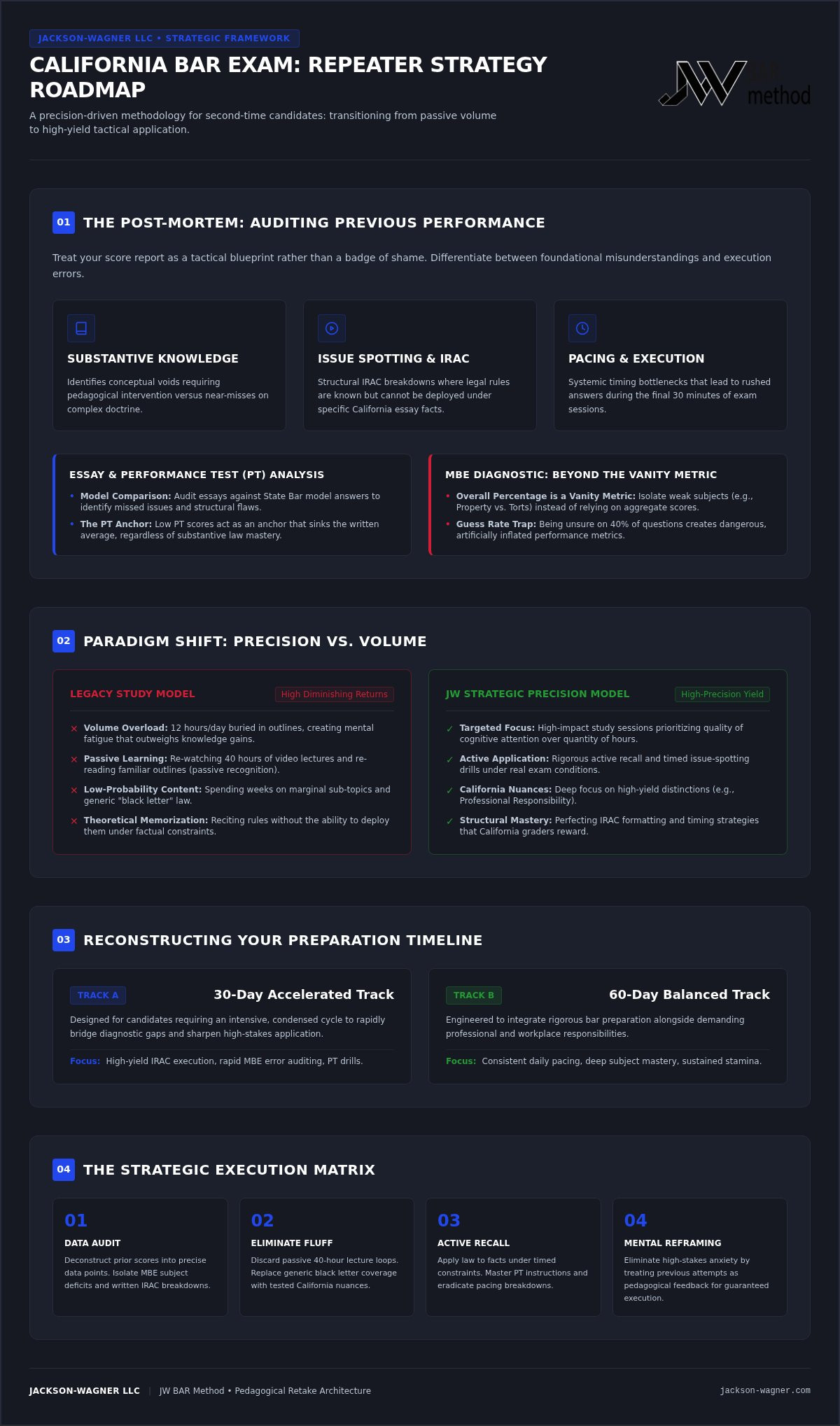
Your score report is the most valuable asset you possess in this transition. While legacy prep courses suggest you simply study harder, a strategic audit of your previous performance is what actually differentiates a second failure from a final victory. You must identify the specific gap that prevented you from passing the bar examination. Was it a lack of substantive knowledge, a failure in issue spotting, or a breakdown in time management? Don't treat your results as a badge of shame; treat them as the blueprints for your next attempt.
Many students fall into the trap of passive review. Re-reading outlines you've already seen is a recipe for stagnation. You aren't learning; you're just recognizing. To master how to approach studying the second time around, you must differentiate between near-misses and foundational misunderstandings. A near-miss on an essay often points to structural IRAC flaws, while a low MBE score in a specific subject suggests a conceptual void that requires a modern, pedagogical intervention. You need a surgical approach to your weaknesses rather than a broad, ineffective brushstroke.
Deconstructing Your Essay and PT Scores
Analyze your essays against the high-scoring model answers provided by the State Bar. Don't look for what you got right; hunt for what you missed. Structural weaknesses in your IRAC application are often the culprit when you know the law but can't secure the points. Pay specific attention to your Performance Test (PT) score. In California, the PT is a high-stakes exercise in following complex instructions under pressure. If this score was low, it likely acted as the anchor that sank your overall written average, regardless of how well you knew your substantive law.
The MBE Diagnostic: Beyond the Percentage
Your overall MBE percentage is a vanity metric. To improve, you must track performance by specific subject matter to find hidden weaknesses. Did you struggle with Property but excel in Torts? Evaluating your guess rate is equally critical. If you were unsure on 40% of the questions but happened to guess correctly, your score is inflated and dangerous. Finally, look at your timing. Rushed answers in the final 30 minutes of a session indicate a systemic pacing issue that no amount of memorization can fix. You must address the clock with the same rigor you apply to the law itself.
Shifting the Paradigm: Precision vs. Volume in Bar Prep
Legacy prep programs often treat the bar exam as a memory test of every possible legal rule. For a high-achieving repeater, this volume-heavy approach is a trap. You don't need more information; you need better application. When considering how to approach studying the second time around, you must shift your focus from broad coverage to tactical precision. Precision means moving beyond the generic "black letter" law and mastering the specific nuances that California graders use to distinguish passing scores. Spending 12 hours a day buried in outlines leads to diminishing returns, where mental fatigue outweighs any marginal gain in knowledge. Effective preparation is about the quality of your focus, not the quantity of your hours.
The goal is to move from "learning the law" to "applying the law" under high-stakes pressure. Many students fail because they can recite a rule but cannot deploy it within the specific factual constraints of a California essay. By narrowing your focus to highly-testable areas, you free up the mental bandwidth required to master the IRAC structure and timing strategies that actually win points. Understanding how to approach studying the second time around requires a disruptive mindset that rejects the "more is better" philosophy of traditional bar review.
The Legacy Course Trap
Watching 40 hours of video lectures for a second time won't change your score. Passive learning provides a false sense of security, while active recall provides results. You've already seen the material; the goal now is to identify the "fluff" in traditional programs that wastes your time and replace it with rigorous practice. If a program asks you to spend weeks on low-probability sub-topics, it isn't respecting your timeline or your professional needs. You need a method that prioritizes active engagement over the psychological comfort of re-reading familiar outlines.
Mastering the California-Specific Nuances
Success requires a deep dive into the specific distinctions of the state of california state bar. You must prioritize high-yield areas like Professional Responsibility, which is a near-guaranteed essay topic, and the distinct rules of California Evidence and Civil Procedure. Reviewing the California Bar Examination official requirements shows that graders reward precision in these local distinctions. Our JW Bar Method Prep is built on this philosophy, moving you beyond encyclopedic knowledge and into the structured application required for licensure. This targeted focus ensures you aren't just working hard, but working with the modern efficiency required to pass.
Reconstructing Your Study Schedule for the Second Attempt
Your second study schedule must be a departure from the generic 10-week timeline mandated by law schools. Repeating the same failed process is a strategic error. Deciding how to approach studying the second time around requires a rejection of the standard model in favor of a "Reverse Engineering" approach. Instead of starting with lectures, you start with the California Bar Examination official guidelines and your previous score report. You identify the gaps first, then fill them with targeted theory. This makes every hour you spend high-impact and results-driven.
Efficiency is paramount, especially for the working repeater. You don't have the luxury of wasting time on subjects you've already mastered. Your schedule should prioritize active application over passive reading. If you're balancing a career with prep, your roadmap must be agile. It should focus on high-yield windows of deep work rather than marathon sessions that lead to burnout. By shifting the focus to what you don't know, you compress the learning curve and maximize your chances of success.
The Accelerated Prep Strategy
Choosing an accelerated track is often the superior choice for repeaters. A 30-day or 60-day roadmap forces a level of intensity and focus that a standard program lacks. You aren't starting from scratch; you're refining a foundation. Use your previous audit to allocate time proportionally. If your MBE scores were high but essays were low, your schedule should reflect a 70/30 split in favor of written practice. Incorporate daily high-stakes drills to build the muscle memory and speed necessary to navigate the exam's pressure.
Active Recall and Spaced Repetition
Replace bulky outlines with "Attack Outlines" designed for rapid-fire rule memorization. These streamlined documents focus only on the elements you need to trigger a passing IRAC response. Use the "Write-Audit-Rewrite" method for every essay. Don't just read the model answer; rewrite your response using the model's structure. Treat california bar exam practice as a diagnostic tool rather than a checklist. Every missed question is a data point that directs your next study block. This ensures your preparation remains dynamic and aligned with the actual demands of the graders.
Mastering the Mental Game: Overcoming Repeater Anxiety
The psychological weight of a previous failure can be heavier than the substantive law itself. You must shed the "Scarlet F" mentality. Failure isn't a reflection of your legal mind; it's a pedagogical data point. When you analyze how to approach studying the second time around, your first task is to manage the "I Already Know This" bias. This complacency is dangerous. It leads you to skim over nuances that graders use to filter out passing scores. You need to approach familiar topics with the curiosity of a first-timer but the precision of an expert. Approaching the material with a fresh, analytical lens ensures you don't miss the subtle distinctions that separate a 60 from a 75.
Strategic rest is a core component of our methodology. Burnout isn't a badge of honor; it's a failure of planning. If you're mentally exhausted, your issue spotting suffers and your speed on the MBE drops. Incorporate "Exam Day Visualization" into your weekly routine. Mentally walking through the start of the exam, the reading of the first prompt, and the execution of your IRAC structure prevents second-time panic. You aren't just studying law; you're training your nervous system to perform under extreme pressure. This mental conditioning is what allows you to remain decisive when the clock is ticking.
Replacing Stress with Structure
A predictable, rigid methodology is your best defense against decision fatigue. When you know exactly which drill to perform at 8:00 AM, you save your mental energy for the actual law. Confidence in the MBE comes from knowing your process is sound, not just from memorizing rules. Build a support perimeter of peers and mentors who understand the unique rigors of the California Bar. Surrounding yourself with those who respect the challenge reinforces your professional empowerment. This structured environment replaces high-stakes anxiety with a steady cadence of progress.
The Attorney’s Exam Perspective
Seasoned lawyers often face a unique Seniority Bias. You've practiced for years, so you assume the bar is a formality. However, the california attorney's exam requirements demand a specific type of academic precision that day-to-day practice often erodes. For those taking only the essay portion, strategic shortcuts are essential. You must focus on the grader's rubric rather than your real-world experience. Success requires unlearning the "it depends" of practice and embracing the definitive IRAC structure required for licensure. You are not being tested on your lawyering skills, but on your ability to perform within a specific academic framework.
Ready to replace anxiety with a proven roadmap? Explore the JW Bar Method Prep - Full Exam California Bar to secure your future and transform your preparation into a passing score.
Why the JW Bar Method is the Definitive Choice for Second-Time Success
Legacy courses are built on a one-size-fits-all model that fails to account for the unique needs of a repeater. They expect you to watch the same lectures and read the same outlines that didn't work the first time. The JW Bar Method is a modern evolution that rejects this cycle of inefficiency. When you rethink how to approach studying the second time around, you need a partner that assumes the risk of your outcome. We don't just provide content; we provide a structured, results-oriented environment that prioritizes your success over legacy industry standards. This bold reliability is why our students replace stress with a clear, tactical roadmap.
Our proprietary methodology targets the specific gaps repeaters face, such as issue-spotting fatigue and IRAC structural decay. We focus exclusively on California licensure, ensuring every minute of your prep is high-yield. Unlike legacy providers that dilute their focus across multiple jurisdictions, we specialize in the unique demands of the California graders. This specialization allows us to offer accelerated tracks that respect your existing knowledge base and professional commitments. You aren't starting from zero; you're refining your skills for a decisive california bar exam victory in 2026.
A Modern Evolution in Legal Education
We've disrupted the traditional bar prep model by leading with a financial assurance that establishes absolute trust. This isn't a marketing gimmick; it's a reflection of our confidence in the JW Bar Method curriculum. While legacy providers rely on passive video consumption, we utilize active pedagogical features designed to trigger recall under pressure. We've replaced the generic fluff of traditional programs with precise, testable nuances. This approach ensures you're prepared for the actual exam, not just a theoretical version of it. We empower you to take control of your results through a modern, agile learning environment.
Your Final Bar Exam
Visualize the moment you see your name on the pass list. That result isn't just a professional milestone; it's the end of a high-pressure journey. Whether you are preparing for the Full Exam or the Attorney's Exam, the next step is to align your effort with a methodology that actually works. Don't let another cycle pass using tools that have already proven ineffective. It's time to commit to a program that treats you like the professional you are. Secure your spot in the next JW Bar Method cohort and ensure this is the last time you ever have to think about bar prep.
Securing Your Path to California Licensure
Transformation begins the moment you stop repeating the same legacy study habits that failed you. Success on your second attempt requires a surgical audit of your previous performance and a total shift from passive volume to tactical precision. By reconstructing your schedule around high-yield California nuances and mastering the psychological traps of repeater anxiety, you turn past obstacles into a definitive roadmap for victory. Understanding how to approach studying the second time around isn't about working more hours; it's about working with a modern, results-driven efficiency that respects your professional time.
The JW Bar Method provides the structured empowerment you need to cross the finish line. With our proprietary results-oriented curriculum and specialized accelerated tracks for attorneys, we've replaced the uncertainty of generic prep with a binary performance guarantee. We assume the risk because we're certain of our methodology's efficacy. It's time to replace high-stakes stress with a reliable, modern path to success.
Pass the California Bar with the JW Bar Method-Explore Our Programs
Your future as a California-licensed attorney is within reach. Take the final step today and ensure this is the last time you ever sit for the bar.
Frequently Asked Questions
How many hours a day should a repeat taker study for the California Bar?
A repeat taker should prioritize 4 to 6 hours of high-intensity deep work rather than marathon 12-hour sessions. Quality of application outweighs sheer volume. Since you already have a foundation of legal knowledge, your focus must shift to active recall and timed drills. This prevents the diminishing returns associated with mental fatigue and ensures you maintain the peak cognitive performance required for the actual exam day.
Is it harder to pass the California Bar Exam the second time around?
Statistically, repeaters face lower pass rates than first-time takers, but this is often due to repeating failed study habits rather than the exam's inherent difficulty. Success depends entirely on your methodology. If you continue using a legacy "big box" course that failed you once, you're likely to see the same result. However, using a structured, results-oriented approach designed for repeaters significantly improves your chances of securing a passing score.
Should I use the same prep material I used the first time?
You shouldn't rely on the same materials if they contributed to a previous failure. Re-reading the same outlines leads to a false sense of familiarity known as recognition bias. To master how to approach studying the second time around, you need disruptive tools that force active engagement. Switching to a proprietary curriculum like the JW Bar Method ensures you're addressing the specific nuances and structural IRAC flaws that generic courses often overlook.
What is the most common reason people fail the California Bar a second time?
The most common reason for a second failure is passive review. Many students spend their second attempt re-watching lectures or skimming outlines they've already seen. This fails to address the underlying "Gap" in their performance, whether it's issue spotting, time management, or structural application. Without a surgical audit of your previous score report, you're simply practicing your existing mistakes rather than correcting them for the next attempt.
How do I know if I need a specialized course like the JW Bar Method?
You likely need a specialized course if you felt like a number in a factory-style prep program or if your previous score was a "near miss." If you're a high-achieving professional who requires flexibility and a roadmap that respects your existing knowledge, the JW Bar Method is the definitive choice. Our programs are designed for those who need to replace legacy volume with modern precision and a binary performance guarantee.
Can I pass the California Bar while working full-time on my second attempt?
Yes, passing while working full-time is entirely achievable with an accelerated preparation track. You don't need a 10-week block of unemployment; you need a strategy that maximizes high-yield study windows. By focusing on "Reverse Engineering" and active recall, you can compress your learning into 30 or 60 days. This approach respects your professional commitments while ensuring you reach the required level of mastery for California licensure.
How do I handle the 'Moral Character' application if I'm a repeat taker?
Your Moral Character Determination remains valid for 36 months after it's approved by the State Bar of California. If your determination is still within this window, you don't need to re-file or pay additional fees for your second attempt. However, it's your responsibility to update the Bar regarding any material changes in your application, such as new employment or legal issues, to ensure your eligibility remains current for admission.
What are the key differences in the 2026 California Bar Exam for repeaters?
The 2026 exam cycle involves significant shifts in administration and format, including moves toward remote testing and changes in question sourcing. For repeaters, this means your old MBE strategies might need updating to align with the latest vendor standards. You must ensure your prep materials are current and specifically tailored to these new requirements. Staying agile and adapting to the current State Bar rubrics is essential for a successful second attempt.


