

What if the most dangerous part of the licensing process isn't the three-day exam, but a 60-page background questionnaire you haven't even opened yet? Most applicants treat the california bar moral character application as a secondary administrative task, but in 2026, it's the primary gatekeeper of your professional career. You've worked too hard to let a simple non-disclosure or a missed deadline stall your admission for months.
We understand the high-stakes anxiety that comes with this level of scrutiny. It's exhausting to worry if a minor past mistake or a confusing timeline will trigger a lengthy investigation. This 2026 strategic guide provides a structured, modern path to success by mastering the complexities of the moral character requirement. You'll gain a proactive strategy to ensure your licensure isn't delayed by bureaucratic hurdles or accidental omissions. We'll break down the current 6 to 8 month processing window, clarify the red flags that actually matter, and provide a clear timeline for submission that aligns perfectly with your exam preparation. By the end of this guide, you'll have the absolute confidence to submit an application that moves straight to approval without the need for an informal conference or an extended investigation.
Key Takeaways
- Secure your license by filing at least eight to ten months in advance; this proactive timeline accounts for the 2026 bureaucratic realities that often exceed official estimates.
- Understand the non-negotiable duty of candor within the california bar moral character application, where strategic disclosure of past red flags prevents permanent admission delays.
- Navigate the 2026 State Bar Applicant Portal and Live Scan requirements with a precision checklist designed to eliminate technical errors and administrative friction.
- Learn how to integrate your moral character strategy with the JW Bar Method, treating this administrative phase as your first true performance test for the bar.
What is the California Bar Moral Character Application?
The california bar moral character application is a comprehensive background investigation designed to ensure that every prospective lawyer possesses the integrity required to practice law. While the bar exam tests your legal knowledge, this application evaluates your personal history. It's an exhaustive process managed by the State Bar of California that probes everything from your financial responsibility to your criminal record. You shouldn't view this as a simple formality; it's a rigorous screening process where the Committee of Bar Examiners acts as a gatekeeper for the profession.
The scope of this investigation is far wider than a standard employment check. The State Bar scrutinizes your entire adult life through several critical lenses:
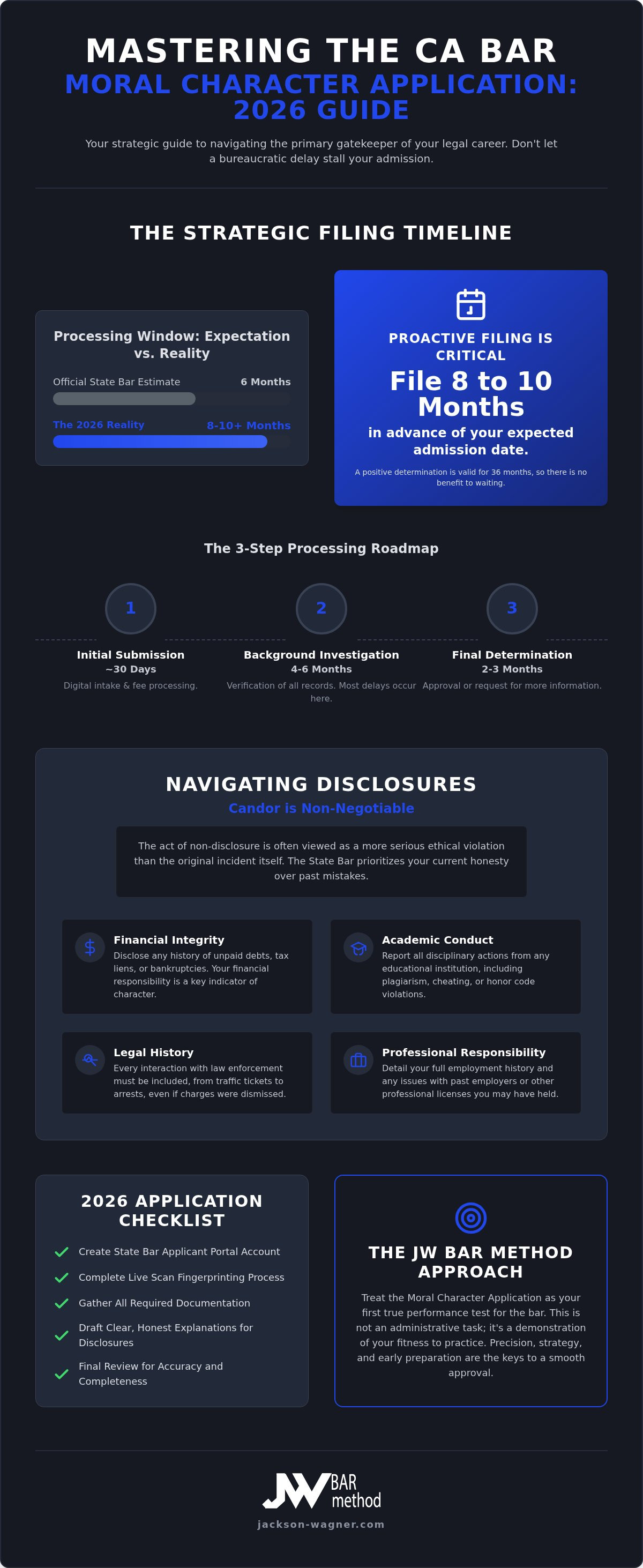
- Financial Integrity: Your credit history and any history of bankruptcy, unpaid debts, or tax liens.
- Academic Conduct: Records of plagiarism, cheating, or general disciplinary actions from law school and undergraduate institutions.
- Legal History: Every interaction with law enforcement, including arrests, convictions, or even dismissed charges.
- Professional Responsibility: Your history with past employers and any previous professional licenses you've held.
Candor is the cornerstone of a successful filing. The Committee often views the act of non-disclosure as a separate, more serious ethical violation than the original incident itself. Whether it's an old traffic ticket or a university disciplinary hearing, full transparency is your best defense. The State Bar prioritizes your current honesty over past mistakes that have been appropriately addressed.
The Purpose of the Moral Character Requirement
The primary goal is protecting the public and maintaining the integrity of the legal profession. The Committee doesn't just look for a "clean" record; they evaluate your capacity for rehabilitation and your current moral standing. Under the 2026 State Bar rules, "Positive Moral Character" is defined as the absence of proven conduct or behavior which has a substantial adverse bearing on an applicant’s fitness to practice law, including traits of honesty, fairness, and respect for the judicial process.
Who Must Apply and When
Every person seeking admission to practice law in California must submit a california bar moral character application. This includes traditional JD students and seasoned out-of-state lawyers. Because a positive determination is valid for 36 months, you should apply early to avoid being stuck in a processing backlog. For those moving from other jurisdictions, understanding the California attorney's exam requirements makes an early moral character filing even more essential. A delay in your character determination can prevent you from being sworn in, even if you've already passed the exam.
Strategic Timeline: When to File Your Application in 2026
Timing isn't just a logistical detail; it's a strategic weapon in your licensure journey. While the official California Bar Moral Character Application website often cites a six-month processing window, the 2026 reality for most applicants is closer to eight or ten months. If you wait until you graduate to file, you're already behind. This bureaucratic lag can trap you in a professional purgatory where you've passed the bar exam but can't actually practice law. Because a positive determination remains valid for 36 months, there is zero benefit to waiting until the last minute.
The 2026 Processing Roadmap
Understanding the internal machinery of the State Bar helps you manage expectations and plan your career launch. The process generally follows this three-step cadence:
- Step 1: Initial Submission and Fee Payment (Approx. 30 days): This phase covers the technical intake of your digital files and the processing of your application fees.
- Step 2: Assignment and Background Investigation (4-6 months): Your file is assigned to an investigator who verifies your employment, academic history, and legal records. This is the longest phase and where most delays occur.
- Step 3: Determination or Request for Information (2-3 months): The Committee either issues a positive determination or asks for a written explanation regarding specific disclosures.
Avoiding the Post-Exam Limbo
The most frustrating scenario for any aspiring lawyer is passing the February or July 2026 Bar Exam only to watch colleagues get sworn in while your status remains "pending." This "post-exam limbo" is almost always avoidable with an early bird strategy. For JD students, the ideal filing window is during your 2L year. For out-of-state lawyers, you should initiate the california bar moral character application the moment you commit to seeking California licensure. If your circumstances change during the long wait, such as a new job or a change of address, you must update your application within 30 days to maintain your duty of candor.
Managing these administrative hurdles requires the same level of discipline you'll need for the exam itself. You can find more granular tactics in our guide on decoding the California bar exam moral character application. By aligning your filing timeline with a rigorous study schedule like the JW Bar Method, you ensure that every obstacle to your practice is cleared before the first results are even posted.
Navigating Disclosures: Candor, Red Flags, and Rehabilitation
Candor isn't just a preference; it's the primary metric by which your fitness is measured. When you submit your california bar moral character application, you're entering a contract of absolute transparency with the Committee of Bar Examiners. A common mistake is believing that a past misdemeanor or a youthful indiscretion is a disqualifier. In reality, the act of hiding that incident is almost always what triggers a denial. The State Bar prioritizes your current honesty over the underlying conduct, viewing a failure to disclose as a contemporary ethical breach that suggests you aren't ready to hold a license.
Common red flags that draw scrutiny in 2026 include alcohol or drug-related incidents, academic discipline, and patterns of financial irresponsibility. If you have these in your past, the art of the disclosure statement becomes your most critical tool. Your explanation must be objective, concise, and genuinely remorseful. Avoid the temptation to litigate the past or blame others. The Committee isn't looking for excuses; they're looking for an acknowledgment of the mistake and clear evidence of rehabilitation. In 2026, this evidence often includes long-term employment stability, community service, or professional certifications that demonstrate a corrected trajectory.
You can find the specific standards for these disclosures on the official page for The State Bar of California's Moral Character Application. Remember that the burden of proof is on you to establish your good character. If the investigator has to find information you should have provided, your credibility is effectively neutralized.
Financial Integrity and Credit History
Financial instability is a significant hurdle because it often correlates with future malpractice or the mishandling of client funds. Defaulted student loans, significant credit card debt, or recent bankruptcies will trigger an inquiry into your current fiscal management. The State Bar views financial responsibility as a direct proxy for the trust required to manage client accounts and maintain professional fiduciary duties. If you have past financial issues, provide documentation showing that you're currently in a payment plan or have successfully resolved the debts.
Past Criminal and Disciplinary Conduct
You must disclose every interaction with the legal system, including expunged records and juvenile incidents that you might think are "wiped" from your history. There's a vital distinction between an explanation and an excuse. An explanation focuses on the facts and the lessons learned, while an excuse seeks to minimize the behavior. For minor issues, a well-crafted self-disclosure is often sufficient. However, if your history involves crimes of moral turpitude or professional fraud, you should consider consulting an ethics expert before hitting submit. Handling a complex disclosure yourself can be risky if you don't understand the specific nuances the Committee is looking for in 2026.
2026 Application Checklist: Documentation and Logistics
Completing the california bar moral character application requires more than just memory; it demands a meticulous audit of your last decade. The 2026 State Bar Applicant Portal is a centralized hub where you'll upload everything from your residential history to your professional references. You must provide a comprehensive 10-year lookback for both your employment and residential records. Any gaps in this timeline will trigger immediate flags, so you should cross-reference your records with tax filings or old resumes before you begin the digital entry. Precision at this stage prevents the investigator from having to ask clarifying questions that could stall your file for weeks.
Fingerprinting remains a common logistical bottleneck. If you're currently in California, you must use a Live Scan service provider. However, out-of-state applicants often face confusion regarding national vs. California-specific requirements. You'll need to use specific FD-258 fingerprint cards if you're filing from outside the state, ensuring that the processing agency routes the results correctly to the State Bar. Current processing times for 2026 indicate that results can take several weeks to clear, so completing your fingerprints should be your first priority once the application is initiated.
The Essential Document List
Precision is everything here. You'll need to gather several categories of certified records well before your submission deadline:
- Certified Court Records: Required for any litigation where you were a named party.
- Police Reports: Essential for any arrests, even if no charges were filed.
- Driving Records: You must obtain these from every state where you've held a license in the last ten years.
Cross-referencing your california bar moral character application with your original law school application is a vital step. The Committee checks for consistency. Any discrepancy between what you told your law school and what you tell the Bar is a major red flag that suggests a lack of candor.
Managing Your References
Choosing your references is a strategic decision. The State Bar requires both Category 1 and Category 2 references. Category 1 references must be members of the bar in any U.S. jurisdiction who have known you for at least six months. Category 2 references are general character witnesses who aren't necessarily lawyers but can vouch for your integrity in a professional or personal capacity.
Reach out to your references before you list them. Ensure their contact information is current and explain that they'll receive a digital questionnaire from the State Bar. A "No Response" from a reference is one of the most common causes of administrative delays in 2026. If you're ready to apply this same level of precision to your study schedule, explore how the JW Bar Method can streamline your path to licensure.
Integrating Moral Character with the JW Bar Method
The california bar moral character application is often treated as a separate administrative island, disconnected from the actual study process. This is a strategic error that impacts your mental bandwidth. At Jackson-Wagner LLC, we view administrative discipline as a mandatory prerequisite for exam-day focus. If you're still scrambling for driving records or reference contact info while trying to master Community Property, you've already lost the mental game. By integrating your licensure logistics into a structured timeline, you eliminate the background noise that distracts from high-stakes preparation. You need a clear head to perform at your peak.
Think of your application as your very first Performance Test (PT). It requires the same attention to detail, adherence to strict instructions, and persuasive yet factual writing that the bar exam demands. Students who apply the JW Bar Method's rigor to their documentation find that the process becomes a training ground for the exam itself. You're learning to navigate the State Bar's specific expectations and deadlines long before you sit down in the testing center. This isn't just paperwork; it's professional practice that builds the discipline required for success.
There is a massive psychological advantage to reaching "Pending" or "Approved" status before your final study push begins. Knowing that your background is cleared allows you to visualize your success without the nagging fear of a bureaucratic delay. It transforms the bar exam from a terrifying hurdle into the final, logical step of a plan already in motion. You aren't just a student; you're an attorney-in-waiting who has already cleared the most personal part of the process through early, decisive action.
The Precision Advantage
Jackson-Wagner LLC advocates for efficiency in every phase of the licensing journey. Getting your paperwork finalized before the intense "Bar Season" begins is essential for your cognitive health. You need your limited energy for MBE drills and essay outlines, not for chasing down 10-year residential histories or missing police reports. Use our guide on passing the California bar exam in 2026 to align your study schedule with these administrative milestones. Precision in your application mirrors the precision required for your answers on exam day.
Final Readiness for 2026 Success
A "Complete Applicant" is one who has mastered both the law and the logistics. Your next step is clear: submit your california bar moral character application today to secure your 2026 admission. Don't let a 60-page questionnaire be the reason your career stalls at the finish line. Take control of your professional future by choosing a prep method that accounts for every variable. Master the California Bar with the JW Bar Method and ensure your path to licensure is as efficient as it is certain. We're here to help you navigate the high-stakes reality of California admission with absolute confidence.
Master Your Path to California Admission
The california bar moral character application shouldn't be a source of anxiety; it's the first milestone in your career as a trusted legal professional. By prioritizing absolute candor and early action, you eliminate the bureaucratic friction that stalls so many careers. You've seen how a structured approach to documentation and reference management prevents the frustration of post-exam limbo. Now, it's time to apply that same level of precision to your actual study schedule.
Jackson-Wagner LLC provides the specialized California Bar pedagogy and authoritative guidance needed to navigate every licensure requirement with certainty. Our accelerated prep for busy professionals ensures that you don't just pass the exam, but that you're ready to be sworn in the moment results are released. Don't leave your admission to chance or legacy study models that ignore the administrative realities of the 2026 cycle.
Secure Your California Licensure with the JW Bar Method
You have the tools and the strategy to succeed. We look forward to seeing you at the swearing-in ceremony.
Frequently Asked Questions
How long does the California Bar moral character application take in 2026?
In 2026, the california bar moral character application typically takes between 6 and 8 months to process. However, many applicants should plan for an 8 to 10 month window to account for potential bureaucratic backlogs or requests for additional documentation. If your background includes complex disclosures or multiple out-of-state residences, the timeline can extend even further. Filing as early as your 2L year is the most reliable strategy to avoid delays in your admission.
Can I take the California Bar Exam before my moral character is approved?
Yes, you can sit for the California Bar Examination while your moral character determination is still pending. The State Bar allows you to complete the testing requirements independently of the background investigation. However, you won't be admitted to practice law or sworn in as an attorney until you receive a positive determination. Coordinating your filing timeline with your study schedule ensures that you aren't stuck in professional limbo after passing the exam.
What happens if I forget to disclose a minor traffic ticket?
Forgetting to disclose any incident is often viewed as a breach of your duty of candor, which is a serious ethical flag. If you realize you've omitted a ticket, you must update your california bar moral character application immediately through the State Bar Applicant Portal. The Committee generally prioritizes honesty over minor past infractions. Providing the information voluntarily before an investigator discovers it demonstrates the integrity required for licensure, whereas a hidden record suggests a lack of fitness.
How much does the California Bar moral character application cost in 2026?
The cost of the application varies depending on whether you're a law student or an attorney licensed in another jurisdiction. You should consult the 2026 Schedule of Charges on the State Bar website for the exact fee amounts. Beyond the base filing fee, remember to budget for Live Scan fingerprinting and the costs of obtaining certified court or driving records. These administrative expenses are a necessary investment in your professional licensing process.
Does a low credit score disqualify me from the California Bar?
A low credit score won't automatically disqualify you, but the underlying reasons for it will be scrutinized. The State Bar looks for patterns of financial irresponsibility, such as defaulted student loans or unpaid judgments, because these issues can impact your ability to manage client trust accounts. If you have past financial instability, you should provide evidence that you're currently managing your debts. Showing a consistent payment plan demonstrates the rehabilitation and responsibility the Committee requires.
What is an 'Informal Conference' in the moral character process?
An Informal Conference is a meeting with the Subcommittee on Moral Character to discuss specific concerns in your file. This isn't a formal trial, but it's a serious inquiry into your fitness to practice law. It usually occurs when your disclosures or background check reveal issues that require clarification beyond your written statements. Preparation is essential because your performance during this meeting will directly influence whether the Committee grants you a positive determination for admission.
Do I need to disclose juvenile records on my California Bar application?
Yes, you're required to disclose juvenile records on your application. Many applicants mistakenly believe these records are sealed or "wiped" and don't need to be reported. However, the requirement for candor is absolute and includes incidents from your youth. Omitting these details can be interpreted as a lack of honesty, which is often more damaging than the record itself. Disclosing them with a brief, objective explanation of your growth is the safest path to approval.
How do I update my application if I change jobs after filing?
You must update your application within 30 days of any material change, including changes to your employment or residence. This update is completed through the State Bar Applicant Portal. Keeping your professional history current is a continuous requirement that remains in effect until you're sworn in as an attorney. Promptly reporting these changes reinforces your commitment to transparency and ensures your investigator has the most accurate information to finalize your background check.


