

What if the biggest threat to your legal career isn't the MBE, but a decade-old credit card default or a forgotten misdemeanor? For many candidates, the california bar exam moral character application is a source of intense anxiety that often overshadows their actual studies. You aren't just filling out a form. You're providing a high-stakes demonstration of the candor and trustworthiness required for professional admission. It's natural to worry that the State Bar's 6 to 8 month processing window will delay your career, especially when a single omission can lead to an adverse determination.
This guide provides the strategic framework you need to handle the disclosure process with absolute confidence. You'll learn how to align your application timing with your JW Bar Method Prep schedule to ensure your character determination arrives before your results. We'll explore the specific requirements for the $551 general applicant fee, the $1,054 attorney applicant fee, and the 86 scaled score required on the MPRE. This article delivers a clear roadmap to turn a stressful administrative hurdle into a structured, reliable path toward your law license.
Key Takeaways
- Submit your application at least eight months before your expected admission to ensure your character determination doesn't delay your entry into the profession.
- Learn how to execute strategic disclosure within the california bar exam moral character application to address past financial or legal mistakes with absolute candor.
- Identify the specific red flags, such as moral turpitude standards and high debt ratios, that trigger deeper investigations by the Committee of Bar Examiners.
- Discover how to manage 'Abeyance' status and staff requests for additional documentation to keep your application moving through the 2026 queue.
- Align your administrative timeline with your JW Bar Method Prep schedule to eliminate background check anxiety and focus entirely on mastering the exam.
What is the California Bar Exam Moral Character Requirement?
Earning a passing score of 1390 on the exam is a significant victory, but it doesn't grant you an automatic license to practice law. The State Bar of California requires every applicant to receive a positive moral character determination before they can be sworn in. This isn't a mere formality. It's an exhaustive investigation into your history to ensure you possess the honesty, fairness, and respect for the law required of a fiduciary. The Committee of Bar Examiners acts as the gatekeeper, distinguishing between those who are academically capable and those who are ethically fit for the high-stakes environment of the California legal system.
Understanding the california bar exam moral character application is vital because meeting admission requirements is a separate track from passing the bar exam itself. You might excel on the MBE and essays, but a failure to demonstrate "good moral character" will halt your career before it begins. California’s standards are notoriously high because the state views the law license as a privilege, not a right. The process is designed to protect the public and the integrity of the judicial system from individuals who may lack the necessary trustworthiness.
The Scope of Inquiry: What the State Bar Investigates
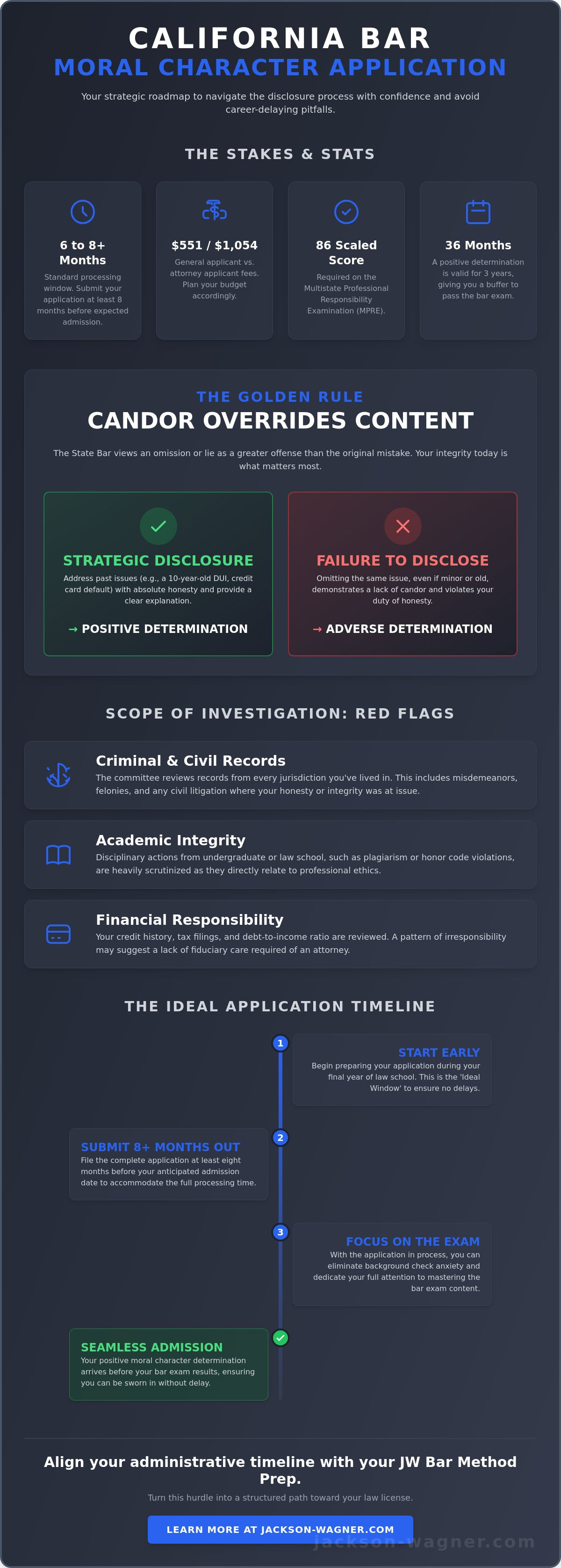
The investigation is thorough and spans your entire adult life. The Committee doesn't just skim your records; they verify every detail across multiple categories to build a complete profile of your past conduct:
- Criminal and Civil Records: They review every jurisdiction where you've lived, looking for everything from misdemeanors to civil litigation where your honesty was at issue.
- Academic Integrity: Every disciplinary action from your law school or undergraduate years is scrutinized. Plagiarism or conduct violations are major red flags that require extensive explanation.
- Financial Responsibility: Your credit history and tax obligations are examined. High debt-to-income ratios aren't disqualifying on their own, but a pattern of fiscal irresponsibility suggests a lack of fiduciary care.
Why Candor Overrides Content
The State Bar views lying as a greater sin than the original mistake. This is often called the "death penalty" for an application. If you fail to disclose a DUI from ten years ago, the Committee will likely deny you, not because of the DUI, but because you lacked the candor to admit it. In 2026, the standard for "Good Moral Character" focuses heavily on your current integrity and your ability to take responsibility for past actions. The State Bar evaluates who you are today, but they can only do that if you provide a complete and honest california bar exam moral character application from the start. Professional readiness, as emphasized in the JW Bar Method Prep, begins with this level of absolute transparency.
The Strategic Timeline: When to Submit Your Application
Timing is the difference between a seamless transition into practice and a frustrating professional delay. The State Bar of California explicitly warns that the California Bar Moral Character Application requires a minimum of six to eight months to process. If your history includes complex issues like past bankruptcies or previous legal disciplinary actions, that window can stretch even longer. Strategic applicants don't wait for their exam results to start this process. They act early to ensure their positive determination is ready the moment they pass the exam.
You should coordinate this filing with the California bar exam application deadline. While the exam application has strict semi-annual cutoffs, the moral character application is a rolling process. A positive determination remains valid for 36 months, which gives you a generous buffer to pass the exam without needing to pay for an extension application. These extensions cost $360 for general applicants and $496 for attorney applicants, so getting it right the first time saves both time and capital.
The 3-Step Submission Window
Strategic timing follows three distinct phases. The 'Ideal Window' occurs early in your final year of law school, ensuring your determination is finalized before graduation. The 'Risk Window' involves filing alongside your exam application, which often creates a frustrating delay after you pass. Finally, the 'Delay Window' is filing after results, which leaves you licensed but unable to practice for months. Early filing allows you to clear these hurdles so you can focus entirely on your JW Bar Method Prep - Full Exam California Bar.
Updating Your Application: The Ongoing Duty to Disclose
Your responsibility remains active until you're sworn in. You must report status changes, like new jobs, address updates, or legal issues, within 30 days. This ongoing candor ensures that when your California bar exam score report arrives, there are no administrative holds on your certification. Failure to disclose new information is often treated as a character flaw in itself, potentially triggering a red-flag review that can derail your admission.
By treating the california bar exam moral character application as a strategic milestone rather than an afterthought, you eliminate the 'Admission Gap.' This is the period where candidates have passed the test but remain in professional limbo because their background check is still pending. Start your application today to ensure you're ready to practice the moment your name appears on the pass list.
Navigating Red Flags: Criminal, Financial, and Academic Issues
A past mistake doesn't have to end your legal career before it starts. The Committee of Bar Examiners understands that applicants are human; however, they require absolute transparency regarding any "red flags" in your history. Whether you are dealing with a decade-old DUI, a period of academic probation, or a significant debt load, the key to a successful california bar exam moral character application is demonstrating that these incidents are isolated and unrepresentative of your current character. The State Bar prioritizes the "moral turpitude" standard, which flags crimes involving dishonesty or a lack of integrity, but even these can be overcome with a proactive strategy.
Financial integrity is another high-priority area for investigators. While a low credit score isn't a disqualifier, a pattern of fiscal neglect suggests you may struggle with the fiduciary duties required of an attorney. If you have defaulted student loans or outstanding judgments, you must show you're actively managing these obligations. This is where The State Bar of California's Moral Character Requirements become a roadmap for your disclosure strategy, emphasizing that your current stability matters more than past financial turmoil. Proving you have changed since the incident occurred is the core of your submission; the Committee values current responsibility over historical errors.
The Rehabilitation Framework
Rehabilitation is the passage of time coupled with affirmative corrective action that proves you've outgrown your past mistakes. You can't just wait for time to pass; you must actively build a record of character growth. This involves gathering third-party evidence, such as reference letters from employers or community leaders who can attest to your integrity. Engaging in community service or pursuing proactive professional development provides the Committee with concrete proof that you've transformed. This level of preparation ensures that when you begin your JW Bar Method Prep - Full Exam California Bar, your focus remains on the law rather than administrative anxiety.
Financial Disclosures and Credit Reports
Investigators look for patterns of neglect rather than a simple snapshot of your debt. If your credit report shows significant issues, you should create a "Financial Correction Plan" before submitting your california bar exam moral character application. This plan documents your efforts to pay down debt or settle judgments, demonstrating the fiduciary responsibility the State Bar demands. Showing a structured approach to your finances mirrors the structured approach to study found in the JW Bar Method Prep - Full Exam California Bar. By treating your financial history as a problem to be solved with data and action, you prove you possess the maturity required for admission.
The Determination Process: Review, Investigation, and Decision
After you submit your california bar exam moral character application, it enters a multi-stage review process that tests your patience as much as your record. The initial phase involves a staff review for completeness. If you've omitted a single employer or failed to provide a required court document, the State Bar will pause your application. This administrative delay is avoidable with a meticulous approach. Once deemed complete, an investigator scrutinizes your disclosures, often contacting references or past employers to verify your candor. Your goal is to move through this stage without triggering a request for additional information, which can restart your six to eight month waiting period.
You may encounter the 'Abeyance' status, a technical hold that often causes significant anxiety. Abeyance occurs when the Committee cannot reach a determination because of a pending event, such as an unresolved lawsuit or a current criminal charge. While your application is in abeyance, the processing clock stops. You must resolve the underlying issue before the Committee will proceed. If the staff cannot clear your application based on the written record alone, they may refer your file to the Committee of Bar Examiners for an Informal Conference or a more intensive investigation.
The Informal Conference Demystified
An invitation to an Informal Conference is not a rejection; it's a strategic opportunity to clarify concerns directly with the Committee. You should treat this meeting like a high-stakes professional interview rather than a casual chat. Expect pointed questions about any red flags you disclosed, such as past financial defaults or disciplinary issues. The Committee is looking for maturity, remorse, and proof of rehabilitation. Possible outcomes include an immediate positive determination, a conditional approval requiring specific future conduct, or a denial. If you receive an adverse determination, you have the right to appeal to the State Bar Court, though this involves a $531 filing fee and a significantly longer timeline.
Finalizing Your Path to Licensure
A positive character determination is a vital piece of the puzzle, but it must align with other California bar admission requirements to secure your license. You must also achieve a scaled score of 86 on the MPRE and, of course, pass the bar exam itself. Once all three pillars character, ethics, and the exam are satisfied, you'll receive your notification for the Oath of Office. This final step transitions you from an applicant to a member of the State Bar. To ensure you're academically ready the moment your character check clears, secure your spot in the JW Bar Method Prep - Full Exam California Bar and master the substantive law while the Committee handles your background.
The JW Bar Method: Beyond the Application
Professional readiness begins long before you sit for the first session of the MBE. It starts with a clear administrative slate that allows you to commit 100% of your cognitive resources to the law. The california bar exam moral character application is often the last invisible barrier to your career, and treating it as a secondary task is a strategic error. When you eliminate the uncertainty of your background check early, you replace "Administrative Anxiety" with a sense of bold reliability. This proactive mindset is exactly what we cultivate at Jackson-Wagner as we guide you through the complexities of the state of california state bar licensure journey.
Our methodology is built on the premise that a prepared candidate is an unstoppable candidate. By the time you reach the peak weeks of your study schedule, your character determination should be a settled matter, not a source of late-night worry. This alignment between your administrative filings and your pedagogical progress ensures that when you see your passing score, there are no "holds" or "pending investigations" standing between you and your oath of office.
Strategic Focus: Clearing the Mental Deck
Unresolved character issues act as a constant drain on your mental energy. If you're wondering how an investigator will interpret a past financial default while trying to master the nuances of Evidence, you aren't studying at peak capacity. Our JW Bar Method Accelerated Prep - Full California Bar Exam assumes you have already handled these hurdles, allowing for a high-intensity, results-oriented focus. Integrating your administrative deadlines into your study calendar isn't just organized; it's a competitive necessity. You don't want to receive a request for an Informal Conference in the middle of your final practice exams.
Your Future as a California Attorney
The integrity you demonstrate during the california bar exam moral character application process is the same integrity that will define your reputation in the courtroom. A clean record and a positive determination are the foundations of a successful legal career in 2026 and beyond. By handling your disclosures with candor today, you join the ranks of the California Bar with the confidence of a professional who has nothing to hide. This transparency is the first true test of your role as an officer of the court. Don't let administrative delays stall your momentum. Master the California Bar Exam with the JW Bar Method and step into your new career with the certainty of a secured admission.
Step Into the Courtroom with Absolute Confidence
You've learned that the california bar exam moral character application is a high-stakes test of integrity that requires a minimum of six to eight months for processing. By mastering the rehabilitation framework and prioritizing absolute candor, you transform a potential career bottleneck into a demonstration of professional maturity. Strategic candidates don't leave their admission to chance. They resolve administrative hurdles early to ensure their focus remains entirely on the rigors of the exam.
Jackson-Wagner provides the only proprietary JW Bar Method specifically engineered for the unique challenges of California licensure. Whether you're a first-time law student or an experienced practitioner, our structured programs for Attorneys and Law Students offer an accelerated learning path that legacy providers can't match. We focus exclusively on the California Bar, ensuring every minute of your study is optimized for success. Secure Your California Bar Success with the JW Bar Method today. Your future as a California attorney is within reach; take the final step with a partner committed to your professional empowerment.
Frequently Asked Questions
How long does the California Bar moral character application take to process?
The standard processing time is a minimum of six to eight months. The State Bar of California advises applicants to submit their files early, ideally at the start of their final year of law school. Complex histories involving legal or financial issues can extend this window significantly. Filing early ensures your determination is finalized before your exam results are released, preventing professional delays.
Can I take the California Bar Exam before my moral character is approved?
Yes, you can sit for the exam while your application is still pending. The moral character determination is a separate requirement for admission, not a prerequisite for the test itself. However, you cannot be sworn in as an attorney until you've passed the exam, met the MPRE requirement, and received a positive moral character determination.
What happens if I forget to disclose a minor traffic ticket?
You must amend your application within 30 days of discovering the omission. The Committee of Bar Examiners prioritizes candor over the incident itself; a forgotten ticket isn't usually a problem, but a perceived attempt to hide it is. Providing an update demonstrates the honesty required for a successful california bar exam moral character application.
Does a past DUI automatically disqualify me from the California Bar?
A past DUI isn't an automatic disqualification. The Committee evaluates the "moral turpitude" of the offense and looks for evidence of rehabilitation, such as the passage of time and corrective actions. If the incident was isolated and you've shown significant personal growth, you can still receive a positive determination. Transparency is your best defense during this review.
How much does the California Bar moral character application cost in 2026?
The standard fee for a general applicant is $551. Attorney applicants seeking admission in California must pay a higher fee of $1,054. These costs are for the initial determination. If you need to extend a determination later, the fees are $360 for general applicants and $496 for attorneys. Always verify current rates on the official State Bar portal before filing.
What is an informal conference with the Committee of Bar Examiners?
An informal conference is a meeting where the Committee seeks clarification on specific areas of your application. It isn't a trial, but it is a serious inquiry into your fitness for the legal profession. You'll answer questions about red flags, such as past criminal conduct or financial issues, to prove your current integrity and rehabilitation.
How long is a positive moral character determination valid in California?
A positive determination remains valid for 36 months from the date it's issued. This three year window provides ample time to pass the bar exam and complete other admission requirements. If you aren't admitted within this period, you'll need to file an application for extension and pay the associated fee to maintain your status.
Do I need to disclose expunged criminal records on my application?
Yes, you must disclose all criminal records, even if they were expunged or sealed. The california bar exam moral character application requires full disclosure of your entire history regardless of the legal status of the record. Failing to list an expunged incident is often viewed as a lack of candor, which is a much more serious issue than the original offense.


