
With a historical passage rate often plunging as low as 30%, the california state bar exam remains the most formidable barrier to entry in the American legal profession. It's natural to feel a sense of anxiety when facing those numbers, especially while trying to decode the 2026 transition to ExamSoft or balancing your study schedule with a full-time career. You don't just need more hours in the library; you need a modern, results-oriented strategy that respects your time and your professional ambitions.
This guide empowers you to master the technical requirements, structural breakdown, and strategic framework necessary to conquer this examination with absolute confidence. We provide a clear roadmap for the two-day structure, including the five-essay gauntlet and the 200-question MBE. You'll also learn how to navigate the moral character application process and adopt a study method that prioritizes cognitive efficiency over the outdated, volume-based prep used by legacy providers.
Key Takeaways
- Identify the confirmed 2026 exam dates and filing deadlines to build a flawless registration timeline.
- Master the internal mechanics of the california state bar exam, including the five-essay gauntlet and the 90-minute Performance Test.
- Navigate the mandatory steps for the Moral Character application and Applicant Portal registration to avoid administrative delays.
- Replace inefficient volume-based study with a precision-focused framework that targets high-yield topics for maximum cognitive impact.
- Explore a modern, California-specific path to licensure that prioritizes professional results over outdated legacy study models.
Understanding the 2026 California Bar Exam Landscape
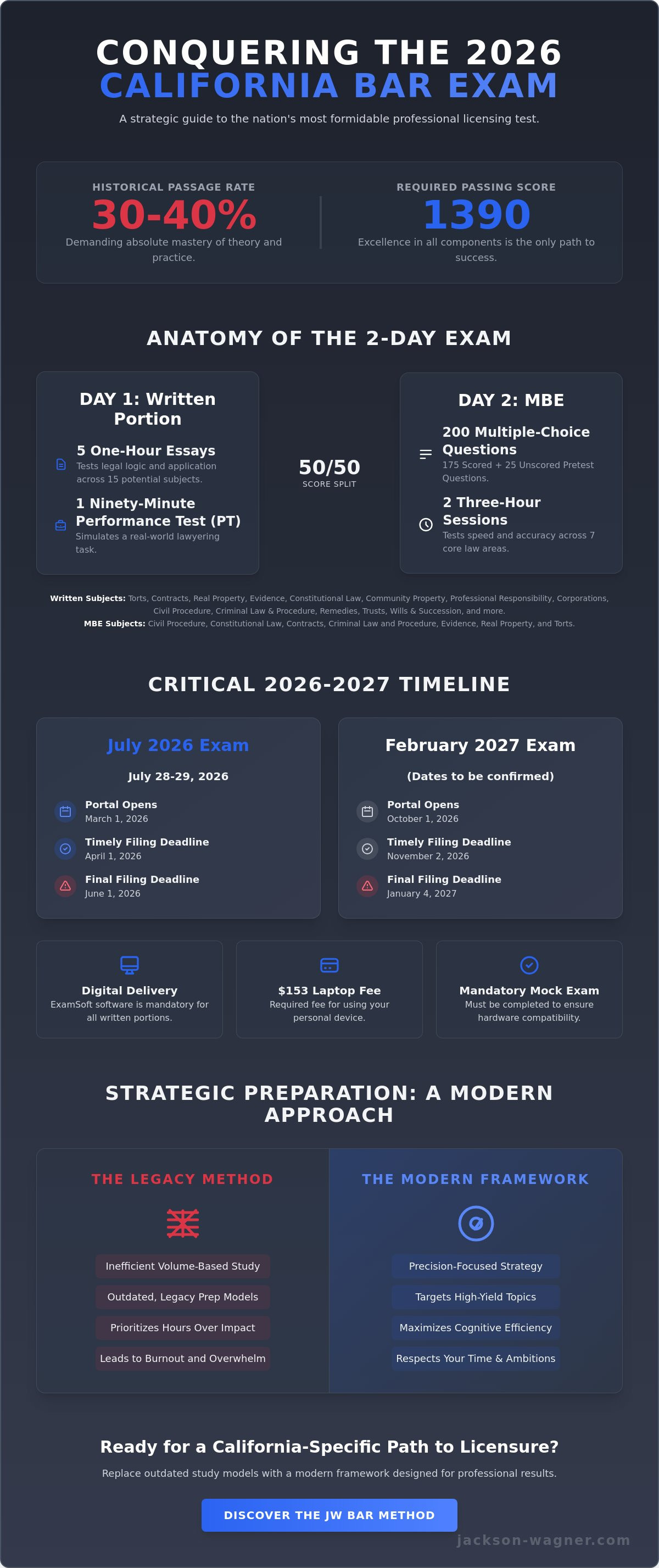
The California Bar Exam remains the most rigorous professional licensing test in the United States. It's a reputation earned through a grueling 30-40% average passage rate and a curriculum that demands absolute mastery of both theory and practice. For those targeting the 2026 cycles, the stakes are exceptionally high. The upcoming July session is confirmed for Tuesday, July 28, and Wednesday, July 29, 2026. Successfully navigating this landscape requires more than just legal knowledge; it requires a precise understanding of the technical and administrative hurdles set by the State Bar of California.
The 2026 administration marks a firm commitment to digital delivery through ExamSoft. You can't simply show up with a pen and paper. Every applicant must use a personal laptop equipped with specific security software to complete the written portions of the exam. This transition isn't just about convenience; it introduces a layer of technical compliance that can derail your performance if ignored. You'll need to pay a $153 laptop fee and complete a mandatory mock exam to ensure your hardware is compatible before the actual test dates.
Applicants must also identify their specific track early. The General Bar Exam is the standard path for most law students, but licensed attorneys from other jurisdictions may qualify for the specific Attorney’s Examination track. This version omits the Multistate Bar Examination (MBE) but doubles down on the written rigor. Choosing the wrong track or failing to meet the specific registration requirements for your category can lead to significant delays in your licensure timeline.
Critical 2026 Deadlines and Logistics
Success starts with administrative precision. Missing a filing window is a mistake you can't afford. For the July 2026 california state bar exam, the application portal opens on March 1, 2026. The timely filing deadline is April 1, 2026, while the absolute final deadline is June 1, 2026. If you're looking ahead to February 2027, the window opens on October 1, 2026, with a timely deadline of November 2, 2026, and a final cutoff of January 4, 2027.
- Laptop Registration: You must register your device and install the required software weeks before the exam.
- Mock Exams: Completion of at least one mock exam is mandatory to unlock your actual exam files.
- Fee Waivers: Certain applicants, specifically those who withdrew from or were unsuccessful in February 2025, may be eligible for fee waivers through the July 2026 cycle.
The Evolution of the California Bar
The exam has evolved from its historical three-day format into the current two-day structure. This change hasn't made the test easier; it has simply condensed the pressure. The scoring is now a balanced 50/50 split between the written portion and the MBE. To understand how to navigate this scoring weight effectively, review our Passing the California Bar Exam in 2026: The Definitive Strategic Guide. This balance means you can't afford a weak day; excellence in both essays and multiple-choice is the only reliable path to a passing score of 1390.
Anatomy of the Exam: Essays, MBE, and Performance Tests
The california state bar exam is a two-day endurance test designed to separate the prepared from the overwhelmed. To reach the required total scaled score of 1390, you must demonstrate proficiency across three distinct components: the written essays, the Multistate Bar Examination (MBE), and the Performance Test (PT). According to official exam information, the first day focuses on your ability to synthesize legal rules and apply them to complex facts, while the second day tests your speed and accuracy through 200 multiple-choice questions.
The written portion consists of five one-hour essay questions. These aren't just tests of memory; they're tests of legal logic. You'll also face one 90-minute PT, which simulates a real-world lawyering task. On the second day, the MBE covers seven core areas of law across two three-hour sessions. This section is administered by the National Conference of Bar Examiners (NCBE) and accounts for 50% of your total score. It includes 175 scored questions and 25 unscored pretest questions. Balancing these three pillars requires a structured approach rather than raw memorization.
Mastering the California Essay Subjects
The essay portion can pull from 15 different legal subjects. You must know the core subjects like Torts, Contracts, Real Property, Evidence, and Constitutional Law, but California adds its own layer of complexity. You'll need to master state-specific distinctions in Community Property, Professional Responsibility, and Wills and Trusts. Recent cycles have shown an increase in crossover essays, where a single prompt might blend Evidence with Criminal Procedure or Torts with Remedies. If you're feeling the pressure of this broad scope, the JW Bar Method Prep provides a streamlined framework to manage this complexity.
The Performance Test: The Hidden Decider
Many applicants treat the 90-minute PT as an afterthought, but it's often the section that determines whether you cross the 1390 threshold. It tests practical lawyering skills, not substantive law. You're given a File of facts and a Library of law, and you must produce a professional document under extreme time pressure. Success on the PT requires rapid analysis and a disciplined approach to drafting.
- Objective Memos: Neutral analysis of a legal issue based on the provided library.
- Persuasive Briefs: Advocacy-based writing designed to convince a court or official.
- Client Letters: Translating complex legal concepts into clear, actionable advice.
The challenge isn't finding the law; it's organizing it within the 90-minute window. Most students fail because they spend too much time reading and not enough time writing. Precision in your outlining is what leads to a passing score on this high-value section.
Admissions Requirements: Registration and Moral Character
Securing your seat for the california state bar exam involves more than just paying a fee; it requires navigating a complex administrative gauntlet that begins in the Applicant Portal. Creating an account is your mandatory first step toward licensure. This portal serves as the hub for your entire admissions journey, from initial registration to the final release of results. For current California Bar Exam Information, you should always consult the official portal to verify your specific eligibility based on your educational background.
The State Bar recognizes three primary educational paths. Graduates from ABA-accredited or California-accredited schools typically move straight to registration. However, those from unaccredited law schools or those participating in the Law Office Study Program must first pass the First-Year Law Students' Examination (FYLSX) before they can apply for the general bar. This ensures that every applicant meets a baseline of legal competence before facing the nation's most difficult professional exam. The california state bar exam doesn't just test your mind; it tests your preparation months before you sit in the exam hall.
Navigating the Applicant Portal
The registration process differs significantly between law students and practicing attorneys. Students should ideally register during their first year of study. Attorneys licensed in other jurisdictions must provide proof of good standing and may need to submit additional documentation if they seek to skip the MBE through the specific Attorney’s Examination track. The portal is also where you'll manage testing accommodation requests. These requests for physical or mental disabilities require extensive medical documentation and should be submitted months before the exam dates to ensure processing.
- Social Security Exemptions: Necessary for foreign applicants without a U.S. SSN.
- Testing Accommodations: Requires comprehensive medical history and early submission.
- Attorney Good Standing: Mandatory for those on the specific attorney track.
The Moral Character and MPRE Timeline
The most common mistake applicants make is treating the background check as a secondary task. You must file your California bar exam moral character application as early as possible. This process is a deep-dive investigation into your personal, professional, and financial history. Because the State Bar’s investigation can take 6 to 10 months, or even longer if issues arise, filing late can delay your admission to the bar even if you pass the exam itself.
Licensure also requires a scaled score of 86 or higher on the Multistate Professional Responsibility Examination (MPRE). It's a binary requirement; without it, you aren't a lawyer. Coordinate your MPRE testing dates so they don't conflict with your primary 2026 bar study schedule. For out-of-state lawyers who are already managing a full-time practice, review the California Attorney’s Exam Requirements to understand how your existing experience influences your admission path. Efficiency in these administrative tasks is just as critical as efficiency in your study method.
Strategic Preparation: Why Volume Study Often Fails
Most legacy bar prep courses operate on a flawed premise: that more information equals better results. They bury you under 10-week schedules and 8-hour daily video lectures, claiming that 100% coverage is the only way to pass. This "brute force" model is a recipe for cognitive overload. When you try to memorize every obscure rule across 15 different subjects, your brain naturally prioritizes the wrong data. For the california state bar exam, success isn't about how much you can remember; it's about how accurately you can apply high-yield rules under pressure.
Precision prep replaces volume with strategy. It identifies the patterns in how the State Bar tests specific subjects and focuses your energy there. This is especially critical for the "Attorneys Problem." Seasoned lawyers often fail this exam because they rely on their years of practice experience rather than the specific, often pedantic, rules the bar examiners require. To pass, you must stop answering like a practitioner and start answering like a bar examinee. This shift requires active recall through constant practice rather than passive video watching.
The Dangers of Generic Bar Prep
National prep courses often treat the California exam as a slightly harder version of a standard state test. They fail to emphasize the deep state-specific distinctions in areas like Community Property or Professional Responsibility. For a working professional, a one-size-fits-all schedule is impossible to maintain. You need a program that respects your existing expertise while highlighting the nuances that actually appear on the test. Review our analysis of Top California Bar Prep Programs 2026 to see why specialized methods consistently outperform legacy courses.
Building a 2026 Study Roadmap
Your roadmap must be sustainable. Calculate your "Burn Rate" by determining how many hours of high-intensity study you can actually maintain before your retention drops. Quality always beats quantity. Prioritize the MBE by starting multiple-choice drills months in advance. These questions train your brain to spot the examiners' traps. Finally, ensure your plan includes regular, timed, and graded feedback on your essays and performance tests. Without a professional critique of your writing, you're simply practicing your own mistakes.
If you're balancing a full-time career with your studies, you don't have time for the traditional 10-week grind. The JW Bar Method Accelerated Prep is designed specifically for professionals who need a high-yield, precision-focused path to licensure without the fluff of legacy models.
The JW Bar Method: A Modern Path to Licensure
The JW Bar Method is a disruptive alternative to the legacy educational models that have dominated the industry for decades. Unlike national providers that spread their resources thin across multiple jurisdictions, our pedagogical framework is built exclusively for the california state bar exam. This singular focus allows us to deliver a level of precision and depth that generic courses simply cannot match. We don't just teach the law; we teach the specific patterns and preferences of the California examiners.
Our approach is defined by a sense of bold reliability. We act as a partner in your success, so certain of our methodology that we are willing to assume the financial risk of your performance outcome through a binary performance guarantee. This commitment seeks to replace the high-stakes anxiety of the 2026 cycle with a structured, authoritative path to success. By moving away from the stress of high-pressure certification and toward a modern, reliable framework, you can approach the testing center with the confidence of a practitioner who has already mastered the material.
Accelerated Prep for Professionals
Working professionals require flexibility and efficiency, not a 10-week grind that ignores their existing expertise. The JW Bar Method Accelerated Prep for the Attorney’s Exam is specifically engineered to respect your time. We condense over 1,000 pages of dense legal material into actionable, high-yield rules that are most likely to appear on the 2026 exam. This isn't about cutting corners; it's about maximizing cognitive impact.
- Customized Feedback: We use rapid feedback loops to identify your specific structural weaknesses in essay writing.
- High-Yield Focus: Our curriculum prioritizes the subjects and "crossover" patterns that historically drive passing scores.
- Strategic Efficiency: We replace passive video consumption with active recall exercises designed for long-term retention.
Your Next Steps for 2026
Success on the california state bar exam begins with an honest evaluation of your current readiness. You must choose the track that aligns with your qualifications, whether it's the Full Exam or the specific Attorney's Exam track. Once your path is clear, the transition from student to licensed advocate requires a mentor-led environment that provides more than just books and lectures. You need a structured roadmap that accounts for the technical transitions of 2026 and the rigorous demands of the State Bar.
Don't leave your licensure to chance or outdated study habits. The 2026 administrations will reward those who prioritize strategic precision over sheer volume. If you're ready to move beyond the limitations of legacy prep and embrace a modern, results-oriented methodology, now is the time to act. Secure your spot in the 2026 JW Bar Method Program and begin your transition to authoritative confidence today.
Secure Your Future in the California Legal Profession
Facing the 2026 cycles requires more than just grit; it demands a strategic alignment with the State Bar's technical and pedagogical standards. You've seen how the transition to ExamSoft and the 1390-point threshold create a high-stakes environment where traditional study volume often fails. By prioritizing high-yield topics and active recall, you can bypass the cognitive overload that plagues many applicants. The california state bar exam is a test of both legal knowledge and mental endurance.
Our method is built with an exclusive California-only focus to ensure you aren't wasting time on irrelevant national trends. Whether you're a first-time taker or a veteran practitioner, our accelerated prep tracks condense thousands of pages into actionable rules. We're so confident in this framework that we offer a bold, performance-based financial guarantee. We assume the risk so you can focus on results. It's time to replace anxiety with authoritative confidence. Master the 2026 California Bar Exam with the JW Method and take the final step toward your professional goals. You have the tools and the roadmap; now it's time to execute.
Frequently Asked Questions
What is the pass rate for the California Bar Exam?
The average passage rate for the california state bar exam typically fluctuates between 30% and 40%. These figures vary slightly between the February and July administrations; July usually sees a higher percentage of first-time takers from ABA-accredited schools. Success requires a scaled score of 1390, making it essential to focus on high-yield subjects rather than trying to memorize every possible legal rule.
Can I take the California Bar Exam if I am already an attorney in another state?
Yes, attorneys licensed in other jurisdictions can sit for the exam. If you've been in good standing for at least four years, you qualify for the Attorney’s Examination, which omits the MBE and focuses solely on the written portions. Attorneys with less than four years of practice must complete the full two-day examination to gain licensure in the state.
How much does it cost to take the California Bar Exam in 2026?
For the 2026 cycles, first-time applicants pay a general fee of $677. Licensed attorneys pay $983 for their specific track. If you choose to use a personal laptop for the written sessions, there's an additional $153 fee for the required ExamSoft software. These costs are separate from the Moral Character application and MPRE fees required for admission.
Is the California Bar Exam going to be remote or in-person in 2026?
The July 2026 examination is scheduled to be administered entirely in person at designated test sites. While remote options were utilized during the pandemic, the State Bar has returned to physical test centers. You'll need to select your preferred testing location during the registration process through the official Applicant Portal.
What happens if I fail the Moral Character application?
If your Moral Character application is denied, you won't be admitted to the bar even if you pass the legal examination. You have the right to appeal the decision or reapply after a specified period, which is usually two years. It's vital to be transparent about your history during the background check to avoid a negative determination based on lack of candor.
How long should I study for the California Bar Exam while working?
Working professionals should plan for a study period of four to six months rather than the traditional 10-week sprint. Success while working 40 hours a week depends on precision and active recall rather than raw study volume. Focusing on high-impact practice sessions allows you to maintain professional responsibilities without sacrificing your performance on the california state bar exam.
What is the "Baby Bar" and do I need to take it?
The "Baby Bar," or First-Year Law Students' Examination (FYLSX), is a one-day test consisting of 100 multiple-choice questions. You must take it if you attend a State Bar-unaccredited law school or participate in the Law Office Study Program. It must be passed within three administrations of becoming eligible to receive credit for all law school work completed to that point.
When are the 2026 California Bar Exam results released?
Results for the July 2026 administration are scheduled for release on November 6, 2026. For those who sat for the February 2026 exam, the results will be available on May 1, 2026. You can access your specific scores and pass/fail status through the State Bar’s Applicant Portal on these designated dates.


