
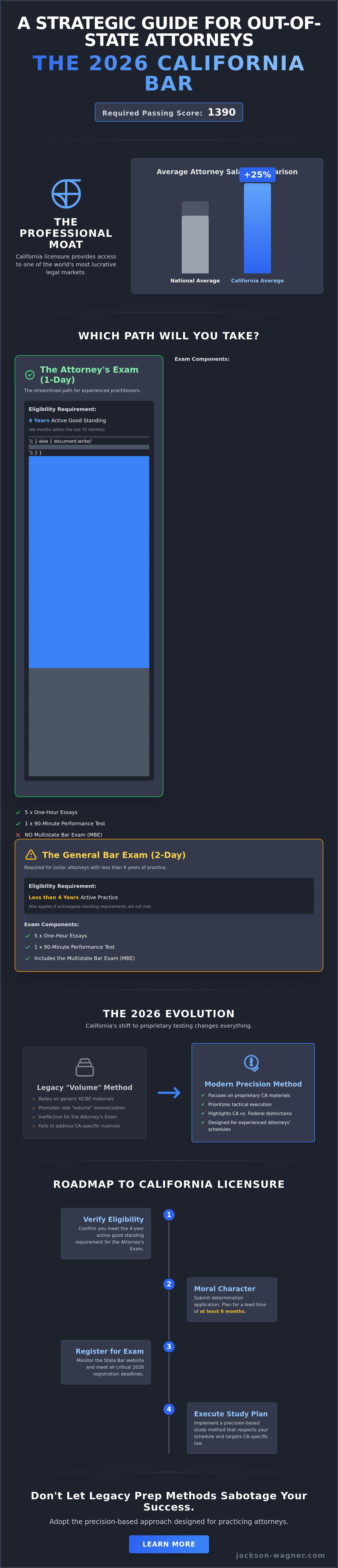
California's 1390 cut score isn't just a hurdle; it's a professional moat that protects one of the most lucrative legal markets in the world. You've already built a successful career in another jurisdiction, so the prospect of taking the california bar as an out of state attorney shouldn't feel like a regression to your 1L year. It's natural to feel anxious about the 2026 testing landscape and the information overload from legacy prep providers who demand hundreds of hours of rote memorization that simply don't fit into your schedule.
This guide provides the strategic clarity you need to master the 2026 eligibility requirements and the tactical shifts required for seasoned practitioners to secure licensure. We'll outline a streamlined path that treats your professional experience as an asset, not a hindrance. You'll learn how to qualify for the one-day Attorney's Exam, prepare for the state's move toward proprietary testing components, and implement a study method that respects your billable hour requirements while ensuring you meet the rigorous standards of the California Bar.
Key Takeaways
- Verify your eligibility for the one-day Attorney’s Exam by confirming four years of active good standing in another U.S. jurisdiction.
- Identify how California’s 2026 shift toward proprietary testing materials changes essay grading expectations and your overall drafting strategy.
- Discover why taking the california bar as an out of state attorney requires a precision-based study method that prioritizes tactical execution over legacy "volume" memorization.
- Leverage the "professional moat" of California licensure to access a legal market where average salaries sit 25% above the national average.
- Master the administrative timeline, including the essential six-month lead time for Moral Character Determination and critical 2026 registration deadlines.
Eligibility and the 2026 California Attorney’s Exam Format
California does not offer reciprocity. Licensure requires passing a rigorous examination regardless of your years in practice. For many, taking the california bar as an out of state attorney means qualifying for the one-day Attorney’s Examination. This abbreviated format is reserved for those who have been active members in good standing of another U.S. jurisdiction for at least four years immediately preceding their application. It's a specialized path designed for the experienced practitioner.
The exam structure is lean. It consists of five one-hour essays and one 90-minute Performance Test administered on a single Tuesday. The Multistate Bar Examination (MBE) is waived for these candidates. While skipping 200 multiple-choice questions sounds like a relief, it's a double-edged sword. It removes the statistical "floor" that many examinees rely on to buffer their written scores. The State Bar of California maintains a 1390 cut score. Without the MBE, your entire result rests on your ability to deliver precise, high-impact written analysis under extreme time pressure.
The 4-Year Good Standing Requirement
Calculating your eligibility requires looking at the last 72 months of your career. You must have been "active" and in "good standing" for at least 48 of those months. Time spent on inactive status or suspended for administrative reasons, such as failing to pay dues, does not count toward the threshold. You'll need to secure a Certificate of Admission and a Certificate of Good Standing from every jurisdiction where you hold a license. Strategic timing is vital. If you apply even one month before hitting the 48-month mark, you'll be forced into the two-day General Bar Exam.
The "Baby Bar" and the Junior Attorney Path
Junior attorneys with less than four years of practice don't have the luxury of the one-day exam. They must sit for the full General Bar Exam, which includes the MBE. Some applicants, particularly those from non-ABA accredited backgrounds, may be required to pass the First-Year Law Students’ Examination (FYLSX). Even when not mandated, the baby bar exam acts as a diagnostic for the full CA Bar. It tests core subjects with the same grading rigor you'll face during the final hurdle. You must decide if immediate market access is worth the two-day grind or if waiting for the four-year mark is the better tactical move for your practice.
2026 Evolution: California’s Shift to Proprietary Testing
California is leading a nationwide departure from standardized testing. By 2026, the state has accelerated its move toward proprietary testing materials, signaling a final break from the National Conference of Bar Examiners (NCBE). For those taking the california bar as an out of state attorney, this shift is seismic. It means the "general law" approach that works for the Uniform Bar Exam (UBE) is no longer sufficient. California's new testing components focus heavily on state-specific distinctions, forcing a change in how:
- Essays are drafted to meet state-specific rubrics
- Graders evaluate the depth of legal analysis
- Applicants prioritize California law over federal rules
The examiners are no longer looking for generic competency. They're looking for a mastery of the California legal landscape that national providers simply don't teach. You need a strategy that recognizes the state's desire to maintain a high barrier to entry through proprietary content.
The Sunset of Generic Bar Prep
Legacy bar prep providers rely on volume. They drown students in thousands of MBE practice questions, assuming that repetition leads to success. This strategy is particularly useless for the Attorney's Exam, which doesn't even include the MBE. Yet, national providers often fail to strip away the "fluff" from their curriculum. With California developing its own questions for the general portion, the "feel" of every written prompt has changed. You can't rely on the predictive patterns found in national materials. Precision in subjects like Evidence and Civil Procedure is now the primary scoring driver. If you don't highlight the specific nuances between the California Evidence Code and the Federal Rules of Evidence, you're leaving points on the table. The best bar exam preparation service recognizes this transition by discarding generic drills in favor of precision-based analysis. Using a UBE-focused course is a liability. Those programs are designed for portability, while California's exam is designed for exclusivity.
Mastering the California Performance Test (PT)
The 90-minute Performance Test is often the silent killer for out-of-state lawyers. Many assume their years of practice in other jurisdictions make this section an easy win. That's a dangerous assumption. The CA PT is a distinct animal compared to the UBE's Multistate Performance Test (MPT). It requires a much higher level of organizational density and a specific "voice" that graders expect. You aren't just drafting a memo; you're executing a tactical document under extreme time pressure. The grading rubric for the proprietary PT rewards efficiency and the ability to extract relevant facts from a dense "library" of simulated law. Our JW Bar Method Prep - Attorney’s Exam California Bar focuses on the "JW Method." This is a proprietary approach to document construction that ensures you hit every grading rubric requirement without getting lost in the file. You need a system that respects your professional experience while acknowledging the specific constraints of the California format.
The Professional Moat: Why California Licensure is a Strategic Asset
The California Bar is often described as a barrier. For the strategic practitioner, it's actually a filter. While other states move toward the Uniform Bar Exam (UBE) to simplify reciprocity, California’s refusal to participate creates a high-value professional moat. This exclusivity ensures that the market remains protected from the saturation seen in UBE jurisdictions, where a single score can grant access to dozens of states simultaneously. Taking the california bar as an out of state attorney is a calculated investment in a destination license that commands higher billing rates and provides access to the world's fifth-largest economy.
Prestige in national Big Law is rarely tied to portability. It's tied to the difficulty of entry. Holding a California license signals a level of competency and resilience that a "motion to admit" simply cannot convey. When you evaluate the return on investment, the 1390 cut score becomes your greatest ally. It keeps the supply of practitioners low while demand in sectors like tech, entertainment, and venture capital remains consistently high. You aren't just passing a test; you're securing a strategic asset that legacy competitors in UBE states cannot touch. With attorney salaries in California averaging 25% above the national average, the financial logic for licensure is undeniable.
California vs. UBE Jurisdictions
UBE scores are a starter license. They offer breadth but lack depth. In a UBE state, your practice is vulnerable to any attorney who can achieve a passing score elsewhere and transfer in. California offers no such backdoor. This lack of easy reciprocity is why a CA license protects your practice from market saturation. Taking the california bar as an out of state attorney means you're entering a market where the competition is as vetted as you are. You're trading the illusion of portability for the reality of market power and long-term career security.
The Attorney’s Exam as a Career Shortcut
Seasoned lawyers often view the exam with dread, yet the format actually favors the experienced mind. By leveraging your existing practice history, you can skip the MBE entirely. The California Attorney’s Exam requirements are designed to reward those who have already mastered the art of legal analysis in the real world. Instead of competing with 3Ls on rote memorization, you're competing on tactical document drafting and sophisticated issue spotting. Reframing the difficulty of the exam allows you to see it for what it is: a career shortcut to one of the most profitable legal environments on the planet.
Tactical Preparation: Why "Volume" Study Fails Seasoned Lawyers
Legacy bar prep models are built for students with empty calendars. They rely on "volume" - thousands of practice questions and hundreds of hours of video lectures. For a practitioner with a full caseload, this approach is a recipe for burnout. Taking the california bar as an out of state attorney requires a shift from knowledge acquisition to point extraction. You don't have time to relearn the rule against perpetuities in exhaustive detail. You need to focus on high-yield California subjects like Community Property and Professional Responsibility, which appear with mechanical frequency on the written portion.
The 2026 grading rubric rewards precision over prose. Graders are looking for specific California distinctions that prove you can practice in this jurisdiction immediately. They aren't interested in your ability to recite the history of common law; they want to see that you can apply the California Evidence Code to a complex fact pattern in sixty minutes. This is where most seasoned lawyers stumble. They rely on their general legal intuition, which often contradicts the specific statutory requirements of the california bar exam. You must treat the exam as a technical challenge rather than a general intelligence test.
The JW Bar Method Advantage
Our accelerated tracks are engineered for the professional reality of the billable hour. We replace the traditional "firehose" method with a structured, modern curriculum that prioritizes high-impact rules. Jackson-Wagner’s methodology focuses on the specific 1390 cut score threshold with surgical accuracy. By stripping away the administrative "fluff" found in national courses, we allow you to focus on the 20% of the law that generates 80% of your score. It's a results-oriented approach that replaces anxiety with a reliable path to success. If you're ready for a study plan that respects your professional time, explore our JW Bar Method Accelerated Prep - Attorney’s Exam California Bar.
Common Pitfalls for Out-of-State Attorneys
The most dangerous trap for an experienced lawyer is the assumption that practice experience translates to exam success. While your analytical skills are an asset, the 90-minute Performance Test is a unique proprietary instrument that requires specific tactical execution. Poor time management on the PT is the leading cause of failure for those taking the california bar as an out of state attorney. You must learn to navigate the "library" and "file" with a speed that practitioners rarely use in daily life. Respecting the exam's constraints is just as important as knowing the law. You cannot afford to treat the PT like a standard brief drafting session; it's a race against a grading rubric.
The Roadmap to Licensure: Registration and Logistics
The path to licensure is as much an administrative marathon as it is an intellectual one. Once you've committed to taking the california bar as an out of state attorney, your first priority is navigating the State Bar's online portal to establish your applicant profile. Registration for the July 2026 exam opens on March 1, 2026, while the February 2027 cycle begins on October 1, 2026. You'll need to account for the attorney's exam fee of $1,650 and the $153 laptop fee. These dates are hard deadlines. Missing the timely filing window of April 1 for the July exam results in escalating late fees that can quickly reach $250, so early registration is a tactical necessity.
A scaled score of 86 or higher on the Multistate Professional Responsibility Examination (MPRE) is a mandatory prerequisite for admission. While many practitioners passed this during law school, your score must be valid according to California's specific look-back period. If your score has expired or you never reached the 86-point threshold, you must schedule a new sitting immediately. Don't let a professional ethics exam delay your admission to the 5th largest economy in the world. Scaling this hurdle early ensures that your focus remains entirely on the written portion of the bar itself.
The Moral Character Application
The california bar exam moral character application is the most overlooked component of the process. For practicing lawyers, this review is exceptionally thorough and requires a minimum six-month lead time for processing. You must disclose every jurisdiction where you hold a license, along with any disciplinary history or administrative suspensions. Common red flags include tax liens, undisclosed lawsuits, or even minor traffic patterns that suggest a disregard for legal obligations. Start this process the moment you decide to sit for the exam. This prevents a situation where you pass the exam but remain unable to practice due to a pending background investigation.
Execution: Your 2026 Success Plan
Finalizing your 2026 study timeline requires choosing a prep track that aligns with your professional reality. While our standard programs offer a steady progression, many practitioners prefer the intensity of our accelerated tracks. We recommend setting a "no-fail" 30-day intensive window leading up to the exam dates of July 28 and 29, 2026. This period should be dedicated to tactical point extraction rather than broad reading. You've already proven your competency in practice; now you just need to prove it to the California graders. Secure your California license with the Jackson-Wagner performance guarantee. Our results-oriented methodology ensures that your study hours are converted directly into passing points.
Secure Your California Licensure Advantage
Success in 2026 hinges on recognizing the State Bar’s transition to proprietary testing and abandoning the outdated "volume-based" study models of legacy providers. You've identified that the one-day Attorney’s Exam is a career shortcut, provided you approach the 1390 cut score with surgical precision. Taking the california bar as an out of state attorney is no longer about relearning the law; it's about mastering a specific, tactical execution that respects your professional time. By focusing on high-yield California distinctions and the unique requirements of the 90-minute Performance Test, you turn a rigorous hurdle into a permanent market advantage.
Our proprietary JW Bar Method is engineered specifically for the 2026 testing shifts, offering accelerated tracks that integrate seamlessly with your billable hour requirements. We replace the anxiety of high-pressure certification with a structured, modern path to success. We're so confident in our results that we provide a binary performance guarantee for qualified candidates. Don't let generic prep courses compromise your career goals. Master the California Bar with the JW Bar Method: Accelerated Prep for Attorneys. You've already built a successful practice; now it's time to claim your place in the California legal market.
Frequently Asked Questions
Can I take the California Bar Exam if I am licensed in another state?
Yes, any attorney in good standing in another U.S. jurisdiction is eligible to sit for the exam. Your years of practice determine whether you must sit for the two-day General Bar Exam or the one-day Attorney’s Examination. California does not offer admission on motion, so passing the exam is the only path to licensure for out-of-state practitioners.
What is the "one-day" Attorney’s Exam in California?
The Attorney’s Examination is an abbreviated version of the bar exam that excludes the multiple-choice Multistate Bar Examination (MBE). It consists of five one-hour essays and one 90-minute Performance Test administered on a single Tuesday. To qualify, you must have been actively licensed in another U.S. jurisdiction for at least four of the six years immediately preceding your application.
Do I need to take the "baby bar exam" as an out-of-state attorney?
Most out-of-state attorneys are not required to take the First-Year Law Students’ Examination (FYLSX). This requirement typically applies to students at unaccredited law schools. However, junior attorneys with less than four years of practice must take the full two-day General Bar Exam. Some practitioners use the baby bar as a voluntary diagnostic tool to test their writing against California’s rigorous grading standards before the final sitting.
How much does it cost for an out-of-state attorney to take the California Bar?
The base application fee for the California Bar Exam for attorneys is $1,650. You must also pay a $153 fee to use a laptop for the written portion of the test. These fees are paid directly to the State Bar and do not include the costs associated with the Moral Character Determination or MPRE registration. Late filings can incur additional penalties up to $250.
Is there reciprocity between California and other states in 2026?
No reciprocity exists between California and any other jurisdiction in 2026. The State Bar of California maintains a strict policy requiring all applicants to pass an examination. Taking the california bar as an out of state attorney is a strategic move to enter a protected market where the lack of reciprocity creates a professional moat for those who secure licensure.
What is the passing score for the California Attorney’s Exam?
The passing score is a scaled score of 1390. Since the Attorney's Exam removes the MBE, your entire score depends on your performance on the written essays and the Performance Test. This makes precision and tactical point extraction essential, as you lack the multiple-choice "floor" that helps many candidates reach the 1390 threshold on the general exam.
How long does the Moral Character determination take for attorneys?
The State Bar recommends allowing a minimum of six months for the Moral Character Determination process. For attorneys with multi-jurisdictional histories or disciplinary records, the investigation can be more extensive. It's a separate requirement from the bar exam. You should submit your application as early as possible to ensure your background check is complete by the time you receive your passing results.
Why is California moving away from the MBE in 2026?
California is transitioning toward proprietary testing materials to better assess an applicant's ability to handle state-specific legal nuances. This shift reduces reliance on national standardized tests and allows the state to develop its own exam components that reflect the actual practice of law in California. For those taking the california bar as an out of state attorney, this means generic national prep courses are becoming increasingly obsolete.


