

Most candidates fail the California Bar Exam not because they lack legal knowledge, but because they lose the tactical war against the clock. You've likely felt the crushing weight of information overload from legacy prep courses that prioritize volume over strategy. It's easy to get lost in the nuances of the california bar exam format, especially when you're trying to determine if you need the full 2-day experience or the streamlined Attorney’s Exam.
We understand that this isn't just a test; it's the final barrier to your professional career. You need a structured, modern approach that replaces high-stakes anxiety with a reliable path to success. This tactical breakdown will help you master the structural nuances of the 2026 exam, turning your study time into a series of calculated wins rather than endless rote memorization.
We'll walk through the specific 2-day schedule, provide the exact tactics needed to conquer the 90-minute Performance Test, and clarify the path for licensed attorneys. By the end of this guide, you'll have the clarity to choose an accelerated prep path that works for your schedule and the confidence to walk into the exam room ready to execute.
Key Takeaways
- Decode the 2026 two-day gauntlet to identify exactly how to allocate your energy between the written and multiple-choice components.
- Master the california bar exam format by prioritizing the 90-minute Performance Test, a critical high-weight section often neglected by legacy prep courses.
- Determine if you qualify for the specialized one-day Attorney’s Exam, a streamlined path that eliminates the MBE for eligible practitioners.
- Transition from inefficient rote memorization to a tactical execution strategy that focuses on high-impact subjects and precision-based learning.
- Learn how accelerated prep tracks provide a modern alternative to the information overload found in traditional, outdated bar review models.
The 2026 California Bar Exam Structure: A Bird’s-Eye View
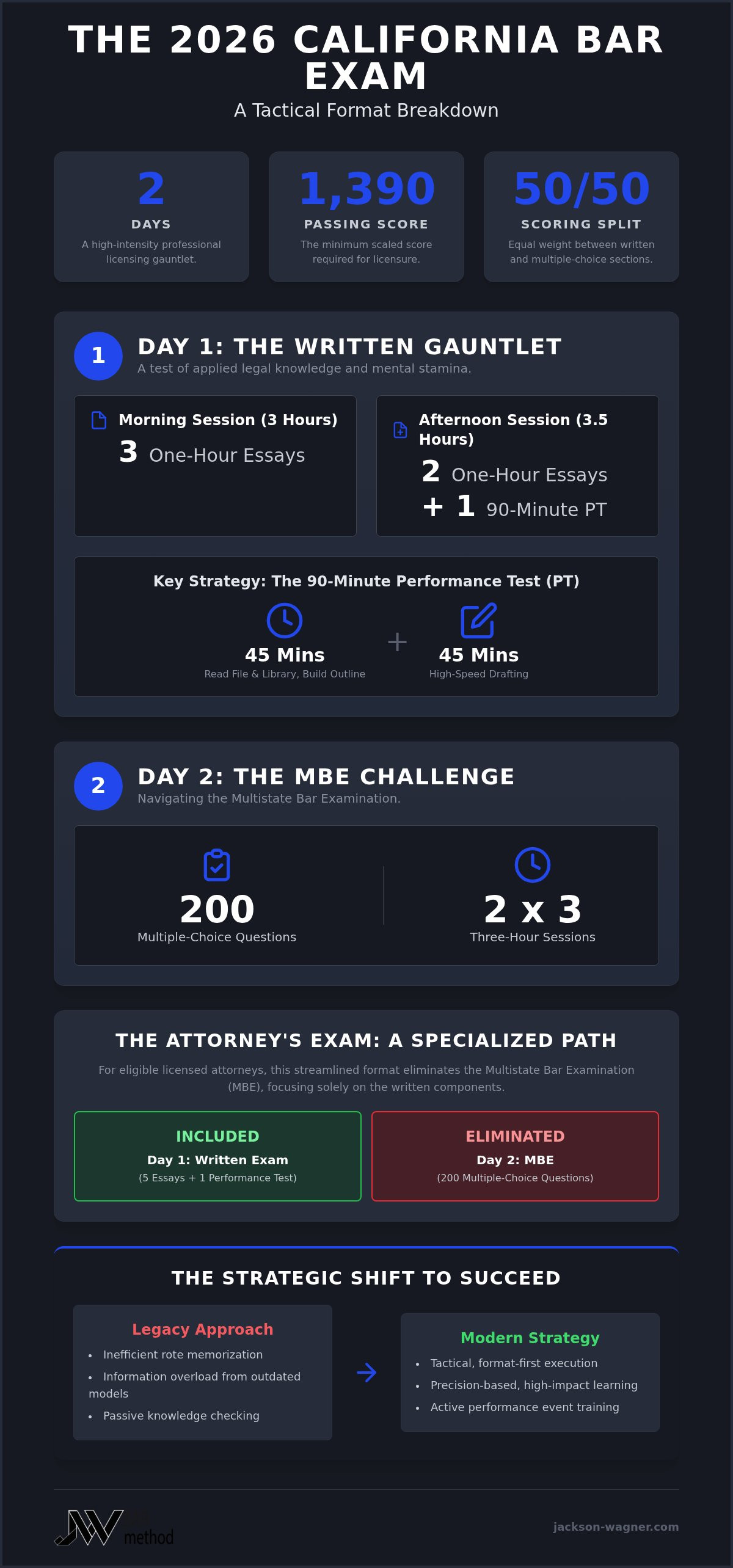
The 2026 California Bar Exam isn't just a test of what you know; it's a test of how you perform under extreme structural pressure. The current california bar exam format is a high-intensity, two-day professional licensing gauntlet designed to push your cognitive endurance to its limit. Day 1 is entirely written, consisting of five one-hour essays and a single 90-minute Performance Test (PT). Day 2 pivots to the Multistate Bar Examination (MBE), where you'll tackle 200 multiple-choice questions across two three-hour sessions. The scoring is a precise 50/50 split between the written work and the MBE, making it impossible to rely on one section to carry a poor performance in the other.
The 2026 Testing Environment
The State Bar of California has standardized a modern testing environment that prioritizes digital efficiency. In 2026, laptop testing is the baseline requirement for almost all applicants, with the administrative focus remaining on in-person testing centers. You'll need to navigate specific software requirements and laptop fees, which are part of the logistical hurdle. The most critical number to remember is 1,390; this is the minimum scaled score required for licensure. Because this score is scaled, your raw performance is adjusted against the difficulty of the specific exam version you take. For those looking for a deeper dive into the tactical nuances of these requirements, our strategic guide on the california bar exam provides the context you need to plan your study sessions effectively.
Why Format Mastery is Your Competitive Edge
Success requires a format-first mindset where understanding the clock is just as vital as knowing the law. The current california bar exam format is a significant departure from the legacy three-day versions of the past, which offered more time for recovery between sections. Today's two-day schedule demands a relentless pace. Legacy prep courses often fail because they treat the exam as a passive knowledge check rather than an active performance event. Format mastery is the ability to strategically allocate your limited mental energy across 12 hours of high-pressure testing without hitting a cognitive wall. By mastering the rhythm of the exam, you transform from a student trying to remember rules into a professional ready to execute a tactical plan.
Day 1: Mastering the Essays and the Performance Test
Day 1 of the california bar exam format is a test of sheer mental stamina. You'll spend six and a half hours in the testing room, excluding breaks, proving your ability to apply complex legal rules to dense factual patterns. The morning session is a three-hour block dedicated to three one-hour essays. The afternoon session is slightly longer, requiring two more one-hour essays followed immediately by the 90-minute Performance Test (PT). Graders look for a disciplined IRAC (Issue, Rule, Analysis, Conclusion) structure. Don't waste time on flowery language. Focus on clear rule statements and exhaustive analysis to maximize your point potential.
Tactical Execution of the 90-Minute PT
The PT is a "closed universe" exercise designed to simulate real-world lawyering skills. You aren't expected to bring any outside legal knowledge into this section. Success on the PT within the California Bar Examination Components hinges on a strict 45/45 time management strategy. Spend exactly 45 minutes reading the "File" and "Library" while building a comprehensive outline. Use the final 45 minutes for high-speed drafting. This prevents you from getting lost in the "Library" or being misled by distractor facts. In 2026, you should be prepared to produce professional documents like a legal memorandum, a persuasive brief, or a client letter.
The Essay Subject Pool
The examiners can pull from a pool of 13 potential subjects. This includes core Multistate topics like Torts and Contracts, as well as California-specific subjects like Community Property and Trusts. It's common to encounter "crossover" essays where multiple subjects, such as Evidence and Criminal Procedure, appear in a single prompt. Strategically, you must recognize that Professional Responsibility is a near-certainty on every exam. Because it often appears as a standalone essay or a crossover issue, mastering this subject provides a high return on investment. If you're looking for a more efficient way to tackle these subjects, consider the JW Bar Method for a streamlined approach.
Day 2: Navigating the Multistate Bar Examination (MBE)
If Day 1 was a sprint of creative legal writing, Day 2 is a marathon of analytical precision. The Multistate Bar Examination (MBE) is a 200-question, six-hour test administered in two rigorous three-hour blocks. According to the Official California Bar Exam Format, only 175 of these questions are actually scored. The remaining 25 are "experimental" pre-test questions used by the NCBE to calibrate future exams. Because you can't distinguish between a scored question and an experimental one, you must treat every prompt with the same level of tactical intensity.
The subjects tested are strictly limited to seven core areas of law: Civil Procedure, Constitutional Law, Contracts, Criminal Law and Procedure, Evidence, Real Property, and Torts. Success in the 2026 california bar exam format requires more than just knowing the rules; you must master the ability to identify "distractor" answers that are designed to look legally sound but are factually inapplicable. Precision beats volume every time in this environment.
The Mechanics of the 1.8-Minute Question
Timing is the primary reason high-achieving students fail the MBE. You have exactly 1.8 minutes per question. If you spend three minutes debating a single Evidence prompt, you're effectively stealing time from three other questions later in the block. The 2026 california bar exam format remains consistent in its demand for rapid-fire legal analysis. We recommend a "triage" system for difficult questions: if you don't recognize the specific legal pivot within 40 seconds, make a tactical guess and move on. Protecting your pace is more important than solving any single outlier question. The NCBE drafts these questions to be challenging, but they're predictable once you understand the recurring patterns they use for California candidates.
MBE Scoring and Scaling
Understanding the difference between your "raw score" and your "scaled score" is essential to demystifying your results. Your raw score is the number of questions you answer correctly out of 175. The State Bar then applies a statistical scaling formula to ensure that an applicant's score reflects the same level of difficulty regardless of which exam cycle they participate in. A strong performance on the MBE is a powerful asset because it can "subsidize" a weaker performance on the written portion of the exam. If you're ready to move beyond generic question banks, utilizing the best bar exam preparation service ensures your practice drills focus on precision rather than empty volume.
The California Attorney’s Exam Format: A Specialized Path
For lawyers who've been in good standing for at least four years in another jurisdiction, the State Bar offers a streamlined yet unforgiving alternative. This one-day event is a 100% written gauntlet. It eliminates the MBE entirely, focusing exclusively on your ability to synthesize law and facts on paper. While this sounds like a reprieve, the california bar exam format for attorneys actually raises the stakes. There is no multiple-choice safety net to catch you if a specific essay topic catches you off guard. It is a test of pure, high-speed legal writing and analysis.
Full Bar vs. Attorney’s Exam Comparison
| Feature | Full General Bar Exam | Attorney's Exam |
|---|---|---|
| Duration | 2 Days | 1 Day |
| Written Portion | 5 Essays + 1 PT | 5 Essays + 1 PT |
| MBE Portion | 200 Questions | None |
| Total Testing Hours | ~12 Hours | ~6.5 Hours |
This format is the definition of high-risk, high-reward. You save a full day of testing, but you must be perfect in your execution. You should review the california attorney’s exam requirements to ensure your out-of-state standing meets the strict 2026 criteria before committing to this path. Many candidates choose the 1-day option to minimize time away from their practice, but they often underestimate the mental fatigue that comes with six consecutive hours of writing.
The "Un-Learning" Process for Seasoned Lawyers
The biggest hurdle for practicing attorneys isn't the law itself; it's their own professional experience. In your daily practice, you write to persuade a judge or advise a client. On the Bar, you write to satisfy a rigid, academic rubric. Real-world legal writing often omits the "obvious" steps that graders require for full credit. Mastering the 2026 grading standards requires you to "un-learn" your professional habits and return to a strict, formulaic IRAC structure. Because you're likely balancing a full-time practice, an accelerated, structured prep track is essential for success. You don't have time for the fluff of legacy courses; you need precision.
To maximize your efficiency and ensure you hit every mark on the grader's checklist, explore our JW Bar Method Prep - Attorney’s Exam California Bar for a results-oriented approach.
Strategic Preparation: Why Format Mastery Trumps Rote Memorization
Legacy industry standards are failing modern candidates by equating volume with competence. Success in the 2026 california bar exam format requires a sharp pivot from rote memorization to tactical precision. While traditional courses bury you in exhaustive outlines, the JW Bar Method focuses on high-impact subjects that actually determine your score. Over-studying legal nuances that rarely appear on the exam is more than just a waste of time; it's a tactical error that leads to cognitive fatigue and diminished returns.
The 2026 requirement for stamina cannot be overlooked. You're preparing for a two-day marathon that demands 12 hours of peak performance across the written and MBE portions. Building this mental muscle requires a study plan that simulates the actual testing environment rather than just passive reading. Jackson-Wagner stands as the modern alternative to outdated, high-pressure models, providing a streamlined path that respects your time and mental health.
The JW Bar Method Advantage
Our structured prep replaces high-stakes anxiety with a reliable, repeatable path to success. We recognize that today's candidates are often juggling professional responsibilities, which is why our accelerated prep is superior for the modern learner who requires flexibility. We don't just hope you pass; we've built a system so effective that it includes a binary performance guarantee. This focus on measurable outcomes establishes absolute trust and ensures our interests are perfectly aligned with your results. By mastering the california bar exam format through our lens, you gain the confidence to execute when the clock starts.
Your Next Steps to Licensure
Achieving your license in 2026 requires clearing several administrative hurdles alongside the exam itself. Ensure your Moral Character application is underway and that you've secured your MPRE score of 86 or higher. Your final decision is choosing the right preparation track. Whether you opt for the JW Bar Method Prep - Full Exam California Bar or the JW Bar Method Accelerated Prep - Full California Bar Exam, you're choosing a precision-based methodology over legacy volume. Secure your path to success with the JW Bar Method.
Take Command of Your 2026 Licensure Strategy
The 2026 california bar exam format is a rigorous test of endurance, but it's one you can conquer with the right methodology. You now understand that mastering the timing of the Performance Test and the analytical precision of the MBE is far more valuable than memorizing endless outlines. By focusing on high-impact subjects and disciplined IRAC structures, you transform the stress of Day 1 and Day 2 into a series of manageable, strategic wins. Success isn't about how much you read; it's about how effectively you execute under pressure.
We provide a modern alternative to outdated, volume-heavy prep. Our accelerated prep for busy professionals is designed for those who require flexibility and results without the information overload. Because we're so confident in our California-exclusive expertise, we provide a binary performance guarantee that establishes absolute trust in your outcome. Don't settle for legacy industry standards when you can have a structured, reliable path to success. Master the California Bar with the JW Bar Method. Your journey to becoming a California attorney is within reach; let's execute your plan with precision.
Frequently Asked Questions
What is the schedule for the 2026 California Bar Exam?
The 2026 California Bar Exam follows a strict two-day schedule. For the July 2026 administration, the dates are Tuesday, July 28, and Wednesday, July 29. Day one is dedicated to the written portion, which includes five one-hour essays and one 90-minute Performance Test. Day two focuses on the Multistate Bar Examination (MBE), consisting of 200 multiple-choice questions administered in two three-hour sessions. This structure requires intense stamina and tactical preparation.
How long is the California Performance Test (PT)?
The California Performance Test (PT) is exactly 90 minutes long. This "closed universe" exam requires you to complete a specific lawyering task, such as drafting a memorandum or a client letter, using only the provided "File" and "Library." Success within the california bar exam format depends on a disciplined 45/45 time split: 45 minutes for reading and outlining, and 45 minutes for drafting your response. Precision during this window is critical for securing a high written score.
What subjects are tested on the California Bar Exam essays?
The State Bar of California tests 13 potential subjects on the essay portion of the exam. These include Business Associations, Civil Procedure, Community Property, Constitutional Law, Contracts, Criminal Law and Procedure, Evidence, Professional Responsibility, Real Property, Remedies, Torts, Trusts, and Wills and Succession. Professional Responsibility is tested on virtually every exam, either as a standalone prompt or as a crossover issue with other subjects. You must be prepared to synthesize multiple subjects within a single one-hour prompt.
Can I take the California Attorney’s Exam if I am licensed in another state?
You are eligible to take the California Attorney’s Exam if you've been licensed and in good standing in another United States jurisdiction for at least four years. This specialized version of the california bar exam format is a one-day written test that excludes the MBE portion. It consists of five one-hour essays and the 90-minute Performance Test, all administered on the first day of the general exam. It's a high-stakes path for experienced legal professionals.
What is a passing score for the California Bar Exam in 2026?
The minimum passing score for the California Bar Exam is a scaled score of 1,390. This score is a combined total from both the written portion (essays and PT) and the MBE portion, with each half weighted at 50%. Because the score is scaled to account for the relative difficulty of different exam versions, your raw score is adjusted through a statistical formula. This ensures fairness across administrations, regardless of the specific difficulty of your test.
Is the California Bar Exam multiple choice or essay-based?
The exam is a hybrid of both multiple-choice and essay-based questions. The current format is a two-day event where the first day is entirely written, featuring five essays and a Performance Test. The second day is entirely multiple-choice, using the Multistate Bar Examination (MBE). This structure ensures that candidates possess both the analytical skills for rapid-fire questions and the writing skills required for complex legal analysis. You won't pass by excelling in only one of these areas.
How many questions are on the MBE portion of the CA Bar?
There are 200 multiple-choice questions on the MBE portion of the exam. However, only 175 of these questions are scored. The remaining 25 are experimental "pre-test" questions used by the NCBE to evaluate future exam materials. Since these experimental questions are indistinguishable from the scored ones, you must approach all 200 questions with the same level of tactical precision during the two three-hour testing blocks. Managing your pace is the only way to finish on time.
What happens if I fail one portion of the exam but pass the other?
You cannot "bank" a passing score on one portion if you fail to reach the 1,390 threshold overall. You must achieve the required scaled score across both the written and MBE portions during a single exam administration. If your total score falls below 1,390, you must retake the entire two-day exam. The only exception is for those taking the Attorney's Exam, who are only graded on the written portion during their specific one-day schedule.


