
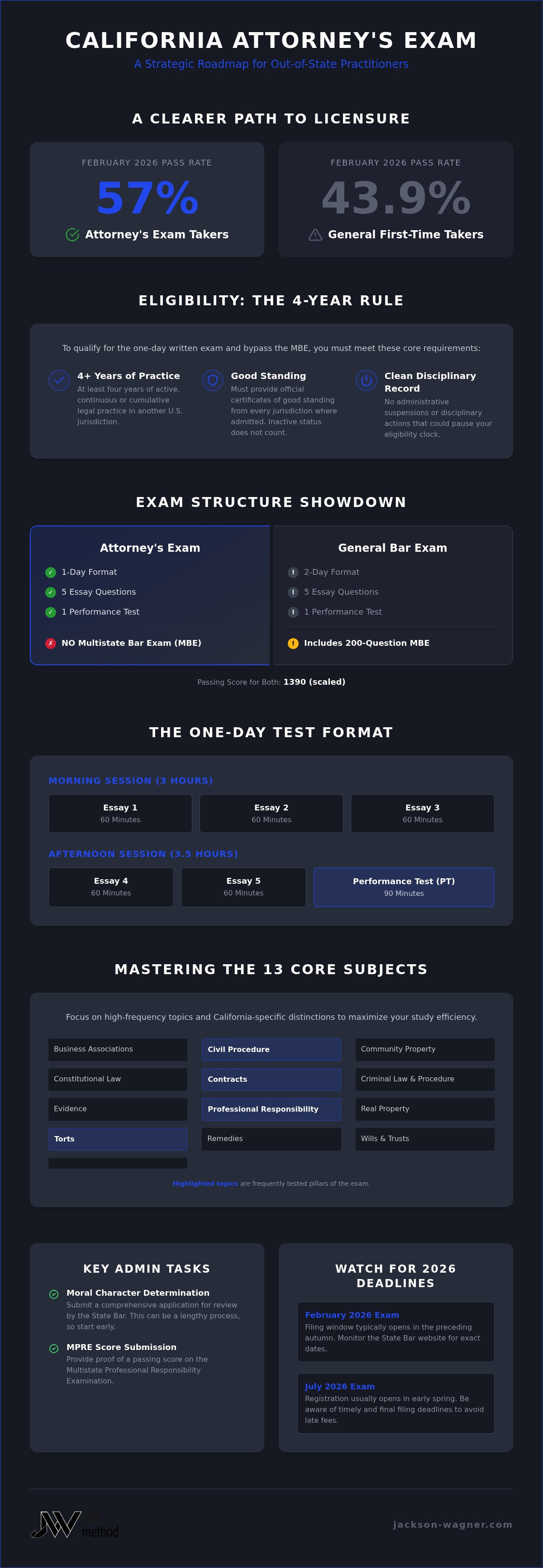
With a February 2026 pass rate of 57% for the Attorneys' Exam compared to a 43.9% rate for general first-time takers, the path to a California license is significantly wider for practitioners who understand the california attorney's exam requirements. However, many qualified lawyers still hesitate because they view this test as an insurmountable wall rather than a strategic hurdle. You've spent years building a successful practice; the thought of returning to the law school grind of the MBE is likely exhausting. You shouldn't have to sacrifice your billable hours to navigate a maze of administrative hurdles or second-guess your eligibility.
This guide will strip away the confusion to provide you with a definitive roadmap for your licensure. We'll help you master the eligibility rules and application deadlines so you can bypass the Multistate Bar Examination entirely. You'll gain the clear confirmation you need to move forward with absolute certainty. We'll explore the strict 4-year practice rule, clarify the 2026 filing windows for both the February and July sessions, and introduce a streamlined methodology designed specifically for the professional schedule. By the end of this guide, you'll have the confidence to pass on your first attempt without the fluff of traditional bar prep.
Key Takeaways
- Confirm your eligibility by verifying at least four years of active practice in good standing within another U.S. jurisdiction to qualify for the shortened exam track.
- Master the high-intensity, one-day testing format that focuses exclusively on five essays and one Performance Test while bypassing the Multistate Bar Examination.
- Stay ahead of the 2026 registration cycle by identifying the critical filing windows and fee structures for both the February and July exam dates.
- Navigate the essential administrative california attorney's exam requirements, including the Moral Character Determination and MPRE score submission, to avoid licensing delays.
- Accelerate your success by pivoting from traditional, volume-based study habits to a practitioner-focused methodology designed for busy legal professionals.
The 4-Year Rule: Eligibility for the California Attorney's Exam
The Attorney's Exam isn't just a shorter test; it's a recognition of your professional standing as an experienced practitioner. To bypass the Multistate Bar Examination (MBE) in 2026, you must meet specific california attorney's exam requirements that differentiate you from law students. This track is reserved for lawyers admitted to practice in another U.S. jurisdiction who possess a clean disciplinary record. The State Bar of California establishes these parameters to ensure that only those with a proven track record of practice qualify for the streamlined one-day written format. While the Full Bar Exam is a two-day endurance test, the Attorney's Exam track allows you to focus exclusively on legal analysis and writing.
Defining 'Good Standing' and Active Practice
Verification is a rigorous process. California doesn't simply take your word for it; they require official certificates of good standing from every jurisdiction where you're admitted. A common point of confusion involves "active" versus "inactive" status. If you've moved to inactive status to reduce bar dues or while working in a non-legal role, that time generally won't count toward your eligibility. Administrative suspensions can also create hurdles. Even a minor suspension for missing a CLE deadline or late dues payment can pause your clock. You must resolve these discrepancies in your home state before your California application can proceed. The four-year practice requirement is defined as a continuous or cumulative period of active licensure in good standing immediately preceding the exam date.
Attorneys with Less Than Four Years of Experience
If you haven't yet reached the four-year milestone, the path to licensure changes. Junior attorneys are legally mandated to take the Full California Bar Exam, which includes the 200-question MBE. You face a strategic decision: test now and tackle the multiple-choice section, or wait until your experience matures to qualify for the written-only track. Testing early requires a different level of preparation and a mastery of broader testing formats. If you decide to move forward before hitting the four-year mark, you'll need a comprehensive plan like the one found in our guide on Passing the California Bar Exam in 2026: The Definitive Strategic Guide. Understanding these california attorney's exam requirements early prevents wasted registration fees and ensures you select the most efficient route for your career timeline.
Understanding the Exam Structure: Essays and Performance Tests
The California Attorney's Exam is an exercise in professional precision. Unlike the general bar exam, this one-day marathon removes the multiple-choice burden and focuses entirely on your ability to analyze and communicate legal principles under pressure. You must secure a scaled score of 1390 to earn your license in 2026. This requires a strategic pivot; you aren't just proving you know the law, you're proving you can apply it within the specific constraints of the california attorney's exam requirements. The clock is your primary adversary, demanding that you move from a blank screen to a sophisticated legal analysis in sixty-minute increments.
The Five Essay Questions: Subject Coverage
Preparation begins with mastering 13 potential subjects. While this sounds daunting, the examiners frequently return to core pillars such as Civil Procedure, Torts, and Contracts. However, the real danger for out-of-state practitioners lies in the "California distinctions." You cannot rely on general common law for subjects like Community Property or Wills and Trusts; the State Bar expects you to know the specific statutes that govern the Golden State. Professional Responsibility is also a guaranteed component, often tested through the lens of California's unique ethical rules. To maximize your limited study time, the JW Bar Method Prep - Attorney’s Exam California Bar prioritizes these high-frequency topics, ensuring you don't waste energy on obscure theories that rarely appear on the exam.
The 90-Minute Performance Test (PT)
The Performance Test is the centerpiece of the afternoon session. It simulates a real-world legal task, such as drafting a memorandum to a partner or a closing argument, using a closed universe of provided facts and "library" cases. Many experienced attorneys fail this section because they rely too heavily on their actual practice style. The Bar's rubric is rigid; it rewards organization and adherence to the specific instructions in the "Task Memo" rather than creative lawyering or outside legal knowledge. It's vital to recognize that the PT is worth twice as much as a single essay in the final score calculation. Because of this heavy weighting, mastering the PT format is often the difference between a passing score and a repeat attempt. For the most current subject lists and formatting guidelines, always consult the official California Bar Admission Requirements before beginning your final review. Understanding these california attorney's exam requirements allows you to approach the PT with the mindset of a tester, not just a practitioner.
Administrative Requirements: Moral Character and the MPRE
Securing a passing score on the written exam is a monumental achievement, but it's only one half of the california attorney's exam requirements. The State Bar of California employs a rigorous vetting process to ensure every new admittee meets the highest ethical and professional standards. You must clear two distinct administrative hurdles: the Moral Character Determination (MCD) and the Multistate Professional Responsibility Examination (MPRE). These are not mere formalities. They are comprehensive investigations that can stall your licensure for months if you approach them with a casual mindset. If you have a history of out-of-state discipline, even a private reprimand, you should expect an exhaustive inquiry into your fitness to practice law in California.
The MPRE for Practicing Lawyers
The MPRE is a mandatory component for all attorneys seeking California licensure. You must achieve a scaled score of 86 or higher to satisfy this requirement in 2026. While you may have taken this exam years ago in another jurisdiction, you must ensure your score meets California's specific threshold and that the National Conference of Bar Examiners (NCBE) can still officially report it. California generally accepts older scores, but the burden of proof rests entirely on you. If your previous jurisdiction required a lower passing score, you might need to sit for the MPRE again to align with California's stricter standards. Do not leave this until the last minute; a missing MPRE score will prevent you from being sworn in even if you pass the Attorney's Exam.
The Moral Character Application Process
The MCD application is an intensive deep dive into your personal and professional history. You'll need to submit live-scan fingerprints, a comprehensive employment history, and multiple professional references who can attest to your integrity. For a detailed breakdown of this complex filing, consult our guide on Decoding the California Bar Exam Moral Character Application: A 2026 Strategic Guide.
Transparency is your primary defense during this investigation. You are required to disclose past litigation, financial issues, or minor professional infractions from any jurisdiction. The State Bar prioritizes your "Duty of Disclosure" over your personal "Right to Privacy" in this context. Omission is often viewed more severely than the underlying issue itself; an honest disclosure of a past credit problem is manageable, but a hidden one is often disqualifying. Processing times for these applications typically range from six to eight months. We strongly recommend filing your MCD application at least six months before your intended exam date to ensure your administrative path is clear by the time you receive your results. Don't let a clerical delay or a slow background check stall your transition into the California legal market.
Registration Logistics: 2026 Deadlines and Fees
Missing a deadline is the most preventable form of failure. You've worked too hard to let a calendar oversight derail your licensure. Mastering the california attorney's exam requirements starts with the Applicant Portal. You must navigate a strict timeline that penalizes procrastination with significant late fees. Treating the administrative calendar with the same precision as your legal analysis ensures that your path to the February or July 2026 exam remains clear and cost-effective.
2026 Application Calendar
For the February 24-25, 2026 exam, the timely filing window opens on October 1, 2025, and closes on November 1, 2025. If you miss this initial window, you can still file during the late period from November 2 to November 30, though you'll incur additional costs. The final cutoff for the February session is January 2, 2026. For the July 28-29, 2026 cycle, you must file between March 1 and April 1, 2026. Testing accommodations requests for the February exam are due by January 1, 2026, while the July deadline is June 1, 2026. It's vital to remember that the laptop certification deadline is separate from the exam registration; failing to certify your software can force you to handwrite your answers under intense pressure.
Total Estimated Cost of Licensure
Budgeting for the California Bar is about more than just the registration fee. While the attorney applicant fee is approximately $1,500, you must also account for the estimated $153 laptop fee and the $150 MPRE registration. Hidden costs often surprise practitioners who don't plan ahead. You'll need to pay for live-scan fingerprinting services and official certificates of good standing from every jurisdiction where you're admitted. These administrative costs can easily exceed $2,000 when fully aggregated. For a deeper look at managing these logistics, read our guide on How to Navigate the State Bar of California: A 2026 Guide to Licensure Success.
Withdrawal and refund policies are notoriously rigid. If your practice demands force a deferral, you'll likely lose a significant portion of your fees depending on how close you are to the exam date. The State Bar generally doesn't offer full refunds for change-of-mind or work conflicts. Don't let the financial and administrative burden overwhelm you. You can streamline your path and protect your investment by choosing a prep program that respects your professional schedule. Secure your spot and start your journey with the JW Bar Method Prep - Attorney’s Exam California Bar to ensure your administrative efforts lead to a first-time pass.
Strategic Preparation: The JW Bar Method Advantage
Traditional bar prep is a relic. It's built for law students with infinite time and zero professional experience. As a practitioner, your greatest asset, your real-world experience, can actually be a liability if you don't know how to filter it through the california attorney's exam requirements. You don't need a 400-hour video library or thousands of multiple-choice questions. You need a surgical strike on the specific writing patterns that satisfy California graders. We've designed a methodology that replaces the "brute force" memorization of legacy models with a structured, pedagogical approach that respects your professional schedule.
Precision Over Volume
The JW Bar Method focuses on the "Practitioner's Pivot." This involves adapting your sophisticated legal drafting to the rigid, often pedantic rubric used by the State Bar. While you might write nuanced briefs for a judge, the Bar rewards a specific hierarchical structure and explicit rule-to-fact application. Our curriculum for the JW Bar Method Prep - Attorney’s Exam California Bar is built specifically for the 2026 format. We isolate the writing patterns that allow you to "score hunt" effectively, ensuring you hit every required element of the grading scale without wasting time on irrelevant legal theory. This focused approach is why our students can successfully prepare in just 30 to 45 days while maintaining a full-time caseload.
Maximizing Your Performance Test Score
The 90-minute Performance Test is your strategic safety net. It accounts for a massive portion of your written score, yet most programs treat it as an afterthought. We use high-stakes drills to sharpen your timing and organization, ensuring you can produce a passing work product in a fraction of the time you'd spend in your office. Because the PT is worth twice as much as a single essay, mastering this section is the most efficient way to secure a passing 1390 scaled score. We don't just give you practice tests; we give you a repeatable system for navigating the "library" and "file" with professional speed.
We are so confident in this modern, disruptive approach that we assume the financial risk of your performance. Unlike legacy providers who offer vague promises, we provide a binary performance guarantee that establishes a sense of absolute security. We act as your partner in this process, providing a streamlined roadmap that removes the anxiety of the "hardest bar exam in the US." If you're ready to bypass the volume and focus on results, you can secure your 2026 license with the JW Bar Method Accelerated Prep and join the ranks of California practitioners with confidence.
Secure Your California Future in 2026
Mastering the california attorney's exam requirements is about more than just legal knowledge; it's about administrative precision and strategic study. You now have the definitive roadmap for the 4-year eligibility rule, the 2026 registration deadlines, and the specific structure of the one-day written exam. By focusing on high-yield topics and the heavily weighted Performance Test, you can bypass the MBE and transition into the California legal market with speed and efficiency.
Don't let the reputation of the "hardest bar exam" stall your career growth. We provide a specialized Attorney's Exam track that respects your time and your professional expertise. With our accelerated 30-day prep options and a binary performance guarantee, we assume the risk so you can focus on the result. You've already built a successful practice; it's time to bring that excellence to the Golden State. We're ready to help you cross the finish line.
Pass the 2026 Attorney's Exam with the JW Bar Method
Frequently Asked Questions
Can I take the California Attorney's Exam if I am currently inactive in my home state?
You cannot qualify for the abbreviated track if your current status is inactive. One of the primary california attorney's exam requirements is that you must be in active status and good standing for at least four consecutive years in another U.S. jurisdiction. If you've moved to inactive status to reduce dues or while working in a non-legal role, you'll need to reactivate your license and potentially wait until you've met the cumulative active practice threshold before applying.
How many days is the California Attorney's Exam in 2026?
The California Attorney's Exam is a one-day testing event in 2026. This written-only track consists of five one-hour essay questions and one 90-minute Performance Test administered in a single high-intensity session. This differs from the general bar exam, which is a two-day marathon including the Multistate Bar Examination (MBE). By qualifying for the attorney track, you effectively bypass the second day of multiple-choice testing entirely, focusing purely on legal analysis and drafting.
What is the passing score for the California Attorney's Exam?
You must achieve a minimum passing score of 1390 out of 2000 on the scaled grading system. This threshold applies to both the general bar exam and the written-only attorney track. Because the Attorney's Exam consists only of essays and a Performance Test, your score is derived entirely from your written performance. Achieving this number requires a strategic mastery of the grading rubric, as there is no multiple-choice section to buffer your final results or offset a weak essay.
Do I have to take the MPRE if I've been practicing for 20 years?
Yes, every applicant must satisfy the MPRE requirement regardless of their years of practice. California requires a scaled score of 86 or higher. While you likely took the MPRE decades ago, you must ensure your score was officially reported to the State Bar or sit for the exam again. There are no seniority exemptions for this ethical requirement. It's a mandatory administrative step that must be completed before you can be officially sworn in as a member of the bar.
What happens if I fail the Attorney's Exam but pass the ethics portion?
If you fail the written exam, you must register for a future session and retake the entire one-day test. However, if you've already achieved a passing score of 86 on the MPRE, that score remains valid and you don't need to repeat the ethics portion. Your Moral Character Determination also stays active for a specific period after approval. This allows you to focus your subsequent prep entirely on the essays and Performance Test without repeating these administrative hurdles.
Is the Attorney's Exam easier than the full California Bar Exam?
The Attorney's Exam isn't "easier" in terms of content, but it's more efficient for experienced practitioners. While it removes the MBE, it places 100% of the grading weight on your written analysis. For many, this is a relief, but it requires a different kind of intensity. Understanding the california attorney's exam requirements means recognizing that you have no margin for error in your essays. Success depends on your ability to pivot from real-world drafting to Bar-specific writing.
How long does the Moral Character determination take to process in 2026?
Processing times for the Moral Character Determination typically range from six to eight months in 2026. Because this investigation involves fingerprinting, employment verification, and reference checks across multiple jurisdictions, delays are common. You should file your application as early as possible, ideally six months before your intended exam date. This ensures that your background check is finalized by the time you receive your passing results, preventing a bottleneck in your final licensure after the test.
Are there any exemptions to the 4-year practice requirement?
There are no exemptions to the four-year practice rule for the written-only track. If you've been licensed for less than four years, you are legally classified as a general applicant and must take the full two-day exam, including the MBE. The State Bar of California maintains this strict threshold to ensure that only seasoned practitioners can bypass the multiple-choice portion. If you're close to the four-year mark, it's often strategic to wait rather than testing early.


