
The 1390 passing score isn't a measurement of your legal potential, it's a gatekeeper that rewards strategy over brute-force memorization. Most applicants fail because they treat all california bar exam subjects with equal importance, drowning in a sea of rules while their professional lives suffer. You don't need to memorize every nuance of the law to succeed; you need a high-efficiency approach that targets the specific areas where points are actually won.
It's exhausting to balance a demanding career with the fear of the nation's most rigorous licensing test. This strategic masterlist promises to streamline your preparation by focusing on a clear hierarchy of high-yield subjects designed for the July 2026 exam. We'll preview the essential California-specific distinctions and provide a structured study guide that builds the confidence you need to pass on your first attempt. It's time to replace legacy study habits with a results-driven methodology that respects your time and your professional goals.
Key Takeaways
- Learn how to navigate the 1390 hurdle by prioritizing the 15+ legal subjects according to their weight and frequency on the 2026 exam.
- Master the "Seven Pillars" of the california bar exam subjects that double as MBE topics to ensure you're capturing the highest possible point yield.
- Differentiate between federal rules and California-specific variations so you don't lose critical points on the essay portion.
- Replace passive study traps with active recall and the 80/20 rule to focus your limited time on the rules that actually matter.
- See how a specialized, California-only approach, such as the Jackson-Wagner LLC Bar Method, outperforms generic national courses for modern professionals.
The 2026 California Bar Exam Landscape: Why Subjects Matter
The California Bar Exam isn't just another test; it's a professional gauntlet. Administered by the State Bar of California, this assessment evaluates your mastery of 15+ legal subjects over a grueling two-day period. In 2026, California remains the most rigorous jurisdiction in the nation. The reason is simple: the "1390" passing score. While other states lower their standards, California maintains a high bar that demands more than just basic knowledge. You need a complete psychological shift. Law school taught you how to think like a lawyer, but passing this exam requires you to execute like a practitioner under extreme pressure. Success depends on how you prioritize the vast list of california bar exam subjects to meet that 1390 threshold.
The Two-Day Marathon Structure
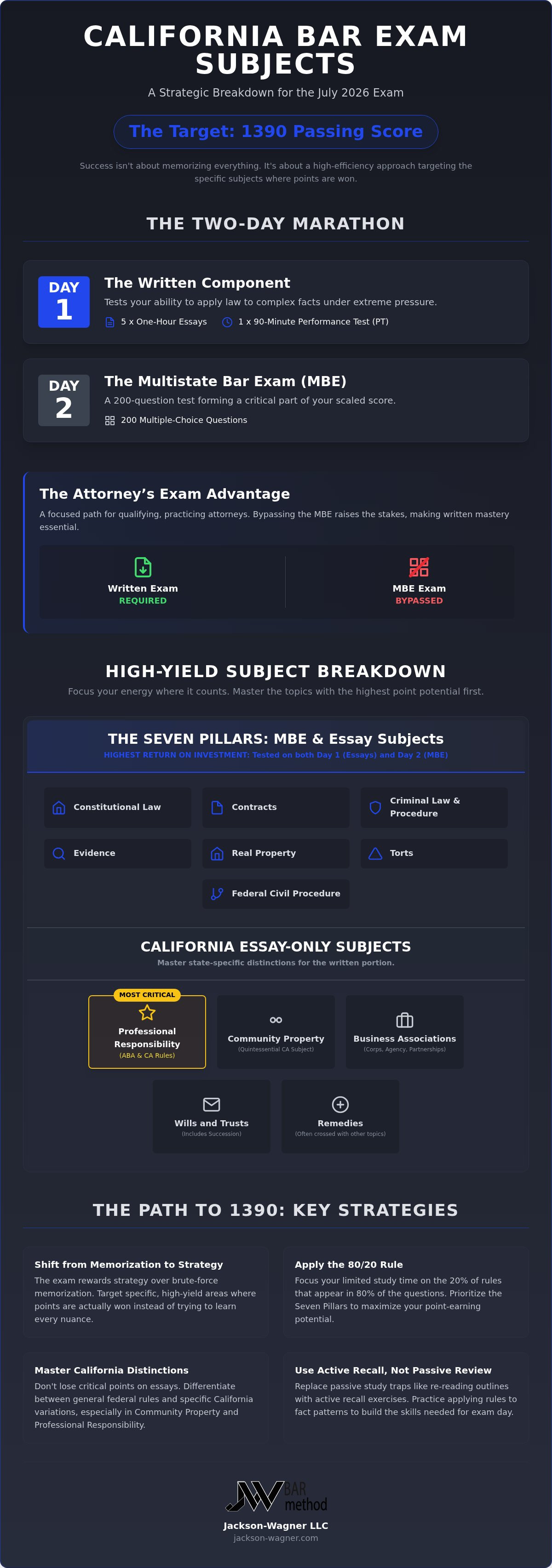
The full exam is a test of endurance and precision. Day 1 consists of five one-hour essay questions and one 90-minute Performance Test (PT). These written components test your ability to apply law to complex facts. Day 2 shifts to the Multistate Bar Examination (MBE), featuring 200 multiple-choice questions. Your final score is a scaled combination of these two days. This means a strong performance on the MBE can buffer a weaker essay, but you can't afford to ignore any of the core california bar exam subjects. Precision matters because the scaling process is unforgiving to those who only have a surface-level understanding of the rules.
The Attorney’s Exam Advantage
If you're already a practicing attorney in good standing in another jurisdiction, you may qualify for a significant advantage. Qualifying applicants can bypass the MBE entirely and sit for the one-day Attorney’s Exam. This format focuses exclusively on the written portion: the five essays and the PT. While skipping the multiple-choice section sounds easier, it actually raises the stakes. When 100% of your score depends on your writing, your mastery of the rules must be absolute. You don't have the MBE to lean on. Understanding the specific california attorney’s exam requirements is the first step toward a strategic study plan. You'll need to focus heavily on California-specific law and Professional Responsibility; these are frequent targets for the examiners' pens. Efficiency is your only path to success when you're balancing a full-time practice with the demands of a 1390 score.
Core Subjects of the California Bar: The High-Yield Breakdown
Strategic prioritization is the difference between a passing score and a repeat attempt. While the list of 15 possible california bar exam subjects seems daunting, they aren't all created equal. You must categorize them by their frequency and where they appear on the exam to maximize your study efficiency. Some subjects are the heavy hitters of the Multistate Bar Exam (MBE), while others are unique "California-isms" that the examiners rely on to test your local knowledge.
The Multistate Bar Exam (MBE) Subjects
Seven subjects form the bedrock of your 2026 preparation. These "Seven Pillars" offer the highest return on your time investment because they're tested on both the 200-question MBE and the essay portion. Mastering these topics provides a double-edged advantage; you're simultaneously preparing for the multiple-choice section and the written day. If you can't recite the elements of these subjects from memory, your foundation isn't ready for the 1390 hurdle:
- Constitutional Law
- Contracts
- Criminal Law & Procedure
- Evidence
- Real Property
- Torts
- Federal Civil Procedure
California Essay-Only Subjects
Beyond the federal pillars, you must navigate subjects that appear exclusively in the written portion. These topics require you to distinguish between majority rules and specific California distinctions. Professional Responsibility is the most critical; it's tested on nearly every exam, often as a standalone essay or "crossed over" with another topic. Be prepared for these additional california bar exam subjects on the essay day:
- Community Property: The quintessential California-specific subject.
- Professional Responsibility: ABA and California Rules of Professional Conduct.
- Business Associations: Corporations, Agency, and Partnerships.
- Wills and Trusts: Including Succession rules.
- Remedies: Frequently crossed with Contracts or Torts.
Don't let the 90-minute Performance Test (PT) be an afterthought. It's a "closed universe" where subject knowledge takes a backseat to raw lawyering skills. You're given a file and a library, and you must produce a memo, brief, or letter. While you don't need to memorize rules for this section, you need a disciplined strategy to manage the clock. Efficiently managing these disparate topics requires a plan that cuts through the noise. For professionals who can't afford to waste a single hour, the JW Bar Method Prep provides the structured hierarchy needed to dominate the 2026 exam.
MBE vs. California-Specific Subjects: A Strategic Comparison
Passing the 2026 exam requires more than a general understanding of the law; it requires a surgical distinction between federal standards and state variations. A common pitfall for applicants is failing to recognize that not all california bar exam subjects carry equal weight or require the same depth of study. A strategic applicant knows that a deep dive into Federal Civil Procedure is mandatory for the MBE, but they also know that failing to spot a California-specific Evidence distinction on an essay can be fatal. You must navigate the state of california state bar requirements with a focus on where the points actually live. This means knowing when to apply the Federal Rules of Evidence and when the California Evidence Code takes precedence.
Don't fall into the trap of over-studying low-frequency "cross-over" topics like Agency or Partnerships at the expense of heavy hitters. While these can appear, they often carry less weight than the core subjects. Your time is better spent perfecting rule statements for the "Seven Pillars" or mastering the nuances of California Professional Responsibility. Efficiency is the hallmark of the JW Bar Method; we focus on the rules that have the highest probability of appearing on your 2026 exam paper.
Rules of Professional Responsibility
This isn't just another subject; it's a mandatory competency. You'll face it on the MPRE and almost certainly on the California essay day. The examiners expect you to pivot seamlessly between the ABA Model Rules and the California Rules of Professional Conduct. Fact patterns often revolve around conflicts of interest, the mishandling of client funds, or the duty of confidentiality. Because it's tested so frequently, Professional Responsibility is the most important "minor" subject in your arsenal. You can't afford a mediocre performance here if you want to reach that 1390 threshold.
Community Property and Wills/Trusts
For the 2026 essays, you need a reliable framework to handle California's unique marital property laws. We recommend the "Marriage, Title, and Source" approach. It's a structured way to categorize assets and determine their characterization as community or separate property. Similarly, Wills and Trusts frequently appear as a single, complex crossover essay. You'll need high-yield rule statements for 2026 that cover valid will execution, trust formation, and the rights of omitted heirs. Mastering these California-specific california bar exam subjects ensures you aren't blindsided by the state's unique legal landscape during the written portion of the exam.
Strategy for Mastery: Prioritizing Subjects by Weight and Frequency
Passing the 1390 hurdle requires a ruthless commitment to efficiency. You can't afford to treat all california bar exam subjects as equal priorities. Instead, apply the 80/20 rule: focus your energy on the 20% of legal rules that historically yield 80% of the points. Many students fall into the trap of passive reading or endless lecture watching. This is a fatal error. Active recall is the only way to ensure rule retention under the high-pressure environment of the 2026 exam. By using targeted california bar exam practice, you can diagnose specific subject weaknesses early and pivot your strategy before it's too late.
Graders don't want a legal treatise; they want IRAC. Every essay you write must follow the Issue, Rule, Analysis, and Conclusion format to meet the State Bar's expectations. This structure ensures you're capturing the specific points allocated for each california bar exam subjects category without getting lost in irrelevant theory. Precision in your rule statements and a logical flow in your analysis will separate your answer from the thousands of mediocre responses the graders read every cycle.
Developing Your 2026 Study Roadmap
Your preparation should follow a logical, three-phase progression designed to build competence and confidence. Phase 1 focuses on a substantive review of the Seven Pillars that dominate the MBE. This creates a solid foundation for the entire test since these subjects frequently appear on the essay day as well. In Phase 2, you'll shift to the memorization of California-specific rule statements, ensuring you can distinguish between federal and state law on a dime. Finally, Phase 3 involves high-intensity issue-spotting and full-length simulations. You must practice writing full essays in 60 minutes to build the muscle memory required for the real thing.
The Performance Test: Mastering the Skills Subject
The 90-minute Performance Test (PT) is often overlooked, but it's your strategic safety net. Because it's a "closed universe" format, you don't need to bring outside knowledge into the room. You're evaluated on your ability to manage a File and a Library under extreme time pressure. Success here can compensate for a difficult essay on a niche subject, especially since the PT is weighted heavily in your final score. Treat the PT as a skill to be mastered through repetition. Practice extracting rules from the Library and applying them to the facts in the File until the process becomes second nature.
Ready to stop guessing and start preparing with precision? The JW Bar Method Accelerated Prep - Full California Bar Exam is designed for modern professionals who need a high-yield path to licensure.
Conquering the California Bar Subjects with the JW Bar Method
Generic national courses fail because they lack the surgical precision required for the Golden State. We don't do national. We don't do generic. Jackson-Wagner LLC is the only pedagogical approach built exclusively for the 15+ california bar exam subjects you'll face in 2026. By stripping away the bloat of legacy education models, we've created a pathway that prioritizes high-yield rules over exhaustive, low-value memorization. You don't need a 600-hour commitment to succeed; you need a structured, modern strategy that respects your professional timeline and replaces high-stakes anxiety with absolute confidence.
Tailored Programs for Law Grads and Attorneys
We recognize that a recent graduate's needs differ from those of a seasoned practitioner. For the general applicant, the Jackson-Wagner LLC Prep - Full Exam California Bar provides comprehensive mastery across both the MBE and written portions. If you're an out-of-state practitioner, the Jackson-Wagner LLC Prep - Attorney’s Exam California Bar offers focused precision for the one-day written gauntlet. For those facing extreme time constraints, our Jackson-Wagner LLC Accelerated Prep - Full California Bar Exam and Jackson-Wagner LLC Accelerated Prep - Attorney’s Exam California Bar deliver the same high-impact results in a condensed timeframe. These tracks ensure you're mastering the california bar exam subjects that carry the most weight without sacrificing your existing career.
Absolute Confidence in Results
We act as a disruptive mentor, providing a structured path to success that replaces high-stakes anxiety with professional empowerment. Our belief in this methodology is so absolute that we assume the financial risk of your performance. This binary performance guarantee isn't just a marketing anchor; it's a testament to a curriculum that consistently outperforms legacy industry standards. You aren't just buying a course; you're securing a partnership with CA bar pedagogy specialists who are as invested in your 1390 score as you are. Secure your spot in our 2026 cohort and take the first step toward california bar exam success today.
Secure Your Future as a California Attorney
Mastering the 15+ california bar exam subjects doesn't require you to sacrifice your professional life or drown in a sea of low-yield theory. Success in 2026 depends on a surgical focus on the "Seven Pillars" and a disciplined mastery of California-specific rule distinctions. By applying the 80/20 rule and prioritizing active recall over passive consumption, you can navigate the 1390 hurdle with absolute precision. Legacy prep courses often fail because they lack the localized focus needed for this jurisdiction.
You deserve a partner that assumes the risk of your performance. Our proprietary JW Bar Method is exclusively focused on California licensure, offering an accelerated path to success for modern professionals. We're so confident in our results-driven pedagogy that we offer a performance-based financial guarantee. It's time to replace exam-day anxiety with the empowerment of a structured, reliable roadmap.
Take the definitive step toward your legal career today. Pass the 2026 California Bar with the JW Bar Method and join the ranks of successful practitioners who chose strategy over volume. You've done the work; now it's time to secure the result.
Frequently Asked Questions
What is the passing score for the California Bar Exam in 2026?
The passing score for the California Bar Exam in 2026 is 1390. This scaled score is required to demonstrate the minimum competence necessary for licensure in the Golden State. While other jurisdictions have lowered their thresholds, California maintains this high standard to ensure the integrity of its legal profession. Reaching this number requires a strategic mastery of all california bar exam subjects through a disciplined, high-efficiency study plan.
Can I take the California Bar Exam if I am already licensed in another state?
You can certainly take the exam if you're already licensed in another jurisdiction. Qualifying attorneys may sit for the one-day Attorney’s Exam instead of the full two-day version. This format allows you to skip the MBE portion and focus entirely on the written essays and Performance Test. It's an efficient path for practitioners looking to expand their reach into the California market without repeating the entire multiple-choice gauntlet.
How long does it take to get California Bar Exam results?
Results for the July 2026 exam are scheduled for release on November 6, 2026. If you sit for the February 2026 exam, you can expect your results around May 1. The State Bar of California typically takes three to four months to process and scale the written and multiple-choice portions. This waiting period is a standard administrative timeline, allowing for meticulous grading of the five essays and the 90-minute Performance Test.
Is the California Bar Exam harder than the UBE?
Most applicants consider the California Bar Exam significantly harder than the Uniform Bar Exam (UBE). This reputation stems from the 1390 passing score, which is higher than the equivalent passing thresholds in most UBE jurisdictions. Additionally, California tests a wider range of subjects and requires applicants to master specific state law distinctions. Success here demands a more specialized approach than the generic preparation used for national, multi-state examinations.
What subjects are tested on the California-specific portion of the exam?
The California-specific portion focuses on subjects like Community Property, Professional Responsibility, and Wills and Succession. While the MBE covers federal law, the essay portion often requires you to apply the California Evidence Code or the California Code of Civil Procedure. Mastering these california bar exam subjects is critical because examiners look for your ability to distinguish Golden State rules from majority standards. Precision in these state-specific nuances often determines your final score.
How much does it cost to take the California Bar Exam in 2026?
For 2026, the General Applicant fee is $677, while the Attorney Applicant fee is $983. You must also account for the $153 laptop fee if you choose to use your own device for the written portions. Late filing fees and laptop late fees can add an additional $50 to $200 to your total investment. These administrative costs are paid directly to the State Bar and are separate from any professional preparation materials you utilize.
Can I work full-time while studying for the California Bar?
You can absolutely work full-time while studying if you utilize a high-efficiency preparation strategy. Many modern professionals find that legacy 10-week, 600-hour programs are incompatible with their careers. By focusing on high-yield rules and active recall, you can master the necessary material in significantly less time. Our accelerated tracks are specifically designed to help practitioners balance their professional responsibilities with the rigorous demands of the 2026 California licensure process.
What is the "Baby Bar" and do I need to take it?
The "Baby Bar," officially known as the First-Year Law Students' Examination, is a one-day test required for students at unaccredited or correspondence law schools. Most students at ABA-accredited or California-accredited schools don't need to take it. It covers three core subjects: Contracts, Criminal Law, and Torts. If you're required to sit for this exam, passing it is a mandatory prerequisite before you can receive credit for your subsequent years of legal study.


