

If you find yourself staring at a "server down" screen just 48 hours before the July 28, 2026, California Bar Exam, is a standard help desk ticket really going to save your legal career? For many, the choice of a legacy prep provider feels like the safe bet until the reality of technical instability and generic essay feedback sets in. The recent surge in Themis bar review complaints highlights a systemic issue; legacy platforms often treat candidates like mere data points in a mass-market algorithm rather than future attorneys.
It's understandable to feel anxious when the February 2026 pass rate sat at a sobering 30.8 percent. You need a reliable partner who understands that California licensure is too high-stakes for "good enough" support. This article analyzes the recurring failures of traditional bar prep and teaches you how to identify a support system that prioritizes your individual success. We'll explore why expert-led feedback is non-negotiable and how the JW Bar Method Prep provides the financial assurance you need to walk into the exam room with absolute confidence.
Key Takeaways
- Recognize how technical glitches and platform instability during peak study hours can create unnecessary paralysis during your final preparation weeks.
- Learn to identify the core issues behind recurring Themis bar review complaints, specifically focusing on the lack of substantive feedback for complex California essays.
- Master the art of auditing a prep course's support system by demanding transparency on grader credentials and maximum turnaround times.
- See how the JW Bar Method Prep eliminates the middleman, providing you with direct access to experts who share the financial risk of your outcome.
- Discover why a binary performance guarantee is the ultimate proof of a provider's confidence in their own pedagogical results.
The Reality of 'Big Bar' Prep: Why Themis Complaints Matter for Your License
Success in the 2026 California Bar Exam requires more than just checking boxes on a digital dashboard. While "big bar" providers tout impressive national pass rates, these figures often obscure the individual struggle of the candidate. If you don't pass, the provider's global average is irrelevant to your career. This gap between corporate marketing and personal results is a central theme in many bar review program complaints. When you're facing the toughest bar examination process in the country, you aren't just a percentage. You're a future professional whose career depends on precision, not generalizations.
The 'Mass-Market' Support Trap
A platform designed to serve 50 different jurisdictions simultaneously cannot offer the granular focus required for California's specific essay standards. Legacy providers often rely on a low-touch model to maintain high profit margins. This results in copy-paste feedback on complex Performance Tests (PT) that fails to identify specific structural weaknesses. Candidates frequently report feeling like a data point in a mass-market algorithm. You're pushed toward "completion rates" rather than substantive mastery of the law. This disconnect is a primary driver of dissatisfaction among those who find that "adaptive" algorithms are no substitute for expert intervention.
When Reliability Becomes a Risk Factor
Administrative friction during the critical 10-week study window leads to total study paralysis. Technical instability is a recurring issue that candidates cannot afford. If the platform goes down during the final "crunch" weeks before the July 28, 2026, exam date, your momentum vanishes instantly. Bureaucratic delays in answering substantive legal questions further derail your learning. In these moments, you're treated as a "user" in a database rather than a student with a dedicated mentor. The psychological cost of this generic support is immense. It replaces confidence with high-stakes anxiety. You need a partner who shares the financial risk of the outcome, not a help desk that views your license as a support ticket.
3 Recurring Themis Bar Review Complaints Analyzed
Identifying systemic issues is the first step toward avoiding them during your 2026 study cycle. Many Themis bar review complaints center on the platform's inability to adapt to the high-pressure reality of the final study weeks. It isn't just about a site being slow; it's about the algorithm forcing "spaced repetition" on topics you've already mastered while ignoring your glaring weaknesses in subjects like Community Property or Constitutional Law. This rigid adherence to a pre-set schedule often leads to "algorithm fatigue," where candidates spend hours on low-value tasks instead of addressing their actual comprehension needs.
The Feedback Loop: Quality vs. Quantity
The most dangerous recurring complaint involves essay grading. High-volume providers often outsource this critical task to low-level graders or rely on AI-driven templates. This results in generic, non-substantive feedback that fails to identify deep structural flaws in your writing. For the california bar exam, where graders expect sophisticated IRAC application and nuanced analysis, a "good job" or "needs more detail" comment is functionally useless. You need precision to pass. The State Bar of California doesn't reward mediocrity, yet legacy models continue to prioritize grading volume over the pedagogical depth required to fix a failing essay structure.
The 'Ghosting' Phenomenon in Peak Season
As the July 2026 exam date approaches, support response times often spike. Waiting 48 hours for a rule clarification on Real Property or Torts is unacceptable when you're only 10 days away from the test. This "ghosting" phenomenon leaves students vulnerable at their most stressful moment. Looking at California bar exam statistics, it's clear that the margin for error is razor-thin. The February 2026 overall pass rate was a sobering 30.8 percent, proving that you can't afford to be stuck in a support queue while your competitors are receiving active mentorship.
Platform instability and technical glitches during peak study hours only compound this frustration. When thousands of users log in simultaneously, legacy servers often struggle, leading to downtime that derails your momentum. Direct access to expert mentors isn't just a luxury; it's a "must-have" for the 2026 exam cycle. If you're tired of being treated like a support ticket, exploring the JW Bar Method Prep ensures you have a partner who is as invested in your results as you are. You deserve a reliable platform that stays online when the stakes are highest.
Why Legacy Platforms Struggle with California-Specific Personalization
California isn't just another state on a map; it's a unique legal jurisdiction with grading standards that demand surgical precision. National platforms often treat California candidates like they're studying for a generic MPRE-style exam, providing surface-level support that fails to account for the State Bar's specific rigour. Many Themis bar review complaints originate from this "one-size-fits-all" pedagogy. When a platform tries to serve 50 states simultaneously, the nuanced requirements of the California Performance Test (PT) and the specific California-only subjects often get lost in the shuffle of a mass-market curriculum.
California Bar vs. The Rest of the Country
The grading rigour in California is fundamentally different from the rest of the country. Graders aren't looking for a basic recitation of rules; they're looking for sophisticated, lawyerly analysis that applies those rules to complex fact patterns. Legacy providers often rely on national templates that lack this depth. To succeed in 2026, you need a best bar exam preparation service that specializes exclusively in California licensure. Adaptive algorithms might help you memorize MBE rules, but they're notoriously poor at addressing deep-seated writing flaws or structural weaknesses in your essay organization. An algorithm cannot tell you why your "Analysis" section lacks the specific counter-arguments California graders expect.
Pedagogical Responsiveness vs. Administrative Help
There's a critical difference between administrative support and pedagogical responsiveness. A customer service agent can help you reset your password, but they cannot resolve a fundamental Constitutional Law misunderstanding at 11:00 PM. Large-scale operations are incentivized to minimize human interaction to maintain high profit margins, often replacing expert mentors with "help tickets." This model is a core source of Themis bar review complaints during the final two weeks of prep. True pedagogical responsiveness means having direct access to a mentor who can identify why your legal analysis is falling short. In a high-stakes certification environment, a "help desk" is a poor substitute for an expert who understands the law and the exam's unique pressures.
This personalization gap is even more pronounced for those taking the California Attorney's Exam. Practicing lawyers have different needs than recent law school graduates; they require an efficient, precision-focused approach rather than 100 hours of basic lectures. Generic platforms often ignore this "Attorney Exam" gap, forcing experienced professionals into the same rigid algorithm as everyone else. A mentor-led model replaces this administrative friction with a structured, reliable path to success, ensuring that your study time is spent on high-value mastery rather than navigating a large-scale database.
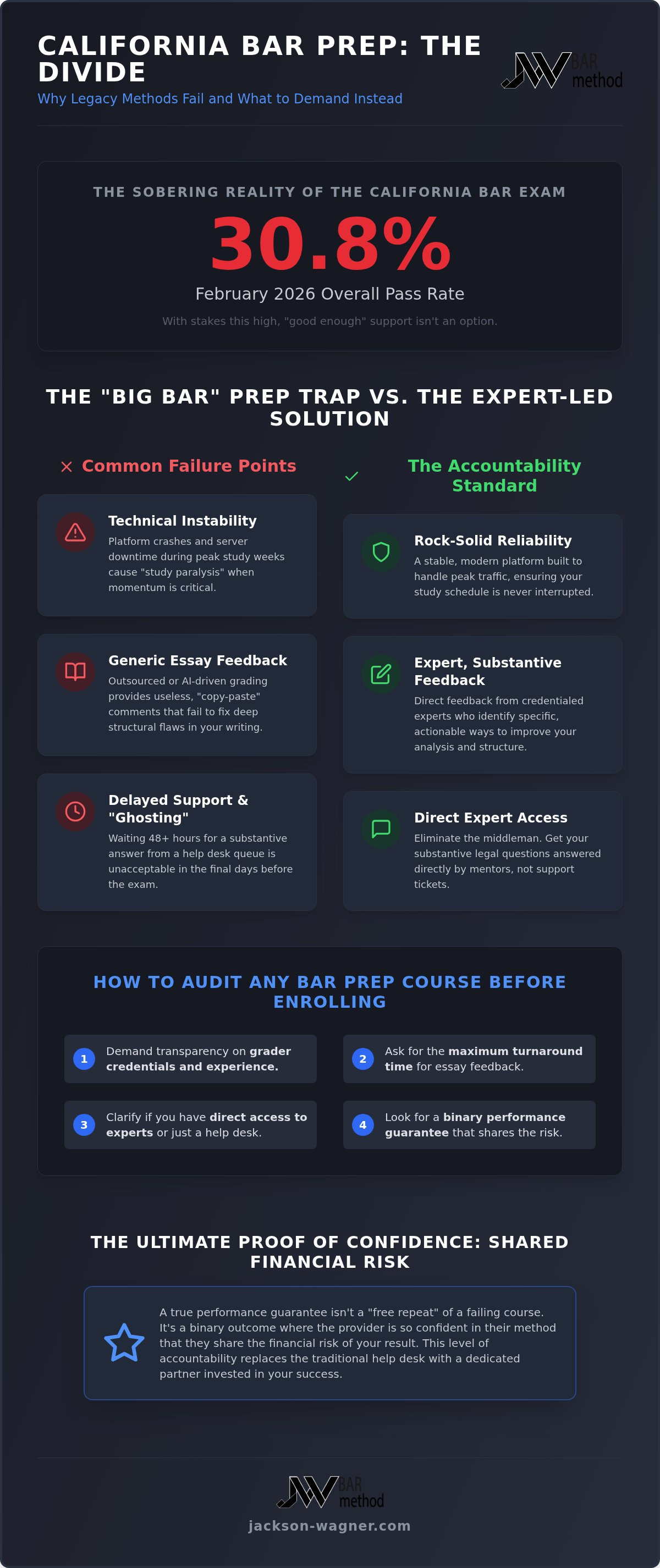
How to Audit a Bar Prep Course’s Support Before Enrolling
Before you commit thousands of dollars to a legacy provider, you must peel back the marketing layer to see the actual support structure. Many Themis bar review complaints arise because students realize too late that the "support" they were promised is actually an automated ticketing system. You aren't just buying access to a database; you're buying a path to licensure. If that path is blocked by administrative friction, your investment is at risk. A rigorous audit of a program's human infrastructure is the only way to ensure your 2026 study window remains productive.
Demand transparency before you enter your credit card details. Use this checklist to vet any potential partner:
- Verify Grader Credentials: Ask if your essays will be graded by licensed California attorneys or law students with no practical experience.
- Confirm Turnaround Times: Secure a written commitment for a maximum 48-hour response time for legal inquiries during the final 21 days of prep.
- Request Feedback Samples: Don't settle for a marketing template. Ask to see an actual graded essay to evaluate if the feedback is substantive or merely a rubric of checked boxes.
- Identify Communication Channels: Determine if there is a direct line to a mentor or if every question must pass through a generic "help" portal.
Evaluating the Financial Assurance
Most legacy providers offer a "guarantee" that is nothing more than a free retake of the same failed course. This isn't financial assurance; it's a trap that costs you months of your career. A true binary performance guarantee means the provider assumes a portion of your financial risk. When a company is willing to lose money if you don't pass, their incentives align perfectly with your success. Scrutinize your contract for red flags regarding "service availability" clauses that might protect the provider during technical outages while leaving you stranded during the final crunch. If you want a partner who stands behind their results with absolute certainty, explore the JW Bar Method Prep today.
The Accelerated Track Audit
Working professionals have no time for administrative delays. If you are currently navigating the california attorney's exam requirements, your study window is likely compressed into 30 days of high-intensity mastery. A program that works for a 10-week schedule often fails on a 4-week timeline. You need high-impact feedback that identifies structural flaws instantly. Ensure the program you choose has a dedicated track for accelerated learners that prioritizes expert-led intervention over algorithmic busywork. In the final weeks before the 2026 exam, the speed of your support system will determine the quality of your performance.
The JW Bar Method: Where Expert Accountability Replaces the Help Desk
The Jackson-Wagner LLC philosophy is built on a single, disruptive premise: the bar exam is a high-stakes professional barrier that requires a mentor, not a help desk. While legacy providers scale their operations by adding layers of administrative staff and automated filters, the JW Bar Method Prep eliminates the middleman entirely. We've seen how the volume-heavy approach of traditional courses leads to the very issues highlighted in recurring Themis bar review complaints. When you're struggling with a complex hearsay exception or a nuanced Community Property issue, you don't need a support ticket. You need a specialist who understands the law and your specific writing style.
Our 2026 commitment is defined by precision and absolute accountability. We don't treat your preparation as a series of generic tasks to be completed for a "green checkmark" on a dashboard. Instead, we focus on substantive mastery. This disruptive mentor model ensures that every piece of feedback you receive is designed to move the needle on your score. We've replaced the mass-market algorithm with a structured, expert-led environment where your questions are answered by the same people who designed the curriculum. This is the difference between being a user in a database and a candidate for the bar.
Expert-Led Guidance for California Licensure
California licensure is a complex process that demands more than just legal knowledge. You have to navigate the state bar of california through a maze of administrative hurdles and specific grading expectations. By working with specialists who focus exclusively on this jurisdiction, you gain an advocate who understands the local landscape. We handle the administrative friction so you can focus on the law. Our pedagogical approach is tailored to the 2026 exam cycle, ensuring you're prepared for the specific rigour of the California examiners. We don't dilute our expertise by trying to cover 50 states; we master one so you can pass it.
Your Success is Our Financial Risk
We believe that a provider should only succeed when their students do. This is why our binary performance guarantee is the ultimate customer service promise. Unlike legacy models where "Themis bar review complaints" often center on the lack of accountability, our model forces us to provide superior, personalized support. If you don't pass, we face a direct financial consequence. This financial assurance aligns our incentives with your licensure goals. It's a level of commitment that "big bar" providers simply cannot match. You deserve a partner who is as invested in your "Pass" as you are. Choose a path that replaces corporate apathy with expert-led results. Explore the JW Bar Method Prep and secure your future in the California legal profession.
Secure Your Legal Career with Precision and Accountability
You've seen why generic support models and technical instability lead to the recurring Themis bar review complaints we analyzed. Passing the toughest exam in the country requires more than just a completion percentage. It requires surgical precision in your writing and a platform that stays online when the stakes are highest. By auditing a provider's support structure and demanding expert-led feedback, you protect your career from the failures of mass-market education.
Jackson-Wagner provides specialized California Bar expertise and direct access to expert mentors who understand the State Bar's unique grading rigour. We don't just offer a retake. Our binary performance guarantee means we share the financial risk of your outcome, ensuring our incentives are perfectly aligned with your success.
Master the California Bar with the JW Bar Method, Guaranteed.
You have the drive to succeed. Now, choose the partner who is as committed to your "Pass" as you are.
Frequently Asked Questions
Are Themis complaints about technical issues really that common?
Technical instability is a documented concern that tends to peak during high-traffic windows before the exam. These Themis bar review complaints often highlight platform outages and server lag that disrupt critical study momentum. While providers attempt periodic updates, the scale of a national user base creates inherent risks. For the 2026 exam cycle, ensuring you have a reliable digital partner is as critical as mastering the law itself.
What should I do if I receive generic essay feedback from my bar prep provider?
You must immediately demand a more substantive critique or seek a specialist mentor. Generic feedback fails to identify the structural flaws that lead to failure in California. If your grader only provides surface-level comments, you aren't receiving the pedagogical guidance necessary for licensure. Consider switching to a program like the JW Bar Method Prep, where feedback is expert-led and focused on the specific rigour of California's grading standards.
How does legacy support compare to modern alternatives for the California Bar?
Legacy providers typically operate on a high-volume, low-touch model that prioritizes national statistics over individual California mastery. While these companies rely on their size as a proxy for quality, the resulting administrative friction is a common source of Themis bar review complaints. Modern alternatives replace this corporate apathy with direct expert access and a binary performance guarantee. This shift ensures the provider is personally invested in your specific licensure outcome.
Can I get a refund from a bar prep company if their platform fails?
Most traditional bar prep contracts are designed to protect the provider, offering "free retakes" of the course rather than financial refunds for technical failures. This model places the entire risk on the student. You should carefully audit your user agreement for service availability clauses. Unlike legacy models, a binary performance guarantee provides actual financial assurance, proving the provider is confident enough to share the risk of your exam outcome.
Is personalized support necessary to pass the California Attorney’s Exam?
Personalized support is essential for practicing lawyers who must master the California Bar's nuances on a condensed timeline. The JW Bar Method Accelerated Prep - Attorney’s Exam California Bar is specifically designed to eliminate the busywork found in generic courses. Attorneys require precision feedback that respects their professional experience while addressing the specific structural expectations of the State Bar. Generic algorithms cannot provide the strategic mentorship required for this track.
How does the JW Bar Method handle student questions during peak season?
We eliminate the "help ticket" middleman by providing direct access to expert mentors. During the peak 2026 study season, questions are handled with pedagogical urgency rather than administrative delay. Our philosophy as a disruptive mentor means your legal inquiries are answered by professionals who understand the law, not customer service agents. This ensures that your learning momentum never stalls due to bureaucratic friction or technical "ghosting" common in larger firms.
What is the difference between a 'free retake' and a binary performance guarantee?
A "free retake" merely gives you another chance to use the same failed methodology, costing you more time and lost wages. In contrast, a binary performance guarantee is a financial assurance where the provider assumes the risk of the outcome. If you don't pass, the provider faces a direct financial loss. This model ensures the JW Bar Method Prep is meticulously designed to produce results, as our success is inextricably linked to yours.
What are the red flags to look for in bar prep customer service reviews?
Look for recurring mentions of "generic feedback," "unresponsive support," or "platform outages" during the final weeks of study. These are indicators of a system that cannot handle peak-season volume. Another red flag is a lack of transparency regarding who is actually grading your essays. If reviews suggest students feel like data points in a mass-market algorithm, the program likely lacks the expert-led accountability required for the high-stakes California Bar Exam.


