
The traditional approach to bar prep is a relic of a legacy educational model that prioritizes volume over precision. If you're preparing for the 2026 cycle, you don't need more information; you need a strategic advantage. Mastering the california bar exam format is the first step in moving from overwhelmed student to licensed attorney. The reality is that the 1390 passing score isn't a measure of your intelligence. Instead, it's a reflection of your ability to navigate a very specific two-day testing structure with surgical accuracy.
We know the pressure you're under. Balancing a career with the crushing volume of California-specific law feels like a losing battle when pass rates remain low. This article promises to replace that anxiety with a structured, modern path to success. You'll gain a clear understanding of the 2026 exam schedule, including the February 24-25 and July 28-29 dates, alongside tactical insights into high-yield topics. We're breaking down the Multistate Bar Examination and the "Performance Test Trap" so you can approach your study with absolute confidence and precision.
Key Takeaways
- Master the specific breakdown of the two-day california bar exam format, including the five-essay written portion and the 200-question MBE.
- Identify the "Performance Test Trap" and learn how to capitalize on the double-weighted value of the 90-minute PT to maximize your score.
- Transition from legacy volume-based study to a precision-focused method that emphasizes diagnostic baselines and high-yield California legal standards.
- Evaluate the streamlined one-day Attorney’s Exam pathway for experienced practitioners to bypass the MBE and focus exclusively on written mastery.
- Prepare for the 2026 shift toward integrated digital testing environments with a structured approach that mirrors modern law practice.
Navigating the California Bar Exam Format: Why 2026 Demands Precision
California's legal licensing process isn't just a test; it's a professional gauntlet. The California Bar Exam Format is notoriously designed to filter for the most resilient and analytically precise minds in the legal field. With historically low pass rates that often hover below 50%, the State Bar of California maintains a standard of rigor that many find insurmountable. However, the anxiety surrounding this exam usually stems from outdated preparation models rather than the test's inherent difficulty. By 2026, the shift toward a fully integrated digital testing environment demands a new level of technical and substantive precision. You can't afford to study harder; you have to study smarter.
We replace high-stakes anxiety with professional empowerment. The JW Bar Method rejects the "factory model" of bar prep that has dominated the industry for decades. Instead of drowning you in thousands of pages of generalized law, we prioritize precision over volume. This philosophy is the core of our approach. We move candidates away from the stress of high-pressure certification and toward a structured, modern, and reliable path to licensure. This is the difference between a student who merely studies and a candidate who achieves licensure with surgical accuracy.
The 2026 Exam Landscape: What has Changed?
The 2026 cycle continues the State Bar's commitment to a digital-first experience. The partnership with ExamSoft remains the standard for all written sessions, meaning your success depends on your ability to perform within specific software constraints. Candidates must remain vigilant regarding administrative deadlines, specifically the mandatory mock exam window in late July 2026. While the National Conference of Bar Examiners (NCBE) still provides the Multistate Bar Examination (MBE), the way you interact with these 200 multiple-choice questions has evolved. Success now requires a seamless transition between the analytical demands of the MBE and the technical execution required for the written portions within the California Bar Exam Format.
Why Legacy Prep Methods Fail Modern Candidates
Traditional bar review courses often trap students in a 1,000 hour cycle of passive video watching and generic drills. This "factory model" fails because it ignores the efficiency gap between general legal knowledge and the specific, high-yield requirements of California licensure. High-achieving professionals don't have time for fluff. The JW Bar Method acts as a disruptive mentor, cutting through the noise of legacy industry standards. We focus exclusively on the "Rule of Law" as tested in California, ensuring every minute of your study contributes directly to reaching that 1390 scaled score. We assume the risk of your performance because our methodology is built for the modern learner who requires flexibility and results.
Deconstructing the Two-Day Schedule: Essays, PT, and the MBE
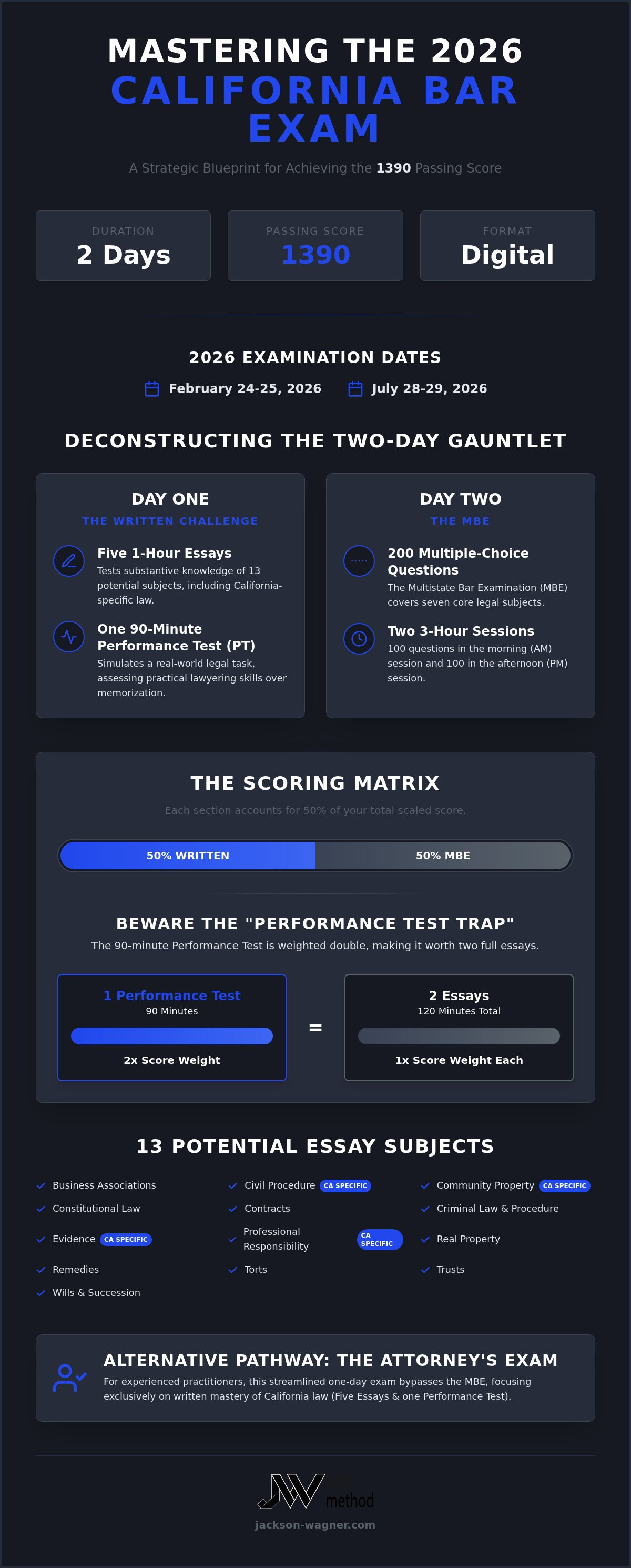
The 2026 california bar exam format is a precise, two-day marathon designed to test both substantive legal knowledge and professional endurance. Success requires more than just memorization; it demands an understanding of how the State Bar weights your performance. The exam is split into two distinct parts: the written portion and the Multistate Bar Examination (MBE). Each section accounts for 50% of your total scaled score, requiring a combined total of 1390 to achieve licensure. For the most accurate scheduling and administrative details, candidates should regularly consult the Official California Bar Exam Information provided by the state's governing body.
This 50/50 split is critical. It means that a stellar performance on the multiple-choice section cannot fully compensate for a failure in the written portion, and vice versa. You must approach both days with equal tactical rigor. The california bar exam format tests 13 potential essay subjects, including California-specific distinctions that often trip up candidates who rely on generic, out-of-state prep materials. These subjects include:
- Business Associations
- Civil Procedure (Federal and California)
- Community Property
- Constitutional Law
- Contracts
- Criminal Law and Procedure
- Evidence (Federal and California)
- Professional Responsibility (ABA and California)
- Real Property
- Remedies
- Torts
- Trusts
- Wills and Succession
Day One: The Written Challenge
Tuesday is dedicated to the written portion of the exam. This session consists of five one-hour essay questions and one 90-minute Performance Test (PT). The essays test your ability to apply legal principles to complex fact patterns across the subjects listed above. Precision in spotting California-specific distinctions, particularly in Evidence and Civil Procedure, is often what separates a passing score from a repeat attempt. Because the licensure process involves more than just the exam, it's vital to begin decoding the California Bar Exam Moral Character Application well in advance to avoid administrative delays.
Day Two: Mastering the MBE Marathon
Wednesday shifts the focus to the MBE, a 200-question multiple-choice test administered in two 3-hour sessions. These questions cover seven core areas of law: Contracts, Torts, Evidence, Real Property, Constitutional Law, Criminal Law and Procedure, and Civil Procedure. Think of the MBE as the anchor for your total scaled score. It provides a standardized metric that allows the State Bar to scale written scores, making it a high-stakes component where every point counts. If you want to move beyond the "factory model" of studying, the JW Bar Method Prep - Full Exam California Bar offers an accelerated path to mastering these core subjects with surgical precision.
The Hidden Weights: Scoring Dynamics and the Performance Test Trap
The scoring dynamics of the California Bar Exam are often shrouded in mystery, leading many candidates to waste hundreds of hours on low-yield subjects. To succeed, you must understand that the exam isn't a linear accumulation of points. It's a weighted system where specific components carry disproportionate influence. The 90-minute Performance Test (PT) is the most significant example of this. Despite being a single task, the PT is double-weighted, effectively acting as two essay questions in your final score. This "2-for-1" value makes it the highest-yield component of the written day. You can find the official breakdown of these components on the California Bar Exam Format page, but raw data doesn't tell the whole story.
Many candidates fall into the "Performance Test Trap" by treating it as an afterthought. Success here doesn't require memorizing a single rule of law. Instead, the PT simulates real-world practice through a "File" of facts and a "Library" of legal authorities. The State Bar isn't testing what you know; they're testing what you can do with information you've never seen before. We replace the stress of this high-pressure session with a structured, reliable method for extraction and application.
The Performance Test: Precision Under Pressure
The PT is a pure test of lawyering skills: extraction, organization, and application. The most common pitfall is poor time management, where candidates spend too long reading the library and leave insufficient time to draft the actual work product. Our approach utilizes proprietary templating that allows you to build your answer as you read. This method ensures you hit every grading rubric requirement without the frantic rush in the final fifteen minutes. By mastering the california bar exam format through a skills-based lens, you turn the PT from a source of anxiety into a scoring engine.
Strategic Scoring: The Path to 1390
The ultimate goal is a scaled score of 1390 out of 2000. It's a common misconception that you must master every obscure legal theory to reach this threshold. In reality, the exam is compensatory. This means a dominant performance on the MBE can bridge the gap for a mediocre essay day. You don't need perfection; you need strategic precision. The raw scores from your essays and PT are converted to a 2000-point scale through a process that accounts for the relative difficulty of the MBE. Understanding this relationship allows you to allocate your study time where it actually generates points. If you're looking for the Best Bar Exam Preparation Service 2026, focusing on these scoring nuances is what sets us apart from volume-based legacy courses.
Strategic Preparation: Implementing the JW Bar Method for 2026
Success on the 2026 exam isn't an accident. It's the result of a pedagogical approach that prioritizes high-yield mastery over the exhaustive volume of legacy courses. Implementing the Jackson-Wagner LLC Bar Method involves a five-step progression designed to navigate the complexities of the california bar exam format with surgical precision. We don't just provide information; we provide a structured, modern environment where your efforts are translated directly into points. Our method is a precision tool against the factory model of bar prep that often leads to cognitive overload.
- Step 1: Diagnostic Baseline. We stop the cycle of redundant studying. By identifying your existing legal knowledge versus specific California requirements, we focus your energy where it's needed most.
- Step 2: Substantive Immersion. We strip away the fluff of generic law. You'll focus exclusively on the "Rule of Law" as it's actually tested in California, ensuring every hour of study is productive.
- Step 3: High-Stakes Drills. You'll engage in california bar exam practice under strict timed conditions. This builds the muscle memory required to handle the 200-question MBE and five-essay written sessions.
- Step 4: Expert Feedback. Structure is the difference between a 60 and a 75. We refine your essay responses based on the Jackson-Wagner LLC Bar Method criteria that graders prioritize.
- Step 5: The Final Taper. We prepare your mental readiness and stamina. The 48-hour marathon requires more than just knowledge; it requires a strategy for maintaining peak performance through the final hour of Day Two.
Active Mastery vs. Passive Review
Legacy "Big Bar" courses rely on a factory model of passive video watching that ignores the "forgetting curve." This is why many candidates feel unprepared despite studying for 1,000 hours. We replace this with active mastery. The Jackson-Wagner LLC Bar Method utilizes structured repetition to ensure information isn't just seen, but retained. Our approach to rule-block memorization treats legal rules as modular, pre-formatted analytical tools that you can deploy instantly under the pressure of the california bar exam format. This shifts you from a state of high-stakes anxiety to one of professional empowerment.
Accelerated Tracks for Practicing Attorneys
Practicing attorneys face a unique challenge: balancing a high-pressure career with the rigors of licensure. You don't have the luxury of time that a recent graduate might have. The Jackson-Wagner LLC Bar Method Accelerated Prep program is designed specifically for this scenario. It cuts the noise and focuses on the high-yield precision needed for results. You can learn more about Passing the California Bar Exam in 2026 to see how our streamlined approach fits into your professional life. We act as a partner so certain of our efficacy that we assume the financial risk of your performance outcome.
Secure your path to licensure with the Jackson-Wagner LLC Bar Method Accelerated Prep - Attorney's Exam California Bar and experience the advantage of a results-driven mentor.
Pathways to Licensure: Full Bar vs. the California Attorney’s Exam
Seasoned practitioners often view the California Attorney’s Exam as a shortcut, but this perspective is a strategic error. Eligibility is strictly limited to attorneys who have been licensed in another U.S. jurisdiction for at least four years and remain in good standing. While the california bar exam format for these candidates is condensed into a single day, it removes the statistical safety net provided by the MBE. You are essentially completing Day One of the full bar: five one-hour essays and the 90-minute Performance Test. This "No MBE Cushion" reality means your written precision must be absolute. Without 200 multiple-choice questions to anchor your score, a single mediocre essay can jeopardize your entire result.
We treat the Attorney’s Exam as a high-precision exercise in professional communication. The State Bar expects a level of sophistication from experienced lawyers that goes beyond mere rule-spotting. You must demonstrate an ability to handle complex California-specific distinctions under the same grueling time constraints as traditional students. Our method replaces the stress of this high-pressure certification with a structured, reliable path to success that respects your professional obligations and limited study windows.
The Attorney’s Exam Strategic Guide
Success for experienced lawyers hinges on mastering Professional Responsibility and the Performance Test. Graders have zero tolerance for ethical oversights or disorganized work products. Because the PT is double-weighted, it remains your most valuable scoring engine. For a deep dive into eligibility and administrative hurdles, consult our California Attorney’s Exam Requirements guide. The JW Bar Method adapts for seasoned practitioners by cutting the noise of 1L subjects and focusing on the sophisticated analytical structures that secure a passing 1390 scaled score.
Final Steps: Application to Oath
Navigating the 2026 administrative cycle requires meticulous attention to detail. For the February 2026 exam, the timely filing window opens October 1, 2025, and closes November 1, 2025. If you are targeting the July 2026 exam, you must register between March 1, 2026, and April 1, 2026. Missing the ExamSoft upload windows can result in immediate disqualification, regardless of your performance. Once you've mastered the california bar exam format and completed the test, you'll need to understand How to Navigate the State Bar of California for post-exam logistics and the final oath of office.
Achieve professional empowerment and secure your California license with the JW Bar Method Prep - Attorney’s Exam California Bar. Join the ranks of licensed California attorneys with a partner that assumes the financial risk of your performance.
Secure Your Future in the California Legal Community
Achieving licensure in California requires more than just endurance; it requires a surgical understanding of the test's specific structure. We've deconstructed the california bar exam format to show you that success lies in mastering high-yield topics and the double-weighted Performance Test. By rejecting the "factory model" of legacy prep, you reclaim your time and focus on the analytical precision that graders demand. Whether you're a first-time taker or a seasoned practitioner, your path to the 1390 passing score must be structured, modern, and reliable.
We provide an exclusive focus on California licensure and accelerated prep options for attorneys to fit your professional schedule. Our binary performance guarantee ensures that we are just as invested in your outcome as you are. This level of bold reliability replaces the stress of high-pressure certification with a clear, results-driven roadmap. It's time to move beyond the uncertainty of traditional study methods. Master the California Bar with the JW Bar Method today. Your professional empowerment starts with a method built for precision and results. You have the drive to succeed; now you have the strategy to match it.
Frequently Asked Questions
What is the pass rate for the California Bar Examination?
The pass rate for the California Bar Examination historically remains among the lowest in the nation, often fluctuating between 35% and 55% depending on the specific administration. For the February 2026 cycle, the Attorney's Exam saw a 57.0% success rate. These figures underscore the absolute necessity of a precision-based study method. Success isn't about general knowledge; it's about mastering the specific california bar exam format and scoring rubrics.
Can I take the California Bar Exam if I am already licensed in another state?
You can absolutely take the California Bar Exam if you are licensed in another jurisdiction. If you've been in good standing for at least four years, you may qualify for the one-day Attorney’s Exam, which excludes the MBE. Attorneys licensed for fewer than four years must complete the full two-day examination. Both pathways require a rigorous focus on California-specific law and advanced writing skills to meet the 1390 passing threshold.
How much does it cost to take the California Bar Exam in 2026?
For the 2026 cycle, the application fee for a first-time taker is $677, while the fee for the California Attorney’s Exam is $983. Additionally, candidates using a personal laptop must pay a $153 laptop fee. These costs are separate from other administrative requirements, such as the moral character application or the MPRE. Budgeting for these fees early ensures that administrative hurdles don't interfere with your strategic preparation timeline.
What happens if I fail the California Bar Exam?
If you don't achieve a passing score, you're permitted to register for the next available administration. Candidates whose scaled scores fall between 1350 and 1390 automatically receive a second reading of their written answers by different graders to ensure accuracy. If you fail, it's vital to pivot from a volume-based approach to a precision-focused strategy. We analyze your score report to identify specific structural weaknesses before your next attempt.
Is the California Bar Exam administered online or in person in 2026?
The 2026 California Bar Exam is administered entirely in person at designated testing centers across the state. While the written portions are completed on laptops using ExamSoft software, the testing environment is strictly controlled and supervised. There are currently no options for remote or fully online administration. This in-person california bar exam format requires candidates to build the physical and mental stamina necessary for two consecutive days of high-stakes testing.
How long should I study for the California Bar Examination?
While legacy prep courses often suggest a factory model of 1,000 or more hours, the actual duration depends on your diagnostic baseline and professional experience. Most successful candidates dedicate 8 to 10 weeks of focused, high-yield study. Practicing attorneys often utilize our accelerated tracks to balance rigorous preparation with full-time work obligations. The key isn't the total number of hours; it's the precision of your drills and your mastery of the substantive law.
What is the difference between the California Bar Exam and the Attorney’s Exam?
The primary difference lies in the duration and the components tested. The full California Bar Exam is a two-day marathon consisting of five essays, one Performance Test, and the 200-question MBE. The Attorney’s Exam is a condensed one-day version for lawyers licensed for at least four years, consisting only of the written portion. Because the Attorney’s Exam lacks the MBE cushion, candidates must achieve exceptional precision in their essay responses to pass.
Do I need to use ExamSoft for the 2026 exam?
Yes, you must use ExamSoft’s Examplify software if you choose to take the written portion of the exam on a laptop. The State Bar requires all laptop users to complete a mandatory mock exam and software installation by specific deadlines, usually in late July for the summer session. This technical requirement is a critical part of the modern exam landscape. Ensuring your hardware meets the current specifications is just as important as mastering the law.


