

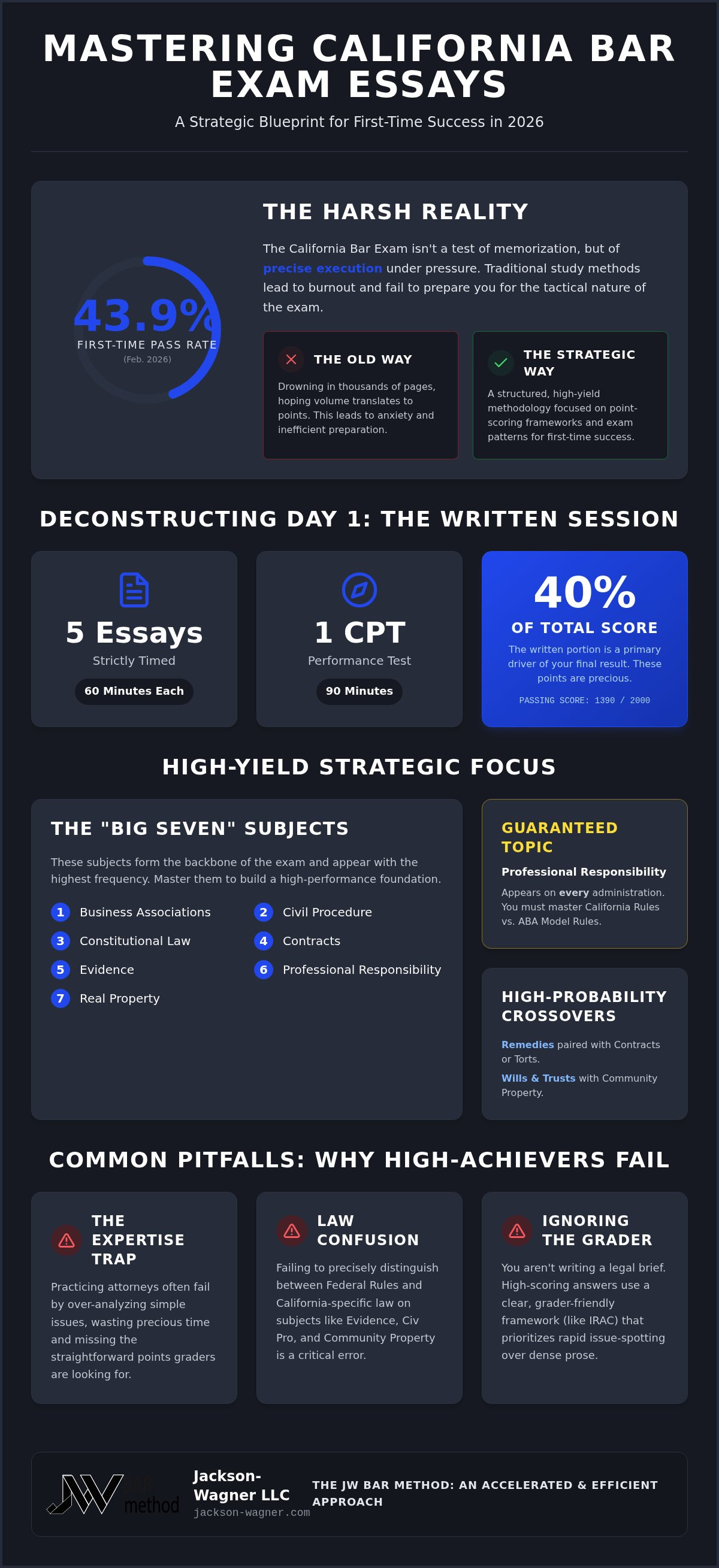
The 43.9% first-time pass rate from the February 2026 administration confirms a harsh reality: the California Bar Exam isn't a test of how much you can memorize, but how precisely you can execute. Most students approach california bar exam essay questions by drowning in thousands of pages of legacy outlines, hoping that volume will somehow translate into points. It's a recipe for burnout and anxiety, especially when you're facing a strict 60-minute limit per essay and the constant confusion of California-specific versus Federal law.
We believe your preparation should be as elite and efficient as your future legal career. This strategic blueprint replaces the stress of high-pressure certification with a structured, results-oriented methodology designed for first-time success. You'll gain a clear prioritization of high-yield subjects and a repeatable writing framework that guarantees points even on the most complex fact patterns. We're moving past the volume-based study of the past to give you the confidence to handle crossover questions with surgical precision. This is your path to mastering the essay portion and securing your California licensure.
Key Takeaways
- Understand the precise structure of the 2026 Day 1 written session, including the strategic 60-minute time allocation required to dominate each essay.
- Identify the high-yield "Big Seven" subjects and why Professional Responsibility remains a non-negotiable, guaranteed topic within california bar exam essay questions.
- Implement a sophisticated, grader-friendly writing framework that moves beyond basic IRAC to prioritize high-impact issue spotting.
- Learn to avoid the common "Expertise Trap" where over-analyzing simple issues can derail even the most experienced practicing attorneys.
- Discover how the JW Bar Method's accelerated tracks provide a modern, efficient alternative to traditional, volume-based study models.
The Scope and Structure of California Bar Exam Essay Questions in 2026
The State Bar of California administers an exam that is widely considered the most difficult in the nation. Success starts with understanding the tactical battlefield of Day 1. This session is dedicated entirely to the written portion, featuring five california bar exam essay questions and one 90-minute Performance Test (CPT). Each essay is strictly capped at 60 minutes. It's a high-stakes environment where every second counts. If you're a first-time applicant, you'll face this alongside the MBE. If you're a qualifying practitioner, the Attorney's Exam focuses your entire grade on these written responses. Mastering california bar exam essay questions requires more than just legal knowledge; it demands a sophisticated approach to time and structure.
Tested Subjects and California-Specific Law
The examiners pull from a pool of 13 potential subjects. You must be prepared for everything from Business Associations and Contracts to Wills and Succession. The real difficulty lies in knowing when to pivot. While many subjects rely on general majority law, others demand strict adherence to California-specific distinctions. You'll need to master the nuances of Community Property and Professional Responsibility through a localized lens. Additionally, Evidence and Civil Procedure often require you to contrast Federal rules with the California Evidence Code or the Code of Civil Procedure. Crossover questions are the norm. You might start a response in Torts only to find it's actually a complex Remedies problem. Precision isn't just preferred; it's required for a passing score.
The Weight of the Essay Portion
Your performance on these five essays is a primary driver of your final result. The essay portion accounts for 40% of the total scaled score for the full exam. Since you need a 1390 out of 2000 to pass, these points are precious. For those on the Attorney's Exam track, the written portion is your entire world. It's the make-or-break factor. Many practicing attorneys fail because they over-analyze, losing sight of the point-scoring structure the graders use. You aren't writing a legal brief for a partner; you're demonstrating a mastery of issue spotting and rule application under a ticking clock. A high-performance strategy is the only way to bridge the gap between knowing the law and actually passing the bar.
2026 Subject Frequency and High-Yield Strategic Focus
The State Bar doesn't test all 13 subjects with equal frequency. To master california bar exam essay questions, you must adopt a high-yield strategic focus. The "Big Seven" subjects form the backbone of the exam:
- Business Associations
- Civil Procedure
- Constitutional Law
- Contracts
- Evidence
- Professional Responsibility
- Real Property
However, 2026 trends suggest a resurgence in subjects that have been relatively dormant in recent cycles, such as Community Property and Wills. You can't afford to be blindsided by a subject you haven't touched in weeks. Effective triage involves allocating your limited study hours based on the statistical probability of a subject appearing. This isn't about cutting corners. It's about precision engineering your study schedule for maximum point acquisition. This structured approach replaces anxiety with a calculated plan for victory. By focusing on the subjects that historically appear most often, you build a foundation of high-performance knowledge that carries you through the high-stakes environment of the testing center. You aren't just studying law; you're studying the exam itself. This mindset shift is what separates elite candidates from those who get lost in the volume of legacy outlines.
The "Guaranteed" Topics: Professional Responsibility
Professional Responsibility isn't just a subject; it's a certainty. Reviewing California Bar Examination details confirms PR appears on every administration. You must master the California Rules of Professional Conduct and distinguish them from ABA Model Rules. For example, define the duty of loyalty as an attorney's obligation to place client interests above all others. Whether a standalone or crossover, PR is your most reliable source of points.
High-Probability Crossovers
Crossover questions are where candidates often lose footing. You'll frequently see Remedies paired with Contracts or Torts, or Wills and Trusts colliding with Community Property. Success requires identifying the "primary" subject anchoring the fact pattern before addressing secondary issues. This sophisticated approach ensures you don't miss the legal intersections graders use to distinguish passing answers. Mastering these intersections is vital for anyone tackling california bar exam essay questions.
If you're balancing a full-time practice with study, our accelerated prep tracks can help you refine this triage strategy and focus only on what matters most.
Anatomy of a High-Scoring Answer: The JW Bar Method Approach
Basic IRAC is a baseline; it's not a strategy. Graders spend roughly two minutes reviewing each of your california bar exam essay questions. If they have to hunt for your conclusion or struggle through a wall of text, your score will suffer. The JW Bar Method prioritizes a sophisticated, grader-friendly architecture. We replace dense blocks of text with bold headings and strategic white space. This digital-age formatting ensures that every point you earn is immediately visible to the person holding the red pen.
The structure of the bar exam demands that you move beyond student-level writing. You're demonstrating professional competence. Success requires you to engineer your response for maximum point density. This means every sentence must serve a specific purpose: identifying an issue, stating a rule, or applying a fact. Your goal is to make the grader's job as easy as possible by providing a clear, logical map of your legal reasoning.
Precision Issue Spotting
Avoid the "Kitchen Sink" approach. Throwing every possible legal theory at the page signals desperation, not mastery. We teach "Strategic Precision." Use the facts of the prompt as a literal checklist for your response. If the examiners included a specific date or a seemingly minor adjective, it's a trigger for a specific issue. Our proprietary Attack Outlines help you develop instant recall for these triggers. You'll learn to map the fact pattern to the law in the first 10 minutes of your 60-minute window, leaving the rest of the time for high-impact analysis. This ensures you never miss a major issue while avoiding the fluff that wastes your time.
Mastering the Analysis and Counter-Arguments
The analysis section is where 80% of your grade is determined. High-scoring candidates follow the "No Fact Left Behind" rule. You must link every relevant fact in the prompt to a specific element of the legal rule. Don't just conclude; prove your conclusion by weaving facts and law together. This is also the place to address counter-arguments. Acknowledging the other side shows the grader you understand the complexities of the law. However, don't let a counter-argument derail your flow. State the opposing view, apply the relevant facts, and then firmly dispose of it to reinforce your primary conclusion. This level of sophistication is what earns the scores necessary for first-time success. Our methodology ensures that your analysis remains lean and potent, avoiding the "Expertise Trap" that often plagues practicing attorneys.
Common Pitfalls: Why High-Achievers Fail the Essay Portion
High achievers often enter the testing center with a false sense of security. They rely on their professional experience, which is exactly why they struggle with california bar exam essay questions. The bar isn't looking for a nuanced legal opinion. They're looking for a specific, verbatim rule statement applied to a set of facts. If you can't recite the rule for hearsay or the elements of a contract exactly as they appear in the grader's rubric, you're leaving points on the table. Precision is the only currency that matters here. You must replace your instinct to "lawyer" with the discipline to perform.
The Practicing Attorney’s Dilemma
Transitioning from "Real World" lawyering to "Bar World" academic writing is the biggest hurdle for experienced lawyers. In practice, you fight the facts or look for outside evidence. On the exam, you must accept the prompt as absolute truth. Bringing in outside knowledge or over-complicating simple issues is a fast track to a failing score. For those taking the shortened path, understanding the California Attorney’s Exam Requirements: The 2026 Guide is essential for navigating these specific academic expectations. You must learn to play the game by the State Bar's rules, not your own.
Time Management Strategies
Clock management is where most candidates lose the war. The danger of the "Perfect" first essay is real. Spending 75 minutes on Question 1 leaves you with only 45 minutes for Question 2. You can't recover that time. We advocate for the 15-minute outline rule. Don't start typing immediately. Spend the first quarter of your hour mapping every issue. If you fall 10 minutes behind, use "placeholder" conclusions to ensure you finish every one of the california bar exam essay questions. Get the rule and the basic analysis down first. You can always go back and refine if the clock allows. This ensures you don't leave the final essay half-empty.
Finally, don't ignore the Performance Test (CPT). It's a companion to your essay success, not a separate hurdle. While the essays test your legal knowledge, the CPT tests your ability to follow instructions under extreme pressure. Neglecting this 90-minute session is a common mistake that drags down an otherwise passing written score. You need a comprehensive strategy that covers every minute of the exam day.
If you're ready to master the clock and avoid these common traps, see how our JW Bar Method Prep can streamline your path to success.
Mastering the Essays with the JW Bar Method
Mastering california bar exam essay questions requires a departure from traditional, volume-heavy study models. While legacy programs bury you in outlines, the JW Bar Method focuses on active, high-stakes drills that mirror the actual 60-minute testing environment. This is especially critical for practicing attorneys who are balancing a career with the demands of the Attorney's Exam. We replace passive reading with a structured pedagogy that forces you to apply the law under pressure. This results-driven framework is the core of our approach. For a deeper look at the overall requirements, read our Passing the California Bar Exam in 2026: The Definitive Strategic Guide.
Accelerated Preparation for the Full Bar
Accelerated preparation isn't about cutting corners. It's about surgical precision. Busy professionals require a study track that respects their time while ensuring absolute mastery of the subjects that actually drive scores. Our JW Bar Method Accelerated Prep - Full California Bar Exam is designed specifically for this demographic. We eliminate the guesswork by providing a clear prioritization of high-yield topics. Precision always beats volume in bar preparation. By focusing on the rules that drive passing scores, you build a foundation of high-performance knowledge without the burnout associated with legacy outlines.
The Performance Guarantee
We provide a sense of security through professional empowerment. The JW Bar Method addresses the high-stakes anxiety of the CA Bar by acting as a disruptive, highly competent mentor. Our binary performance guarantee distinguishes us from more cautious competitors, offering a level of certainty that is rare in professional licensing. It's time to move past the excitement of a promise and into the steady, structured progression of our curriculum. Your next step is clear. Enrolling in the JW Bar Method Prep - Full Exam California Bar or our specialized attorney tracks ensures you have the reliable path to success you deserve. We're ready to help you conquer california bar exam essay questions and secure your future in the legal profession.
Secure Your California Licensure in 2026
Success on the California Bar Exam is a matter of precision engineering. You've seen how mastering california bar exam essay questions requires more than just a deep legal vocabulary; it demands a tactical command of the 60-minute clock and a ruthless prioritization of high-yield subjects. By avoiding the pitfalls of over-analysis and utilizing a grader-friendly structure, you transform high-stakes anxiety into a predictable path toward success. We've built our reputation on replacing legacy study models with an agile, results-oriented pedagogy that empowers you to perform when it matters most.
Our proprietary JW Bar Method Prep is focused exclusively on California licensure, offering accelerated tracks specifically designed for busy professionals who can't afford to waste time on volume-based outlines. Don't leave your performance to chance or outdated study habits. It's time to leverage a modern alternative that's so confident in its efficacy that it assumes the risk of your outcome. Master the California Bar with the JW Bar Method and step into your legal career with absolute confidence. You have the tools and the strategy; now it's time to execute. We're ready to partner with you for a first-time pass.
Frequently Asked Questions
How many essay questions are on the California Bar Exam in 2026?
You will face five one-hour essay questions during the written portion of the 2026 exam. These are administered on the first day alongside a 90-minute Performance Test. This structure applies to both the full exam and the Attorney's Exam. Success requires maintaining high performance across all five sessions without allowing fatigue to diminish your precision. Consistency is the primary driver of a passing scaled score.
What subjects are most commonly tested on the California Bar essays?
The most frequently tested subjects include the "Big Seven": Professional Responsibility, Business Associations, Civil Procedure, Constitutional Law, Contracts, Evidence, and Real Property. Professional Responsibility is a certainty on every administration. Other subjects like Community Property, Torts, and Wills often appear as crossover components. Understanding this frequency allows you to prioritize high-yield topics during your final weeks of preparation for the 2026 cycle.
How long should I spend on each California Bar essay question?
You should spend exactly 60 minutes on each of the california bar exam essay questions. We recommend a strict internal schedule: 15 minutes for reading and outlining, followed by 45 minutes of high-density writing. Never steal time from one essay to finish another. Maintaining this rhythm ensures you don't leave the final essay of the day half-finished, which is a common reason for failure.
Do I need to know California-specific law for the bar exam essays?
Yes, California-specific law is required for several key subjects. You must know the distinctions for Community Property, Professional Responsibility, and certain rules within Evidence and Civil Procedure. For other subjects, you'll generally apply ABA Model Rules or majority law. Our method emphasizes these distinctions so you can pivot between Federal and state rules with surgical precision during the high-pressure environment of the exam.
What is the passing score for the California Bar Exam essay portion?
A total scaled score of 1390 out of 2000 is required to pass the exam. The written portion, which includes the essays and the Performance Test, accounts for 50% of your total score. Because the essays are scaled against the difficulty of the specific administration, your goal is to achieve high raw scores through comprehensive issue spotting and rule application. Every point is vital for reaching that passing threshold.
Can I use IRAC on the California Bar Exam essay questions?
You can use IRAC, but a more sophisticated architecture is often necessary for high scores. While IRAC provides a basic framework, california bar exam essay questions demand deeper analysis and the inclusion of counter-arguments. Our proprietary approach builds on IRAC by using bold headings and strategic white space to make your legal reasoning immediately visible to the graders who review your work in under two minutes.
How are the California Bar Exam essays graded?
Graders evaluate your answers based on your ability to identify legal issues, state relevant rules accurately, and apply those rules to the facts. Most essays are graded on a scale from 40 to 100. They aren't looking for a perfect legal brief; they're looking for evidence of professional competence and the ability to analyze complex fact patterns under extreme time pressure. Accuracy and structure are paramount.
What happens if I don’t finish an essay question on the bar exam?
Failing to finish an essay results in a significant loss of potential points. If you realize time is running out, pivot to a placeholder conclusion strategy immediately. Briefly state the remaining rules and provide a one-sentence analysis for each remaining issue. This allows you to capture partial credit rather than leaving a section entirely blank. Every point counts toward reaching that 1390 scaled score and securing your licensure.


