
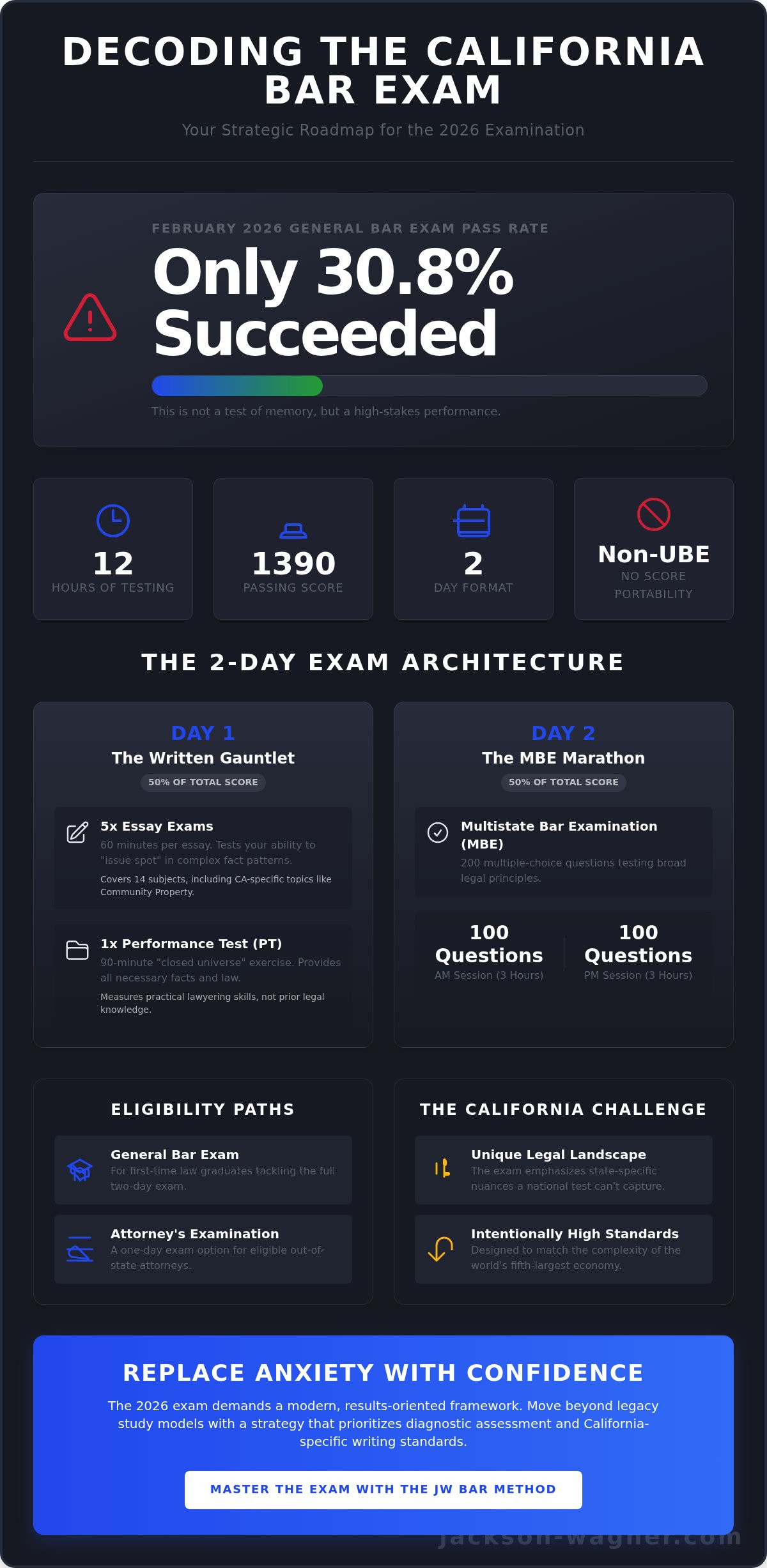
Only 30.8% of candidates passed the February 2026 General Bar Exam. This staggering statistic confirms what every law graduate suspects: the California Bar is a high-stakes performance, not just a test of legal memory. If you're searching for clarity on what's the California Bar Exam and how to navigate its 2026 requirements, you're likely feeling the weight of the daunting two-day format. You deserve a path that replaces this anxiety with absolute confidence and professional empowerment.
We understand that the journey to licensure often feels like a gauntlet of information overload and conflicting advice. This guide is designed to strip away the noise and provide the strategic framework you need to move from uncertainty to success. You'll master the structure, the rigorous scoring system, and the practical reality of the nation's most difficult licensing process.
We'll examine the five-essay structure, the 200-question MBE, and the specific eligibility rules for both the General Bar Exam and the Attorney's Examination. From critical application deadlines to the strategic advantages of the Jackson-Wagner LLC Bar Method Prep approach, this is your definitive roadmap to becoming a member of the California State Bar.
Key Takeaways
- Master the two-day exam architecture, including the five-essay written portion, the Performance Test, and the 200-question Multistate Bar Examination.
- Understand exactly whats the california bar exam demands for licensure in the world’s fifth-largest economy and why it remains the nation’s most rigorous gatekeeper.
- Learn why a 1390 scaled score is the non-negotiable threshold for success in 2026.
- Identify your specific eligibility path, whether you're a first-time law graduate or an out-of-state attorney seeking the one-day exam option.
- Replace legacy study models with a modern, results-oriented framework that prioritizes diagnostic assessment and California-specific writing standards.
Understanding the California Bar Exam: Purpose and Scope
The California Bar Exam isn't just a test; it's a high-stakes professional barrier. It functions as the mandatory licensing mechanism for the State Bar of California. For anyone asking whats the california bar exam, the answer lies in its role as the final gatekeeper for legal practice within the world's fifth-largest economy. This is a grueling two-day assessment administered twice every year, once in February and again in July. It demands more than just legal knowledge. It requires the stamina to perform under extreme pressure for twelve hours of testing. You're competing for a spot in a legal market that is larger than most countries.
Why California Opts Out of the UBE
Unlike many other states, California maintains its own sovereign testing standards rather than adopting the Uniform Bar Exam (UBE). This decision reflects the state's unique legal landscape and complex regulatory environment. When you investigate whats the california bar exam involves, you'll find it is a unique challenge compared to other states. The California curriculum emphasizes state-specific legal nuances that a general national exam simply cannot capture. This choice has significant implications for every applicant. Because California is a non-UBE jurisdiction, scores earned here don't port to other states. You're testing for the right to practice in California specifically. The standards are intentionally high to match the complexity of the state's legal system. This lack of reciprocity means your preparation must be laser-focused on California's specific demands.
The 2026 Exam Landscape
In 2026, the testing environment continues to evolve with a focus on digital administration and sophisticated security protocols. The Committee of Bar Examiners remains the ultimate authority, setting the passing standards that determine who enters the profession. They define the exam as a test of minimum competence and high-pressure execution. While official sites provide the logistics, they often fail to mention the psychological toll of the 2-day format. Success in this environment requires a modern approach that moves beyond legacy industry standards. You need a pedagogical strategy that prioritizes efficiency and practical application. The 2026 applicant must be prepared for a digital-first experience that rewards precision and structured thinking. This is not a marathon of memorization; it's a demonstration of professional readiness.
The Anatomy of the Exam: Structure and Components
Understanding whats the california bar exam actually looks like is the first step toward conquering it. The test is a two-day marathon that evaluates your ability to process complex facts and apply legal principles under intense pressure. Day one is the written gauntlet. It consists of five 60-minute essays and a single 90-minute Performance Test (PT). Day two shifts to the Multistate Bar Examination (MBE), which features 200 multiple-choice questions administered in two three-hour sessions. According to the official California Bar Examination information, both the written and the MBE portions are weighted equally at 50% of your total scaled score. This balance means you cannot rely on one section to carry you; you must demonstrate proficiency across every component to reach the required 1390 passing mark.
Mastering the Written Essays
The written section covers a broad spectrum of 14 possible subjects. These include core topics like Contracts and Torts, along with California-specific areas such as Community Property and Professional Responsibility. Success on Day 1 isn't about rote memorization of every obscure rule. It's about "issue spotting." You must identify the legal conflicts buried within complex fact patterns quickly and accurately. The JW Bar Method prioritizes high-yield essay topics, ensuring you spend your energy on the subjects most likely to appear on the exam. This strategic focus is essential for managing the sheer volume of information required for Day 1 success. If you're looking for a structured way to tackle these subjects, a JW Bar Method Prep - Full Exam California Bar course offers the targeted pedagogy needed to excel.
The 90-Minute Performance Test (PT)
The PT is a "closed universe" exercise. It doesn't test your prior knowledge of the law. Instead, it provides you with a "File" and a "Library." The File contains factual documents like transcripts, depositions, and letters. The Library contains legal authorities such as statutes and judicial opinions. Your task is to synthesize this data under extreme time pressure to produce a specific work product. You might be asked to draft a persuasive brief, a predictive memorandum, or a formal client letter. Many applicants struggle here because they fail to manage the clock effectively. Because it mimics actual lawyering skills, the PT is often the "make or break" section for candidates who have mastered the law but lack practical execution skills.
Day two is dedicated entirely to the MBE. This section tests seven core areas of federal law: Civil Procedure, Constitutional Law, Contracts, Criminal Law and Procedure, Evidence, Real Property, and Torts. You'll face questions designed to test subtle distinctions in the law. Mastering the MBE requires a pedagogical approach that focuses on pattern recognition and efficiency. When you grasp whats the california bar exam demands in terms of objective accuracy, you can tailor your study sessions to maximize your performance on these 200 questions.
Passing Standards and the Notorious "California Difficulty"
California’s reputation as the "hardest bar exam in the nation" isn't just hyperbole; it's a statistical reality. When people ask whats the california bar exam difficulty level, they're usually reacting to the low pass rates that consistently trail other jurisdictions. For instance, the February 2026 General Bar Exam saw an overall pass rate of just 30.8%. This rigor is enforced by The State Bar of California through a combination of complex essay testing and a high minimum passing threshold. Understanding these standards is vital for any 2026 candidate who wants to avoid becoming a statistic.
The 1390 Cut Score Explained
Your success depends on reaching a total scaled score of 1390 out of 2000. This number represents a "scaled" value, meaning your raw performance is adjusted to account for the relative difficulty of a specific exam administration. The written portion and the MBE are weighted equally at 50% each. This 50/50 split means you can't neglect one side and expect to pass. Scaling ensures that a 1390 in July is psychometrically equivalent to a 1390 in February, despite differences in the questions. You can review historical State Bar of California results to see how these benchmarks have shifted over the years. This transparency helps you understand the level of precision required for licensure.
Why High-Achievers Fail
Law school excellence doesn't guarantee a bar pass. Many top-tier graduates fail because they treat the bar as a test of legal knowledge volume rather than a test of execution. They fall into the trap of over-studying minor rules, sacrificing the time needed to master exam-taking strategy. Precision beats volume every time. The 2026 landscape rewards candidates who can apply core principles with surgical accuracy under strict time constraints. Success requires a shift from academic theory to professional performance. If you focus solely on memorizing 14 subjects without practicing the "issue spotting" mentioned in previous sections, you're leaving your results to chance. Modern bar preparation must be as agile and results-driven as the legal market itself. It's about working smarter, not just longer, to conquer the nation's most rigorous exam architecture.
Eligibility: Who Can Take the California Bar?
Eligibility for the California Bar is broader than many realize. While most candidates are law students, the state offers distinct pathways for practicing lawyers and foreign-educated professionals. When you ask whats the california bar exam eligibility, you must first identify your specific applicant category. General applicants typically include graduates from American Bar Association (ABA) schools or those accredited by the State Bar of California. However, California is unique in its openness to foreign-educated lawyers. If you've completed a legal education outside the United States, you may qualify by completing an additional year of study at an ABA or California-accredited school. This inclusivity makes the state a global destination for legal licensure, though it requires a meticulously planned educational path.
The California Attorney’s Exam Option
If you've been practicing law in good standing for at least four years in another US jurisdiction, you may qualify for the Attorney’s Exam. This is a significant strategic advantage. It reduces the standard two-day gauntlet into a one-day assessment. You'll tackle the five essays and the Performance Test but skip the 200-question Multistate Bar Examination entirely. This format respects your professional experience while still testing your competence in California law. You can find more details on the California Attorney’s Exam requirements to see if you meet the specific 2026 criteria. For those eligible, the JW Bar Method Prep - Attorney’s Exam California Bar provides the accelerated, writing-heavy focus this specific format demands.
The Moral Character and MPRE Requirements
Passing the exam is only half the battle. You must also satisfy the Multistate Professional Responsibility Examination (MPRE) and the Moral Character application. For 2026, California requires a minimum MPRE score of 86. This test of legal ethics is a mandatory prerequisite that should be cleared early in your journey. Simultaneously, the Moral Character application is a deep dive into your professional and personal history. It's a separate, rigorous process that can take six months or longer to process. Delays here will prevent your licensure even if you pass the bar. Consult our Moral Character Application guide for a strategic filing timeline that ensures your paperwork doesn't stall your career. Success in 2026 requires managing these administrative hurdles with the same precision you apply to your legal studies.
Strategic Preparation: How to Pass in 2026
Knowing the rules and the structure is only the foundation. To succeed in 2026, you must pivot from passive learning to high-stakes execution. If you're still wondering whats the california bar exam strategy for a passing score, it begins with a departure from legacy study habits. While traditional courses bury you in 600 hours of video lectures, a results-oriented approach focuses on the specific pedagogical needs of the California applicant. Success isn't about how much law you can read; it's about how much law you can apply under pressure.
Follow this five-step strategic framework for licensure:
- Diagnostic Assessment: Establish your baseline in both essay writing and MBE accuracy before you open a single textbook. You can't fix a performance gap you haven't identified.
- Pedagogical Alignment: Select a prep provider that prioritizes California-specific standards over national generalities. The state's unique legal landscape demands more than a one-size-fits-all approach.
- Structured Acceleration: Implement a schedule that maximizes efficiency. This is vital for working professionals balancing a career with the demands of the 2026 exam cycle.
- Execution Drills: Shift your focus to active issue spotting and Performance Test synthesis. Passive reading is the enemy of the 1390 scaled score.
- High-Yield Review: Dedicate your final weeks to the subjects and rules most likely to appear. Focus your energy where the points are most concentrated.
Why Precision Beats Volume
The legal industry is evolving, and your preparation must follow suit. The JW Bar Method serves as a modern alternative to legacy "big bar" prep by focusing on the 20% of law that actually appears on 80% of the exam. We reject the idea that sheer volume equals competency. Instead, we empower you to master high-yield rules with surgical precision. This is why accelerated prep programs are becoming the gold standard for busy attorneys and high-achieving graduates. When you understand whats the california bar exam actually tests, you realize that memorizing every obscure footnote is a waste of your most valuable resource: time.
Mental Readiness and Execution
The psychological pressure of a two-day exam can be as debilitating as a lack of legal knowledge. Replacing that anxiety with a sense of "bold reliability" is essential for peak performance. You need more than just materials; you need a partner who assumes the financial risk of your outcome. A performance guarantee isn't just a marketing claim. It's a testament to the efficacy of the curriculum and a shield against the stress of high-pressure certification. This structured, modern approach ensures you walk into the testing center feeling both motivated and legally protected. See how the JW Bar Method guarantees your success on the California Bar.
Secure Your California Licensure in 2026
The path to joining the California State Bar is intentionally rigorous, designed to filter for those who can execute under the highest professional stakes. You now understand whats the california bar exam requires: a 1390 scaled score, mastery of the two-day format, and a strategic focus on the high-yield rules that drive results. Whether you're a first-time taker navigating the full 14-subject gauntlet or an experienced attorney eligible for the one-day format, your success depends on choosing a preparation model that prioritizes precision over sheer volume.
Master the California Bar with the JW Bar Method-Guaranteed. Our proprietary JW Bar Method pedagogy is exclusively focused on California licensure, offering accelerated tracks for practicing attorneys who need efficiency without compromising on reliability. We replace the anxiety of high-pressure certification with a structured, modern, and dependable path to success. Don't leave your career to chance with legacy study models. Take command of your professional future and step into your new role with absolute confidence.
Frequently Asked Questions
Is the California Bar Exam the hardest in the US?
Yes, California is widely regarded as the most difficult bar exam in the nation due to its high cut score and low pass rates. While many states have transitioned to the Uniform Bar Exam (UBE), California maintains its own rigorous standards, resulting in an overall pass rate of just 30.8% for the February 2026 administration. This reputation persists because the state demands a higher level of precision and state-specific legal knowledge than almost any other jurisdiction.
How long is the California Bar Exam in 2026?
The exam is a two-day event in 2026. Day one consists of six and a half hours of writing, which includes five one-hour essays and one 90-minute Performance Test. Day two involves six hours of multiple-choice testing for the Multistate Bar Examination (MBE). Total testing time spans approximately 12.5 hours over the two days, excluding check-in and mandatory breaks. When asking whats the california bar exam duration, you must also factor in the mental stamina required for this 2-day format.
What is the passing score for the California Bar?
The passing score is a scaled 1390 out of a possible 2000 points. This threshold is applied across both the written and multiple-choice sections, which are weighted equally at 50% each. Achieving this score requires consistent performance across all subjects, as the scaling process adjusts raw scores to maintain a uniform standard of difficulty across different exam cycles. Precision in your answers is essential to reaching this non-negotiable benchmark.
Can I take the California Attorney’s Exam instead of the full Bar?
You can take the one-day Attorney’s Examination if you've been a practicing lawyer in good standing in another US jurisdiction for at least four years. This option allows you to skip the MBE entirely, focusing only on the five essays and the Performance Test. It's a strategic choice for experienced professionals looking to streamline their path to California licensure without the burden of a 200-question multiple-choice section.
When are the 2026 California Bar Exam dates?
The July 2026 General Bar Examination is scheduled for July 28 and 29, 2026. For candidates planning for the following cycle, the February 2027 exam will take place on February 23 and 24, 2027. Application windows open early, with the July 2026 application period starting on March 1, 2026. Knowing whats the california bar exam timeline is critical for managing your study schedule and administrative deadlines.
How much does it cost to take the California Bar Exam?
The application fee for first-time takers is $677, while attorney applicants pay $983. Most candidates also pay a $153 laptop fee to use their own computers for the written portion of the exam. These fees are paid directly to the State Bar of California and don't include the costs of the MPRE or the Moral Character application process. Candidates should budget for these expenses well in advance of the filing deadlines.
Can I work full-time while studying for the California Bar?
Working full-time while studying is possible but requires a highly structured and efficient preparation strategy. Legacy prep courses often demand 40 hours of study per week, which is unsustainable for most professionals. Modern, accelerated programs focus on high-yield rules and precision, allowing you to maximize your limited study hours without sacrificing your performance on the 1390 cut score. Success depends on quality of study rather than sheer volume.
What happens if I fail the California Bar Exam?
If you fail, you must wait for the next semi-annual administration to retake the exam. Statistics show that repeat takers often face lower pass rates, with the February 2026 repeat taker rate sitting at just 23.1%. Success on a subsequent attempt requires a diagnostic assessment of your previous scores and a shift toward a more results-oriented study methodology. You must identify exactly where your execution failed to ensure a different outcome on your next attempt.


