
The standard 600-page outline is a relic of the past that's actively sabotaging your chances of passing the nation's most rigorous legal examination. Many candidates believe that success requires encyclopedic memorization of every possible legal nuance, yet this outdated approach is exactly why so many brilliant legal minds fail. You've likely felt the crushing weight of information overload from massive prep books; it's a fear-based system that doesn't respect your time or your professional life. If you're juggling a full-time job while preparing for the July 28 and 29, 2026, exam dates, the generic study schedule provided by a legacy California Bar Exam prep course simply won't cut it.
We understand that you don't need more information; you need a strategic advantage. This article exposes the truth behind common bar prep myths and reveals how a precision-based methodology ensures you hit the 1,390 passing score without wasting months on irrelevant material. We'll explore why traditional volume-based training is fundamentally misaligned with the exam's actual demands. You'll discover how to trade high-stakes anxiety for a structured, modern path to success that guarantees you're ready to dominate the essays and the MBE on your first attempt.
Key Takeaways
- Understand why a modern California Bar Exam prep course must function as a strategic partner rather than a simple content repository to ensure success in 2026.
- Identify the five most dangerous study myths that lead to information overload and high-stakes failure among even the most dedicated candidates.
- Discover the "precision over volume" methodology that prioritizes high-impact material and protects your psychological stamina during exam season.
- Use a structured framework to evaluate your study options based on your specific exam track, whether you're taking the Full Bar or the Attorney's Exam.
- Learn how to secure a reliable path to passing with a modern alternative that replaces legacy inefficiency with a performance-backed methodology.
The Evolution of the California Bar Exam Prep Course in 2026
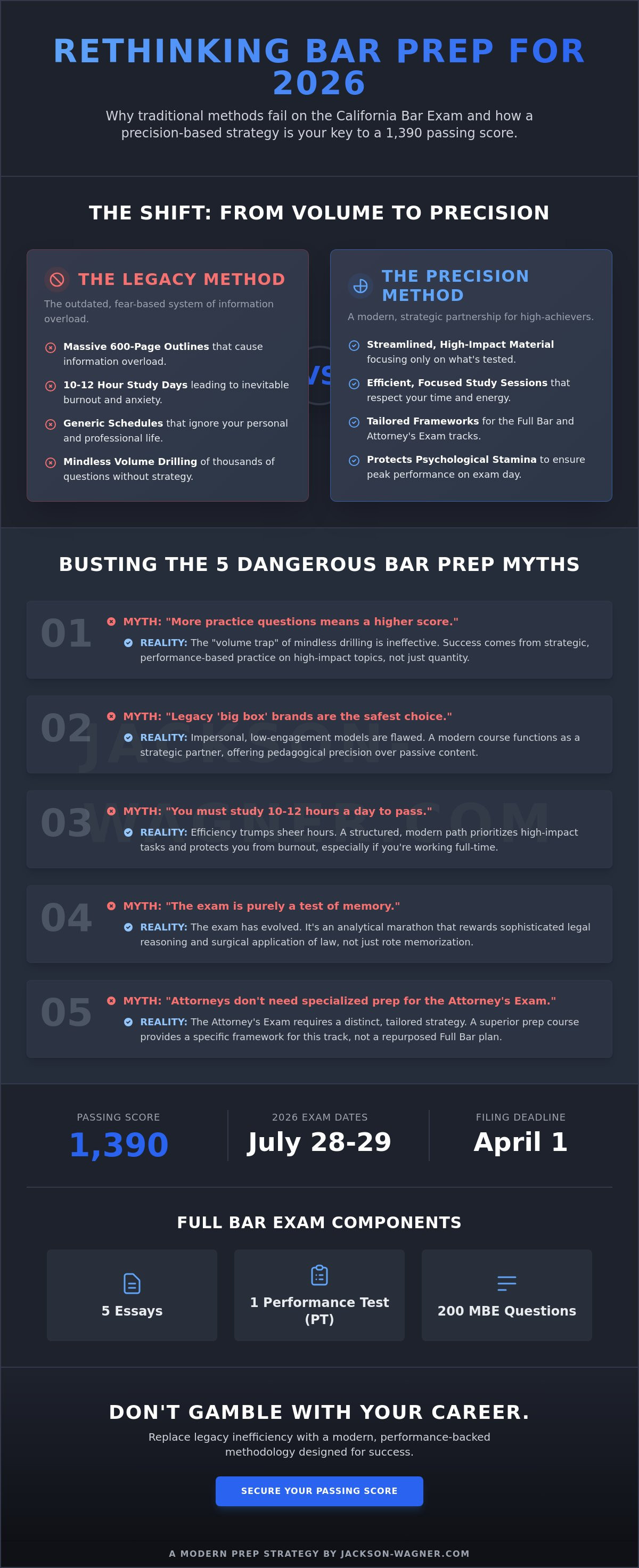
The 2026 California Bar Exam is no longer a simple test of memory. It has transformed into a high-stakes analytical marathon that demands strategic precision rather than encyclopedic knowledge. For decades, candidates were told that success was a matter of sheer volume; more hours, more pages, and more practice questions. That era is over. A modern California Bar Exam prep course must function as a strategic partnership rather than a mere content repository. It's a shift from passive consumption to active, performance-based execution. The State Bar of California has refined its grading rubrics to reward candidates who can apply law with surgical accuracy, making the 1,390 minimum scaled score a formidable barrier for those using outdated tools.
The legal landscape in 2026 requires more than just "learning the law." It requires an understanding of how to navigate a nuanced, performance-based evaluation system. Graders are looking for sophisticated legal reasoning, not just a list of elements. This evolution reflects the reality of modern practice where efficiency and clarity are paramount. Because the California Bar remains the nation’s most rigorous exam, the stakes of choosing the wrong methodology are catastrophic. Failing doesn't just mean losing a summer; it means delaying a career and sacrificing months of professional income.
Beyond the "Big Box" Model
Legacy "big box" providers continue to rely on massive, impersonal lecture halls and generic, pre-recorded videos. This model is fundamentally flawed for the modern learner. It assumes that every candidate has the same baseline and the same schedule, which is rarely the case for today's high-achievers. Pedagogical precision is the new standard in professional licensing. High-achievers often struggle with standardized, low-engagement prep models because these systems prioritize "checking boxes" over actual skill acquisition. You don't need a 600-page outline that covers every obscure detail. You need a streamlined system that identifies what is actually tested and teaches you how to write for a passing score. Efficiency is the only way to survive the crushing workload of bar season.
The 2026 Licensure Landscape
Applying for the July 2026 exam requires strict adherence to a specific timeline. The timely filing window opens on March 1 and closes on April 1, 2026, with the actual exam taking place on July 28 and 29. Success starts with navigating the State Bar of California licensure requirements early to avoid administrative delays. Candidates must choose the correct track: the Full Bar Exam, which includes five essays, one Performance Test, and 200 MBE questions, or the Attorney’s Exam for those already licensed in other jurisdictions. Each track requires a distinct approach. A superior California Bar Exam prep course recognizes these differences and provides a tailored framework. In a year where the exam format remains stable but the competition is fiercer than ever, your study methodology must be your greatest competitive advantage.
Busting the 5 Most Dangerous Bar Prep Myths
Conventional wisdom is often just collective anxiety masquerading as advice. Most candidates choose a California Bar Exam prep course based on what their peers are doing rather than what actually produces results. This herd mentality perpetuates dangerous myths that lead to burnout and failure. To succeed in 2026, you must dismantle these misconceptions and replace them with a strategy built for the actual exam you'll face on July 28 and 29. Success isn't about how much you suffer; it's about how effectively you prepare.
- Myth 1: "More practice questions always lead to a higher score."
- Myth 2: "Legacy brands are the safest choice for high-stakes exams."
- Myth 3: "You must study 10-12 hours a day to pass the California Bar."
- Myth 4: "The exam is purely a test of memory."
- Myth 5: "Practicing attorneys don’t need specialized prep for the Attorney’s Exam."
The Volume Trap: Why 2,000 Questions Isn’t the Answer
Many students fall into the trap of mindless drilling. They believe that completing 2,000 multiple-choice questions guarantees a passing score on the MBE. This is a fallacy. There is a massive difference between "passive recognition" and "active mastery." Passive recognition happens when you see a question and remember the answer because you've seen the pattern before. Active mastery is the ability to explain why that answer is correct based on the underlying legal principle. Without detailed feedback and a focus on the specific nuances of California law, you are simply reinforcing bad habits. In the 2026 testing environment, precision beats volume every time. Strategic study allows you to master the material in less time, leaving room for the rest and recovery necessary for peak performance.
The Legacy Bias vs. Modern Results
Defaulting to a famous brand is often a fear-based decision. Candidates worry that if they fail using a non-traditional method, they'll have no one to blame but themselves. However, if you look at the California Bar Exam statistics, it becomes clear that legacy brands aren't protecting students from the state's low pass rates. These large-scale educational publishers suffer from a massive innovation gap. They are slow to adapt to changes in how the exam is graded and how modern adults learn. A results-oriented approach requires agility and a focus on the individual learner's needs. For those seeking a more effective path, choosing a precision-based study method can be the difference between a first-time pass and a wasted year. Practicing attorneys taking the Attorney's Exam are particularly vulnerable to this bias, often underestimating the specific stylistic requirements the California graders demand. Don't let a "big box" curriculum dictate your professional timeline.
Volume vs. Precision: Choosing a Results-Oriented Methodology
Traditional bar prep is built on a flawed premise: that quantity equals quality. These encyclopedic courses attempt to teach you every obscure corner of the law, regardless of its likelihood of appearing on the exam. This "teach everything" model forces you to sift through thousands of pages of low-yield material. In contrast, a strategic approach prioritizes what matters. By focusing on the core principles that actually drive your score, you can achieve mastery without the soul-crushing weight of irrelevant data. This shift in methodology doesn't just save time; it fundamentally changes your psychological state on exam day. When you know you've mastered the highest-probability topics, you walk into the room with confidence rather than the frantic hope that you'll remember a random footnote. Choosing a results-oriented California Bar Exam prep course means choosing a partner that assumes the financial risk of your performance. A binary performance guarantee aligns the provider's incentives with your success, creating a level of accountability that legacy brands simply don't offer.
The Cognitive Load of Traditional Prep
Cognitive load refers to the amount of mental effort being used in the working memory. Big-box courses often exceed this limit by dumping thousands of pages of text onto students, leading directly to "bar prep burnout." When your brain is overwhelmed, it stops retaining information and starts merely surviving the day. The JW Bar Method reduces this mental friction by stripping away the noise. We replace the "kitchen sink" approach with a streamlined curriculum designed for maximum retention. Strategic focus is the ability to identify high-yield topics with 90% accuracy. By concentrating your energy on the areas that provide the highest return on investment, you can study for fewer hours while achieving superior results. This efficiency is essential for candidates who don't have the luxury of putting their lives on hold for three months.
Feedback: The Missing Ingredient
The most significant weakness of most prep models is the lack of meaningful feedback. Automated grading systems can tell you if you got a multiple-choice question right, but they can't tell you why your essay analysis failed to meet the California graders' expectations. Mastering California-specific essay writing requires a rigorous feedback loop. You need expert, individualized critique on your performance tests to understand how to structure your arguments and apply the law with the required precision. Many courses fail to provide this level of scrutiny, leaving students to guess their progress. As you enter the final weeks of study, you need definitive strategic guidance to refine your technique. High-quality feedback transforms your study from a guessing game into a predictable path to licensure. Without it, you are simply repeating the same mistakes and hoping for a different result on exam day.
A Strategic Framework for Evaluating Your Study Options
Choosing your study partner is the most consequential decision you'll make this year. It's the difference between stepping into the exam room with a proven blueprint or a pile of confusing flashcards. To find the right California Bar Exam prep course, you need a framework that looks past marketing slogans and focuses on structural efficacy. Use these five steps to vet any program before you commit your time and capital.
- Step 1: Assess your specific track. Determine if you're taking the Full Bar Exam or the $1,650 Attorney’s Exam. Each requires a fundamentally different study rhythm.
- Step 2: Evaluate the methodology. Does the course prioritize high-yield topics with 90% accuracy, or does it rely on the "kitchen sink" approach of teaching everything?
- Step 3: Check for a performance guarantee. A provider that doesn't offer a binary financial assurance isn't truly a partner in your success.
- Step 4: Verify California-specific depth. Ensure the course provides individualized, expert feedback on the 90-minute Performance Test and the five one-hour essays.
- Step 5: Determine flexibility. If you're a working professional, a rigid, 12-hour-a-day schedule is a recipe for failure. Look for a system that adapts to your life.
The Attorney’s Exam Distinction
Seasoned lawyers often struggle when they try to use standard "student" prep courses. These legacy models are built for recent law graduates with 60 hours a week to spare. If you're an out-of-state practitioner, you don't need to relearn the basics of legal reasoning; you need to master the specific stylistic demands of the California graders. Understanding the requirements for out-of-state lawyers is the first step toward efficiency. For this demographic, a JW Bar Method Accelerated Prep - Attorney’s Exam California Bar course is often the best fit. It respects your existing expertise while providing the surgical precision needed to pass the essay-only track without the MBE burden.
Beyond the Price Tag: Calculating ROI
The sticker price of a course is only one part of the financial equation. You must calculate the hidden costs of failure. Between the $878 general bar fee, the $153 laptop fee, and months of lost wages, failing the bar is an incredibly expensive setback. If a lawyer earns $150,000 annually, a six-month delay in licensure represents $75,000 in lost opportunity. A more specialized, precision-based course is the cheaper option when it prevents a second attempt. Don't forget that your strategic planning must also account for the Moral Character Application, an often-overlooked logistical hurdle that can delay your swearing-in even after you pass. If you're ready to move beyond generic lectures and secure your professional future, explore our precision-based prep options today.
The JW Bar Method: A Modern Alternative to Legacy Prep
The JW Bar Method isn't just another curriculum; it's a fundamental rejection of the legacy industry's "more is better" philosophy. We've built the antidote to big-box inefficiency by focusing on the specific pedagogical requirements of the 2026 exam. This isn't about passive video watching or reading through endless outlines. It's about a strategic partnership where we assume the financial risk of your performance. Our "Bold Reliability" signature means we're so certain of our methodology that we offer a binary performance-backed financial assurance. While other providers distance themselves from your actual results, Jackson-Wagner stands as a disruptive mentor, ensuring you have a reliable path to success.
Whether you're a first-time taker or a seasoned legal professional, we provide accelerated, structured tracks tailored to your specific licensure goals. We recognize that practicing attorneys don't need the same hand-holding as recent graduates. Our JW Bar Method Prep - Attorney’s Exam California Bar is specifically calibrated for those who need to master the essay portion without the redundant MBE review. We've stripped away the administrative bloat to create a student-centric environment that respects your time and your career. You don't have to sacrifice your practice to pass the bar.
Precision over Pedantry
The JW Bar Method filters out the noise that plagues a standard California Bar Exam prep course. Traditional pedantry focuses on memorizing every possible exception to a rule; our precision-based curriculum focuses on the essentials required for licensure. We move you from the stress of high-pressure certification to a steady, structured progression. You're invited to experience the JW Bar Method advantage first-hand by focusing on the high-yield material that actually drives your score. This isn't just about working harder. It's about working with a surgical focus that ensures you don't waste a single hour on irrelevant content that won't appear on the July 28 and 29, 2026, exam dates.
Next Steps for 2026 Candidates
Enrollment is now open for our July 2026 cohorts. You can choose between our standard JW Bar Method Prep or the JW Bar Method Accelerated Prep depending on your study window and professional commitments. If you're balancing a full-time caseload, the accelerated track provides the flexibility you need without sacrificing the depth of our feedback loops. Success on the California Bar is a choice of strategy, not just effort. Don't let an outdated model dictate your professional timeline. Secure your path to California licensure with the JW Bar Method.
Secure Your Professional Future in the California Legal Market
The path to licensure in 2026 demands a departure from the high-volume, low-impact study habits of the past. You've seen how legacy models prioritize encyclopedic memorization over the strategic precision required by the nation's most rigorous exam. Success is no longer about how many pages you read; it's about mastering the high-yield material that actually appears on the test. By choosing a California Bar Exam prep course built on a proprietary precision-based methodology, you replace the anxiety of uncertainty with a structured, reliable roadmap to a passing score.
Our accelerated tracks for working professionals ensure that your study schedule adapts to your life, not the other way around. We stand behind our curriculum with a binary performance guarantee, assuming the financial risk of your outcome so you can focus entirely on execution. You have the talent and the drive; now you need the right strategy to claim your seat at the bar. You're ready to move beyond the myths of traditional prep and secure your license on the first attempt.
Master the California Bar with the JW Bar Method
Frequently Asked Questions
Is the California Bar Exam actually the hardest in the nation?
Yes, it's widely regarded as the most difficult professional licensing exam in the United States due to its historically low pass rates and high minimum scaled score of 1,390. While many states have moved toward a standardized national test, California maintains its own rigorous format that demands a high level of analytical depth. This intensity makes choosing the right California Bar Exam prep course a critical career decision rather than a simple administrative task.
Can I pass the California Bar Exam while working full-time?
You can pass while working if you utilize a precision-based methodology that prioritizes high-yield content over mindless volume. Traditional "big box" courses often demand 50 to 60 hours of study per week, which is unsustainable for most working professionals. By focusing on the 90% of law that is actually tested, you can achieve mastery in a fraction of the time, allowing you to balance your professional responsibilities with effective exam preparation.
What is the difference between the California Bar Exam and the Attorney’s Exam?
The Full Bar Exam is a two-day test consisting of the 200-question Multistate Bar Examination (MBE), five essays, and one Performance Test. In contrast, the Attorney’s Exam is limited to the written portions, the essays and the Performance Test, and is available to those already licensed in another jurisdiction for at least four years. Because your entire score on the Attorney's Exam depends on your writing, you need a specialized California Bar Exam prep course that focuses specifically on the stylistic demands of California graders.
Why do high-achieving law students often fail the bar on their first attempt?
High-achievers often fail because they treat the bar exam as an academic research project rather than a test of strategic application. Law school rewards deep theoretical dives, but the bar exam rewards the ability to identify and apply rules quickly under extreme time pressure. When these students use legacy prep models, they often get lost in 600-page outlines and fail to develop the "test-taking" muscle needed to hit the required 1,390 score.
How long should I realistically study for the California Bar Exam?
Most candidates should plan for a 10 to 12-week study window, though the daily intensity varies based on your methodology. A precision-based approach allows for a more manageable schedule of 4 to 6 hours a day, whereas traditional methods often require 10 to 12-hour marathons. It's also vital to account for administrative timelines, such as the March 1 to April 1 timely filing window for the July exam, to ensure your focus remains on the law as the exam dates approach.
Are online bar review courses as effective as in-person classes in 2026?
Digital-first platforms are often more effective because they provide the flexibility and individualized feedback that massive lecture halls can't match. In 2026, the most successful candidates use online environments that offer sophisticated, pedagogical tools and expert critique on their writing. This allows you to study at your own pace while receiving the specific, nuanced guidance necessary to master the California-specific subjects and performance tests.
What happens if I don’t pass the bar after taking a prep course?
If you don't pass, you should immediately evaluate whether your prep course provided a binary performance guarantee or simply offered a "free" repeat of the same failed materials. You'll need to analyze your score report from the State Bar to determine if your weakness was in the MBE or the written components. Simply repeating the same volume-based study habits rarely leads to a different result; a shift to a precision-based strategy is usually required for a second attempt.
What specific subjects are tested on the California-specific portion of the exam?
The essay portion covers a broad range of subjects including Community Property, Professional Responsibility, and Wills and Trusts, often in "cross-over" questions that test multiple areas at once. You must also master California-specific nuances in Evidence and Civil Procedure that differ from the Federal rules tested on the MBE. Because these subjects are unique to the state's exam, your preparation must go beyond general legal principles to include the specific rules favored by California graders.


