

What if your fail letter isn't a final verdict on your potential, but a high-resolution map of exactly how you'll pass in 2026? Most candidates treat their results as a source of shame, yet the most successful retakers view them as a diagnostic goldmine. It's frustrating to stare at a sheet of numbers and feel like you're decoding an ancient language while the pressure of the 1390 pass mark looms. You've likely spent months in a study cycle that felt like a marathon, only to be met with "scaled" scores that don't seem to reflect your actual effort.
This guide to understanding your california bar exam score report will strip away the mystery and turn those cryptic marks into a tactical advantage. You'll gain a clear understanding of the mechanics behind the written and MBE weighting, allowing you to identify the precise sub-topic gaps that cost you points. We're moving past the anxiety of the 30.8% pass rate and toward a structured, data-driven path to success. We will analyze the 1390 scaled requirement and build a roadmap that replaces guesswork with precision for the 2026 administration. You deserve a strategy that's as rigorous as the exam itself.
Key Takeaways
- Learn how to treat your results as a diagnostic roadmap by focusing on the 1390 scaled score requirement.
- Master the mechanics of understanding your california bar exam score report to see how the 50/50 weighting between written and MBE scores impacts your final result.
- Identify specific grading markers in your essays and PTs to determine if your performance suffered from knowledge gaps or application errors.
- Break the cycle of passive "legacy" study habits that prioritize volume over the precision needed for a passing score.
- Develop a high-impact strategy for the 2026 exam that leverages your historical data to ensure a structured path to licensure.
The Anatomy of the California Bar Exam Score Report
The score report is your first piece of evidence for the 2026 cycle. It’s a confidential breakdown that the State Bar of California sends exclusively to applicants who fall short of the 1390 scaled score requirement. While passing candidates receive a simple notification of success, those who miss the mark get a granular look at their performance. This document is the foundation of understanding your california bar exam score report because it reveals exactly how close you were to the finish line and where your mechanics failed you. It isn't a mark of shame; it's a diagnostic tool that separates your effort from your results.
The State Bar uses scaled scores to account for variations in exam difficulty across different years. This ensures that a 1390 in February 2026 represents the same level of proficiency as a 1390 in any other administration. For a broader perspective on the exam's history and structure, you can consult this California Bar Examination overview. The format of your report depends on which exam you took. General Bar Exam applicants see a full breakdown of written and MBE scores. Attorney's Exam applicants receive a report focused solely on the written portion, as they are exempt from the multiple-choice section. This distinction is vital because it changes how you calculate your path to a passing score.
The Components of Your 2026 Results
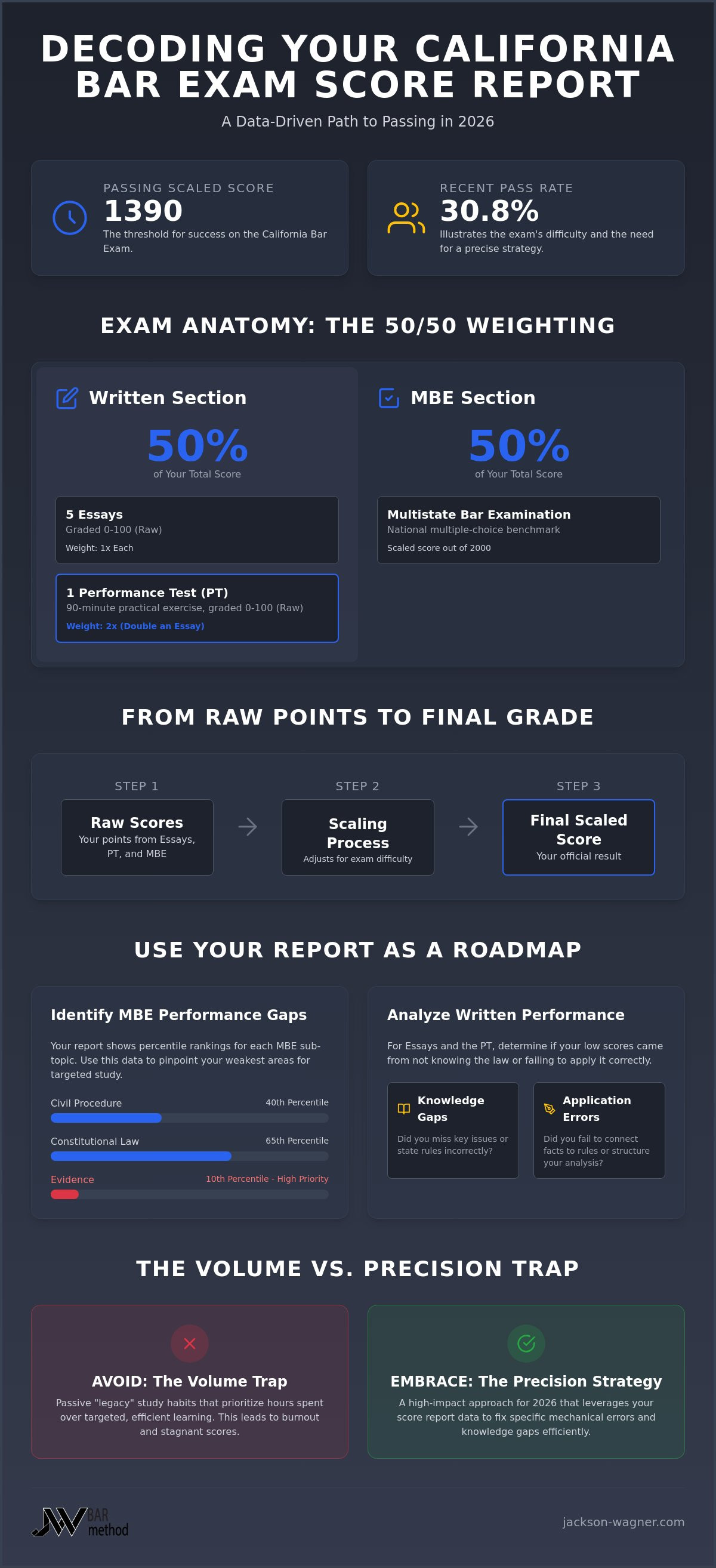
Your 2026 results consist of three primary pillars that determine your final standing. First, five essay questions are each graded on a raw scale of 0 to 100. Second, the Performance Test (PT) is a 90-minute exercise that also uses the 100-point scale but carries double the weight of a single essay. Finally, the Multistate Bar Examination (MBE) provides a scaled score out of 2000. These components are weighted equally; the written and MBE portions each contribute 50% to your final grade. If you're an attorney applicant, your written score is the entirety of your report, making essay precision your only path to success.
Decoding Phased Grading
California employs a sophisticated phased grading system to ensure accuracy. If your initial score is close to the passing threshold, your written work undergoes a second review by a different grader. This calibration process ensures that every essay is judged against a consistent standard rather than a grader's individual mood. A scaled score is the mathematical adjustment applied to raw points to ensure that the relative difficulty of a specific exam doesn't unfairly penalize or reward a candidate. Understanding your california bar exam score report requires looking past the raw numbers to see how this scaling either boosted or hindered your final standing. This transparency is what allows you to build a better plan for the next cycle.
Decoding the Numbers: Scaled Scores vs. Raw Scores
Your raw score is merely a starting point; it doesn't tell the whole story of your performance. To truly master understanding your california bar exam score report, you must look at how the State Bar transforms these raw marks into a scaled final grade. This conversion process ensures that no single exam administration is unfairly difficult or easy compared to previous years. The most critical takeaway for your 2026 strategy is the 50/50 split. Your written performance and your MBE performance carry equal weight in the final calculation. If you excelled at multiple-choice questions but struggled with the written portion, your total score likely stalled below the 1390 threshold.
Analyzing the percentile data in your report reveals how you performed relative to the 2026 applicant pool. This data is far more useful than the raw numbers alone. If you see that you're in the 40th percentile for Civil Procedure but the 10th for Evidence, your roadmap is already halfway written. Identifying "near-miss" scores is equally vital. If you were within 50 points of passing, you don't need a total overhaul of your law knowledge. Instead, you need a precision strike on the specific mechanical errors that prevented your raw scores from scaling into the passing range. For those who need to bridge this gap quickly, the JW Bar Method Accelerated Prep - Full California Bar Exam provides the targeted feedback necessary to turn near-misses into 2026 passes.
The MBE Scaled Score: A National Benchmark
The MBE is a national benchmark, but California scales these results to fit its specific grading universe. Don't obsess over your raw count of 175 scored questions. Instead, examine the sub-topic percentiles to find knowledge gaps. If your Torts score is high but Constitutional Law is lagging, you've identified a specific area where your precision failed. California’s scaling often feels more aggressive than other jurisdictions, meaning every single correct answer carries immense weight in pushing you toward that 1390 mark.
Written Score Calculation
The written score calculation follows a rigid formula where your total raw written score is multiplied by a scaling factor. You can find more detail on the official grading process regarding how these phases interact. A single "bombed" essay, typically a score below 55, is significantly harder to recover from than a mediocre MBE day. This is largely because the Performance Test carries double the weight of a single essay. If your PT score was a 65, it might have saved an otherwise weak essay set. If it was a 50, it almost certainly sank your written average regardless of how well you knew the black letter law.
Identifying Performance Gaps in Essays and PTs
A raw score of 62.5 isn't just a number; it's a specific signal from the grader that your answer was nearly proficient. In the context of understanding your california bar exam score report, you must distinguish between a knowledge gap and an application failure. A 62.5 often means you identified the correct legal issues and stated the rules accurately, but your analysis lacked the depth or factual integration required to reach a passing 65. If you see consistent scores in the 60 range across all five essays, you likely don't have a problem with the law itself. Instead, you're likely facing structural issues where your IRAC format or headings aren't guiding the grader effectively through your logic.
A "knowledge fail" typically manifests as a score of 55 or lower. This suggests you missed an entire branch of the law or fundamentally misunderstood the call of the question. Conversely, an "application fail" happens when you have the right law but treat the facts as an afterthought. Graders want to see you "fight" with the facts. If your report shows a mix of high 60s and low 50s, your preparation was likely uneven, favoring some subjects while ignoring others. For the 2026 exam, your goal is to stabilize these fluctuations by mastering the mechanical precision that turns a 60 into a 65.
Reading Between the Lines of Essay Scores
The 65-point threshold is the gold standard for a passing response. When you receive a 55, the grader is telling you that you failed to use the provided facts or missed a major "bucket" of issues. It's helpful to use state of california state bar resources to compare your actual answers against the released model responses. This comparison reveals exactly where your analysis fell short of the benchmark. Don't just read the law; study the "why" behind the model answer's structure to see how they earned those extra five points.
The Performance Test Diagnostic
The PT is often where the battle for a 1390 is won or lost. Because of the 2.0 weighting factor, the difference between a raw score of 60 and a 70 is massive. If your PT score was a 60, it dragged your written average down twice as hard as a weak essay would have. You need to determine if you failed the task or the time management. Most high-achieving attorneys lose points here because they treat the PT like a real-world brief rather than a timed academic exercise. If you didn't follow the specific "Memo" instructions to the letter, your score will stall regardless of how well you wrote. Understanding your california bar exam score report means recognizing that the PT is a test of your ability to follow directions under extreme pressure, not a test of your legal brilliance.
Why Your Score Stalled: The Volume vs. Precision Trap
"I studied ten hours a day and still failed." This is the most frequent objection voiced by candidates who don't see their names on the pass list. It's a crushing reality, yet it highlights a fundamental misunderstanding of the california bar exam grading philosophy. Legacy bar prep companies have conditioned you to believe that volume is the solution. They bury you in massive outlines and hundreds of hours of passive video lectures. This "Legacy Prep" model fails because it prioritizes the consumption of information over the surgical execution of the exam. Understanding your california bar exam score report reveals that your failure likely wasn't a lack of law study; it was a lack of precision in your output.
High-achieving attorneys often struggle with this exam specifically because they over-analyze the prompts. They bring a practice-oriented mindset to an academic exercise that rewards mechanical accuracy over nuanced legal theory. You don't need to know more law to pass in 2026. You need to execute the law you already know with absolute precision. Moving from "knowing the law" to "executing the exam" is a pedagogical shift that separates successful retakers from those stuck in a cycle of repeated attempts. Your score report is the evidence that the volume-heavy approach has reached its limit.
The Myth of "More Study"
Re-enrolling in a generic, one-size-fits-all course is often a recipe for a repeat result. If your score report shows you were within striking distance of the 1390 mark, your missing variable isn't "more study" in the traditional sense. It's a change in how you engage with the material. Your report proves you've already consumed the necessary volume. To move a stagnant score toward a 1440 safety margin, you must pivot to active recall and high-stakes drills. Passive reading won't bridge the gap. You need a system that forces you to retrieve information under pressure, mimicking the actual conditions of the 2026 administration.
Precision Over Volume
The JW Bar Method approach to score report analysis is built on identifying "low-hanging fruit." We don't look at your MBE sub-scores and tell you to read the textbook again. We identify the specific mechanical triggers you missed. You must shift your mindset from being a student to being a tactical exam taker. This means mastering the "application" phase where points are actually won. If you're ready to stop the cycle of passive learning and start a results-driven diagnostic, explore how the JW Bar Method Prep - Full Exam California Bar replaces legacy volume with modern precision. Stop guessing why you failed and start executing the path to your 2026 license.
Turning Your Score Report into a 2026 Success Strategy
Analyzing the data is merely the first step; the true value of understanding your california bar exam score report lies in how you translate those numbers into a rigorous, personalized schedule for 2026. A generic calendar won't fix the specific application errors that cost you points on the Evidence essay or the Torts MBE sub-topic. You need a surgical approach that allocates time based on the deficits identified in your diagnostic. This is where the best bar exam preparation service distinguishes itself by replacing bulk review with targeted execution. By focusing your energy on the areas where you're currently losing points, you ensure that every study hour contributes directly to a passing scaled score.
The JW Bar Method provides a structured path to bridge the gap between a near-miss and a definitive pass. We assume the financial risk of your performance because we're certain our pedagogical standards work. This binary guarantee replaces the lingering anxiety of a repeat cycle with professional empowerment. You aren't just studying again; you're refining a high-precision tool for licensure. Your 2026 success depends on your ability to stop acting like a student and start executing like a tactical exam taker who understands the mechanics of the 1390 threshold.
Strategic Re-Entry for the 2026 Exam
Within the first 48 hours of receiving your report, you must decide on your re-entry path. If your score was within 100 points of the 1390 mark, the JW Bar Method Accelerated Prep - Full California Bar Exam is designed to sharpen your existing knowledge without wasting time on basic lectures. For practitioners already licensed elsewhere, navigating the california attorney’s exam requirements demands a strategy that respects your professional schedule while addressing the state's unique grading nuances. Don't wait for the "right time" to start. The moment you finish your diagnostic, your 2026 preparation has already begun.
The JW Bar Method Advantage
Our approach replaces passive consumption with high-stakes drills that target your specific weaknesses. If your report showed a failure to follow PT instructions, our curriculum forces you into timed environments that prioritize task execution over legal brilliance. You'll work with authoritative mentors who have mastered the art of the California Bar Exam. This isn't a tutoring session; it's a tactical briefing designed to ensure you never have to read a fail letter again. Apply the JW Bar Method to your 2026 preparation today and turn your score report into your last diagnostic.
Secure Your 2026 License with Data-Driven Precision
Your results letter isn't a final verdict; it's the tactical blueprint you need to cross the 1390 threshold in 2026. By understanding your california bar exam score report, you move from the frustration of a near-miss to the certainty of a high-precision execution plan. You've seen that volume alone won't bridge the gap. Instead, you need a strategy that targets the specific structural weaknesses in your essays and the sub-topic gaps in your MBE performance. It's time to replace the anxiety of legacy study models with a modern, results-oriented methodology.
The proprietary JW Bar Method focuses on the precision required to turn raw points into scaled success. Whether you need accelerated tracks for practicing attorneys or a full diagnostic overhaul, our performance-backed guarantee assumes the risk of your outcome. You have the data. You have the roadmap. Now, you need the execution. Master the California Bar with the JW Bar Method and take the final step toward your professional goals. You've done the hard work of identifying the gaps; let's close them once and for all.
Frequently Asked Questions
How do I calculate my total scaled score from the raw scores provided?
The State Bar uses a formula to combine your written and MBE scaled scores. Each section contributes 50% to the final result. You add the scaled written score to the scaled MBE score and divide by two to find your final average. Understanding your california bar exam score report requires focusing on these scaled results rather than raw points. Raw points are merely the baseline before the scaling factor is applied.
What is a passing score for the California Bar Exam in 2026?
The minimum passing scaled score for the California Bar Exam is 1390. This standard has remained consistent for recent administrations. You must reach this exact number to be eligible for admission to the State Bar. If your score falls even one point below this threshold, you won't be admitted. The report you receive will detail how far you were from this target.
Does the California Bar Exam allow for a reconsideration of my grade?
There's no provision for the reconsideration of grades once they're released. The phased grading system already includes a second review for candidates who are near the passing mark. Unless you can prove a clerical or administrative error, the score on your report is final. This is why using your results as a diagnostic for the next attempt is more productive than contesting them.
What is the difference between the General Bar Exam and the Attorney’s Exam score reports?
General Bar Exam reports include a breakdown of the MBE, five essays, and the Performance Test. The Attorney’s Exam report focuses exclusively on the written portion. This is because attorney applicants are exempt from the multiple-choice section of the test. Their entire 1390 requirement must be met through the essays and the PT alone, making written precision their only metric for success.
Why is the Performance Test (PT) weighted more heavily than the essays?
The PT carries double the weight of a single essay because it simulates real-world legal tasks. Graders use a 2.0 multiplier on your raw PT score when calculating your written average. This makes the PT the most critical component for boosting a stagnant written score. If you performed poorly on the PT, it dragged your total average down twice as fast as a weak essay.
What does it mean if my written and MBE scores have a large discrepancy?
A large discrepancy suggests your study strategy was unbalanced. A high MBE score with a low written score indicates you know the law but can't apply it under pressure. Understanding your california bar exam score report helps you identify if you need to pivot toward writing precision or deeper legal memorization. You need both halves of the exam to work in tandem to reach the 1390 mark.
How many times can I retake the California Bar Exam?
California doesn't currently limit the number of times an applicant can sit for the exam. You can retake the test as many times as necessary to achieve a passing score. However, each attempt requires a new application and the payment of standard fees. Most candidates find that after three attempts, a fundamental change in preparation methodology is required to break a failing cycle.
Will my score report show me exactly which questions I got wrong on the MBE?
Your report won't show the specific questions you missed on the MBE. You only receive scaled scores and percentiles for the seven sub-topics tested. This data tells you which areas of law need more focus without revealing the actual exam content. You should use these percentiles to identify if your knowledge gaps are subject-specific or if you have a general issue with multiple-choice mechanics.


