

A strong score on a short, untimed practice set can feel reassuring, but it doesn’t show how you’ll perform across the full California Bar Exam. That’s where the importance of full-length timed practice exams becomes clear: a realistic simulation tests what you know and how well you manage time, sustain concentration, and keep working as fatigue sets in.
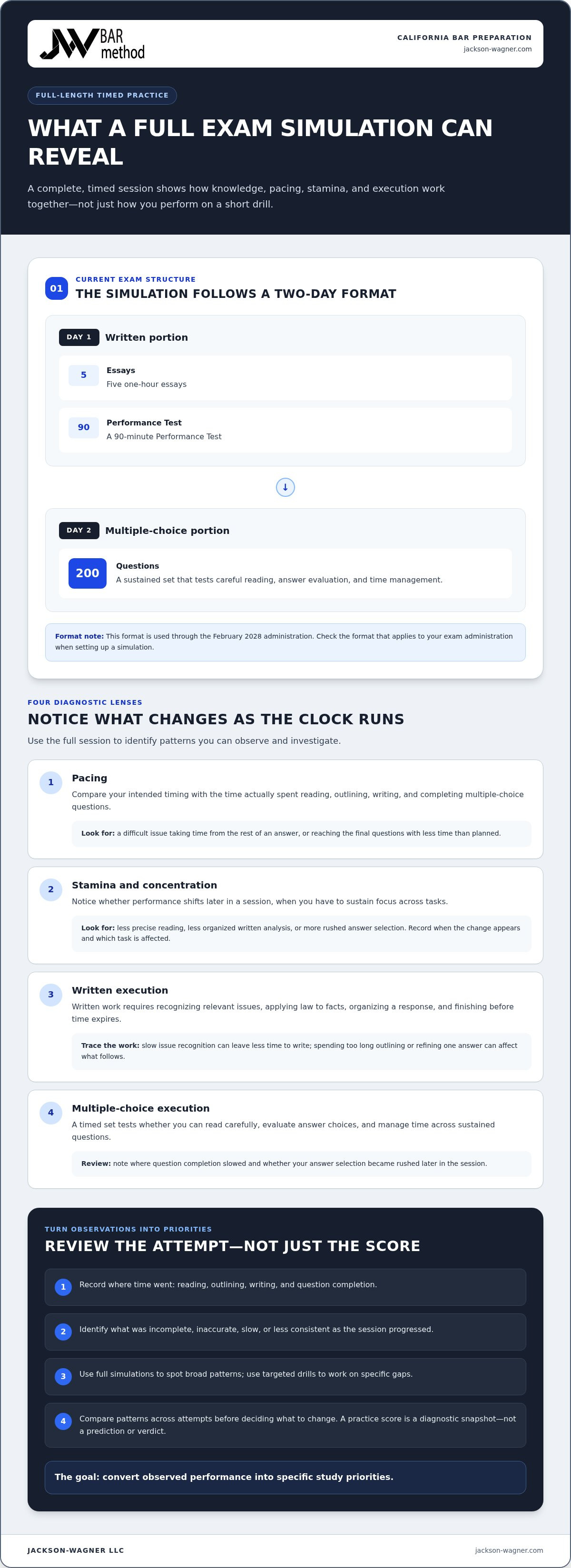
It’s natural to wonder whether your practice reflects exam-day demands or to worry that a low score means you’re falling behind. Treat the score as information, not a verdict. The current California Bar Exam format, used through February 2028, spans two days: a written day with five one-hour essays and a 90-minute Performance Test, followed by 200 multiple-choice questions. Short drills can build individual skills, but they can’t reveal every pacing or endurance gap that may emerge over a full exam.
This article explains what a full-length simulation can uncover and how to turn the results into specific study priorities. You’ll also learn how to balance timed practice with careful review, so each exam strengthens your preparation instead of simply measuring it.
Key Takeaways
- The importance of full-length timed practice exams lies in seeing how knowledge, pacing, stamina, and execution work together under realistic conditions.
- Use timed simulations to spot where reading, outlining, writing, or answer selection slows down as the clock runs.
- Choose full exams, timed sections, or untimed drills based on the skill gap you need to address, then review every attempt deliberately.
- Turn practice results into specific next steps instead of treating a low score as a verdict on your ability.
- Build simulations into a balanced California Bar study plan alongside focused instruction, targeted practice, review, and rest.
Why Full-Length Timed Practice Exams Matter for California Bar Preparation
The importance of full-length timed practice exams is that they show how your skills work together under sustained exam conditions. A complete simulation follows the current California Bar Exam structure and time limits, rather than sampling a few questions or letting you pause whenever you choose. Through February 2028, the exam is a two-day test with a written portion and a multiple-choice portion. Make sure your practice reflects the format that applies to your exam administration.
A full-length timed practice exam is a complete simulation of the current California Bar Exam, completed in its scheduled sections and time limits to assess performance and endurance. It provides a diagnostic snapshot, not a prediction or promise of your exam-day result. A score can point to an area worth investigating, but it can’t tell you with certainty how you’ll perform on test day.
What does a full-length timed practice exam measure?
Exam performance involves more than recalling legal rules. You must recognize issues, apply law to facts, organize a response, and complete the work within the time available. In the multiple-choice portion, that means reading carefully, evaluating answer choices, and managing time across a sustained set of questions. In written work, it means identifying relevant issues and producing a clear, complete response before time expires.
A full session shows how these demands affect one another. Slow issue recognition, for example, may leave less time to write. Fatigue can make it harder to read precisely later in a session. The State Bar of California page provides background on the organization that administers the exam. Use current exam-format information when setting up your simulation. Realistic conditions make your observations more useful because they show how you respond to combined demands, but they don’t make a practice result automatically predictive.
Why short drills cannot replace a complete simulation
Short drills are useful for isolating a skill. A focused essay exercise can help you practice outlining; a brief multiple-choice set can reveal recurring reasoning errors. But neither shows whether you can sustain those skills across a complete exam, manage time as fatigue builds, or maintain consistent execution from one section to the next.
Use both formats deliberately: complete simulations to diagnose broader performance patterns, then targeted drills to address specific gaps. Review matters in either case. If you don’t examine why an answer was incomplete, inaccurate, or slow, you may repeat the same habits in the next set. For a broader preparation framework, see this California Bar Exam strategic guide.
How Timed Exam Conditions Expose Pacing, Stamina, and Execution Gaps
A timer changes the decisions you make. You might reread a prompt to confirm your understanding, spend longer than planned outlining, or keep refining one answer after it’s time to move on. In an untimed exercise, those choices can go unnoticed. Under exam conditions, they affect the time and attention available for what follows.
A realistic simulation tests how well you read, prioritize, write, choose answers, and sustain concentration while the clock keeps moving. Its value is in exposing patterns you can observe and investigate, not diagnosing every cause or predicting your final result.
What pacing problems become visible under timed conditions?
Compare your intended pacing with what actually happened. After a practice session, note how long you spent reading each prompt, outlining, writing, and completing multiple-choice questions. Did one difficult issue take time away from other parts of an answer? Did you reach the final questions with less time than planned? These details turn a vague sense of “I ran out of time” into a specific issue to review.
Use the current official format when building a simulation. Through the February 2028 administration, the California Bar Exam has a written day with five one-hour essays and a 90-minute Performance Test, followed by a multiple-choice day with 200 questions. The State Bar’s California Bar Examination details can help you align practice with the format and timing for your administration. Avoid treating one pacing plan as universal. Compare your decisions with the allotted time for each task and note where your approach needs adjustment.
How a complete session tests stamina and consistency
Concentration can shift as a session progresses. Track whether your reading becomes less precise, your written analysis less organized, or your answer selection more rushed. Record when you notice a change and which task is affected. If accuracy drops late in a session, fatigue may be one factor, but the practice result alone won’t establish the cause. Review your work and compare patterns across attempts before deciding what to change.
This is another reason for the importance of full-length timed practice exams: a complete session can reveal uneven performance that shorter efforts may not show. Use those findings to guide focused review and instruction in a structured California Bar study plan. Jackson-Wagner’s California Bar preparation connects exam preparation with the JW Bar Method.
Full-Length Exams vs. Short Drills: Choosing the Right Practice for the Gap
The right practice format depends on what you need to learn. A full simulation shows how skills hold up together over a sustained session. A timed section helps isolate pacing within one task. An untimed drill gives you room to strengthen a specific skill without the pressure of the clock. The importance of full-length timed practice exams doesn’t mean every study session should be a full exam. Each format serves a different purpose.
| Practice format | Purpose and strengths | Limitations |
|---|---|---|
| Full-length simulation | Assesses integrated performance, pacing, and consistency across a complete exam experience. | Takes substantial time and won’t explain the cause of a gap without careful review. |
| Timed section | Tests pacing and execution within a specific component or task. | Doesn’t show how performance holds up across the whole exam. |
| Untimed drill | Builds targeted skills such as rule recall, issue spotting, or answer structure. | Doesn’t measure how well you apply the skill under time pressure. |
When should you take a full-length timed practice exam?
Choose a complete simulation when you need to see how separate skills work together or whether targeted improvements carry over to a sustained session. Leave time afterward to review your answers, identify patterns, and adjust your study priorities before the next simulation. Taking an exam without time to learn from it may produce a score, but not a useful next step. There’s no universal schedule for every candidate. Let your preparation stage and the gaps you’ve identified guide your timing.
When are timed sections or untimed drills more useful?
If you understand a task but struggle to finish it, a timed section can help pinpoint where the minutes go. If you’re still developing a skill, remove the clock temporarily. For example, an untimed essay outline gives you space to practice organizing issues before you add time pressure. Choose the smallest practice format that addresses the gap, then check whether the improvement carries over.
Review is essential in every format. For a missed multiple-choice question, identify whether the issue was rule knowledge, reading the facts, or comparing answer choices. For written work, examine issue coverage, analysis, organization, and completion. Use the review to select your next drill or timed section, then return to a full simulation when you’re ready to evaluate performance across tasks again.
How to Take and Review a Full-Length Timed Practice Exam
A simulation becomes useful when you learn from it. Follow the same sequence each time: select representative materials, set realistic conditions, complete the exam, review your work, and adjust your study plan. The importance of full-length timed practice exams comes from both parts of that process: the performance snapshot and the deliberate analysis that follows.
Set up a realistic simulation
Start with questions that reflect the subjects and task types in the current California Bar Exam. Through the February 2028 administration, the format includes a written day with five one-hour essays and a 90-minute Performance Test, followed by a multiple-choice day with 200 questions. Review the official format for your administration before setting up, because exam structures can change.
Then make the conditions consistent enough to compare attempts:
- Set aside uninterrupted time and follow the scheduled sections and time limits.
- Use only materials permitted for your practice conditions, and keep those rules consistent from one simulation to the next.
- Record interruptions or other deviations, such as pausing the timer, so you can interpret the result accurately.
During the exam, note observable behaviors without disrupting your work: when you checked the clock, whether you finished each task, and where your concentration or pace changed. These details give you more to work with than a score alone.
Turn the review into your next study steps
Review your answers after completing the simulation. For essays and the Performance Test, compare your response with the task requirements and available feedback. Look for missed issues, incomplete analysis, unclear organization, and unfinished sections. For multiple-choice questions, examine incorrect answers and correct answers that relied on uncertain reasoning.
Classify each pattern before choosing what to do next:
- Knowledge: You couldn’t recall or accurately state a rule.
- Analysis: You missed a relevant issue or didn’t connect the rule to the facts.
- Writing: Your answer was difficult to follow or underdeveloped.
- Pacing: One task used time needed elsewhere.
- Execution: You misread instructions, rushed, or left work incomplete.
Choose a targeted drill or timed section that addresses the clearest gap, then check whether the improvement carries over in a later simulation. If you’re building a structured California-focused study plan, explore California Bar exam preparation through the JW Bar Method.
Build Full-Length Timed Practice into a Structured California Bar Study Plan
A simulation should shape what you study next, not take over your study plan. Its results are most useful when they connect to instruction, focused practice, answer review, and recovery. The importance of full-length timed practice exams isn’t measured by how often you take them, but by how effectively you use what each attempt reveals.
Turn practice findings into a focused study cycle
Translate each observed gap into a concrete task. If you missed issues because you moved too quickly through a prompt, practice deliberate issue spotting. If you identified the issues but didn’t explain how the facts applied, work on analysis and review model responses or instructor feedback. If you left a task incomplete, examine your pacing and practice that component under timed conditions.
Revisit the same skill in later work. A single low score is a reason to investigate, not overhaul your entire plan. Look for recurring patterns across drills, timed sections, and simulations. As your preparation develops, shift the emphasis: early study may call for instruction and foundational skill-building, while later practice can focus more on integrating those skills under exam-like conditions. Make room for review and scheduled rest so practice remains productive rather than becoming a cycle of exhaustion.
Where structured California Bar preparation can help
A structured program can connect learning, practice, and review instead of leaving each activity isolated. Jackson-Wagner’s JW Bar Method provides California-focused preparation for the Full California Bar Exam and the California Attorney’s Exam. JW Bar Method Prep - Full Exam California Bar is one option for candidates preparing for the full exam. Your study plan should still respond to your preparation stage and the specific gaps your work has revealed.
If you’re comparing preparation approaches, the bar preparation service comparison offers a broader framework for evaluating how instruction and practice fit together. Use that perspective alongside your practice review: identify what needs attention, choose a focused next step, and assess progress through subsequent work.
Explore California Bar preparation through the JW Bar Method to see how structured, California-focused study can support your practice and review cycle.
Turn Practice Insights into a Stronger California Bar Plan
A full-length simulation is most valuable when it leads to a clear next step. Use it to spot patterns in pacing, stamina, and answer execution, then target the gaps with focused practice and deliberate review. That’s the practical importance of full-length timed practice exams: they help you make study decisions based on observed performance, not anxiety over a single score.
Keep your preparation balanced. Combine realistic exam practice with instruction, targeted drills, review, and rest, adjusting the mix as your needs change. Jackson-Wagner’s JW Bar Method offers structured California preparation for both the Full California Bar Exam and the California Attorney’s Exam, with standard and accelerated tracks.
Explore JW Bar Method California Bar preparation and find a structured approach to support your study plan. Each thoughtful practice session can help you prepare with greater clarity and confidence.
Frequently Asked Questions
Why are full-length timed practice exams important for the California Bar?
They let you practice applying knowledge across a complete session, not just isolated questions. The importance of full-length timed practice exams is that they reveal how you manage pacing, maintain concentration, complete answers, and execute your approach as demands accumulate. Use those observations to choose what to work on next. A practice result is diagnostic information, not a guarantee or definitive prediction of your actual exam outcome.
How often should I take a full-length timed practice exam?
There’s no single schedule that works for every candidate. Consider your preparation time, current readiness, and whether you can review each simulation and act on what it reveals. Avoid taking full exams just to collect scores. Confirm that your practice reflects the current official exam structure, then use focused work between simulations to address specific gaps. A simulation is most useful when you have time to learn from it.
Can short practice sets replace a full-length timed exam?
No. Short sets help you focus on a specific skill, such as rule recall, issue spotting, answer structure, or pacing within one task. They don’t reproduce the sustained demands and transitions of a complete session. Use drills to develop or refine a skill, then take a full-length simulation to see how it holds up alongside other exam demands. Both formats are useful, but they answer different questions about your preparation.
What should I do if I score poorly on a practice exam?
Treat the score as a starting point for review, not a verdict. Examine your answers for missed issues, weak reasoning, incomplete work, and timing problems. Note whether concentration or answer quality changed during the session, then look for patterns across questions and tasks before choosing your next study action. One simulation reflects performance under specific conditions. It can guide your preparation, but it can’t determine what will happen on exam day.
Should I take a full-length practice exam under exact exam conditions?
Reproduce current official conditions as closely as practical, including the applicable structure, timing, materials, and uninterrupted work periods. Review official California Bar information before relying on format details, since they may change. Record any differences, such as pausing the timer or taking an unscheduled break. That context helps you interpret results carefully and make a more informed study plan instead of treating the simulation as a perfect measure of exam-day performance.
How do I review a full-length timed practice exam effectively?
Review more than the total score. Compare your answers with the prompts, identify missed issues, examine reasoning and organization, and note where time was lost. Sort findings into actionable categories, such as knowledge, analysis, writing, pacing, or execution. Then choose a targeted practice task for each recurring gap. A focused review turns the simulation into a plan for what to study next, rather than simply another score to track.
Do timed practice exams predict whether I will pass the California Bar?
No practice exam can promise or reliably settle an individual outcome. It shows how you performed on particular material under particular conditions, making it useful as a diagnostic tool rather than a pass prediction. Interpret the result alongside answer review, your broader study progress, and current official exam requirements. If one score is disappointing, use it to identify questions for further review and look for recurring patterns across your work before adjusting your preparation.


