

Passing the California Bar Exam isn’t about memorizing every rule with equal intensity. It’s about knowing which rules to prioritize and how to apply them under pressure. If the california bar exam subjects already feel like an impossible volume to master, that concern is understandable, especially if you’re balancing exam prep with a full-time career and aiming for the 1390 passing score.
This guide maps the tested subjects and explains how the MBE subjects differ from California-specific essay coverage. It also offers a practical way to organize your study time. The goal isn’t to ignore difficult material. It’s to build a useful hierarchy, strengthen the rules that recur across exam formats, and avoid treating every topic as equally urgent.
You’ll find the tested subjects, key California distinctions in areas such as civil procedure, evidence, and professional responsibility, and a study framework for managing a demanding workload. With a structured approach, the list becomes easier to navigate and your preparation can move from rule overload to deliberate practice.
Key Takeaways
- Use the california bar exam subjects list to distinguish the seven MBE subjects from topics tested through California essays.
- Identify where California rules differ from federal law, and give Professional Responsibility focused attention.
- Prioritize frequently tested rules and practice recalling and applying them instead of relying on passive review alone.
- Build a realistic study hierarchy to manage the breadth of the exam alongside work and other commitments.
- Consider how the JW Bar Method’s California-focused preparation aligns with the requirements of California licensure.
The 2026 California Bar Exam Landscape: Why Subjects Matter
The California Bar Exam tests more than legal recall. You need to identify the governing rule, apply it to unfamiliar facts, and produce a focused answer within strict time limits. For study planning, the california bar exam subjects span 15+ areas when federal and California-specific rules are treated as distinct bodies of law. That breadth makes prioritization essential. Understanding the exam’s structure helps you decide what to study and how to practice it.
The exam’s 1390 passing score is a demanding benchmark, not a reason to memorize every legal nuance equally. Shift from law school’s broad exploration of doctrine to exam execution: recognize issues, state precise rules, and apply them directly. The California Bar Examination overview offers broader historical and structural context, while the State Bar’s current exam scope should guide your subject-by-subject preparation.
The Two-Day Marathon Structure
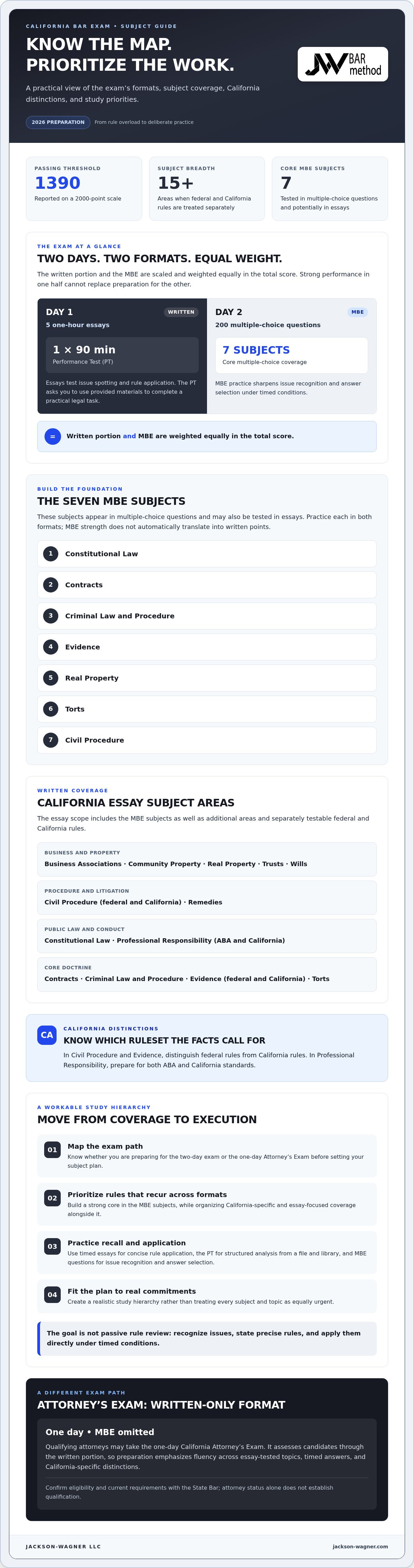
Day 1 is written: five one-hour essays and one 90-minute Performance Test (PT). Essays assess your ability to spot issues and apply legal rules. The PT asks you to use provided materials to complete a practical legal task. Day 2 is the MBE: 200 multiple-choice questions covering seven core subjects. The written portion and MBE are scaled and weighted equally in the total score, which is reported on a 2000-point scale. The passing threshold is 1390. Strong performance in one half can’t replace preparation for the other.
Practice each format for the skill it tests. Timed essays build concise rule application, the PT develops structured analysis from a file and library, and MBE questions sharpen issue recognition and answer selection. Familiarity with a subject isn’t the same as being able to use it under timed conditions.
The Attorney’s Exam Advantage
Qualifying attorneys may take the one-day California Attorney’s Exam, which omits the MBE and assesses candidates through the written portion. Confirm eligibility and current requirements with the State Bar. Attorney status alone shouldn’t be assumed to establish qualification. Because there’s no multiple-choice section contributing to the score, written execution carries the full weight. Each essay and the PT is an opportunity to demonstrate subject knowledge, organization, and application.
That changes the preparation emphasis. Build fluency across essay-tested topics, practice timed answers, and review California-specific distinctions that can shape an analysis. For a focused breakdown of california attorney’s exam requirements, review the separate guide. Establish your exam path before building a subject plan so your study time matches the format.
Core Subjects of the California Bar: The High-Yield Breakdown
Don’t treat the exam’s subject list as a flat checklist. The seven MBE subjects are tested in multiple-choice questions and may also appear in essays, giving you more than one way to demonstrate mastery. Other subjects and California-specific variations are tested through the written portion. The State Bar’s Official California Bar Exam Subjects page is the definitive reference for the current exam scope.
For 2026 preparation, the essay-tested areas include Business Associations; Civil Procedure, federal and California; Community Property; Constitutional Law; Contracts; Criminal Law and Procedure; Evidence, federal and California; Professional Responsibility, ABA and California; Real Property; Remedies; Torts; Trusts; and Wills. Because federal and California rules are separately testable in some areas, the practical study list covers more than 15 subject and rule categories.
The Multistate Bar Exam Subjects
Build your core around the seven MBE subjects: Constitutional Law, Contracts, Criminal Law and Procedure, Evidence, Real Property, Torts, and Civil Procedure. These are central to a 2026 study plan because they appear on the MBE and may also be tested in essays. MBE practice develops quick issue recognition, while essay practice trains you to state and apply the relevant rule. Study each subject in both formats rather than assuming multiple-choice strength will automatically translate to written points.
California-Specific and Essay-Focused Areas
California distinctions deserve deliberate attention. In Civil Procedure and Evidence, be ready to identify whether a question calls for federal or California rules. Professional Responsibility requires attention to both ABA and California standards, so treat it as a core essay area rather than an afterthought. Community Property is a distinct California-focused topic, while Business Associations, Remedies, Trusts, and Wills broaden the essay-tested range beyond the MBE’s seven subjects.
Organize your outline by overlap and contrast. For example, review federal and California Evidence together, but keep their rules clearly separated in your notes and timed answers. This helps prevent a familiar federal rule from crowding out the California rule called for by the facts.
The Performance Test: Skills Over Recall
The Performance Test is different from a subject essay. It’s a closed-universe task, so success depends less on recalling memorized doctrine and more on reading carefully, extracting relevant rules, following instructions, and producing an organized work product under time pressure. Practice using the provided file and library. The goal is disciplined application, not displaying everything you know.
For a California-focused structure to help turn this subject map into a study plan, explore the JW Bar Method California bar preparation.
MBE vs. California-Specific Subjects: A Strategic Comparison
Build your study plan around two kinds of knowledge: broadly tested legal principles and California-specific rules. The distinction matters most in subjects such as Evidence and Civil Procedure, where an essay may call for California law rather than the federal rule you’ve practiced on the MBE. Train yourself to identify the jurisdiction first, then state and apply the correct rule. That simple check can prevent a confident answer based on the wrong standard.
Use the state of California State Bar licensing guide to understand the broader licensure process, but keep exam preparation anchored to the tested scope. Don’t give every possible subject combination the same study time. Review past essay topics for recurring patterns while maintaining baseline coverage across the full syllabus. A less common crossover deserves attention, but it shouldn’t displace practice with core rules or timed essay writing.
Rules of Professional Responsibility
Professional Responsibility merits priority because the exam can test both ABA Model Rules and California Rules of Professional Conduct. Learn where their approaches differ, and label each rule clearly in your outline so you don’t blend them in an essay. The subject also appears on the separate MPRE, which has its own registration and passing requirements. Bar-exam preparation doesn’t replace preparing for or satisfying that requirement.
Practice applying the rules to concrete facts. A conflict question may ask whether a lawyer can represent clients with competing interests and what disclosures or consent are required. A client-funds scenario calls for careful analysis of how funds must be handled and whether the lawyer’s actions create a professional-conduct issue. In a timed answer, identify the duty, state the applicable California or ABA rule, and connect it directly to the facts.
Community Property and Wills/Trusts
For Community Property essays, use a consistent “Marriage, Title, and Source” framework. Identify when the asset was acquired, how title is held, and what funds or other source paid for it. Then analyze facts that could affect its characterization. This sequence makes the analysis easier to follow and helps you avoid treating title alone as the answer.
Wills and Trusts may appear together in a fact pattern involving an estate plan, property transfers, or competing claims after death. Prepare concise rule statements for formation and validity issues, property characterization, and relevant trust or succession questions. Then apply only the rules triggered by the facts. For 2026, prioritize clear rule recall and organized application over memorizing every possible crossover in equal depth.
Strategy for Mastery: Prioritizing Subjects by Weight and Frequency
A study plan should reflect the exam structure and your actual performance, not simply divide time evenly across every topic. Treat the 80/20 rule as a prioritization heuristic, not a promise that a fixed share of rules will produce a fixed share of points. Start with california bar exam subjects that appear across both the MBE and essays, then use timed practice to find where you’re losing points. Track missed issues and rule gaps so each study session addresses a specific weakness.
Passive review has a place, but watching lectures or rereading outlines can create a false sense of familiarity. Close the materials and retrieve the rule from memory, then apply it to a new fact pattern. For essays, use IRAC as a reliable structure: identify the issue, state the rule, apply it to the facts, and reach a clear conclusion. The analysis should do the work. A correct rule without fact-specific application leaves the grader guessing whether you understand how it fits.
Use california bar exam practice to diagnose weaknesses, not just to accumulate completed questions. After each essay or practice set, categorize errors: missed issue, inaccurate rule, weak application, or time management. Address the underlying problem before repeating the same exercise.
Developing Your 2026 Study Roadmap
Move through three connected phases, adjusting the pace to your available study time and diagnostic results:
- Phase 1: Build substantive foundations. Review the seven MBE subjects and test your recall with questions and short rule explanations.
- Phase 2: Add California distinctions. Learn and apply California-specific rules, especially where they differ from federal law.
- Phase 3: Shift to execution. Practice issue-spotting, timed essays, and full-length simulations. Review every error and revisit weak rules.
Don’t wait until the final phase to write practice essays. Early timed attempts show whether you can turn knowledge into organized analysis, while there’s still time to improve.
The Performance Test: Mastering the Skills Subject
The 90-minute Performance Test is a closed-universe task built around a provided File and Library. Work efficiently: read the assignment first, identify the requested work product, then extract relevant facts and authorities. Organize the answer around the task’s instructions rather than a generic essay template. Because the materials supply the governing information, the PT rewards disciplined reading and clear writing, even when the task involves unfamiliar law. Treat it as a distinct skill to practice, not a last-minute substitute for subject study.
For structured preparation focused on California licensure, explore JW Bar Method California exam prep.
Conquering the California Bar Subjects with the JW Bar Method
A broad subject list calls for more than a broad course. Jackson-Wagner LLC’s proprietary JW Bar Method focuses exclusively on California licensure, with preparation programs for the Full California Bar Exam and the California Attorney’s Exam. That California focus connects subject review to the rules and exam formats candidates need to prepare for, rather than treating California as one variation among many.
Preparation should be structured, not automatically measured by hundreds of hours. Aim to identify gaps, strengthen recall, and practice applying rules under timed conditions. For busy professionals, an accelerated track provides an alternative preparation pace. The right option depends on your exam route, current skills, and available study time, so compare program details before deciding what fits your circumstances.
Tailored Programs for Law Grads and Attorneys
Choose a program aligned with the exam you plan to take. The available options are:
- JW Bar Method Prep - Full Exam California Bar, for candidates preparing for the Full California Bar Exam.
- JW Bar Method Prep - Attorney’s Exam California Bar, for eligible attorneys preparing for the Attorney’s Exam.
- JW Bar Method Accelerated Prep - Full California Bar Exam, an accelerated preparation option for the full exam.
- JW Bar Method Accelerated Prep - Attorney’s Exam California Bar, an accelerated option for attorneys preparing for the Attorney’s Exam.
The Attorney’s Exam has a different format from the full exam, so practitioners should confirm eligibility and plan around its written requirements. An accelerated option still calls for consistent practice and careful review. Compare program scope with your exam route and available study time rather than assuming the same plan suits every candidate.
Structured Preparation and Performance Assurance
The JW Bar Method provides structured and accelerated preparation for the Full California Bar Exam and the California Attorney’s Exam. A California-focused program can help organize a wide syllabus around the exam you plan to take. As you assess your progress, look beyond hours or lectures completed. Use recall practice, timed writing, and review of missed issues to see whether you can apply the rules clearly.
Before enrolling, compare the program’s scope with your exam route, your current preparation needs, and the time you have available. Choosing between a standard and accelerated track starts with a realistic view of what you need to cover and how consistently you can study.
To compare your next steps for 2026, read this guide to passing the California Bar Exam, then review the JW Bar Method option that matches your exam route and timeline.
Turn Your California Bar Study Plan into Focused Preparation
The california bar exam subjects may seem like a long list, but a strategic plan makes them easier to manage. Prioritize the MBE subjects that also appear in essays, learn where California rules differ, and use timed practice to turn knowledge into clear, applied answers. For the Attorney’s Exam, focus on the written format and confirm that you meet the State Bar’s eligibility requirements.
For candidates balancing study with work, structure matters. The proprietary JW Bar Method is designed specifically for California licensure, with preparation options for both the Full California Bar Exam and the Attorney’s Exam, including accelerated tracks. Choose a program based on the exam you plan to take and the study timeline that fits your circumstances.
Ready to choose a preparation path that fits your exam and timeline? Explore the JW Bar Method for the 2026 California Bar and compare the available programs.
Frequently Asked Questions
What is the passing score for the California Bar Exam in 2026?
The passing score is 1390 on a 2000-point scale. Your result reflects performance across the written portion and the Multistate Bar Examination (MBE), which are weighted equally in the total score. A strong showing in one part can help, but it doesn’t replace preparation for the other. Check the State Bar of California’s current exam information for official scoring details and any updates.
Can I take the California Bar Exam if I am already licensed in another state?
Yes, an out-of-state license may make you eligible for the California Attorney’s Exam, but it doesn’t automatically qualify you. Eligibility depends on meeting the State Bar’s requirements for that exam. The Attorney’s Exam is a separate path for qualifying attorneys and omits the MBE. If you don’t qualify, you may need to apply for the Full California Bar Exam. Confirm your status and application route directly with the State Bar before planning your study schedule.
How long does it take to get California Bar Exam results?
There isn’t one fixed results timeline that applies to every administration. The State Bar publishes the official results release information for each exam cycle, so use that schedule rather than relying on estimates from past administrations. After the exam, monitor your applicant portal and the State Bar’s announcements for the release date and instructions. Build some flexibility into work and personal plans while you wait.
Is the California Bar Exam harder than the UBE?
“Harder” depends on the candidate and the exam format. In 2026, California’s exam includes essays, a Performance Test, and the MBE, with California-specific rules adding another layer to preparation. The UBE has a different structure and content framework, so a direct comparison isn’t simple. Focus on the format and subjects required for the jurisdiction where you plan to seek admission, and check official exam information for upcoming changes.
What subjects are tested on the California-specific portion of the exam?
In 2026, California-specific rules are tested through the written portion rather than through a separate standalone California component. Essay topics include Community Property and Professional Responsibility, which requires attention to California rules as well as ABA rules. California variations may also matter in Civil Procedure and Evidence. The california bar exam subjects can overlap, so identify whether each question calls for federal or California law before stating your rule.
How much does it cost to take the California Bar Exam in 2026?
The general California Bar Exam application fee is $1,650. The laptop fee is an additional $153 for applicants who use a laptop for the exam. These are exam-related fees, not preparation-course costs, and your total expenses may depend on your circumstances and any applicable charges. Confirm current amounts and payment requirements in the State Bar of California’s official fee schedule before submitting an application.
Can I work full-time while studying for the California Bar?
Yes, some candidates prepare while working full-time, but it requires a realistic schedule and consistent practice. Set specific weekly study blocks, prioritize active recall and timed essays, and use practice results to target weak areas instead of trying to review every topic equally. Your available hours, starting knowledge, and exam route all affect what’s feasible. Choose a study plan you can sustain, then adjust it based on progress.
What is the “Baby Bar,” and do I need to take it?
The “Baby Bar” is the informal name for California’s First-Year Law Students’ Examination. It applies to certain students in unaccredited law study paths, including some students at unaccredited law schools or studying through a law office. Whether you must take it depends on your legal education route and applicable State Bar rules. Check your status with the State Bar rather than assuming it applies to every California bar applicant.


