

The fastest way to lose a six-week bar-prep window is to spend it collecting more outlines. If you’re wondering how to study for the bar exam in 6 weeks, focus on high-value practice, learn from your results, and adjust your plan each week instead of trying to cover every resource.
Six weeks is an ambitious timeline, especially when work, family, or other responsibilities compete for study hours. With multiple California subjects to review, it can be hard to balance memorizing rules with doing practice questions. A realistic plan gives both a place and helps you decide which topics and missed questions need attention first.
This guide lays out a week-by-week California Bar Exam study plan, with priorities for building a foundation, increasing timed practice, and sharpening exam-day execution. You’ll also learn how to use essay and multiple-choice results to target weak areas, schedule study around your available time, and decide whether structured accelerated prep could help keep your preparation on track.
Key Takeaways
- Start with a diagnostic to identify your strongest and weakest areas, then use the results to set priorities for the first week.
- Learn how to study for the bar exam in 6 weeks by following a flexible weekly cycle of focused review, timed practice, feedback, and adjustment.
- Choose study methods for a purpose: use active recall to strengthen rule knowledge, timed questions to build exam skills, and error analysis to target gaps.
- Build your schedule around study blocks you can genuinely protect, with a specific task assigned to each session.
- Compare self-directed study with structured California bar prep based on the organization, feedback, flexibility, and exam fit you need.
Can you prepare for the California Bar Exam in six weeks?
Six weeks can feel like a tight window when you’re facing a demanding exam and competing responsibilities. Whether it’s enough time to prepare depends on your starting point, familiarity with the tested subjects, and the study time you can realistically protect. A candidate refreshing prior preparation has a different task from someone learning most subjects for the first time.
Think of a six-week plan as a focused cycle: diagnose what you know, learn and refresh key rules, practice exam tasks, review your results, and adjust. This is a planning approach, not a promise of passing. The California Bar Exam’s format and requirements can change, so confirm the details for your administration through the State Bar’s official materials. For background on the organization’s role, see the State Bar of California.
A useful short-term bar plan prioritizes active practice and feedback, so each week’s work responds to what your results show. That principle helps you decide not only what to study, but also what to do next when time is limited.
Who is a six-week study plan best suited for?
A condensed plan may be more manageable if you’ve already studied the subjects, taken the exam before, or have a strong legal education foundation to build on. Starting with little subject familiarity may require more time for initial learning, so assess your readiness honestly before committing to a schedule. If you’re a repeat taker, use prior score reports or feedback if available and relevant. They can help you target gaps, but shouldn’t replace a fresh diagnostic.
Account for real life, too. Work, caregiving, health needs, and other fixed commitments affect how much focused study time you can sustain. Build around the hours you actually have, not an idealized calendar.
What to assess before building your schedule
Before deciding how to study for the bar exam in 6 weeks, gather the information your plan depends on. Write down:
- Your exam date and the current California exam requirements for that administration.
- The study blocks you can realistically protect each week, including existing commitments.
- The materials you’ll use, so you can avoid losing time to overlapping resources.
- Your starting point, based on a short diagnostic across relevant subjects and question formats.
Use the diagnostic to identify your strongest areas, weakest areas, and immediate constraints. Try representative questions and a writing task, then note whether each challenge came from rule knowledge, issue spotting, timing, or applying facts. This gives your schedule a practical starting point. Let that evidence guide your priorities instead of trying to give every subject equal time.
Build a six-week California Bar Exam plan around practice and feedback
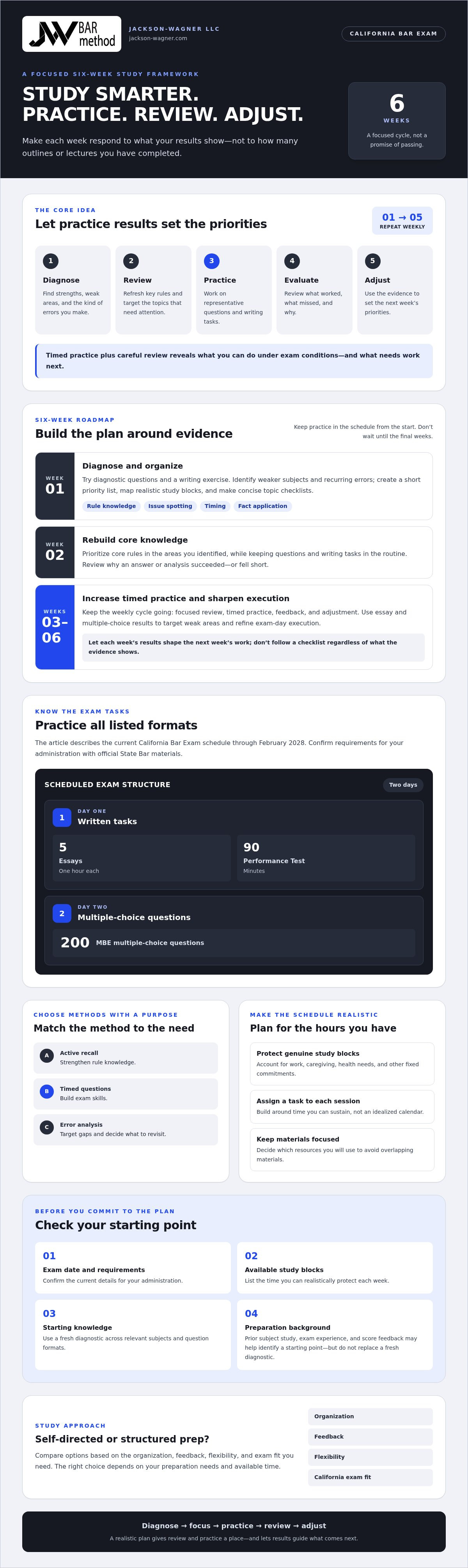
A six-week schedule works best as a repeating cycle, not a checklist you follow regardless of results. Each week, set a clear deliverable: diagnose a skill or subject, review what you need, practice it, evaluate your performance, and use what you learn to plan the next week. This keeps study time responsive instead of letting a long list of lectures or outlines dictate your priorities.
Confirm the tested components and administration details for your exam date using the State Bar’s California Bar Examination details. Through February 2028, the current exam is scheduled as a two-day test: five one-hour essays and one 90-minute Performance Test on day one, followed by 200 MBE multiple-choice questions on day two. Build practice for all these formats into your plan, and recheck official guidance in case the format changes.
Timed practice plus careful review tells you more than completion counts because it shows what you can do under exam conditions and what needs work next.
Weeks one and two: diagnose, organize, and rebuild core knowledge
Week one: Use diagnostic questions and a writing exercise to spot weaker subjects and recurring errors, such as misreading facts, forgetting a rule, or choosing an answer without eliminating alternatives. Turn the results into a short priority list. Map study blocks around fixed responsibilities, and create concise checklists for the topics you need to revisit.
Week two: Rebuild core knowledge in priority areas, but keep practice in the schedule. Work through questions and writing tasks regularly, then review why an answer or analysis succeeded or fell short. Don’t save all timed work for the final weeks. Early attempts expose timing and application problems while there’s still room to address them.
Weeks three through six: practice, refine, and consolidate
Gradually increase exam-style practice as your foundation strengthens. Add mixed-subject question sets so you practice switching topics, and schedule timed essays and Performance Test work alongside MBE practice, using the current official components as your guide. After each set, record the rule or skill behind an error and choose a specific follow-up task, such as recalling the rule from memory or rewriting an issue analysis.
- Week three: Expand timed practice and review errors by subject and skill.
- Week four: Mix subjects and writing formats; target patterns in your results.
- Week five: Rehearse exam-style tasks and refine timing and execution.
- Week six: Focus on high-priority gaps, confirm logistics using current official guidance, and protect sustainable rest.
Keep the sequence flexible. If results show a persistent weakness, adjust the next week’s emphasis instead of forcing the original calendar. If you want an organized accelerated structure, compare your needs with California bar exam preparation options, and check that a program fits your exam, timeline, and starting point.
How should you divide time between review, essays, and practice questions?
Give each study activity a job. Reading an outline can clarify a rule, but it won’t show whether you can recall or apply that rule under pressure. Practice questions reveal how you handle facts and answer choices; writing practice tests whether you can organize legal analysis. Error review connects those results to your next study task.
Match practice to the current California exam. Through February 2028, its format includes essay questions and a Performance Test on day one, followed by MBE multiple-choice questions on day two. Verify the format and subjects for your administration through the State Bar of California before setting your practice mix. Don’t measure progress by hours alone. Track accuracy, time spent, rule recall, and the quality of your reasoning.
| Activity | Use it to | Measure |
|---|---|---|
| Outline or rule review | Clarify a specific knowledge gap | Can you explain the rule without looking? |
| Active recall | Strengthen retrieval before exam day | Accuracy and completeness from memory |
| Timed questions | Practice applying rules and managing pace | Accuracy, timing, and reasoning |
| Essay or Performance Test writing | Build organized analysis in the relevant format | Issue coverage, rule application, and completion |
| Error analysis | Turn missed or uncertain answers into targeted review | Whether the same error recurs |
When to review outlines and rules
Use concise review to answer a question raised by practice. If you missed a question because you couldn’t recall a rule, review it, close your materials, and explain it from memory. Then check what you missed and try again later. This retrieval step is more revealing than rereading or highlighting alone. Passive review can support learning, but it isn’t proof that you’re ready to apply a rule to a new fact pattern.
How to learn from timed practice
Don’t stop at the answer key. For a multiple-choice question, explain why the correct choice fits and why each plausible alternative fails. For a writing task, check whether you identified the issues, stated relevant rules, and connected those rules to the facts. Classify errors as knowledge gaps, misreading, timing problems, or weak application. This turns “I got it wrong” into a useful next step.
Keep a short error list of recurring rules and skills, then revisit it during review and test yourself before checking your notes. When considering how to study for the bar exam in 6 weeks, measure progress by whether you can recall, apply, and explain material more reliably over time, not by how much you’ve touched.
How to keep a six-week bar study schedule realistic while working
A workable study calendar starts with the time you truly have, not the schedule you wish you had. Put fixed commitments on the calendar first: work, caregiving, appointments, meals, breaks, and sleep. Then identify the remaining study blocks and assign each a defined task. For example, reserve a focused block for timed essay practice, while a shorter opening or closing slot can fit rule recall or review of missed questions.
Protect consistent practice sessions where you can. A predictable routine makes it easier to begin and helps prevent practice from being repeatedly displaced by less urgent tasks. For a broader look at planning your preparation, read the California Bar Exam strategic guide.
Set a sustainable weekly workload
Build your weekly plan around available study time after obligations, breaks, and sleep. Separate deeper work, such as timed writing or a question set, from brief review tasks that can fit into a busy day. Assign each block a specific outcome rather than writing “study” on the calendar. At a weekly checkpoint, note what you completed, what your practice results show, and how your energy held up. Adjust the next week accordingly.
Recover quickly when you fall behind
Unexpected demands may disrupt the plan. Don’t try to repay every missed block by stacking unfinished tasks onto the next day. Decide what still matters most, move only the essential work, and let lower-priority tasks go or replace them with targeted review. Preserve timed practice and the review it generates, since those help you identify where effort will be most useful.
If you repeatedly struggle to follow the plan or aren’t sure how to respond to your results, consider whether a different study approach or qualified academic support could help. A structured California-focused program may suit candidates who need more organization within a short timeline. The right fit depends on your exam, schedule, and current needs. Explore structured California bar exam preparation if you’re comparing options.
A realistic calendar won’t make every week predictable. It gives you a clear way to reset when life changes without losing sight of your priorities. That flexibility is central to how to study for the bar exam in 6 weeks while working: plan for the time you have, protect meaningful practice, and adjust based on evidence rather than guilt.
When structured California bar prep can help with a six-week timeline
With only six weeks, organizing subjects, practice, and progress checks can take time away from studying. A structured program may help by giving your preparation a clearer sequence, especially if you’re unsure what to tackle next or how to respond to practice results. Self-directed study can offer more control over materials and pacing, but it also requires you to create and maintain that structure yourself.
Compare both approaches against your actual needs. Look for meaningful feedback, a clear way to monitor progress, flexibility around fixed commitments, and a close fit with the California exam you’ll take. A schedule that looks comprehensive on paper isn’t useful if it leaves too little room for timed practice or doesn’t fit your available study blocks.
Questions to ask before choosing an accelerated prep program
Before enrolling, confirm the program is designed for your specific California exam pathway. Ask how it organizes subject coverage, practice, feedback, and progress review across your available preparation period. Check the schedule expectations and what support is included, then consider whether they fit your work and personal commitments. These questions help you judge whether the structure will guide your study or create another schedule you can’t realistically follow.
- Does the program prepare candidates for the full California Bar Exam or the California Attorney’s Exam?
- How are practice and review built into the study sequence?
- Can the schedule work with your existing responsibilities and starting point?
Explore California-focused preparation options
Jackson-Wagner’s JW Bar Method offers structured preparation for California licensure, with options for both the full California Bar Exam and the California Attorney’s Exam. Choose the pathway that matches your exam. The preparation is focused on California exams, not bar exams in other states, and it isn’t legal representation or training for legal practice. For another perspective on evaluating focused prep, consider the questions above and compare them with the program details.
If you’re weighing how to study for the bar exam in 6 weeks, consider whether a structured plan would make it easier to protect practice time, review your performance, and adapt your priorities. Explore Jackson-Wagner’s California bar prep to compare the available California exam pathways and decide whether the approach fits your timeline and needs.
Turn your six-week plan into focused preparation
A short timeline calls for clear priorities, not a bigger pile of materials. Start with a diagnostic, balance focused rule review with timed essays and questions, and use your results to decide what to work on next. Build your calendar around study time you can genuinely protect, then adjust without sacrificing practice and targeted review.
That’s the core of how to study for the bar exam in 6 weeks: create a repeatable plan, measure more than hours, and respond to what your practice reveals. If you’d benefit from more structure, Jackson-Wagner offers California-focused preparation through structured and accelerated tracks for the full California Bar Exam and the California Attorney’s Exam. Choose the pathway that matches your exam, timeline, and needs.
Explore structured California bar exam preparation and see whether a more organized approach fits your study plan. With realistic priorities and consistent effort, you can make each week count. Keep moving forward, one purposeful study block at a time.
Frequently Asked Questions
Can you pass the California Bar Exam with six weeks of studying?
It’s possible to prepare in six weeks, but no study plan can promise a passing result. Your starting knowledge, prior preparation, practice skills, and available study time all matter. Use the first days to assess your baseline, then build a focused cycle of learning, exam-style practice, feedback, and targeted review. If you’re beginning with little familiarity with the subjects, consider carefully whether your timeline and available hours allow for the preparation you need.
How many hours a day should I study for the bar exam?
There isn’t one daily hour target that fits every candidate. Start by calculating the time you can protect after work, caregiving, sleep, and other fixed commitments, then plan focused blocks with specific tasks. Measure whether your practice and rule recall are improving, not just how long you sit at a desk. If your schedule leaves too little room for consistent practice and review, adjust your plan or reassess your timeline.
What should I study first when I have six weeks before the bar exam?
Start with a short diagnostic across relevant subjects and formats, then use the results to set priorities. Identify whether your main gaps involve rule knowledge, reading questions accurately, timing, or applying law to facts. Review the weakest high-priority areas first, but begin practice early rather than postponing it until you’ve read every outline. This is a practical foundation for how to study for the bar exam in 6 weeks: let evidence guide your next steps.
Is six weeks enough time to study for the bar exam while working full-time?
It depends on your starting point, study availability, and other responsibilities, so six weeks can’t be treated as a guaranteed fit for every full-time worker. Map your real weekly study blocks around work, caregiving, rest, and personal commitments. Protect consistent sessions for timed questions and writing practice, and use shorter blocks for rule recall or reviewing errors. If the calendar only works by sacrificing sleep or repeatedly skipping practice, make a more sustainable plan.
How should I divide bar exam study time between essays and multiple-choice questions?
Practice both formats, along with the Performance Test, according to the current California exam structure. Through February 2028, the exam includes five one-hour essays and one 90-minute Performance Test on day one, followed by 200 MBE questions on day two. Confirm the format for your administration before setting your schedule. Review each practice task carefully, tracking timing, accuracy, rule recall, issue coverage, and reasoning rather than simply counting completed questions.
Should I take a bar prep course if I have only six weeks?
A prep course may help if you need structure for organizing subjects, practice, and progress checks, but it should fit your exam pathway and schedule. Compare its feedback, flexibility, and expectations with what you can manage through self-directed study. Jackson-Wagner LLC offers structured and accelerated preparation through the JW Bar Method for the full California Bar Exam and California Attorney’s Exam. Review the program details to decide whether they fit your timeline and current needs.
What should I do during the final week before the California Bar Exam?
Use the final week to address priority gaps, revisit recurring errors, and complete manageable exam-style practice without trying to relearn every subject. Confirm exam logistics and current instructions through official State Bar materials. Keep your sleep and routine as steady as possible, and avoid filling every remaining block with new material. The goal is to consolidate what you’ve studied and arrive prepared to apply it, not to exhaust yourself with last-minute cramming.


