

Rereading your outline can feel like studying, but it won’t show whether you can recall a rule when the essay clock is running. If legal rules blur together or disappear under pressure, learning how to memorize rule statements for essays starts with a different approach: retrieve and rebuild each rule instead of simply reading it again.
Memorization matters, but repeating polished language isn’t the finish line. You also need to recognize which rule fits the facts, state it accurately, and use it to guide your analysis. That’s what turns a rule you’ve studied into one you can use in an essay.
This guide offers a repeatable process: break rules into elements, practise recalling them from memory, compare similar rules, and apply them to new fact patterns. You’ll also learn how to connect short review sessions with timed essay practice, so recall becomes more reliable without making rereading your whole study plan.
Key Takeaways
- Learn how to memorize rule statements for essays by turning governing law into concise, element-based rules rather than trying to retain whole-page outlines.
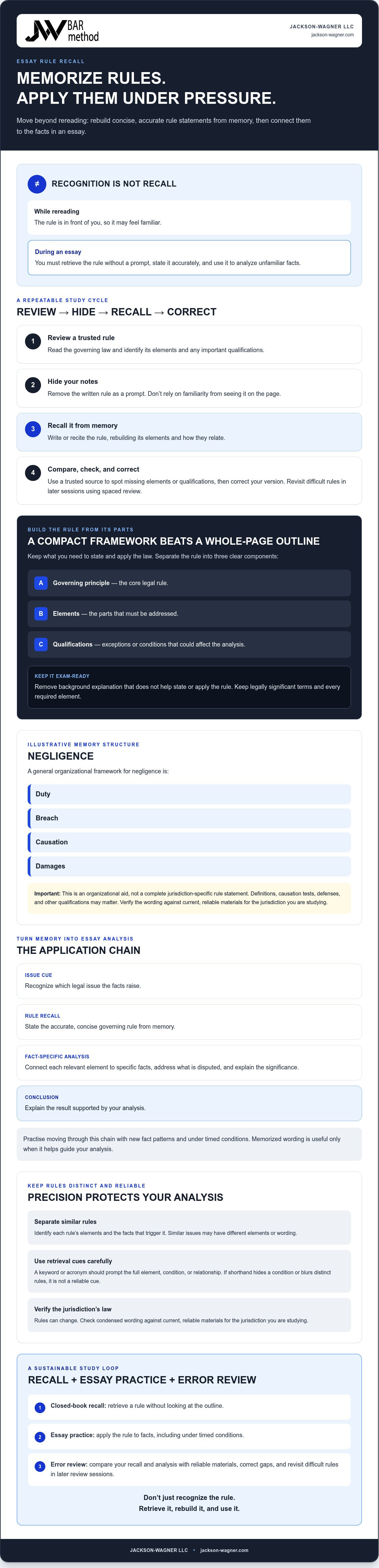
- Use a simple study cycle: review a rule, hide it, recall it from memory, check for gaps, and correct it.
- Keep similar legal rules distinct by identifying their elements and the facts that trigger each one.
- Practise moving from an issue cue to rule recall, fact-specific analysis, and a clear conclusion under timed conditions.
- Build rule review into a manageable routine that pairs closed-book recall with essay practice and error review.
Why memorizing rule statements for essays feels harder than it should
You can read a rule, recognize it immediately, and still struggle to write it from memory once an essay begins. That gap doesn’t mean you haven’t studied. Recognition gives you the rule as a prompt. An exam asks you to retrieve it without one, then use it to analyze unfamiliar facts.
A rule statement is a concise statement of the governing law that supports your analysis. Memorizing one well means retaining more than familiar wording. You need to remember its core elements, how those elements relate, and any important qualifications. That structure helps you rebuild the rule even if you can’t recall its exact phrasing.
Recall alone isn’t the goal. A rule earns its place in an essay when you connect its elements to specific facts, address what’s disputed, and explain the resulting conclusion. Learning how to memorize rule statements for essays therefore means preparing to retrieve and apply the law, not just repeat it.
Why rereading an outline can create false confidence
On the page, a rule may feel obvious because the words are already in front of you. Familiarity, however, isn’t the same as being able to produce the rule independently. After reviewing it, hide your notes and write or recite the rule from memory. Then compare your version with a trusted source and correct missing elements or qualifications. Revisit difficult rules in later sessions using spaced repetition, rather than relying on one long rereading session.
What a strong essay rule statement needs to do
A useful statement captures the governing principle, its elements, and any qualification that could change the analysis. Keep it concise: lengthy outline language can consume exam time and crowd out fact-specific reasoning. Concision doesn’t mean leaving out a required element. It means removing explanation that doesn’t help state or apply the rule.
Keep the law accurate for the exam’s jurisdiction. Similar legal issues can have different elements or wording, and rules can change. Verify your condensed version against current, reliable materials for the jurisdiction you’re studying. Once the rule is accurate and retrievable, practise applying it to facts instead of treating memorization as an end in itself.
Build memorable rule statements from elements, not whole-page outlines
Whole-page outlines are useful references, but they’re difficult to reproduce under exam conditions. Instead, turn each rule into a compact structure you can rebuild: identify the issue, extract its elements, condense the rule, retrieve it without notes, and apply it to facts. This gives you a repeatable answer to how to memorize rule statements for essays without trying to memorize every sentence in your outline.
A usable rule statement is a concise, accurate statement of the governing principle and the elements or qualifications needed to analyze the issue.
Turn a long explanation into a compact rule framework
Start by separating the material into three parts: the governing principle, the elements that must be addressed, and any exception or qualification that could affect the result. Put the elements in a short checklist or outline. Remove background explanation and examples that help you understand the rule but don’t need to appear in its exam-ready version. Keep legally significant terms intact.
Illustrative example, negligence: A general framework commonly organizes negligence around duty, breach, causation, and damages. A compact memory structure might be “duty → breach → causation → damages.” Treat this as an organizational aid, not a complete jurisdiction-specific rule statement. Definitions, causation tests, defenses, and other qualifications may matter. Check your course materials and current law for the jurisdiction before relying on the wording in an essay.
For a more detailed rule, attach a brief qualifier to the element it changes instead of copying a full textbook explanation. For instance, place an exception directly beneath the relevant element in your outline. That keeps the exception visible without burying the main rule in dense notes.
Use precise keywords as retrieval cues
Choose a small number of cues that help you reconstruct the rule’s structure. The goal isn’t to memorize a string of shorthand. Each cue should prompt a legal element, a condition, or a relationship between parts of the rule. After reviewing your framework, cover it and use the cues to write out the rule. Check whether you recalled every element and qualification, then correct omissions.
Be careful with shortcuts. An acronym or compressed phrase can help you remember an order, but it can also hide a condition or make two distinct rules seem interchangeable. If a cue doesn’t bring the full meaning to mind, revise it or add a clarifying word. Test the revised rule against a fact pattern: can you identify which facts relate to each element and which facts raise a qualification?
Candidates preparing for California essays may find a structured study routine helpful for organizing rule review and practice. Explore California bar essay preparation as one option for building that consistency.
Use active recall and spaced review to memorize essay rules
Once you’ve built a concise rule framework, test whether you can produce it without looking. Rereading can refresh familiarity, but it doesn’t show whether you can retrieve the rule on your own. Closed-book production tests recall more directly than rereading because you have to generate the rule without seeing its wording.
Practise recalling rules before looking at your notes
Use a blank page, flashcard prompt, or issue heading to cue a rule. Follow the same cycle each time:
- Study: Review the rule and make sure you understand its elements.
- Hide: Put away your notes and any prompts that contain the answer.
- Recall: Recite or write the rule from memory.
- Check: Compare your version with a trusted, jurisdiction-appropriate source.
- Correct: Rewrite missing or inaccurate parts, then try recalling the rule again.
Track errors precisely. Mark a missing element as a recall gap. Mark a mistaken test, definition, or relationship between elements as a doctrine gap. If the wording is confusing but the substance is right, flag it for clarification. These categories point to different fixes: retrieve the rule again for a recall gap, but return to a reliable explanation when you don’t understand the doctrine.
Schedule reviews around demonstrated difficulty
Let your performance guide when a rule comes back. If you omit an element or state a qualification inaccurately, review it sooner. If you can recall the rule accurately and explain its structure, leave more space before the next direct review while continuing to encounter it in essay practice. There’s no need to force every rule into the same schedule.
Keep each review manageable. A short session might focus on a few difficult rules, followed by a quick check of rules you’ve recalled reliably. Use an error log to record the rule, the type of mistake, and what you need to correct. At the next session, start by retrieving the rule before checking your notes. This turns how to memorize rule statements for essays into a practical routine: study, test, diagnose, correct, and revisit based on what you actually remember.
Practise adapting memorized rules to timed essay fact patterns
A rule isn’t exam-ready until you can retrieve it from an issue cue and use it to explain what the facts mean. Practise that sequence under timed conditions: identify the issue, state the rule from memory, connect each element to a specific fact, and reach a reasoned conclusion. Don’t consult a model answer or outline until you’ve made your own attempt.
Test recall and application in the same practice cycle
Suppose a hypothetical essay raises an issue with several required elements. Write the rule first, then work through each element separately: which facts support it, which facts cut against it, and what remains uncertain? Finish with a conclusion that reflects the strength of the competing facts. This is more useful than reciting a complete rule accurately without connecting it to the problem.
After the attempt, compare your answer with a trusted, jurisdiction-appropriate source. Check three things: Was the rule accurate and complete? Did you spot the issue? Did you link the relevant facts to the rule rather than merely repeat it? These questions help distinguish a memory problem from an issue-spotting or application problem.
Diagnose common essay-rule memorization mistakes
Use the error to choose your next practice step. A broad rule that omits a required element needs a more complete structure. A rule you know but didn’t recognize in the facts calls for issue-cue practice. Track the mistake, then revise the rule framework or prompt so the next attempt targets the actual gap.
| What went wrong | What to practise next |
|---|---|
| You couldn’t state the rule without notes. | Use a blank-page or issue-heading prompt, then check and correct your recall. |
| You stated a broad rule but missed an element or qualification. | Rebuild the rule as an element checklist and test each part separately. |
| You knew the rule but missed the issue in the fact pattern. | Practise identifying the issue from varied fact cues before retrieving the rule. |
| You stated the rule but didn’t analyze the facts. | Annotate facts element by element, including facts that support the other side. |
This is the practical payoff of learning how to memorize rule statements for essays: retrieval becomes a step in analysis, not a substitute for it. For structured support with California essay preparation, explore California bar exam preparation.
Make rule memorization part of a sustainable California bar study plan
Rule review works best when it supports essay practice, not when it becomes a separate project that takes over your study plan. Build a manageable routine for recalling and applying essay rules, then use your practice results to decide what needs attention next.
Fit rule review around essay practice
Use a weekly cycle that gives each part a clear purpose. Choose a focused set of rules to build or refine, test them from memory, and then use them in essay practice. Afterward, review your errors and carry the most important gaps into your next study sessions.
- Build: Condense a focused set of rules into accurate, element-based frameworks.
- Recall: Practise producing those rules without notes and record omissions or confusion.
- Apply: Use the rules in essay practice, connecting each element to facts.
- Review: Check your work, identify recurring weaknesses, and select what to revisit.
Let your own essay feedback guide your priorities. If you repeatedly omit a qualification, practise retrieving that rule’s full structure. If you recall the rule accurately but miss the issue, focus on recognizing cues in fact patterns. Verify California-specific doctrine and exam guidance against current official State Bar materials. Also confirm which exam format applies to your planned administration: the current California Bar Exam format is scheduled to end after February 2028, with the NextGen UBE beginning in July 2028. For a broader overview, consult Passing the California Bar Exam in 2026: The Definitive Strategic Guide.
Know when structured California bar preparation may help
If you find it difficult to keep rule building, recall, and essay practice consistent, a structured preparation program may offer a framework for organizing that work. Jackson-Wagner LLC’s JW Bar Method provides preparation for the California Bar Examination and the California Attorney’s Exam through standard and accelerated tracks. Consider whether structured California-focused preparation fits your needs, and verify that the program aligns with the exam version you plan to take.
Jackson-Wagner’s preparation options may be one way to support consistent California essay practice once you’ve established the study routine above.
Turn rule recall into confident essay analysis
Strong essay preparation isn’t about reproducing an outline word for word. It’s about building concise rules from their elements, retrieving them without notes, and using each element to analyze the facts. That’s the practical answer to how to memorize rule statements for essays: practise recall and application together, then use your errors to decide what to review next.
Keep the routine manageable. Build a focused set of rules, test your memory, apply them in timed essays, and revisit the gaps your practice reveals. Accuracy matters, but so does flexibility. A rule is ready when you can state it clearly and make it work in a new fact pattern.
If structured support would help you maintain that cycle, Jackson-Wagner LLC offers California Bar Examination and California Attorney’s Exam preparation through the JW Bar Method, with standard and accelerated tracks. Explore structured California bar preparation to review the available options.
Start with one rule, retrieve it, and apply it. Consistent practice can make essay preparation feel more organized and purposeful.
Frequently Asked Questions
How do you memorize rule statements for essays?
To memorize rule statements for essays, break each rule into its governing principle, elements, and exceptions, then practise producing it without notes. Check your recall against a trusted, jurisdiction-appropriate source and correct omissions or inaccurate wording. Next, apply each element to facts in an essay problem. Repeat this sequence across later study sessions, giving extra attention to rules you recall incompletely or struggle to apply.
Should I memorize rule statements word for word?
Memorize exact wording when a legal term or phrase is essential, but focus primarily on understanding the rule’s structure and meaning. You should be able to explain each element and adapt the rule to the facts, not just repeat a sentence you can’t interpret. Verify jurisdiction-specific phrasing against current, reliable materials. If you can state the rule accurately in your own concise words, you’re better prepared to use it in analysis.
How can I memorize law school rules quickly?
Prioritize the topics that matter for your course or exam, then condense each rule into its principle, elements, and key qualifications. Hide your notes and write or recite the rule from memory. Check your answer and log missing elements or confusion so you know what to revisit. This approach makes study more focused, but speed shouldn’t replace understanding, repeated practice, or applying rules to essay facts.
How often should I review rule statements?
Set review timing according to how reliably you can recall each rule. Return sooner to a rule that was incomplete or inaccurate; leave more time before reviewing one you can state correctly and explain. There’s no universal interval that suits every candidate or rule. Keep sessions manageable, track errors, and include essay practice so you test both recall and application rather than relying on recognition from rereading.
Do flashcards help memorize rules for essays?
Flashcards can help if the prompt makes you produce a rule’s elements or explain how similar rules differ. Try an issue cue on the front and state the rule from memory before checking the answer against trusted, jurisdiction-appropriate materials. Revise cards when they leave out a condition or qualification. Pair flashcard review with essay practice, since recognizing an answer on a card alone doesn’t show you can apply the rule to facts.
How do I remember rule statements during a timed essay?
Identify the issue, use a concise cue to reconstruct the relevant rule, and mentally check that you have its elements and important qualifications. Then connect each element to specific facts, including facts that support a competing interpretation, before reaching a conclusion. Practise this sequence under timed conditions. Last-minute rereading may refresh familiarity, but it won’t show whether you can retrieve and apply the rule independently.
How many rule statements should I memorize for the California Bar Exam?
There’s no single number of rule statements that guarantees readiness. The coverage you need depends on the current exam scope, your preparation, and how well you recall and apply rules in practice. Consult current official State Bar of California guidance for the exam version you plan to take. Use essay practice and feedback to identify topics where recall is incomplete, then strengthen those rules instead of chasing a fixed count.


