

What if you don’t need to relearn every rule before you can make progress? If you’ve been away from legal study, a stack of outlines can make the bar exam feel like starting from zero. A more focused way to figure out how to relearn law for the bar exam is to test what you remember, identify what’s missing, and rebuild from there.
It’s understandable to feel unsure about what to review, what to learn anew, and how to turn a familiar rule into a clear answer under time pressure. This guide will help you separate those challenges and create a practical plan: diagnose knowledge gaps, use active recall and practice questions to strengthen rule application, and set a schedule that fits your preparation time.
You’ll also learn how to assess preparation support against your exam, background, and starting point. California candidates can consider whether standard or accelerated preparation for the full California Bar Exam or the California Attorney’s Exam may fit their needs. The goal is focused study, not endless rereading.
Key Takeaways
- Learn how to relearn law for the bar exam by checking what you can recall and apply before deciding what needs focused review.
- Use a repeatable practice cycle: attempt a question, retrieve the rule, check your answer, repair gaps, and revisit the material later.
- Balance broad subject coverage with targeted review instead of assuming you must reread every outline before practicing.
- Build a flexible study week around rule review, timed practice, answer analysis, and cumulative recall.
- Assess preparation support by how well it matches your exam, background, and available study time, including California-specific options.
How to Relearn Law for the Bar Exam Without Starting From Zero
Returning to legal study can feel daunting, especially when a large outline makes every subject look like a gap. But how to relearn law for the bar exam isn’t a question you have to answer by rereading everything. Start with a diagnostic. Find out whether you’ve forgotten rules, struggle to recognize issues, or know the law but have trouble expressing it accurately under time pressure. Use what you learn to guide your review.
Relearning means rebuilding both recall and application. Reading can clarify a rule, but it won’t show on its own whether you can retrieve that rule and use it in an answer. Your jurisdiction matters, too. Bar exams differ in their tested subjects, rules, and formats. For background on the variety of exams and components, see this overview of the bar examination in the United States. Confirm current requirements and exam details with your jurisdiction’s official authority before planning your study.
First identify what “rusty” means in practice
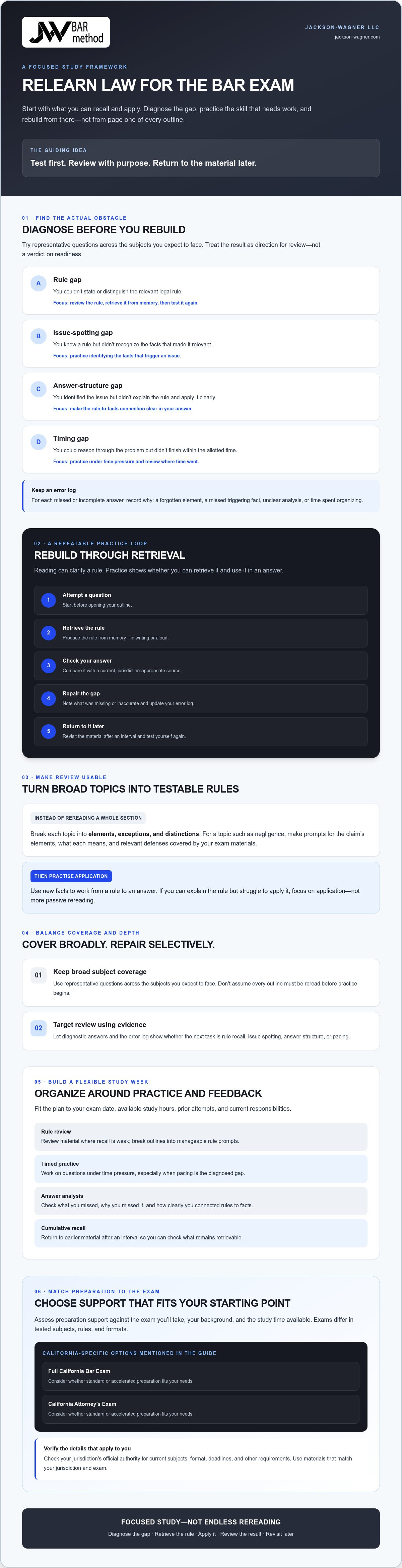
Try a short set of representative questions across the subjects you expect to face. Don’t treat the result as a verdict on your readiness. Instead, identify the kind of repair each question calls for:
- Rule gap: You couldn’t state or distinguish the relevant legal rule.
- Issue-spotting gap: You knew a rule but didn’t recognize the facts that made it relevant.
- Answer-structure gap: You identified the issue but didn’t explain the rule and apply it clearly.
- Timing gap: You could reason through the problem, but not finish within the allotted time.
For every missed or incomplete answer, record the reason, not just whether it was right or wrong. For example, note whether you forgot an element, overlooked a fact that triggered an issue, or spent too long organizing your response. This error log helps you avoid spending hours relearning doctrine when the main problem is application or pacing.
Set a realistic relearning target
Build your plan around your exam date, the study hours you can protect, any prior attempts, and your current responsibilities. Then use your diagnostic results to decide where to begin. If you can explain a rule but fail to apply it, practice with new facts. If you can’t recall the rule, review it, retrieve it from memory, and test it again later.
Check the official exam authority’s current materials for subjects, format, deadlines, and other requirements. The methods in this guide can help candidates in different jurisdictions, but preparation must match the exam they’ll take. Jackson-Wagner’s programs focus exclusively on California, with options for the full California Bar Exam and the California Attorney’s Exam. For broader California planning, read the California Bar Exam strategic guide.
Rebuild Legal Rules Through Retrieval, Not Passive Rereading
Once you’ve identified the kinds of errors you make, turn each one into a short practice loop. Attempt a question before opening your outline. Then retrieve the relevant rule from memory, check it against a current, jurisdiction-appropriate source, repair what’s missing, and test yourself again later. Active recall means producing an answer rather than simply recognizing one on the page. Spaced review means returning to material after an interval instead of cramming it into one sitting. Neither replaces careful study, but both help you see what you can actually recall and apply.
Turn subject outlines into usable rule knowledge
Broad headings are difficult to test directly. Break each topic into elements, exceptions, and distinctions. For example, instead of rereading a full outline section on negligence, create prompts for the elements of the claim, the meaning of each element, and any relevant defenses covered by your exam materials. Close the outline and state the rule aloud or in writing before checking the source. Mark what was missing or inaccurate, then add it to an error log organized by doctrine, rule, and cause of error.
Use materials that match your jurisdiction and exam. For exams with components developed by the National Conference of Bar Examiners, its site can help you locate official information. Check your own exam authority for jurisdiction-specific rules and current requirements. Don’t rely on memory alone for rule statements that may have changed or differ by jurisdiction.
Move from recall to legal analysis
A correct rule statement is only the start. Turn a missed issue into two study tools: a concise rule statement and a fresh application prompt with different facts. If you missed a hearsay issue, for instance, write the governing rule from an approved source, then create a new fact pattern that asks whether the statement is offered for its truth and whether an exception might apply. Answer without looking at your notes, then compare your reasoning with the applicable materials.
Use IRAC, or the response structure preferred by your exam authority, to connect the rule to the facts. Retrieval practice shows which rules you can recall and gives you repeated opportunities to apply them to new facts. Keep the cycle manageable: attempt, retrieve, verify, repair, and retest later. For California candidates considering structured support, California bar preparation options can be one way to explore a guided study path.
Do You Need to Relearn Every Subject Before Practicing?
No. Rereading every outline from beginning to end isn’t automatically the best first move. It can use study time without showing whether you can apply the rules. But practice alone isn’t a complete plan either. If you only work on familiar or frequently tested areas, important gaps may stay hidden. Combine enough broad coverage to map the exam with targeted repair based on your performance.
Each study sequence has trade-offs. Outline-first review can restore structure when foundational concepts feel unfamiliar, but it may become passive if you delay questions. Practice-first study quickly exposes weaknesses, yet a narrow question set can leave whole areas untouched. Integrated review alternates coverage and practice so you can check your understanding as you go, though it requires a clear plan to keep every tested subject in view. There’s no single sequence that fits every candidate.
When broad review may be appropriate
Consider a structured subject review if your diagnostic shows missing concepts across several topics, or if you can’t explain how foundational rules fit together. Use a subject map based on the current exam scope, then work through each area while adding practice to check your understanding. This provides a coverage safeguard: targeted questions can reveal weaknesses, but they can’t confirm mastery of material you haven’t encountered. Verify the tested subjects and format with your jurisdiction’s official exam authority.
When targeted review may be more efficient
If your errors cluster around a specific rule, distinction, or answer skill, focus your next review there rather than restarting the entire outline. Study the relevant material, then answer fresh questions with unfamiliar facts. That follow-up matters: repeating the same question may show that you remember its answer, not that you can transfer the rule to a new problem.
Use both signals to guide how to relearn law for the bar exam: the full subject map shows what needs coverage, while practice errors show where to repair first. A missed question is evidence of a gap, not proof that every untested rule is secure. Practice errors identify what to relearn; they don’t replace coverage. Recheck your map regularly, even when an early diagnostic makes a subject feel comfortable.
Build a Bar Exam Relearning Schedule Around Practice and Feedback
A useful schedule reflects your diagnostic results and the study time you can realistically protect. Don’t fill every available hour with reading. Reserve time to review rules, answer questions, analyze mistakes, and revisit earlier material. If your error log shows repeated confusion about a doctrine, give it focused attention. If you know the rule but run out of time, schedule timed writing or question sets.
Create a repeatable weekly study loop
Plan a sequence you can repeat, adjusting the length of each block to fit your week. For example, assign blocks to subject review, practice questions, answer analysis, and cumulative recall of older topics. Build in rest and contingency time so one disrupted day doesn’t derail the whole plan. As exam day approaches, increase timed work in a way that matches the current format confirmed by your exam authority.
At the end of each week, review your error log. Are the same rule gaps appearing? Are you spotting issues but applying rules vaguely? Use those patterns to revise the next week’s priorities, while keeping every tested subject in your broader coverage plan. Track completed practice and the quality of your reasoning, not just hours studied.
Choose resources that solve your actual gaps
Different materials do different jobs. Outlines help you check coverage and clarify rules. Practice questions test whether you can recognize issues and apply doctrine. Answer review, whether self-guided or supported by a structured course, helps you identify weaknesses in organization, analysis, or timing. Choose resources based on the gap you need to address, rather than collecting materials without a clear purpose.
Independent study may suit candidates who can set priorities, stay consistent, and evaluate their own work. Structured preparation may be useful if you want a clearer sequence or help keeping review and practice on track. Compare options against your jurisdiction, exam date, background, and need for feedback. This bar exam preparation service guidance offers a framework for assessing fit.
For California candidates, Jackson-Wagner offers standard and accelerated preparation for the full California Bar Exam and the California Attorney’s Exam. Confirm that the exam and track match your situation, timeline, and support needs. Explore California bar preparation options as you build a plan for how to relearn law for the bar exam.
When Structured California Bar Preparation Can Help You Relearn Law
Self-study can work well when you can set priorities, choose reliable materials, and assess your own answers. Structured preparation may be a better fit if you need a clearer sequence, exam-specific focus, or a defined path from rule review to practice. Before choosing support, compare it with your actual gaps, exam, background, and available study time. A course should fit your plan, not distract from it.
Structure is useful when it helps you decide what to work on next. A sequenced approach can make a large body of material feel more manageable by connecting subject review with practice and progress checks. As you consider how to relearn law for the bar exam, look for preparation that matches the exam you’ll take and helps address the weaknesses your practice has exposed.
Match a California preparation track to your exam
Jackson-Wagner’s programs prepare candidates for California examinations only, not bar exams in other states. The full California Bar Exam and the California Attorney’s Exam are distinct pathways, so confirm which one applies to you before selecting preparation. For background on the latter pathway, review California Attorney’s Exam requirements, and verify current requirements with the official California exam authority.
The available options include preparation for the full California Bar Exam and for the California Attorney’s Exam, each with standard and accelerated tracks. Those labels describe the available track choices. Confirm current program scope, schedule, and terms directly before enrolling. Don’t assume a track fits based on its name alone. Consider your exam date, starting point, and the time you can consistently devote to study.
Decide whether the JW Bar Method fits your next step
The JW Bar Method is Jackson-Wagner’s structured preparation approach for California exam requirements. To assess whether it suits your needs, ask whether the program aligns with your exam pathway, offers a study structure that works with your timeline, and addresses the kind of support you’re looking for. Check the current course details and applicable terms so your decision rests on confirmed information.
Your next step can be simple: compare the program options with your diagnostic results and study calendar, then review the current terms. Explore California bar preparation with Jackson-Wagner to assess which available track may fit your exam and preparation needs.
Turn Your Study Plan Into Steady Progress
Relearning law doesn’t have to mean starting over with every outline. Begin by identifying whether your main gaps involve rule recall, issue spotting, analysis, or timing. Then use practice to guide focused review, while keeping a plan for broad subject coverage so familiar areas don’t fall out of view.
A repeatable schedule can turn that diagnosis into action: review rules, answer questions, examine your mistakes, and return to earlier material. Adjust the plan as patterns emerge. The best approach to how to relearn law for the bar exam is one that matches your jurisdiction, exam date, starting point, and available study time.
For California candidates considering structured support, Jackson-Wagner uses its proprietary JW Bar Method and offers standard and accelerated preparation for the Full California Bar Exam and the California Attorney’s Exam. Confirm the program and current terms fit your pathway before enrolling. Explore California bar preparation with Jackson-Wagner.
You can make progress one well-chosen study block at a time. Start with what your practice reveals, and build from there.
Frequently Asked Questions
How do I relearn law for the bar exam after years away from school?
Start with a short diagnostic using current questions suited to your jurisdiction and exam. For each error, note whether you forgot a rule, missed an issue, struggled to apply the law, or ran out of time. Review the relevant material, state the rule from memory, and test it against fresh facts. Repeat across subjects, review your progress regularly, and confirm the current exam scope with the official exam authority.
Should I reread all my law school outlines before taking practice questions?
Usually, you can begin with diagnostic practice instead of waiting to reread every outline. Questions show which rules or skills need attention, and outlines can help you repair those gaps. But a diagnostic isn’t a substitute for adequate subject coverage. Use a current subject map for your exam to balance targeted review with systematic coverage, and check your jurisdiction’s official materials to confirm what’s tested.
How can I memorize legal rules for the bar exam?
Practice retrieving rules before looking at your notes. Break a complicated doctrine into its elements, exceptions, and distinctions, then check and correct your answer against reliable, jurisdiction-appropriate materials. Return to the rule in later study sessions and apply it to new facts. Track repeated mistakes so review stays focused. Memorization is only part of preparation: you also need to spot issues and explain how the rules apply.
How many hours should I study each day to relearn law for the bar?
There’s no single daily-hour target that fits every candidate. Set your schedule around the exam date, prior knowledge, work and family responsibilities, and diagnostic results. Assign realistic blocks for rule review, timed practice, and answer analysis, then check whether your errors and performance are changing. Use the exam authority’s current schedule and requirements to plan. Avoid relying on a generic hour total without considering your circumstances.
Can I study for a bar exam while working full time?
It may be possible, but the right plan depends on your exam date, responsibilities, and available study time. Map realistic weekly blocks, prioritize the gaps your diagnostic reveals, and protect time for both practice and reviewing answers. Leave contingency time for missed sessions instead of building a schedule that assumes every day goes as planned. If you consider a course, check its current format and support against your timeline and jurisdiction.
Does Jackson-Wagner prepare students for every state bar exam?
No. Jackson-Wagner LLC focuses on California examinations and offers preparation for the Full California Bar Exam and the California Attorney’s Exam, with standard and accelerated tracks. Candidates planning to sit for another state’s exam should seek preparation aligned with that jurisdiction’s current requirements. Before enrolling, confirm which California pathway applies to you, what the current program covers, and whether its track fits your preparation timeline.


