

The Attorney’s Exam is shorter, but that doesn’t automatically make it easier. If you’re asking, “is the attorney’s exam easier than the full bar,” the answer depends on how you perform under pressure and whether written exams play to your strengths.
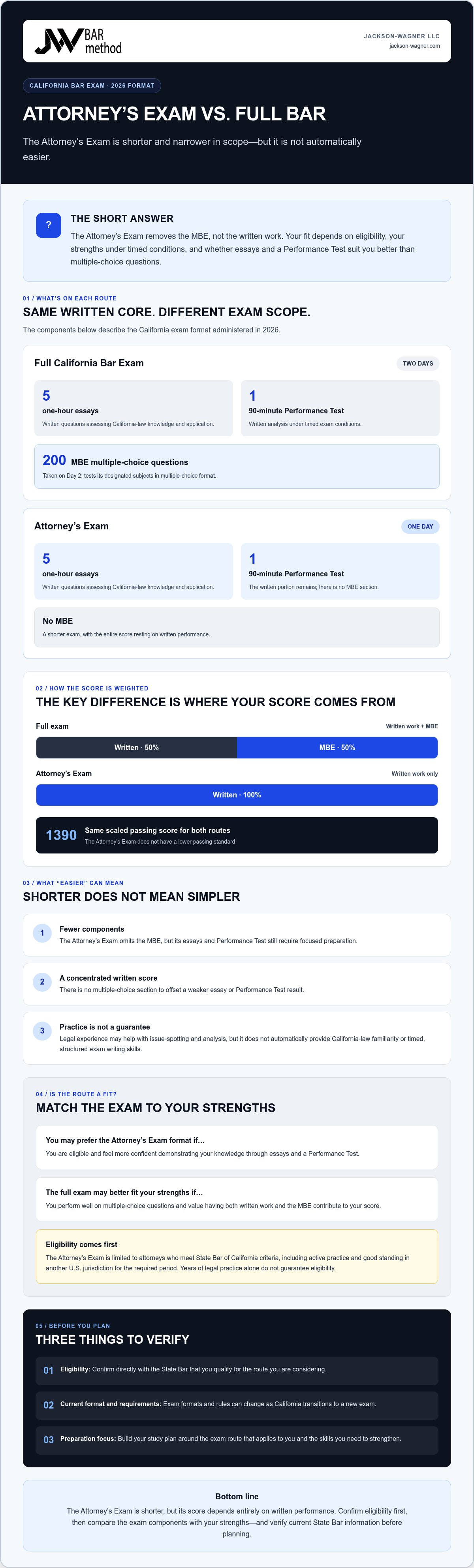
It’s reasonable to expect a one-day exam to feel more manageable than a two-day one. Under California’s current format, the Attorney’s Exam includes five essays and one Performance Test, while the full General Bar Exam also includes 200 multiple-choice questions. But Attorney’s Exam takers rely entirely on their written scores, so there’s no MBE section to balance a weaker essay or Performance Test.
This guide explains what each route includes, why California-specific written questions still demand focused preparation, and how your experience with essays and multiple-choice exams can affect the fit. You’ll also see how eligibility differs from exam difficulty, what to verify with the State Bar before applying, and why current format information matters as California transitions to a new exam. The goal is a clearer next step, not a one-size-fits-all verdict.
Key Takeaways
- The answer to “is the attorney's exam easier than the full bar” depends on your strengths: the Attorney’s Exam is narrower, but its score rests entirely on written performance.
- Compare the current exam components before choosing a route. The Attorney’s Exam includes essays and a Performance Test, while the full exam also includes the MBE.
- Start by confirming your eligibility with the State Bar of California. Don’t assume that years of legal practice automatically qualify you for the Attorney’s Exam.
- Assess your essay, Performance Test, and multiple-choice skills to identify where focused preparation can make the biggest difference.
- Verify the current format and requirements before planning your study schedule, then choose preparation aligned with the exam route that applies to you.
Is the California Attorney’s Exam Easier Than the Full Bar? The Short Answer
It can be narrower in scope, but that doesn’t make it automatically easier. The California Attorney’s Exam is a route for eligible attorneys that, under the 2026 format, tests written performance: five essays and one Performance Test. The full California Bar Exam includes those written components plus the 200-question Multistate Bar Examination (MBE). In other words, the Attorney’s Exam leaves out the MBE, not the need to demonstrate California-law knowledge and strong written analysis.
Both routes currently require a scaled passing score of 1390. On the full exam, written work and the MBE each account for half of the score; on the Attorney’s Exam, written work accounts for all of it. For background on the organization that administers California’s bar examination, see the State Bar of California overview. For current exam logistics and requirements, rely on the State Bar’s official information, since formats and rules can change.
What candidates usually mean by “easier”
“Easier” can mean fewer exam components, less material to prepare, simpler questions, or a better chance of passing. Those aren’t interchangeable. Removing the MBE shortens the Attorney’s Exam, but it doesn’t lower the passing standard or make the essays and Performance Test less demanding. It also concentrates the score in writing, leaving no multiple-choice section to offset a weaker written result.
Prior legal practice may help with issue-spotting and legal analysis, but it doesn’t automatically translate into familiarity with California law or the timed, structured writing an exam requires. A candidate who writes confidently may prefer the Attorney’s Exam format; someone who performs better on multiple-choice questions may value the full exam’s broader scoring mix. Neither preference guarantees an easier experience or a particular outcome.
The most useful short answer for California candidates
If you’re asking is the attorney's exam easier than the full bar, first ask whether you qualify to take it. Under the requirements described for the 2026 exam, the Attorney’s Exam is for attorneys who meet the State Bar’s eligibility criteria, including active practice and good standing in another U.S. jurisdiction for the required period. Confirm the current criteria directly with the State Bar before choosing a route. Candidates who aren’t eligible for the Attorney’s Exam should assess the full-exam route that applies to them.
Start with eligibility, then compare the tested components with your strengths and preparation needs. For qualification details, read the California Attorney’s Exam requirements guide. Verify both 2026 exam components and application rules against current State Bar information before making a study plan.
Attorney’s Exam vs. Full California Bar: What Is Actually Different?
For the California Bar Exam format administered in 2026, the key difference is the MBE. The full exam has written testing and a multiple-choice portion; the Attorney’s Exam omits the MBE but retains the written portion. The table separates those confirmed format differences from eligibility and preparation considerations.
| Comparison | Full California Bar Exam | Attorney’s Exam |
|---|---|---|
| Eligibility | Applicants who meet the State Bar’s requirements for the full exam. | Eligible attorneys who meet the State Bar’s attorney-applicant requirements, including the required period of active practice and good standing in another U.S. jurisdiction. |
| Tested components | Five one-hour essays and one 90-minute Performance Test on Day 1; 200 MBE multiple-choice questions on Day 2. | Five one-hour essays and one 90-minute Performance Test in a one-day exam. No MBE. |
| California-law focus | Written questions assess California-law knowledge and application. The MBE tests its designated subjects in multiple-choice format. | The required written questions still assess California-law knowledge and application. |
| Preparation implications | Prepare for timed essays, the Performance Test, and MBE question practice. | Concentrate preparation on timed written work, California law, and the Performance Test. |
Verified component difference: Under California’s 2026 exam format, the full exam includes five essays, one Performance Test, and the 200-question MBE, while the Attorney’s Exam includes the five essays and Performance Test without the MBE.
Which exam components should candidates compare?
The State Bar describes the one-day Attorneys’ Examination as the written portion of the exam, excluding the MBE. That distinction changes how candidates prepare: Attorney’s Exam takers must demonstrate their exam readiness through essays and a Performance Test alone. The full exam adds multiple-choice practice, which calls for its own question strategy and review.
Why California-specific written work still matters
Essays require candidates to identify legal issues in a fact pattern, select relevant rules, and apply those rules to the facts in a clear, reasoned answer. The Performance Test assesses practical legal analysis using supplied materials, so candidates must work efficiently with the information provided and complete the assigned task under time pressure. Prior practice may help with legal reasoning, but it doesn’t replace learning the applicable California law or practicing the exam format.
The components above describe the California exam format administered in 2026. Exam formats and tested subjects can change, so check the State Bar’s current guidance for the administration you plan to take before setting your study priorities. Once you’ve confirmed the route, compare route-specific California bar exam preparation with the components you need to practice.
What Makes the Attorney’s Exam Difficult for Some Lawyers?
The Attorney’s Exam removes the MBE from the current exam format, but it puts the full weight of the score on written work. That can suit lawyers who organize their thoughts clearly under time pressure. It can also create a sharper challenge for candidates who are less comfortable writing timed essays or completing a practical legal task within a set period.
So, is the attorney's exam easier than the full bar? A more useful question is whether its remaining demands match your strengths. A narrower format can mean fewer types of tasks to prepare for, but it doesn’t automatically mean easier questions, a lower standard, or a light study plan.
When prior practice can help, and where it may not
Legal practice may build skills that transfer to an exam: spotting issues, analyzing facts, and explaining a position. But the value of that experience depends on the work you’ve done. A lawyer whose practice regularly involves rapid written analysis may feel more prepared for timed essays than someone whose work rarely requires it.
Experience also doesn’t guarantee familiarity with California-specific rules or exam conventions. Even strong legal reasoning needs to be paired with accurate rule knowledge and an answer structure that responds directly to the prompt. Treat your background as a potential advantage, not a substitute for targeted study.
Written performance can remain a major challenge
Under timed conditions, candidates must do more than know the law. They need to identify the issues that matter, state relevant rules accurately, connect each rule to the facts, and organize the answer so the analysis is easy to follow. The Performance Test adds a distinct task: work with supplied materials and produce the requested legal analysis efficiently.
Removing multiple-choice testing may reduce the range of formats to practice, but it concentrates preparation on written performance. If a candidate has difficulty prioritizing issues or finishing a response on time, that gap still needs attention.
Weigh the trade-offs:
- Potential advantage: Fewer exam formats to prepare for, with no MBE section.
- Remaining demands: California-law study, timed essays, and the Performance Test.
- Personal factor: Prior experience may help, but its relevance depends on the candidate’s practice and writing habits.
Use a timed essay and Performance Test practice to establish a baseline. Review whether you missed issues, misstated rules, applied facts thinly, or ran out of time. Those results offer a more practical guide to your study priorities than assumptions based on years in practice or the exam’s shorter schedule. Avoid treating pass-rate comparisons as a personal forecast; results from a particular administration don’t determine how an individual candidate will perform.
How to Decide Which California Exam Route Fits Your Situation
Choose based on eligibility and the exam you’re applying to take, not on assumptions about which route sounds easier. Use this decision process to move from official requirements to a realistic study plan.
- 1. Confirm eligibility first. Check the State Bar of California’s current rules for attorney applicants and the full exam. The Attorney’s Exam has specific eligibility requirements; meeting them is separate from deciding which preparation approach suits you. For detailed qualification information, review the California Attorney’s Exam requirements guide.
- 2. Verify the format for your administration. Confirm the tested components, application terminology, and requirements with the State Bar. California is transitioning to the NextGen UBE beginning in July 2028, so don’t assume the format or availability of an exam route will remain the same for every administration.
- 3. Map your starting point. Consider how familiar you are with California law, how recently you’ve practiced, and whether your experience involved timed writing and analysis. Prior licensing and practice may help with legal reasoning, but they don’t automatically establish readiness for California-specific exam tasks.
- 4. Test your skills before setting a schedule. Complete a timed essay and Performance Test practice, and, if considering the full exam, assess your MBE multiple-choice skills too. Review accuracy, organization, issue coverage, and time management to identify gaps.
- 5. Estimate study capacity realistically. Account for work, professional obligations, and personal responsibilities when deciding how much preparation time you can consistently protect. Choose a route-specific plan only after you know the exam components and your baseline.
Match preparation demands to your own starting point
A lawyer who writes regularly and knows California law may have different priorities from an attorney whose practice is in another jurisdiction or involves little timed writing. Likewise, a candidate with strong written skills may still need focused rule review, while someone preparing for the full exam may need to allocate time to both written work and MBE practice. Diagnostic results help turn those differences into concrete priorities instead of simply adding more study hours.
The question is the attorney's exam easier than the full bar can’t be answered without knowing which route you qualify for, your skills, and the administration you’re targeting. Exam requirements are set by the State Bar; preparation choices should address the skills and components you need to develop. For broader licensure context, consult the State Bar’s current admissions resources.
Once you’ve confirmed your route and study needs, compare California bar exam preparation options for the full exam and Attorney’s Exam.
Prepare for the Right Exam with a Focused California Study Plan
Once you’ve confirmed which exam route applies, turn its components into a study plan you can follow and adjust. The answer to “is the attorney's exam easier than the full bar” matters less than whether your preparation targets the exam you’ll actually take and the skills your diagnostic work shows need attention.
Build a plan around the exam you are taking
Start by checking the current State Bar format for your administration. Under the format described for exams through February 2028, the full California Bar Exam includes essays, a Performance Test, and the MBE; the Attorney’s Exam consists of the written portion. California’s NextGen UBE transition means candidates should verify the applicable components rather than rely on a plan built for an earlier administration.
Then translate each component into recurring practice and review. For example, a full-exam plan can reserve time for essay writing, Performance Test tasks, and MBE questions. An Attorney’s Exam plan can devote its practice blocks to essays and performance testing, with California-law review integrated throughout. After each timed task, review more than the result: note missed issues, unclear rule statements, weak fact application, or time-management problems. Use recurring patterns to choose the next week’s priorities instead of adding study hours without a clear purpose.
For additional full-exam strategy and preparation context, read this California Bar Exam strategic guide. Recheck official State Bar information before finalizing your schedule, especially if your exam date falls during a format transition.
Consider structured preparation for either route
A structured plan can help keep learning, timed practice, and review aligned with the exam’s demands. Jackson-Wagner offers preparation programs for both the full California Bar Exam and the California Attorney’s Exam, with standard and accelerated study tracks available for each. The right option depends on your exam route, current skills, and realistic study capacity; no preparation track can replace checking your eligibility or the current exam requirements.
Compare the available California bar preparation programs to find the JW Bar Method option that matches your route. Explore the full-exam or Attorney’s Exam preparation program that fits your verified exam plan.
Choose Your Route, Then Prepare with Purpose
The Attorney’s Exam may have fewer components than the full California Bar Exam, but it still demands strong California-law knowledge and timed written performance. So, is the attorney's exam easier than the full bar? It depends on your eligibility, strengths, and experience with the exam’s required tasks.
Start by confirming your eligibility and the current format with the State Bar of California. Then assess your California-law familiarity, writing skills, and available study time. A diagnostic essay or Performance Test can reveal where your preparation should focus, rather than leaving you to guess or simply add more study hours.
Jackson-Wagner offers preparation programs for both the full California Bar Exam and the Attorney’s Exam, with standard and accelerated study tracks. Explore the options that match your verified route and preparation needs through California bar preparation programs.
With a clear route and a focused plan, you can make your next steps with confidence. Keep your preparation aligned with the exam you’re taking, and build from there.
Frequently Asked Questions
Is the California Attorney’s Exam easier than the full bar?
Not necessarily. If you’re asking “is the attorney's exam easier than the full bar,” the Attorney’s Exam has fewer components, but its score depends entirely on written performance. Under the current format, the full exam includes the MBE, which contributes half of its score. The Attorney’s Exam has no MBE section to balance weaker written work, so difficulty depends on your skills, California-law knowledge, and preparation.
What is the difference between the California Attorney’s Exam and the full bar?
Under the current California format, the full bar is a two-day exam with five essays and a 90-minute Performance Test on the first day, followed by 200 MBE questions on the second. The one-day Attorney’s Exam consists of the written portion: five essays and one Performance Test. Both routes assess written legal analysis, but only the full exam includes multiple-choice testing.
Does the California Attorney’s Exam include the MBE?
No. The California Attorney’s Exam excludes the MBE and consists of the written portion of the exam. The full California Bar Exam includes 200 multiple-choice MBE questions in addition to its essays and Performance Test. This component difference affects preparation: Attorney’s Exam candidates focus on written tasks, while full-exam candidates also need to prepare for MBE questions. Confirm the format for your exam administration with the State Bar.
Can an out-of-state attorney take the California Attorney’s Exam?
An out-of-state attorney may qualify, but holding a license in another jurisdiction alone isn’t enough. Under the stated eligibility criteria, applicants must have been in good standing and actively practicing in another U.S. jurisdiction for at least four years immediately preceding the exam application. Requirements and application terminology can change, so confirm your eligibility directly with the State Bar of California before choosing an exam route.
Do experienced lawyers need to study California law for the Attorney’s Exam?
Yes. Legal experience can support issue spotting and analysis, but it doesn’t automatically establish familiarity with California law or the exam’s writing expectations. Candidates still need to learn and apply the relevant California rules in timed essays and the Performance Test. A useful starting point is a timed writing diagnostic: check for missed issues, inaccurate rules, thin fact application, and difficulty finishing within the allotted time.
How should I choose between Attorney’s Exam and full bar preparation?
Start by confirming which route you’re eligible to take and checking the current exam format. Then assess your California-law knowledge, timed writing, and multiple-choice skills. For example, if you’re eligible for the Attorney’s Exam and your written work is your strongest area, its format may suit you. If you’re taking the full exam, include MBE practice. Use diagnostic results to shape a route-specific plan.
Can I prepare for the California Attorney’s Exam while working full time?
It may be possible, but you’ll need a realistic study schedule that fits your work and personal responsibilities. Set consistent study periods, include timed essay and Performance Test practice, and reserve time to review mistakes and strengthen California-law knowledge. Track your progress to see whether your plan is sustainable and addressing weak areas. Jackson-Wagner offers standard and accelerated preparation options for the Attorney’s Exam, but choose a track based on your circumstances.


