

What if your doubts about passing the California Bar Exam say less about your ability and more about the way you’re preparing? If you’re dealing with imposter syndrome while studying for the bar, an overwhelming syllabus, constant peer comparisons, and a blank practice essay can make even capable students wonder, “Am I smart enough to do this?” That fear is real, but it isn’t proof that you’ll fail.
Bar prep can become chaotic when more materials and longer study hours replace a clear plan for building and testing your knowledge. You don’t need to know everything at once. You need a routine that breaks the workload into focused steps and gives you useful feedback on practice essays.
This article explains how to challenge self-doubt, reduce comparison, and move past analysis paralysis with practical study strategies. You’ll also learn how structured, California-focused preparation, including the JW Bar Method, can help replace volume-driven busywork with purposeful practice. The goal is to study more consistently, assess your progress, and prepare for the California Bar Exam with a clearer plan.
Key Takeaways
- Recognize how the shift from law student to aspiring attorney can fuel self-doubt, without treating that doubt as proof you can’t pass.
- Separate the California Bar’s demands from intimidating narratives, and focus your study plan on the subjects and skills you need to strengthen.
- Check whether your preparation includes active practice and useful feedback, or keeps you busy without showing what you’ve mastered.
- Start high-stakes practice early and use each attempt to identify a specific next step, rather than waiting until you feel completely ready.
- Dealing with imposter syndrome while studying for the bar can become more manageable with a structured, California-focused approach such as the JW Bar Method.
What is Imposter Syndrome in the Context of the Bar Exam?
Imposter syndrome is the persistent inability to believe your success is deserved, even when your effort and accomplishments offer evidence of your ability. The Impostor syndrome overview provides a foundation for understanding the pattern. During bar prep, it can surface at a pivotal transition: moving from being a law student, evaluated through coursework and classroom performance, to preparing for licensure and professional responsibility.
Bar-related imposter syndrome is a mismatch between the effort you’re putting into preparation and the mastery you believe you’ve achieved. High achievers may find that mismatch especially unsettling because they’re used to performing well, setting demanding standards, and treating mistakes as signs they should have known more. Bar prep brings new material, unfamiliar exam tasks, and frequent opportunities to see what you haven’t mastered yet. That’s a learning signal, not a verdict on your potential.
The “Fraud” Narrative vs. Professional Reality
The fear of being “found out” can turn a difficult essay into a reason to avoid writing the next one. You might reread outlines, delay timed practice, or keep changing your study plan rather than risk seeing gaps in your knowledge. But practice is meant to reveal what needs work. A weak answer identifies a target for your next study session; it doesn’t prove you don’t belong in the profession.
The California Bar Exam’s reputation can magnify doubt, making ordinary uncertainty feel like evidence that you’re not capable. Separate that reputation from what you can observe: whether you can recall a rule, apply it to facts, and improve through practice. Some exam nerves are a normal response to a high-stakes test. Persistent self-doubt that interferes with studying or daily life deserves attention, though imposter syndrome itself isn’t a formal clinical diagnosis. If distress feels unmanageable, consider speaking with a qualified mental health professional.
Why Law Graduates Are Uniquely Vulnerable
Competitive law school environments can make achievement feel relative: there’s always someone with a higher grade, faster answer, or stronger résumé. Under pressure, comparison can crowd out more useful evidence, such as your own progress on practice questions.
Classroom habits can follow graduates into independent study. If being called on under the Socratic Method once made uncertainty feel exposing, a missed issue on a practice essay may bring back the urge to have a perfect answer before speaking or writing. Bar essays reward structured analysis, not instant certainty. Write what you can, then use feedback to sharpen the next attempt.
Social media adds another distorted scoreboard. A peer’s polished post about a long study day rarely shows confusion, breaks, or unfinished work. If you’re dealing with imposter syndrome while studying for the bar, measure progress against your study plan and practice results, not someone else’s curated updates.
Why the California Bar Triggers Severe Self-Doubt
The California Bar Exam can feel like a judgment on your intelligence because its reputation is intimidating. But “hardest exam in the nation” is a slogan, not an explanation of what makes preparation challenging. Candidates must learn and apply a broad body of law under timed conditions while managing different task formats. That calls for a deliberate study strategy, not a conclusion that you aren’t capable.
California-specific subjects add another layer. Community Property and Professional Responsibility require focused attention alongside the other tested material. If you’re dealing with imposter syndrome while studying for the bar, encountering a rule you haven’t mastered yet can feel like proof you’re behind. It is more useful to treat it as information about what to practice next.
Deconstructing the California Bar Passing Rate
In February 2026, the California General Bar Examination pass rate was 30.8%. The rate was 43.9% for first-time takers and 23.1% for repeat takers. These figures show that the exam is a serious hurdle, but they don’t tell us why any individual candidate passed or failed, and they don’t measure intelligence. A pass rate describes outcomes across a group, not your potential or the progress you can make with targeted preparation.
Low rates can intensify self-doubt when candidates interpret a difficult exam as a personal test of worth. Put the numbers in context instead. Review the California Bar Exam metrics as measures of exam outcomes, not predictions about your result. More useful indicators are whether you can identify issues, apply rules, organize an answer, and improve with feedback.
The Cognitive Load of Multi-Subject Mastery
Switching between subjects makes preparation demanding. A study day might require recalling a Community Property rule, analyzing a Professional Responsibility problem, then changing gears for another essay or multiple-choice practice. That mental load can make knowledge feel less secure than it is, especially when each practice set exposes another gap.
Volume-based preparation can compound the pressure. If your plan asks you to consume more lectures, outlines, and assignments than you can actively review, it’s easy to feel perpetually behind. Long study days aren’t proof of mastery. Focused retrieval, timed practice, and clear feedback give you better evidence of what you know and what needs work.
The Attorney’s Exam brings its own adjustment. Experienced lawyers may know how legal work unfolds in practice, yet still need to adapt to timed exam writing and precise application of tested rules. Feeling like a beginner at that format doesn’t erase professional experience. It points to a specific skill to train. A focused California preparation approach, such as the JW Bar Method, can help organize the work into a more structured path.
The Link Between Prep Methods and Anxiety
Bar prep anxiety isn’t always just a response to the stakes. Sometimes the study process itself keeps you uncertain: a generic plan can pile on tasks without showing whether you can apply what you’ve learned. A course may provide structure, but if its schedule doesn’t fit your needs or leaves little room to respond to feedback, following it can become another source of pressure.
That’s the checklist trap. Finishing every lecture, outline, and assignment can feel like progress, yet completion alone doesn’t demonstrate that you can recall a rule and use it under timed conditions. When practice reveals a gap, the contrast between a completed checklist and an uncertain answer can prompt the thought, “I’ve done all this work, so why don’t I know it?” The problem may be that your process measures activity more clearly than mastery.
Passive Learning vs. Active Mastery
Repeatedly reading outlines or watching lectures can make material feel familiar without requiring you to retrieve it independently. Then a practice question asks you to produce a rule or apply it to new facts, and familiarity may not be enough. The resulting surprise can feel like a sudden loss of ability, when it may instead show that recognition hasn’t yet become usable knowledge.
Active practice gives you a clearer signal. After reviewing a concept, close your materials and explain the rule from memory, answer a question, or write a timed analysis. Check the result, identify one specific gap, and practice that skill again. This turns the vague feeling of “I know nothing” into a manageable question: “Can I state the rule and apply it accurately?” A structured, California-focused program such as the JW Bar Method can give candidates a defined preparation framework rather than relying on volume alone.
The Problem with Big-Box Bar Review Schedules
A daily task list that keeps growing can make even consistent effort feel inadequate. If the only measures of progress are how many hours you studied or how many items you checked off, there’s always another video or outline to complete. That pressure can lead to fatigue, difficulty concentrating, and increased self-doubt. Those experiences may resemble imposter feelings, but they don’t establish a clinical condition or prove you’re incapable.
Shift the measure. Track what you can do: explain a rule without notes, spot an issue, organize an essay, or use feedback to improve a response. Build your next study block around a defined objective, then assess whether you met it. If you’re dealing with imposter syndrome while studying for the bar, a more useful system can make progress visible and help separate a study-method problem from a judgment about your ability.
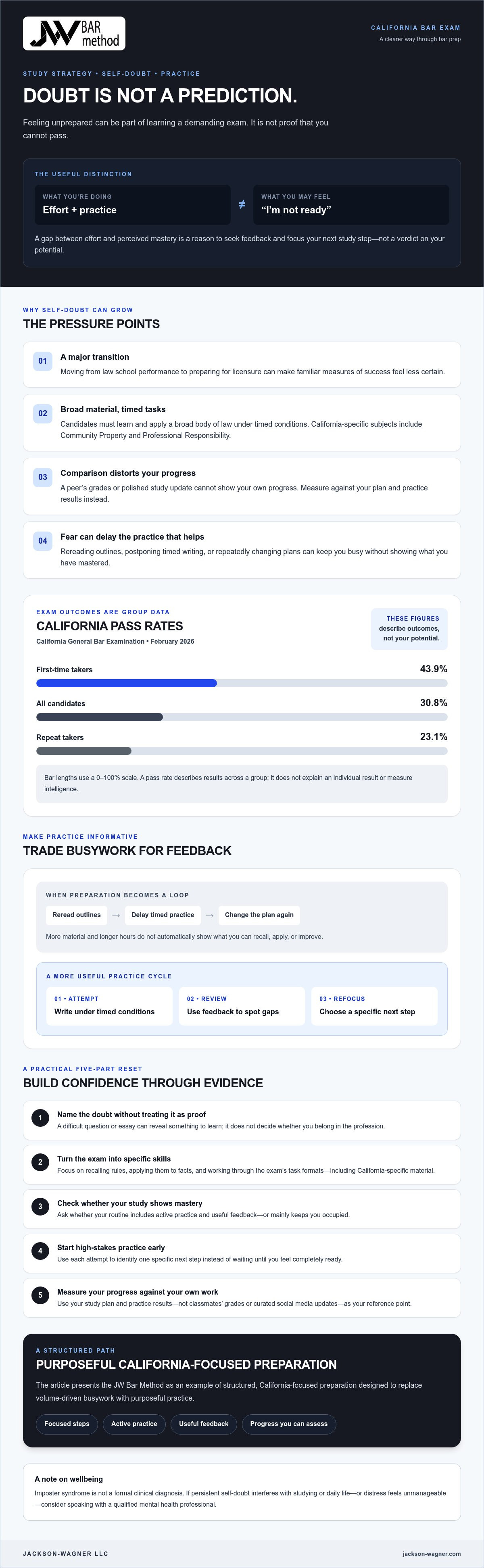
5 Tactical Steps for Dealing with Imposter Syndrome While Studying for the Bar
Confidence grows from evidence, not empty reassurance. Use these five steps to make self-doubt more manageable and turn preparation into observable progress.
- Step 1: Audit your study method. After a study block, ask what you can now do that you couldn’t do before. If your progress is measured only by lectures watched or pages reviewed, add a task that tests your ability to apply the material.
- Step 2: Start timed practice early. Begin with manageable, timed drills so you can practice working through uncertainty before exam day. Review each attempt for a specific adjustment, not as a verdict on your worth.
- Step 3: Curate your environment. If peers’ study hours, scores, or progress posts trigger unhelpful comparisons, limit those inputs during study time. Keep supportive accountability, but choose routines that reinforce your own plan.
- Step 4: Choose precision over volume. Prioritize the rules and skills your work shows need attention. Revisit them until you can recall and apply them, rather than skimming topics just to check them off.
- Step 5: Adopt a professional mindset. Treat an essay like a client file: identify the issue, state the governing rule, apply it to the facts, and note what needs follow-up. Analyze the problem, not your intelligence.
Use Practice as a Diagnostic, Not a Judgment
Retrieval practice means trying to recall a rule or solve a problem before checking your notes. Use California Bar Exam practice to identify a skill to strengthen. After an essay, note whether you missed an issue, misstated a rule, or struggled to apply it. A poor practice result can help you decide what to work on next.
Turn a Low Score into a Next Step
A low MBE score can sting. Review missed questions and look for patterns, such as unfamiliar rules, misread facts, or rushed reasoning. Choose one pattern to address in your next practice block, then check whether your approach improves. Treat performance as feedback for improvement, not a fixed measure of ability.
For a structured approach to California Bar preparation, explore the JW Bar Method.
Beyond the Syndrome: Structured Prep with the JW Bar Method
When your study plan produces more completed tasks than clear evidence of progress, adding more hours may not restore confidence. A structured approach can help you organize the work. The JW Bar Method offers California-focused preparation programs for the Full California Bar Exam and the California Attorney’s Exam, with standard and accelerated tracks. A defined study path can help candidates see what to work on next, although no method can remove the pressure of a high-stakes exam entirely.
Why Precision Beats Volume for the California Bar
Precision means directing study toward tested subjects and skills, then checking whether you can apply them. It doesn’t mean ignoring material or assuming a few topics are enough. Instead of cycling through every outline without a clear priority, use practice to identify a weak rule, review it, and test it again. That focused loop can make progress easier to see and help you decide what deserves your attention.
Keep your preparation anchored to the exam and the applicable licensing process. The State Bar of California licensure requirements provide context for the broader path, while your study work should build the knowledge and exam skills you need to demonstrate. With a clearer roadmap, you can spend less energy wondering whether you’re doing enough and more time on the next measurable task.
A Clearer Path Through the Final Stretch
For candidates who need an accelerated timeline, the JW Bar Method offers accelerated preparation tracks for the California Bar and Attorney’s Exam. A defined sequence of work can replace the feeling that preparation has no finish line. Choose a format that fits your background, available study time, and exam: the full California Bar Exam or the Attorney’s Exam.
Structure won’t guarantee a particular result, but it can help make preparation more deliberate: identify what you need to learn, practice applying it, use feedback, and adjust your plan. That’s a professional way to approach the exam, not a personal trial. You can begin thinking and working like an emerging attorney before results arrive, while recognizing that licensure comes only after you satisfy the applicable requirements.
If you’re dealing with imposter syndrome while studying for the bar, remember that doubt doesn’t erase the work that brought you here. Keep the next step specific, use evidence to guide your preparation, and let a focused plan help you move forward.
Turn Your Preparation Into Forward Momentum
Self-doubt during bar prep isn’t a verdict on your ability. It can be a signal to examine whether your study routine is producing useful feedback or simply keeping you busy. Timed practice, targeted review, and attention to your own progress give you clearer evidence than comparison or endless checklists.
Dealing with imposter syndrome while studying for the bar can also mean choosing a preparation structure that fits the challenge. The JW Bar Method offers a proprietary California-focused curriculum and accelerated preparation tracks for both the California Bar Exam and the Attorney’s Exam.
Ready to replace uncertainty with a defined next step? Explore the JW Bar Method’s California Bar preparation programs.
You’ve already done the work to reach this point. Keep moving forward with a focused plan, one practice task and one measurable improvement at a time.
Frequently Asked Questions
Is it normal to feel like I'm going to fail the California Bar Exam every day?
Repeated fear of failing can happen during high-pressure preparation, but it isn’t a reliable prediction of your result. If you’re dealing with imposter syndrome while studying for the bar, distinguish the thought “I’ll fail” from evidence about your preparation. Look at recent practice work: Can you identify issues, state relevant rules, and apply them? If anxiety is disrupting sleep, concentration, or daily life, consider speaking with a qualified mental health professional.
Does imposter syndrome go away once you pass the bar?
Passing may ease exam-related self-doubt, but it doesn’t guarantee that every feeling of inadequacy will disappear. New professional responsibilities can bring fresh uncertainty, and passing an exam doesn’t define your worth or competence in every situation. Notice whether doubts are tied to a specific skill you can develop or are persistent and affecting your well-being. If distress continues or becomes difficult to manage, support from a qualified mental health professional may help.
How can I tell the difference between imposter syndrome and actually being underprepared?
Look for specific performance evidence rather than relying on a general feeling of failure. Underpreparation may show up as recurring, identifiable gaps: for example, you can’t recall a rule or consistently miss issues in timed essays. Imposter thoughts tend to turn a result into a global judgment, such as “I’m not capable.” Use practice questions and essay feedback to find concrete patterns, then adjust your study plan and check whether your performance changes.
Can I pass the California Attorney's Exam if I haven't studied for a bar in 10 years?
It’s possible to prepare after a long gap, but no one can predict your result from the time away alone. Practicing law may provide useful experience, yet timed exam writing and recalling tested rules still require focused preparation. First confirm your eligibility for the California Attorney’s Exam with the State Bar of California. Jackson-Wagner LLC offers a dedicated Attorney’s Exam preparation program, including an accelerated track, for candidates preparing for that exam.
What should I do if my practice exam scores are triggering a panic attack?
Stop the practice session and focus first on getting support and feeling safe, rather than forcing yourself to continue. If you can, move to a quieter place and contact someone you trust. If symptoms are severe, unfamiliar, or feel like a medical emergency, seek urgent medical help. Once you’re settled, consider discussing recurring panic with a qualified health professional. You can return to practice later with shorter, lower-pressure drills and support.
How does the JW Bar Method help with exam-related anxiety?
The JW Bar Method provides structured preparation focused on the California Bar and Attorney’s Exams, with standard and accelerated tracks. A defined curriculum and study path can help replace open-ended task lists with clearer next steps, while practice and review can show what to work on. The program isn’t mental health treatment, and preparation can’t promise a particular outcome. Review the program details to decide whether its format fits your preparation needs.
Is the California Bar Exam really as hard as everyone says it is?
It is a demanding exam, but its reputation shouldn’t be treated as a measure of your intelligence or future potential. The challenge comes from preparing broadly, applying legal rules to new facts, and producing organized answers under time limits. Those are skills you can practice. Instead of comparing yourself with dramatic stories about the exam, use timed work and feedback to identify specific areas to strengthen in your California-focused preparation.
Can I study for the bar while working full-time without burning out?
It may be possible, but balancing work and bar preparation requires a realistic plan that protects time for focused study and rest. Set a consistent study target that fits your actual schedule, prioritize active practice over endless task lists, and review progress regularly. Jackson-Wagner LLC offers accelerated preparation tracks for the California Bar Exam and Attorney’s Exam, though an accelerated format won’t suit every schedule. Adjust your workload if persistent exhaustion or anxiety is affecting your health.


