

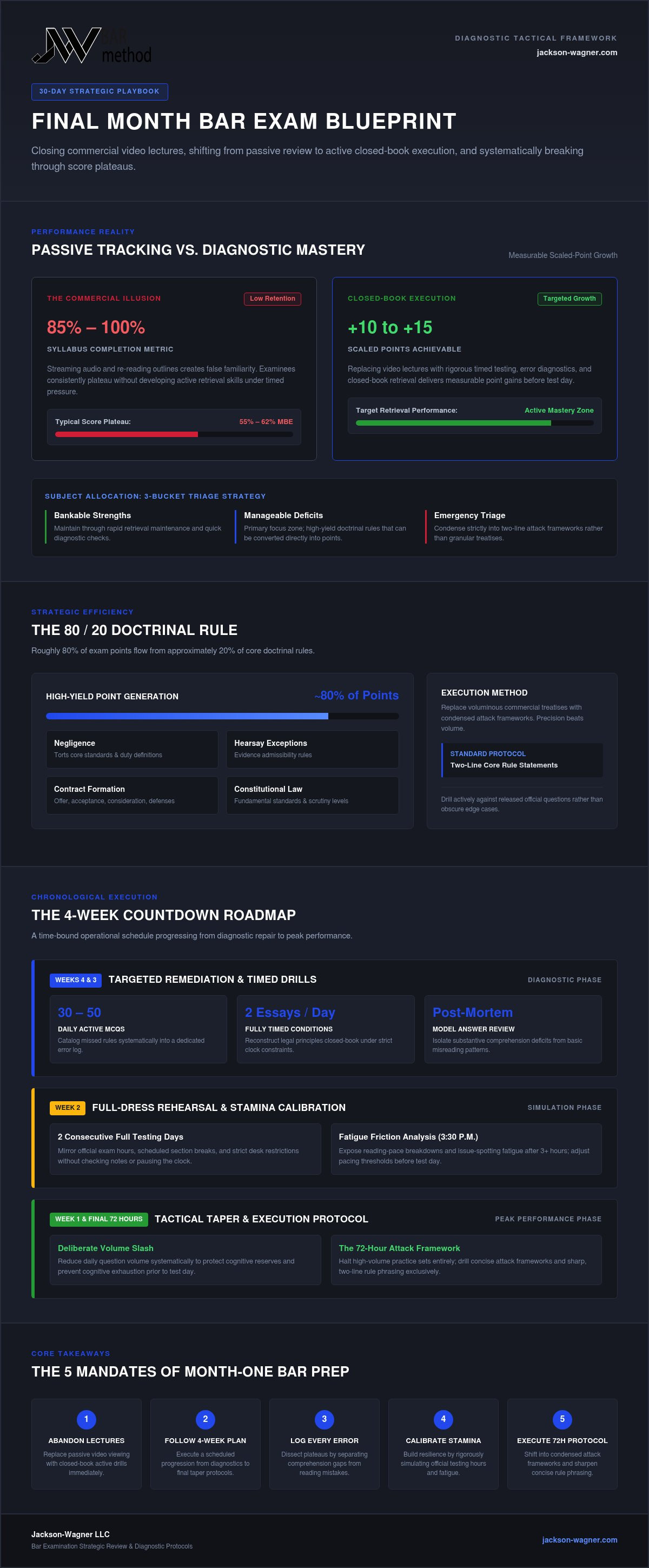
Your commercial bar course progress bar is actively lying to you. Chasing that arbitrary 100% completion metric feels safe, but passive video lectures won't rescue you when your MBE scores plateau between 55% and 62%. If you're stressed about what to do the last month before the bar exam, the answer isn't re-reading outlines or panicking over unfinished assignments. True exam readiness demands closing the lecture tabs, ditching the passive busywork, and shifting immediately to rigorous, closed-book tactical execution.
It's completely normal to feel unprepared right now. When rule statements blur under timed essay pressure and performance tests trigger sheer panic, most examinees double down on the very study habits holding them back. You don't need more outlines; you need targeted, scoring-focused drills that translate into points on the page. By focusing on active retrieval, you can break through stubborn plateaus and gain 10 to 15 scaled points before test day. Below is your definitive, week-by-week 30-day blueprint to eliminate panic, master your timing, and walk into the examination room with total command.
Key Takeaways
- Abandon Passive Lecturing: Audit your true doctrinal readiness and immediately replace video lectures with closed-book, active testing drills.
- Follow a 4-Week Countdown: Discover exact strategies for what to do the last month before the bar exam with a structured timeline from diagnostic review to final taper protocols.
- Implement Error-Tracking Logs: Dissect MBE and essay score plateaus by isolating comprehension deficits from basic misreading patterns.
- Condition for Exam Stamina: Build physical endurance and cognitive resilience by rigorously simulating timed testing environments and real-world distractions.
- Execute the 72-Hour Protocol: Transition away from exhausting high-volume multiple-choice sets and focus exclusively on condensed attack frameworks to sharpen rule phrasing.
Triage Your Final 30 Days: The Shift from Passive Review to Active Testing
Understanding what to do the last month before the bar exam starts with ruthless triage. Most applicants waste their final weeks clinging to a digital syllabus, passively consuming video lectures while their practice scores stay flat. True exam readiness demands that you stop being a spectator. Shut down the recorded lectures; watching someone else explain civil procedure won't teach you to spot a personal jurisdiction issue under pressure. Instead, divide your subjects into three tactical buckets: bankable strengths, manageable deficits, and emergency triage. Reallocate every newly liberated study hour toward timed, closed-book retrieval drills.
Why Commercial Course Progress Bars Create False Security
Legacy commercial prep courses condition you to chase completion percentages. Reaching 85% or 90% syllabus completion guarantees nothing if you can't articulate a rule statement cleanly under strict constraints. As detailed in this Bar Examination Overview, the exam tests multi-component doctrinal competence across essays, performance tests, and multiple-choice questions, not your endurance for streaming audio. Real mastery isn't passive familiarity; it's active formulation. Evaluate your daily progress strictly by diagnostic accuracy, timing metrics, and your ability to write rules from memory on a blank sheet.
The 80/20 Rule: Prioritizing High-Yield Rules Over Obscure Outlines
You don't have time to re-read thousands of pages of granular law. When deciding what to do the last month before the bar exam, apply the Pareto principle. Roughly 80% of your points will flow from 20% of the doctrinal rules. Master negligence, hearsay exceptions, contract formation, and fundamental constitutional standards before touching esoteric edge cases. Ditch voluminous commercial treatises in favor of condensed attack frameworks. Extract core rules into concise two-line statements, drill them actively, and apply them directly to released exam questions. Precision beats volume every single time.
The 4-Week Countdown Checklist: Chronological Blueprint for the Final Month
Structuring what to do the last month before the bar exam requires moving from theoretical knowledge to ruthless, time-bound execution. A disciplined four-week countdown eliminates uncertainty by turning every remaining study block into an intentional diagnostic drill. Instead of guessing your readiness, follow a scheduled progression designed to sharpen issue spotting, expand mental endurance, and peak at the exact right moment.
Weeks 4 and 3: Targeted Remediation and Timed Section Drills
Weeks 4 and 3 focus on identifying doctrinal failure patterns and cementing timed mechanics. Complete a daily quota of 30 to 50 active multiple-choice questions, cataloging every missed rule in an error log. Pair this work with two fully timed essay questions each day, followed by an unsparing post-mortem review against model answers. Incorporating established Bar Exam Study Methods into this phase ensures you actively reconstruct legal principles under pressure rather than re-reading outlines. Candidates preparing under state-specific frameworks can consult our strategic guide on passing the California Bar Exam in 2026 to align these targeted drills with rigorous scoring expectations.
Week 2: Full-Dress Rehearsal and Stamina Calibration
Week 2 is your dress rehearsal. Schedule two consecutive full testing days that mirror official exam hours, section breaks, and desk restrictions. Push through morning and afternoon blocks without checking notes or pausing the clock. This simulation exposes cognitive fatigue friction points, showing you where your reading pace slows or where issue spotting falters after three hours. Adjust your pacing thresholds immediately based on real-time data; knowing how your mind operates at 3:30 p.m. prevents panic on test day.
Week 1: The Tactical Taper and Peak Performance Routine
When mapping out what to do the last month before the bar exam, the final seven days require a deliberate pivot: tapering. Slashing daily question volume protects your cognitive reserves and prevents intellectual burnout. Spend these final days reviewing condensed attack sheets, reciting rule statements, and reinforcing high-yield checklists. Reset your sleep cycle to match morning check-in times, ensuring peak focus when the proctor starts the clock. If you want a structured curriculum designed to maximize execution efficiency during crunch time, exploring Jackson-Wagner's specialized bar prep options can help turn final-week stress into controlled precision.
Diagnostic Benchmarking: Analyzing Practice Scores and Fixing Deficits
Blindly grinding practice sets without analyzing the data won't raise your score. Knowing what to do the last month before the bar exam requires establishing firm benchmark targets. You need a consistent 65% or higher raw score on mixed-set multiple-choice blocks to build a comfortable margin for test day. When scores hover below this threshold, you can't solve the problem by answering more questions. You fix it by diagnosing the exact failure point behind every missed item.
Every error stems from one of three distinct breakdowns: complete doctrinal ignorance, a missed exception or nuance, or a reading error caused by rushing. Isolating these differences keeps you from spinning your wheels. As outlined in standard final countdown bar prep tips, targeted remediation of your distinct personal weaknesses is the fastest route to meaningful score gains during the home stretch.
Mastering the Multiple-Choice Error Log
Maintain a handwritten or digital error log for every single missed MBE question. Record the governing legal rule, the key fact you overlooked, and the specific reason you eliminated the correct answer. This log will expose subconscious habits, such as talking yourself out of the right choice or failing to read call-of-the-question qualifiers. Focus your daily review on fine-grained distinctions within heavily tested topics like negligence, character evidence, and contract remedies to stop repeating preventable errors.
Calibrating Written Essays Against Model Grading Criteria
Essay grading rewards structure and issue clarity over stylistic flair. When evaluating your timed written answers, hold them side-by-side with official released high-scoring benchmarks rather than generic model outlines. Graders scan rapidly under intense time constraints; they look for bolded headings, clear rule statements, and thorough factual application. Understanding what to do the last month before the bar exam means learning how the best bar exam preparation service prioritizes precise rubric alignment, giving examiners the exact keywords and organizational logic needed to award maximum points immediately.
Conditioning, Timing, and Logistics: Preparing Body and Mind for Exam Day
Mental preparation without physical conditioning creates a catastrophic vulnerability. The bar exam functions like an endurance sport; running out of cognitive stamina at hour five ruins weeks of substantive study. Deciding what to do the last month before the bar exam means treating your desk sessions as athletic training. You must actively condition your nervous system to tolerate seated discomfort, ambient room noise, and the psychological shock of encountering a completely unfamiliar essay issue without freezing.
Physical and Mental Stamina Conditioning
Train your body to sit through unrelenting three-hour blocks without standing up or grabbing a snack. Midday cognitive crashes are entirely preventable when you manage fuel deliberately. Swap out heavy carbohydrates and excessive caffeine for low-glycemic meals and disciplined hydration protocols during your practice blocks. If a convoluted fact pattern triggers acute panic, don't rush through the text. Force a three-second reset: plant your feet flat, take two slow diaphragmatic breaths, and parse the call of the question. Controlling your physiological state restores analytical reasoning instantly.
Administrative, Software, and Venue Logistics Checklist
Never let an administrative blunder destroy your testing window. Eliminate operational friction early by locking down technical and venue logistics two weeks ahead of schedule:
- Test the secure browser software: Complete mandatory practice mock exams on your testing laptop and disable automatic operating system updates that could corrupt testing files.
- Pack the compliant clear bag: Assemble your government ID, admission ticket, mechanical pencils, power cords, and permissible foam earplugs inside an approved gallon-sized clear plastic bag.
- Audit venue compliance: Verify official jurisdiction directives, including prohibited personal items and check-in procedures, by reviewing how to navigate the State Bar of California for strict adherence to testing center security.
Knowing what to do the last month before the bar exam requires removing every trace of uncertainty before test morning. To eliminate administrative doubt and master timed performance under genuine exam pressure, explore our specialized preparation tracks to execute your study plan with absolute confidence.
The High-Yield Finish: Structuring Your Final 72 Hours for Execution
The final 72 hours are about cognitive preservation, not panic-fueled cramming. Grinding full 100-question practice sets at this stage won't teach you new doctrine; it will only drain the mental stamina you need for exam day. When refining what to do the last month before the bar exam during this final window, the priority shifts from diagnostic testing to mental calibration. Put away the scoring software. Turn your attention to condensed attack frameworks, streamline test-day logistics, and protect the analytical sharpness you spent weeks building.
What to Review During the Final 48 Hours
Keep your review light, structured, and entirely untimed. Read through foundational statutory elements, core definitions, and formatting templates for professional responsibility and performance tests. Rehearsing these standard outlines ensures your rule statements flow onto the screen without hesitation. Above all, stay off online legal forums and group chats. Candidate speculation about predicted topics only spreads misinformation and triggers needless panic. Keep your study environment quiet, organized, and focused on clean recall.
Executing the Plan on Test Morning
Arrive at the testing center well before doors close to clear check-in and security checkpoints without unnecessary adrenaline spikes. Pack your lunch, double-check your transit route, and wear layered clothing to handle fluctuating room temperatures. Once inside the holding area, tune out the anxious chatter around you. Other examinees second-guessing rules in the hallway will only distract you from your game plan.
When the session begins, treat the first question as an isolated task. Stick strictly to your pacing benchmarks, spot the issues systematically, and apply the facts directly to your rules. True readiness for what to do the last month before the bar exam culminates in this moment: trusting your active preparation, blocking out distractions, and executing with total professional authority.
Execute With Precision and Take Command of Test Day
Passing isn't a matter of luck or marathon lecture sessions. Deciding what to do the last month before the bar exam comes down to decisive action: targeting high-yield rules, analyzing error logs to eliminate recurring blind spots, and tapering deliberately to preserve mental stamina. When you replace passive outlining with closed-book retrieval, your score follows.
Generic bar prep relies on bloated syllabus volume that drains your time without building diagnostic competence. If you're ready to break past score plateaus, choose a specialized curriculum engineered for rigorous professional licensing examinations. Jackson-Wagner delivers a precision pedagogical model that replaces passive review with active execution, offering accelerated study tracks designed for practicing attorneys and high-stakes examinees. Take control of your preparation today: accelerate your bar exam execution with the proven JW Bar Method.
You have the tools and the blueprint. Trust your preparation, maintain your pacing discipline, and walk into the examination room ready to claim your license.
Frequently Asked Questions
How many practice questions should I complete daily during the last month?
Target 30 to 50 active multiple-choice questions per day. Doing more than 50 dilutes your review quality, because thorough post-mortem analysis takes twice as long as answering the questions. Pair these multiple-choice blocks with two timed essays or one performance test. Focus on deep rule extraction rather than superficial question volume to generate actual score gains.
Should I stop using my commercial bar review course in the final weeks?
Yes, stop following their passive schedule when deciding what to do the last month before the bar exam. Standard commercial tracks push passive video lectures and busywork that rob you of active retrieval time. Retain their licensed question banks and grading rubrics, but ditch the daily percentage tracker. Your final month must prioritize closed-book drills over syllabus completion.
What raw score percentage on practice MBE questions indicates a passing trajectory?
Aim for a consistent 65% raw score on mixed, timed 50-question sets. While national scaling varies across exam administrations, a 65% benchmark gives you a comfortable safety cushion against difficult question variants on test day. If your average hovers near 55%, immediately shift focus to dissecting question stems rather than doing unreviewed high-volume sets.
How should I divide my daily study schedule between essays and multiple choice?
Split your day into equal halves of diagnostic execution. Dedicate mornings to your sharpest cognitive window by running a 35-question MBE set followed by detailed error logging. Reserve afternoons for writing two fully timed essays and reviewing them directly against official scoring rubrics. Spend your final evening hour exclusively on rapid, closed-book rule recitation.
Is it normal to feel like I am forgetting basic legal rules four weeks out?
Yes, feeling like you've forgotten doctrine is a normal symptom of cognitive fatigue. The sheer volume of material temporarily clouds immediate recall under low-pressure conditions. When you sit down with a timed fact pattern, prompt triggers will bring that knowledge back to the surface. Combat this sensation by actively writing two-line rule summaries from memory rather than re-reading commercial outlines.
How many full simulated exam days should I complete before the actual test?
Complete two full simulated days approximately two weeks before the exam. Running 200 questions or a full slate of essays across consecutive days tests physical stamina, hydration plans, and afternoon focus. Don't schedule full simulations during your final seven days. Late simulations create intellectual exhaustion when your brain needs a deliberate taper to peak on test morning.
What should I do if my practice scores plateau or drop during the final month?
A sudden score drop almost always indicates cognitive burnout rather than a loss of knowledge. When diagnosing what to do the last month before the bar exam during a plateau, take an immediate 24-hour break from testing. Then, audit your error tracking log to isolate whether mistakes stem from reading comprehension or doctrinal gaps before resuming drills.


