

Highlighting an eighty-page commercial outline isn't studying; it's passive exhaustion disguised as productivity. Real visual bar study is tactical spatial synthesis, not decorative art. If you've ever frozen while trying to recall a four-part constitutional test under timed essay conditions, you know that standard outlines fail when pressure peaks. Yet, many examinees hesitate to try visual learning techniques for the bar exam because they fear wasting valuable study hours drawing intricate diagrams instead of doing practice problems.
That friction disappears when your visual tools are engineered for rapid diagnostic speed rather than aesthetics. You don't need artistic talent to convert complex rules into ruthless, reliable recall systems. In this guide, you will master actionable visual frameworks that deconstruct multi-step legal doctrines, cut your revision time in half, and accelerate retention under strict testing conditions. We'll show you how decision trees and logic schematics turn cognitive overload into fast, instinctual issue-spotting on both multiple-choice questions and timed essays.
Key Takeaways
- Linear commercial outlines create cognitive overload, whereas spatial rule mapping activates dual-coding theory to lock complex doctrines into durable memory.
- Implementing structured visual learning techniques for the bar exam, such as decision trees and scrutiny flowcharts, converts multi-element tests into rapid diagnostic pathways.
- A disciplined deconstruction process strips away doctrinal bloat, allowing you to isolate non-negotiable core elements and map logical forks in minutes.
- Enforcing a strict 30-minute build cap prevents the perfectionism trap, ensuring your diagrams remain functional diagnostic tools rather than time-wasting art projects.
- Integrating spatial schematics into daily practice accelerates timed essay outlining and gives you the clarity to eliminate tricky multiple-choice distractors with surgical precision.
Why Traditional Outlining Fails and How Visual Learning Bridges the Gap
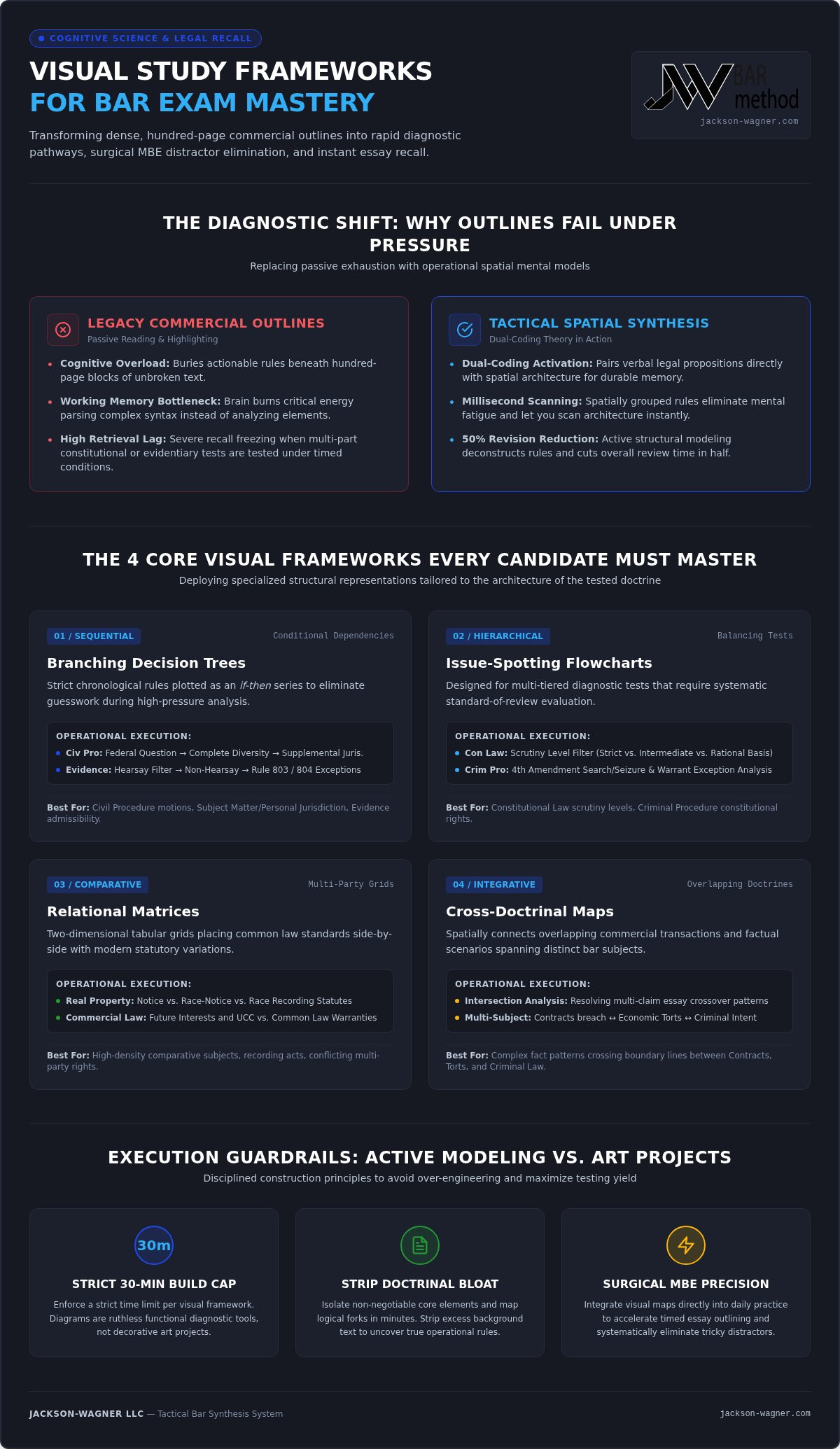
Legacy commercial bar outlines routinely bury actionable law beneath hundred-page blocks of unbroken text. Reading these massive volumes triggers severe cognitive overload, leaving your working memory depleted before you even attempt a practice question. Visual legal synthesis fixes this breakdown. Instead of forcing your brain to decode dense linear paragraphs under strict time limits, visual synthesis organizes legal rules spatially. This approach leverages dual-coding theory, pairing verbal propositions with spatial mental models. Storing rules as structured systems rather than endless text blocks cuts retrieval lag and preserves mental stamina when the exam clock is running down.
The Cognitive Science of Legal Rule Retrieval
Working memory saturates fast. When you read a wall of text detailing the intricate exceptions to hearsay, your brain expends energy simply parsing syntax rather than analyzing legal elements. Spatially grouped rules eliminate this bottleneck. Placing an overarching rule at the center and branching out its exceptions creates distinct visual anchors that trigger rapid recall during high-stress testing sessions. Deploying proven visual learning techniques for the bar exam lets you scan your mental architecture in milliseconds, locating the exact multi-part test you need without mental fatigue.
Shifting from Passive Highlighting to Active Structural Modeling
Color-coding pre-printed materials feels productive, but passive review rarely builds durable neural pathways. Even studying ready-made charts yields minimal gains because someone else did the analytical heavy lifting. True retention requires active structural modeling. Translating a dense statutory framework into structured decision trees or tactical mind mapping layouts forces your brain to categorize hierarchy, identify logical dependencies, and isolate exceptions.
Generating these visual models yourself dramatically accelerates rule synthesis. Practicing active visual learning techniques for the bar exam transforms passive review into ruthless doctrinal deconstruction. You aren't just memorizing facts; you are building an operational framework that allows you to spot buried nuances, eliminate distractors on the MBE, and construct complete essay answers under intense time pressure.
The 4 Core Visual Frameworks Every Bar Candidate Must Master
Static one-sheets fail because they compress information without mapping its operational logic. Different doctrinal subjects demand tailored structural representations. To build actionable recall under timed conditions, you must deploy four specialized visual frameworks matched directly to the architecture of the law you are testing.
- Decision Trees: Perfect for sequential, rule-driven subjects with conditional dependencies like Civil Procedure motions and Evidence admissibility.
- Issue-Spotting Flowcharts: Designed for multi-tiered balancing tests, such as Constitutional Law scrutiny levels or Criminal Procedure Fourth Amendment analyses.
- Relational Matrices: Ideal for high-density comparative subjects, including Real Property recording acts, future interests, and commercial warranties.
- Cross-Doctrinal Concept Maps: Essential for mapping overlapping transactions that sit across Contracts, Torts, and Criminal Law boundaries.
Branching Decision Trees for Sequential Legal Doctrines
Strict chronological rules require rigid logical pathways. Plotting federal subject matter jurisdiction, personal jurisdiction, and venue choices as an if-then series eliminates guesswork during MBE questions. You move sequentially: if federal question jurisdiction fails, test for complete diversity; if diversity holds, check for supplemental jurisdiction limitations. Similarly, mapping Hearsay as an exclusionary filter instantly separates non-hearsay exemptions from exceptions under Rules 803 and 804.
Relational Matrices for Multi-Party and Comparative Rules
Tabular layouts resolve dense multi-party disputes where linear text causes cognitive confusion. A two-dimensional grid allows you to place common law standards directly alongside statutory modern variations, exposing the precise differences bar examiners exploit. Academic reviews of visual learning resources for law students emphasize that tabular matrices are especially powerful for mastering Real Property, letting you match present possessory estates with their corresponding future interests across clean, parallel columns.
Mastering these high-yield visual learning techniques for the bar exam requires moving beyond passive review and adopting structured study habits. Candidates looking to replace traditional outline memorization with systematic, performance-driven diagnostic frameworks often turn to structured options like the JW Bar Method to accelerate retention and master complex exam architecture.
Step-by-Step: How to Turn 100 Pages of Dense Doctrine into Tactical Visual Maps
Staring at a hundred-page commercial outline breeds paralysis. To transform that wall of text into a functional recall engine, you must treat doctrinal condensation as an engineering challenge. Transforming raw law into high-yield visual learning techniques for the bar exam requires a repeatable four-step conversion workflow:
- Isolate the primary legal test and strip away narrative historical context.
- Map binary forks, sub-elements, affirmative defenses, and jurisdictional splits.
- Establish visual hierarchy using spatial anchors, contrasting shapes, and functional color coding.
- Stress-test your schematic directly against past bar exam essay prompts.
Phase 1: Rule Deconstruction and Element Stripping
Do not draw until you have pruned the bloat. Commercial outlines pack judicial history, policy dissents, and redundant verbiage around core tests. Strip these away. Extract only operative statutory language, burden-shifting rules, and essential elements. For example, when deconstructing intentional torts, isolate the exact prima facie elements of Battery, then position affirmative defenses like consent and self-defense immediately alongside those specific triggers rather than on a separate page.
Phase 2: Spatial Architecture and Visual Hierarchy
Spatial arrangement dictates cognitive processing speed. Place the umbrella rule at the top of your page and cascade downward into subordinate elements. Reserve distinct geometric boundaries for distinct legal categories: use clean rectangles for mandatory elements, diamonds for discretionary judicial balancing tests, and rounded boxes for statutory exceptions. Apply consistent, functional color schemes. Shade plaintiff burdens in one tone and defendant affirmative defenses in another to reinforce the adversarial balance on sight.
Phase 3: Validating Visual Maps Against Released Exam Questions
A schematic is useless if it stalls during a timed essay. Run released exam fact patterns through your freshly drawn framework to spot structural bottlenecks. If an essay raises a nuance that lacks a logical branch, your map has a blind spot. Candidates refining their workflows can reference Passing the California Bar Exam in 2026: The Definitive Strategic Guide to align their visual maps with released scoring rubrics. Integrating rigorous visual learning techniques for the bar exam ensures every branch you map translates directly into points on the page.
Common Visual Study Pitfalls and How to Avoid Over-Engineering
A visual aid that takes four hours to build is an expensive liability. The sole objective of visual bar prep is instantaneous doctrinal synthesis, not graphic design. When candidates lose half an afternoon adjusting connector lines or aligning shapes in complex software, diagramming morphs into productive procrastination. Your visuals must remain lean, functional, and focused entirely on active retrieval.
The Aesthetic Trap: When Diagramming Becomes Productive Procrastination
If you catch yourself picking color palettes or styling digital typography, stop immediately. You have slipped from cognitive modeling into creative avoidance. Enforce a strict 30-minute cap on drafting any single doctrinal diagram. The moment that timer sounds, close your notes and immediately test the map against three MBE questions or an essay prompt.
Reach for an unlined legal pad or a dry-erase whiteboard instead of launching complicated design applications. Physical sketching engages kinesthetic processing while eliminating digital software friction. Quick, iterative sketches anchor spatial memory far more effectively than polished vector graphics that take hours to assemble.
Preventing Visual Clutter and Information Densification
Overcrowded diagrams destroy spatial recall. Pasting full rule paragraphs into flowchart nodes merely recreates the linear outline you were trying to escape. Clean schematics depend on concise operative triggers:
- Use brief trigger keywords: Write "harmful or offensive contact" rather than copying verbatim Restatement passages.
- Preserve white space: Keep generous open space around nodes so your brain can index positional relationships instantly.
- Enforce a four-tier limit: Split any doctrine branching beyond four levels into modular, linked sub-maps.
Applying disciplined visual learning techniques for the bar exam keeps your cognitive load manageable and your retrieval speed high under pressure. If you are ready to replace passive outline memorization with a rigorous, high-yield study system, explore the JW Bar Method preparation tracks to master the exam without wasting critical study hours.
Integrating Visual Frameworks into a Complete, High-Yield Bar Prep Strategy
Visual aids produce zero value if they sit idle in a binder. To translate spatial comprehension into raw exam points, your diagrams must function as the central operating system of your daily study routine. Visual learning techniques for the bar exam deliver their highest return when they directly drive your active practice sessions, bridging the gap between abstract doctrinal theory and rapid test execution.
Establish a disciplined morning rhythm. Spend ten minutes actively sketching a core schematic from memory before attempting any practice questions. When tackling multiple-choice sets, deploy that spatial memory to dismantle tricky questions. Instead of getting tangled in deceptive fact patterns, use your mental decision tree to isolate the precise legal stage, disqualify irrelevant doctrines, and eliminate distractor answer choices with surgical speed.
Bridging Visual Recall to High-Scoring Essay Architecture
Every branch of a well-engineered decision tree translates directly into an IRAC heading on your essay page. Navigating your schematic naturally enforces a logical legal hierarchy: primary threshold requirements, such as standing or personal jurisdiction, automatically appear before subordinate substantive elements. Run daily 15-minute essay outlining drills without looking at your notes. Sketch the relevant visual branch on scratch paper, match the facts to each node, and immediately convert that layout into an organized outline ready for full analysis.
Elevating Retention Through Disciplined Curricular Structure
Passive study methods guarantee retention decay. Sitting through fifty hours of linear video lectures or rereading dense outlines creates an illusion of competence that collapses under timed exam pressure. Real mastery demands active structural engagement. Candidates seeking an unfair advantage replace passive lecture tracks with high-intensity diagnostic drills that prioritize element deconstruction and active visual retrieval.
To see how an integrated, structured pedagogical model outpaces outdated commercial prep formats, read Best Bar Exam Preparation Service 2026: Why Precision Beats Volume. When you anchor your preparation in structured spatial systems rather than passive volume, you dramatically shorten your learning curve. Learn more about streamlined bar preparation methods at Jackson-Wagner to turn proven visual learning techniques for the bar exam into a reliable, high-scoring routine on test day.
Master Spatial Synthesis and Secure Your Passing Score
Relying on passive outline memorization cannot withstand the intense pressure of timed exam conditions. High-scoring candidates don't get lost in eighty-page commercial texts; they command structured, functional frameworks. Deploying deliberate visual learning techniques for the bar exam transforms complex legal rules into rapid diagnostic maps, cuts retrieval lag to zero, and gives you an immediate operational scaffold for timed essays and multiple-choice elimination.
Precision always defeats raw volume. Jackson-Wagner developed the proprietary JW Bar Method specifically to eliminate doctrinal bloat and replace passive review with high-retention active practice. Designed for high-efficiency legal mastery, our structured curriculum offers comprehensive programs for full bar exam candidates alongside accelerated preparation tracks for practicing attorney applicants. Stop spinning your wheels in linear text. Discover how the JW Bar Method accelerates your path to bar exam success and step into exam day with absolute confidence in your ability to perform.
Frequently Asked Questions
Can visual learning techniques improve my bar exam score if I am not naturally artistic?
Yes, because visual legal synthesis relies on logical spatial relationships rather than artistic skill. You don't need creative talent to draw boxes, decision forks, and relational grids. The brain processes spatial positions and connections far faster than dense text blocks. Simple, unpolished diagrams force you to deconstruct multi-element tests into clear functional steps, which directly enhances rule recall and issue spotting under strict exam conditions.
How much study time should I allocate to drawing flowcharts versus doing practice questions?
Spend no more than twenty to thirty percent of your study session diagramming rules. The remaining seventy to eighty percent must focus on active application through timed essays and multiple-choice questions. Applying visual learning techniques for the bar exam works best when you treat drawing as an active synthesis sprint capped at thirty minutes. If you spend entire afternoons perfecting charts, you are falling into productive procrastination rather than testing retention.
Is it better to draw visual bar study aids by hand or use mind-mapping software?
Drawing by hand on paper or a dry-erase whiteboard is significantly more effective. Physical sketching engages kinesthetic motor memory, which strengthens neural retention pathways and prevents software distractions. Digital mind-mapping tools often lure examinees into wasting valuable hours adjusting colors, fonts, and node alignments. Keep your initial drafts physical and fast; only transition to digital formats if you need a durable, portable review summary for daily drills.
What happens if a complex legal doctrine has too many exceptions to fit on a diagram?
Break the doctrine into modular, linked sub-maps rather than crowding everything onto one canvas. Trying to force an entire subject onto a single page destroys spatial clarity and overloads working memory. Map the overarching test on a master sheet, then create subordinate one-page schematics for specific clusters, such as individual hearsay exceptions or constitutional scrutiny tiers. Limiting branches to four tiers preserves spatial recall under pressure.
How do visual learning techniques help with timed multiple-choice questions like the MBE?
Visual learning techniques for the bar exam build mental decision trees that let you eliminate wrong answer choices systematically. Rather than getting distracted by narrative facts, your brain categorizes the scenario into a spatial framework: identifying the threshold procedural stage, isolating the governing element, and checking for conditional exceptions. This structured approach stops you from second-guessing yourself and dramatically speeds up your pacing across consecutive question sets.
Can visual study frameworks completely replace traditional commercial bar review outlines?
Visual frameworks replace the need to endlessly reread multi-page commercial outlines during your review phase. While comprehensive outlines remain useful as initial reference repositories to verify nuanced rules, they are terrible diagnostic tools for exam week. Transforming linear doctrine into disciplined visual schematics compresses hundred-page subjects into agile recall sheets, allowing you to cycle through an entire subject's core tests in minutes before practicing essays.


