

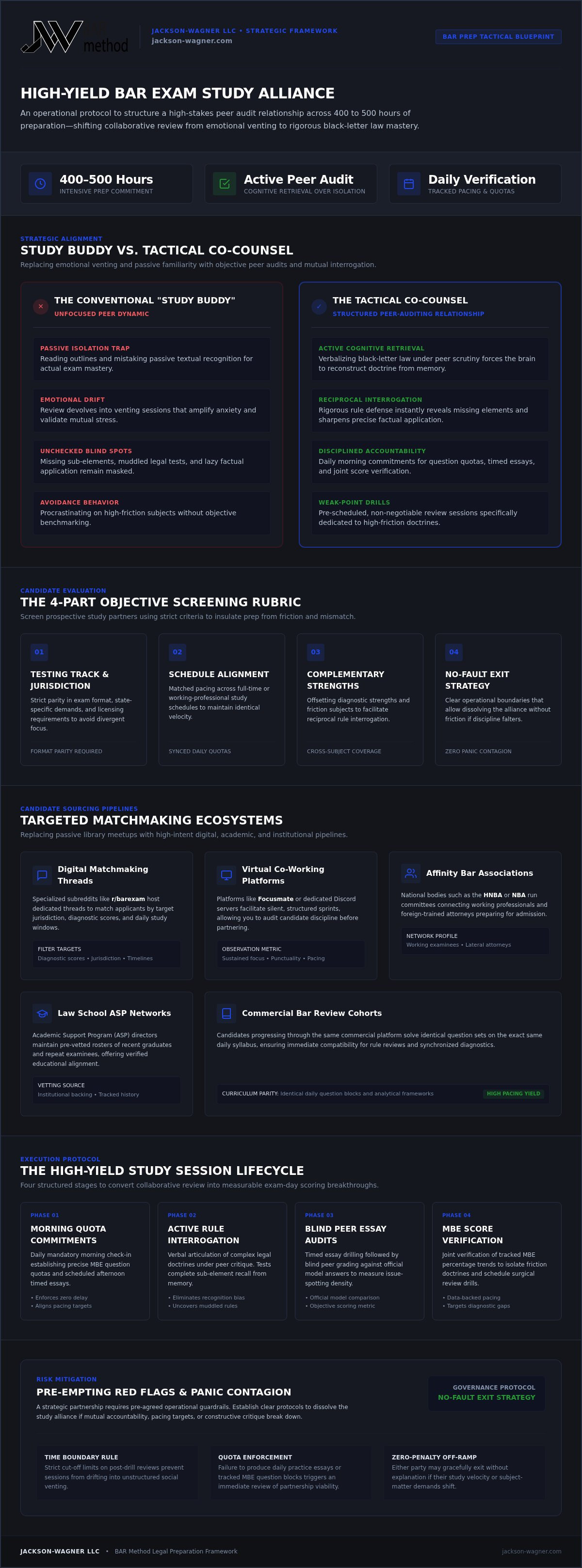
A bar exam study partner shouldn't be a study buddy; they need to be tactical co-counsel. When you're staring down 400 to 500 hours of intensive preparation, pairing with the wrong person turns critical review into an emotional venting session that amplifies anxiety. If you want to know how to find a bar exam study partner who actually drives score growth, you must treat the search like hiring an associate rather than finding a friend.
Studying in total isolation is exhausting, yet teaming up with an unfocused peer creates fatal distractions. You don't need someone to validate your stress; you need an accountable collaborator who sharpens your rule application and keeps your daily pacing honest. This guide outlines how to source serious candidates across modern digital and institutional platforms, screen for format and schedule compatibility, and establish disciplined peer-review routines.
From screening rubrics to structured essay drills, here is your definitive operational blueprint for building a high-yield study alliance that delivers results on exam day.
Key Takeaways
- Transform collaborative prep from passive review into a high-stakes peer audit that sharpens rule application through active interrogation.
- Discover how to find a bar exam study partner across specialized platforms and professional networks who shares your exact exam format and pacing.
- Screen prospective candidates using an objective four-part rubric to ensure strict alignment on testing track, study schedules, and complementary strengths.
- Execute timed, agenda-driven drills and blind peer reviews against official model answers to build measurable performance benchmarking.
- Establish clear operational boundaries and a no-fault exit strategy to insulate your prep schedule from panic contagion and emotional drift.
Why a Bar Exam Study Partner Accelerates Your Path to Licensure
Treating bar prep as a solitary endurance test is an outdated strategy. A high-performing study partnership functions as a structured peer-auditing relationship. While conventional prep courses encourage candidates to passively consume endless video lectures, real scoring breakthroughs occur through active interrogation and rigorous rule defense. Articulating a complex doctrine out loud under the critical eye of an equal forces genuine cognitive retrieval. It also counters the psychological drag of isolation, transforming paralyzing stress into shared momentum. If you master how to find a bar exam study partner who challenges your legal analysis, you replace false confidence with measurable retention.
Active Recall vs. Passive Isolation
Reading outlines in isolation creates a dangerous cognitive trap: recognition mistaken for mastery. You recognize the elements of proximate cause or hearsay exceptions on the page, so you assume you can reproduce them under timed conditions. In high-stakes testing, you can't rely on passive familiarity.
Reciprocal interrogation breaks this illusion. Verbalizing black-letter law under peer scrutiny forces the brain to reconstruct doctrine from memory rather than simply recognizing familiar phrasing. A structured issue-spotting drill with a peer immediately uncovers missing sub-elements, muddled tests, and lazy factual applications that solo practice consistently masks.
Accountability Metrics That Keep You on Schedule
Exam prep quickly falls apart without uncompromising pace control. An effective peer dynamic enforces compliance across every major subject block. Knowing how to find a bar exam study partner who respects structural discipline ensures both of you meet strict daily benchmarking targets:
- Mandatory check-in routines: Daily morning commitments establishing precise question quotas and timed essays for the afternoon.
- Objective score verification: Reviewing tracked MBE percentage trends together rather than glossing over diagnostic weak spots.
- Targeted weak-point drills: Pre-scheduling non-negotiable review sessions for high-friction doctrines, eliminating the temptation to procrastinate on difficult subjects.
Mutual oversight prevents avoidance behavior. It keeps your preparation airtight across every subject block, maintaining steady velocity through the final weeks.
Where to Find a Qualified Bar Exam Study Partner in 2026
Finding a serious peer takes deliberate sourcing. Legacy advice tells you to grab whoever sits beside you in the campus library, but that model ignores the reality of modern, remote bar preparation. Today, examinees include out-of-state attorneys, foreign-trained applicants, and full-time remote professionals who require specific format parity. If you want to know how to find a bar exam study partner who matches your exact testing demands, you must target specialized pipelines where candidates demonstrate real commitment.
Digital Communities and Virtual Study Groups
Modern peer matching happens in digital environments designed for sustained execution rather than casual chat. Look for partners across these specific channels:
- Subreddit matching megathreads: Communities like r/barexam host active matching threads where applicants post specific diagnostic scores, jurisdictions, and target schedules.
- Virtual co-working spaces: Platforms like Focusmate or dedicated Discord servers offer quiet, structured sprints, allowing you to observe a candidate's focus before proposing an analytical partnership.
- Affinity bar associations: National networks such as the Hispanic National Bar Association (HNBA) or National Bar Association (NBA) run dedicated committees that connect working professionals sitting for licensing.
Law School Alumni and Academic Support Networks
Your law school's Academic Support Program (ASP) director remains an overlooked matchmaking resource. ASP directors track individual strengths across subject areas and manage rosters of recent graduates, repeat examinees, and alumni sitting for lateral admissions nationwide. Reaching out directly to an ASP advisor provides a pre-vetted peer list. It ensures your potential collaborator shares your educational foundation and has institutional accountability.
Commercial Bar Review Cohorts and Structured Courses
The highest-yield partners are those enrolled in the same rigorous curriculum, working through identical daily question sets and analytical frameworks. Open discussion boards within commercial prep portals allow you to filter for candidates who post substantive legal questions rather than administrative panic. Preparing for exceptionally tough licensing hurdles requires lockstep precision. Working through a dedicated California bar exam program allows you to align directly with peers mastering identical performance tests and essay rubrics under rigid pacing constraints.
For examinees seeking structured peer accountability grounded in disciplined, high-stakes drills, connecting through a method-driven curriculum at Jackson-Wagner ensures you work exclusively alongside candidates committed to active recall and performance benchmarking.
How to Vet a Study Partner: The 4-Part Screening Rubric
Friendship is a terrible proxy for academic compatibility. A close friend from law school might be an engaging lunch companion, but they can easily derail your preparation if they lack discipline or handle stress poorly. When you evaluate how to find a bar exam study partner who actually elevates your performance, you must treat selection like hiring co-counsel for a high-stakes trial. You need rigorous, metric-driven alignment across format, baseline competence, and daily schedule availability.
Jurisdiction and Exam Track Compatibility
Confirm that both candidates are preparing for the exact same testing track. Studying across mixed jurisdictions introduces conflicting state distinctions and diverging cut scores that waste valuable cognitive energy. For examinees learning how to navigate the State Bar of California, pairing with someone sitting for an out-of-state exam makes little sense due to differing essay expectations and timing constraints. Similarly, full-exam takers should rarely pair with lateral candidates tackling a one-day attorney exam, as the latter skip MBE preparation entirely.
Diagnostic Baseline and Work Ethic Alignment
Asymmetrical partnerships breed resentment. If one examinee consistently acts as an unpaid tutor, neither person achieves maximum efficiency. To prevent this friction, vet candidates across three core operational standards:
- Diagnostic baseline transparency: Exchange initial diagnostic percentiles openly to ensure you operate at comparable analytical stages.
- Equal time allocation: Verify matching daily study windows, ensuring full-time examinees don't end up out of sync with working professionals.
- Receptivity to critique: Gauge emotional maturity during early conversations to confirm both parties can exchange blunt, objective legal analysis without defensiveness.
Executing a Two-Week Trial Period
Never lock into a full prep cycle without testing the dynamic first. If you want to know how to find a bar exam study partner who sustains peak execution under pressure, institute a mandatory two-week trial period with an explicit, no-fault exit clause. Schedule two timed 60-minute essay reviews and one MBE benchmarking session during this window. If meetings consistently start late, drift into emotional venting, or fail to produce actionable analytical insights, invoke the exit clause immediately and transition back to solo study.
Structuring High-Yield Study Sessions: Rules, Drills, and Accountability
Unstructured study meetings quickly deteriorate into social hours or collective panic sessions. Without an exact agenda, review sessions bleed away precious preparation time. When researching how to find a bar exam study partner, your primary goal is finding someone who commits to run meetings with the clinical precision of an appellate conference. High-yield collaboration demands clear time allocations, pre-session writing requirements, and zero tolerance for casual rambling.
The 60-Minute Timed Session Blueprint
Every collaborative session needs a fixed, recurring timeline to maintain momentum. Implement this exact 60-minute framework for daily meetings:
- First 10 minutes: Rapid-fire rule recitation. Alternate reciting black-letter definitions under a strict 60-second timer per rule without consulting notes.
- Next 30 minutes: Blind essay audit. Review one pre-drafted essay against the jurisdiction's released benchmark answers, scoring issues, rules, and factual analysis.
- Final 20 minutes: Multiple-choice autopsy. Dissect five to ten difficult MBE questions both applicants answered previously, focusing entirely on missed answer patterns.
Blind Essay Grading and Calibration Drills
Subjective feedback like "this reads well" provides zero predictive value for exam day. Before every essay session, paste your answers into an unformatted, un-named document. Exchange these files and score them against the official bar exam rubric and released high-scoring applicant answers.
Grade the submission line by line. Did the writer invent non-existent sub-elements? Did they state legal conclusions without weaving in specific facts from the prompt? By stripping away personal identity, you ensure completely objective, unsparing scrutiny that reveals real grading vulnerabilities.
Multiple-Choice (MBE) Question Interrogation
Never waste time discussing questions that both partners answered correctly with high confidence. Filter your joint sessions to target only the questions where one or both selected a wrong choice or guessed blindly. Force each other to articulate out loud why the leading distractor option looked attractive, why the governing doctrine bars it, and what factual trigger pointed directly to the credited answer.
If you want a battle-tested structure that eliminates unproductive study habits through rigorous daily drills, explore the method-driven prep tracks at Jackson-Wagner to master high-stakes bar exam performance.
Navigating Red Flags and When to Dissolve a Study Partnership
An unproductive partnership is worse than studying alone. When collaboration becomes a liability, hesitation is fatal to your pass score. Learning how to find a bar exam study partner also means recognizing when to cut ties. The moment a peer introduces chronic friction, unpreparedness, or unchecked anxiety, you must execute an immediate, professional exit strategy.
Recognizing Critical Warning Signs
Watch for specific behaviors that destroy daily productivity. Red flags include:
- Chronic unpreparedness: Arriving late, failing to complete agreed question sets, or expecting you to explain basic concepts without doing the required reading.
- Panic contagion: Catastrophizing state pass rates, spiraling over difficult practice sets, or turning timed drill sessions into emotional venting hours.
- Information hoarding: Reluctance to share model answer analyses, rubrics, or diagnostic feedback while extracting insights from yours.
Excuses and persistent unreliability signal a lack of professional discipline. You cannot afford to carry someone else's emotional burden through high-stakes preparation.
The Professional Exit Protocol
Severing a study partnership shouldn't turn into an emotional debate. Keep your communication concise, neutral, and final. Deliver a direct pivot that removes room for negotiation:
"My diagnostic pacing requires me to restructure my final prep weeks around solo drills and specific schedule changes. I need to transition entirely to independent study starting today. Thank you for the collaboration so far, and I wish you absolute success on exam day."
Deliver the message cleanly, decline to litigate grievances, and immediately reclaim your mental bandwidth.
Refocusing on High-Precision Preparation
Ending an incompatible partnership frees up dozens of high-value study hours. Reallocate that reclaimed time directly into deliberate practice, timed issue-spotting drills, and active rule memorization. In many cases, candidates who search for how to find a bar exam study partner realize what they actually needed was structural accountability, not casual peer review.
If independent pacing leaves operational gaps in your routine, evaluating the best bar exam preparation service can provide the rigorous pedagogical framework, objective grading standards, and targeted drills required to lock in a passing score on exam day.
Execute Your Preparation with Tactical Precision
Securing a passing score requires ruthless efficiency. Understanding how to find a bar exam study partner allows you to replace passive outline skimming with active interrogation, timed essay benchmarking, and reliable daily pacing. By screening prospective peers against strict objective rubrics and running clinical, agenda-driven drills, you turn peer collaboration into a powerful performance multiplier.
Whether you drill alongside a vetted peer or tackle your schedule independently, ultimate success hinges on active legal mastery rather than passive lecture consumption. If you are sitting for the California Bar Examination or the California Attorney’s Exam, pair your daily work with proven pedagogical frameworks built specifically for high-stakes execution. Discover how the JW Bar Method engineers first-time and repeat bar success through structured drills and active recall. Commit to the process, trust your preparation, and step into test day with absolute confidence.
Frequently Asked Questions
Is it better to study for the bar exam alone or with a partner?
A hybrid approach combining independent active recall with targeted peer interrogation yields the highest pass rates. Solo prep ensures uninterrupted time for memorizing rules and completing question sets. However, structured peer sessions expose cognitive blind spots that solo reading conceals. Treating peer study as an audit mechanism rather than a constant co-working crutch prevents distraction while keeping your schedule accountable.
How do I find a bar exam study partner if I moved away from law school?
You can find a compatible partner through law school Academic Support Program alumni rosters, virtual co-working channels, and verified digital applicant forums. When researching how to find a bar exam study partner remotely, prioritize candidates using identical commercial prep frameworks or testing for the same jurisdiction. Digital platforms allow you to screen candidates nationwide based strictly on study track, daily schedule alignment, and diagnostic baseline rather than physical proximity.
What qualities should I look for in an ideal bar exam study partner?
Look for emotional maturity, matching diagnostic baseline scores, identical jurisdiction targets, and strict punctuality. The ideal partner treats prep like professional legal work. They arrive prepared, welcome rigorous critique without defensiveness, and avoid catastrophizing exam pressure. Avoid friends who use study blocks for emotional venting. Prioritize collaborators who share your exact schedule commitments and bring complementary strengths to essay analysis or multiple-choice benchmarking.
How many hours per week should study partners spend working together?
Study partners should limit joint sessions to three to five hours per week. The vast majority of bar preparation requires solitary memorization, deep reading, and individual question drafting. Dedicating more than an hour a day to peer work typically leads to diminishing returns, fatigue, and conversational drift. Treat collaborative blocks as focused, high-intensity audits rather than an all-day replacement for independent deliberate practice.
What should we do during our bar study sessions to stay productive?
Structure your sessions around timed, active exercises such as rapid rule recitation, blind essay grading, and multiple-choice question autopsies. Avoid reviewing material passively or re-watching lecture clips together. Instead, quiz each other on fine-grained sub-elements under a sixty-second timer, compare pre-written essays against released state bar model answers, and articulate aloud why specific distractor choices in difficult practice sets were legally incorrect.
What happens if my study partner is more prepared or knowledgeable than me?
A knowledge disparity is beneficial if both candidates maintain an active, collaborative dynamic rather than a tutor-student relationship. Explaining complex legal rules to a peer reinforces doctrine for the advanced student, while the less prepared partner receives rapid clarification on tricky distinctions. However, if the gap creates friction or slows pacing, evaluate how to find a bar exam study partner with closer diagnostic scores to preserve balance.
How do I politely end a study partnership that is not helping me pass?
End the partnership using a concise, neutral message that frames the split around individual diagnostic needs and schedule shifts. Avoid itemizing grievances, debating study habits, or assigning blame. State clearly that your remaining weeks require fully solitary practice and timed personal drills. Delivering a professional, direct transition protects your mental bandwidth, prevents lingering interpersonal friction, and allows both candidates to refocus completely on exam day.


