

More study hours won’t necessarily make your California Bar preparation more effective. What matters is how you use each practice attempt: identify a weakness, correct it, then test that skill again. If you’re wondering how to pass the california bar exam, build your study plan around that feedback loop rather than a long list of subjects to cover.
It’s understandable to feel unsure where to begin. The syllabus is broad, practice answers can be difficult to assess, and work or family responsibilities may leave you with fewer study hours than you’d like. A workable plan doesn’t require perfect conditions. It needs clear priorities, consistent practice, and a way to track whether your performance is improving.
This guide covers a practical approach for the current California exam format, which continues through February 2028: organize the material, schedule focused study blocks, practise essays, Performance Tests, and multiple-choice questions, then use your results to target recurring weaknesses. You’ll also learn how to adapt your plan to your available time and choose a preparation path for either the full exam or the Attorney’s Exam. Start with the next step you can realistically repeat.
Key Takeaways
- Check current California Bar Exam requirements and official guidance before building your study calendar.
- Replace passive rereading with a cycle of learning rules, recalling them from memory, applying them, and correcting gaps.
- Use each practice attempt to spot patterns in your analysis, issue coverage, organization, and time management.
- Learn how to pass the california bar exam with a weekly plan shaped by your available study time and practice results.
- Compare independent study with structured preparation based on the feedback, sequencing, and schedule fit you need.
How to pass the California Bar Exam: start with the current requirements
Passing requires understanding the requirements for your exam administration and practising the tasks it tests. A study plan built around outdated formats or assumptions can waste valuable time, so confirm the current details first. A reliable approach to how to pass the california bar exam starts with official information, then turns that information into focused practice.
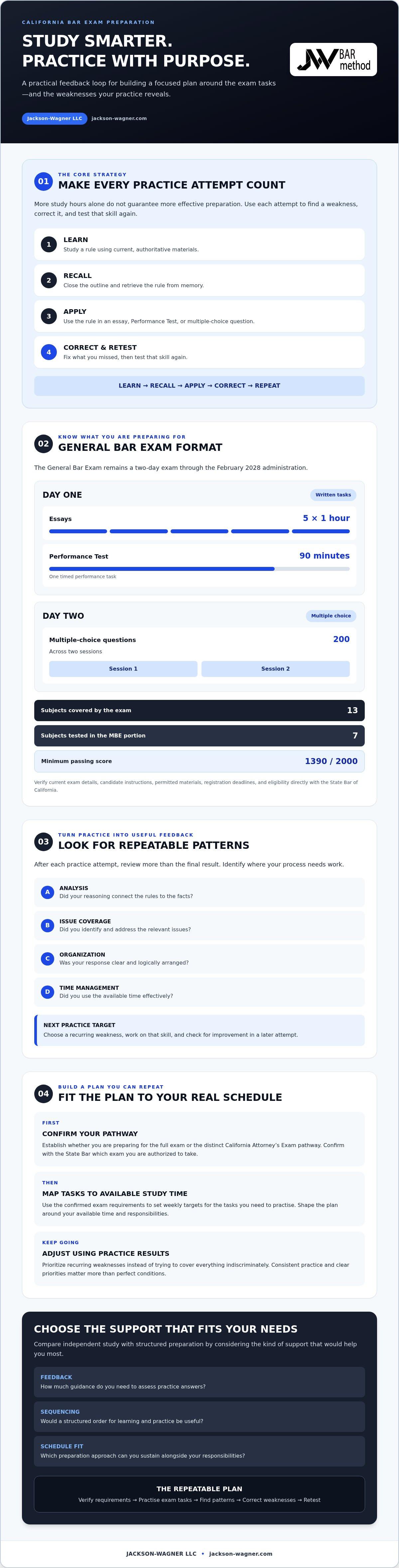
As of September 2026, the General Bar Exam remains a two-day exam through the February 2028 administration. It includes five one-hour essays and a 90-minute Performance Test on day one, followed by 200 multiple-choice questions across two sessions on day two. The exam covers 13 subjects, while the MBE portion tests seven. The minimum passing score is 1390 on a 2000-point scale. For historical and structural context, see this overview of the California Bar Examination, but rely on the State Bar of California for current exam instructions and decisions.
What should you verify before building a study plan?
Check the State Bar’s current exam format, tested components, administration dates, candidate instructions, and rules for permitted materials. Confirm registration deadlines and eligibility directly through official sources, too. Older outlines and prep materials may not reflect current requirements. Exam preparation develops the knowledge and skills tested, while the State Bar separately administers eligibility, registration, moral character review, and other licensure requirements.
Once you’ve verified the details, use them to shape your calendar. Note the exam date, identify the tasks you’ll need to practise, and set weekly targets for each. For a broader planning framework, read the California Bar Exam strategic guide. If official instructions differ from general advice or older study resources, follow the official instructions.
Which preparation path matches your candidate status?
First, establish whether you’re preparing for the full exam or the distinct California Attorney’s Exam pathway. Don’t assume your education, eligibility, or prior exam experience matches another candidate’s. Confirm with the State Bar which exam you’re authorized to take. Attorney’s Exam candidates should review the separate California Attorney’s Exam requirements guide before choosing materials or setting practice priorities.
Your pathway determines what you need to prepare for, so decide before mapping subjects and practice tasks onto your available study time. The full exam and Attorney’s Exam are not interchangeable preparation plans. Once you’ve confirmed your pathway and the current requirements, you can build a schedule around the right exam tasks instead of trying to cover everything indiscriminately.
How to study California Bar Exam subjects without relying on rereading
Rereading an outline can make a rule feel familiar without showing whether you can recall or apply it. Make study time more useful by following a deliberate cycle: learn a rule, retrieve it from memory, apply it to a problem, then correct what you missed. This gives each review session a purpose and helps you see which rules are ready for practice and which need more work.
Before organizing subjects or tasks, confirm the current exam scope and format. The State Bar of California’s page on current requirements for the California Bar Exam is the place to check what’s tested and how the exam is structured. Use current authoritative materials to decide which subjects to include, how to group them, and which task formats to practise. Don’t let an older outline dictate your plan without checking it.
How can active recall make rule learning more useful?
After studying a rule, close the outline and try to state it from memory. Use short prompts to expose gaps: What elements must be shown? What exception applies? Which fact would change the result? Then reopen your notes and correct missing elements or inaccurate statements. This is a quick diagnostic, not a substitute for exam practice. Follow recall with a timed essay, multiple-choice question, or other task that asks you to apply the rule in context.
For example, if you can identify a hearsay issue but forget the requirements for a relevant exception, don’t reread the entire Evidence outline. Write the missing elements in your own words, test yourself on them later, then answer a new fact pattern under time limits. Your next task is specific: recall and apply that exception, rather than “study Evidence” again.
How should you organize rules for exam application?
Keep notes concise and organized by subject, then by issue, so related doctrines are easy to compare. A short rule statement is more useful for practice than copied paragraphs you’ll need to search through. For example, a Contracts outline might separate formation, defenses, and remedies while linking related issues you tend to confuse.
- Write rules in a few clear sentences using your own words.
- List elements, exceptions, and common distinctions beneath each issue.
- Mark uncertain or jurisdiction-specific rules for verification against current authoritative materials before relying on them.
This approach turns each missed rule into a trackable task. It also gives you a focused way to work toward passing the California Bar Exam: practise recalling and applying the right material, then use errors to guide your next round. If you want a structured way to put that process into practice, explore California bar exam preparation options.
Fixing weaknesses through California Bar Exam practice
Practice pays off when it changes what you do next. A completed essay or question set isn’t a measure of progress by itself. Build a repeatable feedback loop: attempt a task, compare your work with reliable guidance, classify the errors, then practise a targeted correction. This turns “I need to study more” into a specific next step.
Use the State Bar of California’s California Bar Examination page to find current exam information and available past questions or materials. Treat sample answers as learning tools, not guaranteed templates for scoring. They can illustrate possible analysis, but your goal is to respond accurately to the facts and task in front of you, not reproduce another answer word for word.
How should you review an essay or performance task?
After completing a timed response, compare it with the question facts and any available official instructions or assessment guidance. Review four areas: legal analysis, issue coverage, organization, and time use. Did you connect rules to specific facts? Did you miss an issue, state a conclusion without support, or spend too long on one section? Record one concrete adjustment to test on the next comparable task, such as “state the rule’s elements before applying each fact.”
- Attempt: Complete the essay or Performance Test under the assigned time conditions.
- Compare: Check your response against the facts, instructions, and reliable guidance.
- Classify: Label each problem, such as a rule gap, missed issue, weak application, unclear organization, or pacing.
- Correct: Choose a focused drill for the main error, then try it on a new task.
How can practice questions reveal knowledge gaps?
For multiple-choice practice, review every answer choice, not just the one you selected. Explain why the correct option fits and why the alternatives fail. Then classify the cause: Did you lack the rule, misread a key fact, reason from the wrong issue, or run short on time? Those distinctions matter. A rule gap calls for recall and application practice. A pattern of misreading calls for closer attention to the facts that control the issue.
Keep a simple error log with the task, error type, likely cause, and next drill. If several questions show that you’re overlooking an exception, schedule a short recall exercise on it, followed by fresh questions that test it. Track recurring patterns and whether the targeted drill helps. This is more useful than collecting unreviewed question counts. It makes how to pass the california bar exam a practical process of diagnosis, correction, and retesting.
How to make a California Bar Exam study plan fit your real schedule
A study plan works only if you can follow it alongside the rest of your life. Start with the time you actually have, not an idealized calendar, then adjust the plan based on completed work and practice results. There’s no universal number of study hours or guaranteed timeline that fits every candidate. The useful measure is whether your schedule gives you regular opportunities to learn, recall, apply, review, and recover.
How do you plan study weeks while working full time?
Audit your week before assigning study tasks. List work hours, caregiving, commuting, appointments, and other fixed commitments. Then protect repeatable study blocks during periods when you can focus reliably. If evenings are unpredictable, a shorter session before work may be more sustainable. If your weekends are busy, don’t build a plan that depends on them being free.
Use a flexible weekly template rather than scripting every minute. For example, reserve one block to learn a topic, another for recall, and a dependable focus period for a timed exam task. Schedule review soon after practice so the feedback informs your next session. Short gaps still have a purpose: use them to retrieve rule elements or revisit a brief error log. Short sessions can support the plan, but they shouldn’t replace timed application entirely.
- Learning: Cover a defined topic or set of rules.
- Recall: Test what you can retrieve without notes.
- Timed practice: Complete an exam-style task in a protected focus block.
- Review: Identify what your work shows you should practise next.
- Recovery: Leave space for rest and unexpected responsibilities.
What should you change when your plan falls behind?
Use a weekly check-in to compare planned work with completed tasks and recurring errors. If practice shows a repeated issue, such as weak analysis or a rule you can’t recall, prioritize that weakness in the next week’s schedule. If a task took longer than expected, adjust the plan rather than letting the backlog grow.
Cut low-value repetition before removing the parts that show whether your preparation is working. For instance, shorten an unfocused rereading block and use that time for a targeted recall exercise or a timed response with review. Keep the plan adaptable: one difficult day is a reason to reset the next block, not abandon the week. Measured adjustments make how to pass the california bar exam a matter of steady, evidence-informed preparation, not a race to fill every available hour.
If you’d prefer a more structured path, explore Jackson-Wagner’s California Bar Exam preparation programs, including options for the full exam and the Attorney’s Exam. Choose a track that fits the exam you’re taking and the preparation schedule you can realistically maintain.
How to choose your next step for California Bar Exam preparation
Independent study can work well if you’re comfortable choosing materials, setting your own sequence, reviewing your practice, and sticking to a routine. Structured preparation may be a better fit if you want a defined sequence or need help maintaining momentum. Neither approach guarantees a passing result. Choose based on the support you’ll use consistently, not promises of guaranteed outcomes.
Before selecting a course, compare what it provides with what your practice record shows you need. Check that its materials reflect current California exam requirements, and verify claims about format, eligibility, or outcomes before relying on them. For broader criteria to consider when comparing providers, see the bar exam preparation service guide.
- Sequencing: Do you need a planned progression, or can you prioritize topics and tasks yourself?
- Feedback: Can you identify recurring errors independently, or would external input help you improve your analysis?
- Accountability: Are you following through on self-set goals, or would a structured program make your routine easier to maintain?
- Schedule fit: Can you complete the work within your available time, including work and family commitments?
How can you tell whether structured preparation fits your needs?
Use your answers to choose a preparation method, not just a provider. If your main difficulty is organizing material, look for clear sequencing. If you practise often but can’t tell whether your essays are improving, find out what feedback or review guidance is included. If your schedule changes week to week, check whether the program’s expectations are realistic for you. Confirm the details directly and compare them with your needs and study habits.
What does the JW Bar Method offer California candidates?
The JW Bar Method is Jackson-Wagner’s California-focused preparation approach. Jackson-Wagner offers standard and accelerated preparation options for the full California Bar Exam, as well as separate standard and accelerated options for the California Attorney’s Exam. The Attorney’s Exam track is for that California exam pathway, not general out-of-state bar preparation.
If you’re considering structured preparation, first confirm which exam you’re taking and how much time you can commit. Then review the relevant track details and decide whether the option fits your schedule and preparation needs. If you’re taking the full California Bar Exam, review the full-exam preparation options. If you’re taking the Attorney’s Exam, review its distinct preparation options. Keep the decision practical: choose a plan you can follow and use to respond to feedback.
Turn your study plan into steady progress
A strong preparation plan isn’t measured by how much material you can reread or how many hours you can fit into a week. It’s built around current exam requirements, active practice, honest review, and adjustments based on what your work reveals. That’s a practical way to approach how to pass the california bar exam: make each study session lead to a clear next step, and keep your plan realistic enough to follow.
Start by confirming your exam pathway and setting a schedule around your actual commitments. Then use practice results to decide what to review next. If you’d like structured, California-focused preparation, Jackson-Wagner’s proprietary JW Bar Method offers standard and accelerated tracks for both the full California Bar Exam and the California Attorney’s Exam. Review the options and choose the pathway that matches your exam and preparation needs.
Explore California bar preparation with the JW Bar Method. Keep showing up, learn from each attempt, and build progress one focused session at a time.
Frequently Asked Questions
How do you pass the California Bar Exam on your first attempt?
Build preparation around current exam requirements, regular exam-style practice, and careful review of your errors. Confirm which exam pathway applies to you, then set a realistic schedule that covers the tested tasks. After each practice attempt, identify whether the main issue was rule knowledge, analysis, organization, or timing, and plan a targeted drill. No study method can guarantee a result, but consistent practice and correction give your preparation direction.
How many hours should I study each day for the California Bar Exam?
There isn’t one daily study-hour target that fits every candidate. Your available time depends on the exam date, prior preparation, work, caregiving, and other responsibilities. Start by mapping your actual week, then protect repeatable study blocks for learning, recall, timed practice, and review. Track what you complete and how your practice is going. If the plan repeatedly fails, adjust the workload instead of treating an unrealistic schedule as a test of commitment.
Can I pass the California Bar Exam while working full time?
It’s possible to prepare while working full time, but your plan needs to fit the time and focus you can reliably protect. Audit fixed commitments, schedule demanding practice during your most dependable focus periods, and use shorter blocks for recall or review. For example, a brief rule-recall session can fit into a busy day, while a timed essay may need a quieter block. Adjust your schedule using practice results, not wishful estimates.
What is the best way to practise for the California Bar Exam?
Use practice to create a feedback loop: complete a task, compare your response with reliable guidance, classify errors, and practise the correction. For written work, assess issue coverage, rule accuracy, fact application, organization, and timing. For multiple-choice questions, explain why the correct answer works and why the alternatives don’t. Keep a short error log so recurring weaknesses guide your next drills. Practice volume matters less if you never review what it reveals.
How should I study if I have failed the California Bar Exam before?
Begin by diagnosing what happened rather than repeating the same plan unchanged. Review any available score information, prior answers, and practice records to distinguish knowledge gaps from issues such as missed issues, weak analysis, or pacing. Choose a specific correction for each recurring pattern, then test it on a new task. A repeat attempt can benefit from structured preparation if you need a clearer sequence or external support, but the plan should respond to your evidence.
Is a California Bar Exam prep course necessary to pass?
No, a prep course isn’t necessary for every candidate. Independent study may suit you if you can choose current materials, sequence your work, assess practice, and maintain a routine. Structured preparation may help if you need more direction or a defined study path. Compare programs by their alignment with current California requirements, feedback, organization, and fit with your schedule. Be cautious about guaranteed-outcome claims. Evaluate the actual preparation approach and your own needs.
What should I do in the final weeks before the California Bar Exam?
Use the final weeks to strengthen exam execution, not rebuild your entire study plan. Prioritize timed practice, review recurring errors, and revisit rules or task skills that your work shows need attention. Check the State Bar’s current candidate instructions and exam logistics so administrative details don’t become last-minute distractions. Keep your schedule realistic and protect time for rest. Focused review and steady routines are more useful than exhausting yourself with unfocused cramming.


