

A pre-made outline can save hours and still leave you unprepared if you only read it. That’s the tradeoff behind the pros and cons of pre-made bar outlines: they give you a ready-made structure for a large body of material, but a condensed rule can feel incomplete, and passive review rarely shows whether you can apply it. If you’re unsure whether to build your own outline or move directly to practice, the right choice depends on how you use the material.
This guide will help you choose an outline strategy that protects study time without treating someone else’s summary as the final word. You’ll see where pre-made outlines offer a practical head start, where they can fall short, and how to adapt them into focused, memorable study tools.
We’ll also look at how to connect rule review with self-testing, essay practice, and feedback so memorized law becomes usable in an exam answer. For California bar preparation, outlines work best as one part of a structured plan, not as a substitute for deliberate practice. That principle also underpins the JW Bar Method’s preparation for the California Bar Exam and Attorney’s Exam.
Key Takeaways
- Match an outline’s level of detail to its purpose: use comprehensive materials for coverage, condensed outlines for review, and attack outlines for quick recall.
- Weigh the pros and cons of pre-made bar outlines against your study time, need for personalization, and confidence in the material’s coverage.
- Choose a pre-made, self-made, or hybrid approach based on your needs. None is automatically best for every candidate.
- Make supplied materials active: test recall, practice exam questions, and revise focused sections when mistakes reveal gaps.
- Check that your outline aligns with current California exam information, then fit review into a broader preparation plan.
Pre-Made Bar Outlines: What Problems Do They Solve?
A pre-made bar outline is study material organized before an individual candidate adapts it. A personally created outline is selected, arranged, and refined by that candidate. The distinction is about who does the initial organizing, not whether the material is useful. Ready-made outlines provide a structure for a broad body of legal rules, while personal outlines reflect the rules and topics you decide need attention.
These materials often come through a bar review course, a type of preparation program that may provide subject outlines alongside other study resources. The outline’s format affects how you use it:
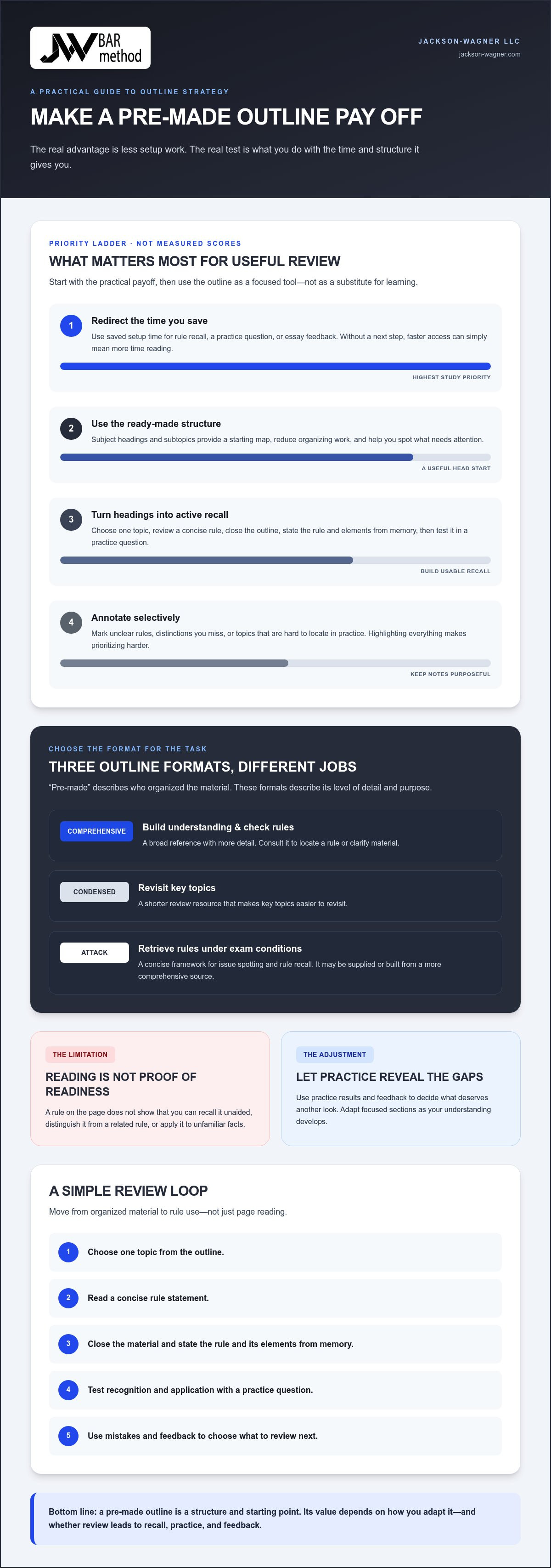
- Comprehensive outlines are broad references with more detail for building understanding and checking rules.
- Condensed outlines reduce that material to a shorter review resource, making key topics easier to revisit.
- Attack outlines are concise frameworks for organizing issue spotting and rule recall under exam conditions. Candidates may create one by condensing and rearranging a longer source.
These formats serve different purposes. A shorter outline isn’t automatically better, and a comprehensive one isn’t necessarily the right tool for every review session.
How Does a Pre-Made Bar Outline Differ From an Attack Outline?
“Pre-made” describes when and by whom the material was organized. “Attack outline” describes its purpose and level of detail. An attack outline may be supplied or built by the candidate from a comprehensive source. Its value comes from making important rules and issue frameworks easy to retrieve, not from being short for its own sake. Choose the format that supports your current study task.
Why Do Bar Candidates Consider Ready-Made Outlines?
Bar preparation requires candidates to organize substantial legal material while leaving time to review and practice. Starting with an existing subject structure can reduce setup work. Instead of deciding how to arrange every topic from scratch, you can identify what you know, what needs clarification, and what needs more review. That starting point makes the pros and cons of pre-made bar outlines easier to assess in practice.
An outline is a reference and organization tool, not a substitute for learning. Reading a rule doesn’t prove you can recall it without the page in front of you, distinguish it from a related rule, or apply it to unfamiliar facts. The outline earns its place in your study plan when it helps you move from organized material to active recall and exam practice.
The Pros of Pre-Made Bar Outlines: Structure, Speed, and a Starting Point
A prepared outline gives you a framework to work from instead of a blank page. Its subject headings and subtopics can show how material is organized, help you identify areas that need attention, and let you start reviewing without first designing a complete system. That structure is especially useful when your study plan must accommodate work, family responsibilities, or a limited preparation timeline.
The benefit isn’t that someone else has done the learning for you. It’s that you can spend less effort arranging material and more effort engaging with it. Use the formats selectively: for example, consult a comprehensive outline to locate a rule, then use shorter notes to guide review and practice.
When Can a Pre-Made Outline Save Useful Study Time?
Building an outline from scratch can involve choosing categories, arranging rules, and deciding how much detail to include. A ready-made structure reduces that setup work and can prevent you from repeatedly reorganizing the same subject. It gives you a practical first map to adapt as your understanding develops.
That time is useful only if you redirect it. Set a specific task for the time you save, such as recalling rules from memory, answering a practice question, or reviewing feedback on an essay. Without a next step, faster access to an outline may simply mean more time spent reading it.
How Can a Ready-Made Outline Support Rule Review?
Use the outline’s headings to set a narrow focus for each review session. Choose one topic, read a concise rule statement, close the material, and try to state the rule and its elements from memory. Then test whether you can recognize and apply the rule in a practice question. This turns a list of headings into a repeatable review routine.
Keep annotations selective. Mark a rule that remains unclear, a distinction you keep missing, or a topic that appears in practice but is difficult to locate. Avoid highlighting every paragraph. If everything looks important, the marks won’t help you prioritize later.
The pros and cons of pre-made bar outlines depend in part on what you do after opening one. A concise rule statement can make repeated review more manageable, but it still needs to hold up when you recall it without prompts and apply it to new facts. Use practice results and feedback to decide what deserves another look instead of treating every page as equally urgent.
For California candidates, outline review is most useful when connected to a broader preparation plan. Explore California bar exam preparation to see how structured study can place review alongside deliberate practice.
The Cons of Pre-Made Bar Outlines: Gaps, Mismatch, and Passive Review
A prepared outline reflects someone else’s choices about what to include, how to explain it, and what to emphasize. It may not match your weak areas or the way you organize rules. A condensed version can be useful for review, but its brevity may leave out explanations or distinctions you need to understand a topic fully.
An outline’s usefulness depends on fit, currency, and active use. Before relying on one, check whether it aligns with current California exam information and the materials guiding your preparation. A clear, familiar-looking document isn’t automatically complete or current.
Can a Pre-Made Outline Leave Out Material You Need?
Yes. Every condensed outline prioritizes, which means some details may be shortened or omitted. Use current exam information published by the State Bar of California to check the outline’s scope, then compare it with your course materials. Pay particular attention to California-specific distinctions and rule updates. A general explanation may not be enough for jurisdiction-focused preparation.
A quick fit check can help you spot issues before building your study plan around the document:
- Scope: Do its subjects and topics correspond to current official California exam information?
- Clarity: Can you explain each key rule, or does the outline use shorthand you don’t understand?
- Currency: Is the material appropriate for your exam cycle, including relevant updates?
- Personal fit: Does it provide enough detail for your weak areas, or do you need to supplement it with course material?
These checks don’t require rewriting every page. They help you identify where the outline works as a reference and where you need another source or a targeted explanation.
Why Can Simply Reading an Outline Feel More Effective Than It Is?
Recognition is not the same as recall. A rule can seem obvious while you’re reading it, yet be difficult to state accurately after you close the outline. Application adds another demand: you must identify the issue in a fact pattern, select the relevant rule, and explain how it applies to the facts.
Test your understanding directly. Read a short section, close the outline, and state the rule or issue framework from memory. Compare your version with the source. If you leave out an element or confuse related rules, return to that specific point, correct your understanding, and try a practice question that requires you to apply it.
Repeated rereading can keep material familiar without showing whether you can produce it independently. As you weigh the pros and cons of pre-made bar outlines, treat mistakes in recall or practice as useful signals. They show what to revisit, not that you need to start the entire outline over.
Pre-Made vs. Self-Made vs. Hybrid Outlines: How to Choose
There’s no single outline strategy that suits every candidate. The right choice depends on how much time you have, whether you need a ready-made structure, and how well you learn by organizing rules yourself. This comparison makes the trade-offs visible:
| Approach | Time | Personalization | Coverage | Risk of passive use |
|---|---|---|---|---|
| Pre-made | Less setup | Lower at first | Depends on the source | Higher if you only read |
| Self-made | More organizing | High | Depends on your source material | Can become page-making without practice |
| Hybrid | Moderate | Targeted | Starts with a prepared base | Lower when revisions follow testing |
A hybrid approach is a practical starting point if you want structure without treating a supplied outline as final. Begin with a prepared resource, then personalize only what your review and practice reveal: clarify confusing rules, flag recurring gaps, and condense material you can already explain. The goal isn’t to produce more pages. It’s to make review and application more effective.
For a broader California study plan, use a California Bar Exam strategic guide to connect outline choices with your preparation priorities. You can also explore JW Bar Method California preparation programs for structured preparation for the full California Bar Exam or the California Attorney’s Exam.
Which Outline Approach Fits Your Time and Study Habits?
Choose a pre-made outline if getting organized is your main obstacle or your preparation time is limited. A self-made outline can suit you if actively synthesizing material helps you learn and you can keep that work focused. A hybrid approach offers a balance: start with an existing framework, then personalize it based on recall and practice results. Time spent creating pages alone doesn’t establish readiness.
What Should You Check Before Using a Pre-Made Outline?
Check that its scope matches current California exam information, its organization is easy to follow, and its rule statements make sense to you. Compare unfamiliar or uncertain rules with reliable course materials and official sources. Finally, ask whether the format helps you review, retrieve rules from memory, and practice, rather than simply read.
The pros and cons of pre-made bar outlines are best judged against those practical criteria. Keep the approach that helps you move from organized material to accurate recall and application, and adjust it when your results point to a better path.
How to Turn a Pre-Made Bar Outline Into an Active Study Tool
A useful outline should change as your preparation reveals what you know and what still needs work. Don’t rewrite every section. Use a repeatable cycle to connect the material to recall, exam practice, and targeted revision.
- Orient. Review the outline’s table of contents and compare its subject coverage with current California exam information and the materials guiding your preparation. Note scope questions to verify before relying on it.
- Diagnose gaps. Choose a topic and identify what you can explain, what feels uncertain, and which rules you can’t yet state clearly. Let your recall, practice results, and feedback guide what needs attention.
- Annotate selectively. Mark meaningful gaps, confusing rules, or distinctions you repeatedly miss. Rewrite difficult statements in clear language while preserving their legal meaning. Keep additions focused. The goal is a more useful outline, not a second textbook.
- Retrieve rules. Close the outline and write or say the rule and its elements from memory. Then check your version against the source. This exposes missing details that reading alone can conceal.
- Practice application. Apply the recalled rules to practice questions, essays, or performance tasks, as relevant to current California exam requirements. Track missed issues, inaccurate rules, and points where you struggled to connect law to facts.
- Revise. Update only the relevant portion of your outline using verified course or official materials. Then test that rule again in a fresh practice task.
Keep Personalization Focused
Not every paragraph needs a highlight or rewrite. Add a note when a rule remains unclear, a key distinction keeps slipping, or practice shows you missed an issue. If an answer reveals that you knew the general rule but misstated an element, refine that statement instead of expanding unrelated sections. Focused edits keep the outline useful for review.
Make Practice the Test
Use closed-book recall before checking the source, then apply the rule to facts and review your answer against feedback. A missed issue may call for clearer issue cues; an inaccurate rule may require checking and correcting the rule statement. Don’t respond to every mistake by rereading the whole subject. Target the gap, then practice again.
Practice should test and refine your outline knowledge, not merely follow it. That’s how an outline can move from a static reference to part of an active study process. To connect review and practice within structured California preparation, explore the JW Bar Method.
Make Your Outline Work for Your Study Plan
The best outline strategy is the one that helps you move from organized rules to accurate recall and confident application. Pre-made outlines can provide structure and reduce setup, while self-made materials offer personalization. A hybrid approach lets you start with a framework and adapt it in response to practice results.
Keep your material current and suited to California exam preparation. Most importantly, don’t let reading or editing replace closed-book recall, exam practice, and focused review of mistakes. The real value of the pros and cons of pre-made bar outlines comes from choosing a resource you can actively use.
If you want outline review connected to a structured study plan, explore California bar preparation with the JW Bar Method. Jackson-Wagner LLC offers preparation programs for the California Bar Exam and California Attorney’s Exam, with standard and accelerated study tracks. Choose the program that fits your preparation needs, then build your skills through focused study and practice.
Frequently Asked Questions
Are pre-made bar outlines worth using?
Yes, pre-made outlines can be worth using when they give you a useful structure and save time you would otherwise spend organizing material. The pros and cons of pre-made bar outlines depend on whether the content fits your needs and whether you use it actively. Check unclear rules, test recall without looking, and use practice results to decide what to review or personalize.
Is it better to make your own bar exam outlines?
Not necessarily. Making an outline can help you synthesize rules, but creating pages isn’t the same as learning or applying the law. A personally made outline may suit you if organizing ideas helps you remember them and you can keep the task focused. If you need a faster starting structure, a pre-made or hybrid approach may work better. Let recall and practice guide your choice.
Can I rely only on pre-made outlines to study for the bar exam?
No. An outline can organize and summarize rules, but it can’t show by itself whether you can recall them accurately or apply them to new facts. Use it alongside active recall, exam-style questions, essays, and feedback that fits your preparation. When practice exposes an incorrect rule or missed issue, revisit that specific material and test yourself again rather than relying on repeated reading alone.
How do I know whether a bar outline is up to date?
Check the outline’s publication or revision date and compare its subject coverage with current information from the State Bar of California and your current course materials. Review California-specific rules and distinctions carefully, especially if the outline was written for a broader audience. If a rule is unclear or appears inconsistent with a reliable current source, verify it before memorizing or relying on it in practice.
What is the difference between a bar outline and an attack outline?
A bar outline is a structured reference to subject material, often with explanations and rule detail. An attack outline is typically more concise and designed to help you recall rules and organize issue spotting under exam conditions. It may be supplied or created by condensing a longer outline. The useful format depends on your task: building understanding, reviewing rules, or quickly organizing an answer.
How should I use pre-made outlines for the California Bar Exam?
First, check that the outline’s scope and content align with current California exam information and the materials guiding your preparation. Use its structure to focus review, then close it and recall rules from memory. Apply those rules to relevant practice questions, essays, or performance tasks. Use missed issues and inaccurate rule statements to guide selective revisions, and verify uncertain material against reliable sources.
When should I stop outlining and start practicing bar exam questions?
Start practicing before your outline feels finished. Use questions early to test whether you understand and can apply the rules you’ve reviewed. If you keep reorganizing or rewriting material without testing yourself, shift that study time to practice and feedback. You don’t need to abandon the outline. Use it to address specific gaps revealed by your answers, then return to practice to check whether your revision helped.


