

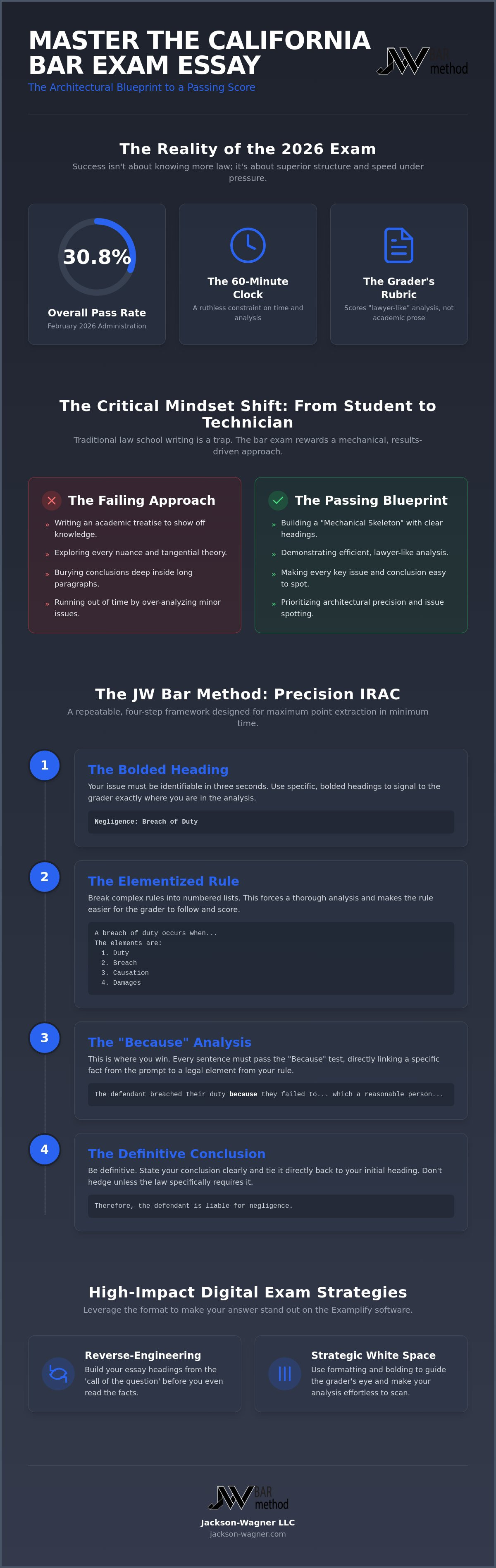
The California Bar Exam is not a test of how much law you know; it's a high-speed architectural drill where your structure determines your survival. With an overall pass rate of just 30.8% for the February 2026 administration, the margin for error is razor-thin. You likely already feel the crushing weight of the 60-minute clock or the fear that your writing will fail to hit the grader's scoring rubric despite your deep legal knowledge. Learning how to structure a california bar exam essay answer is the single most important skill you can develop to bridge the gap between studying and actually practicing law.
It's exhausting to master complex rules only to see your score suffer because you couldn't organize your analysis fast enough. This guide provides the exact architectural framework required to turn your legal knowledge into a passing score of 1390 or higher. You'll master a repeatable template for every essay that ensures you never miss a key issue again, giving you the confidence to dominate every 60-minute block and pass on your very first attempt.
Key Takeaways
- Master the 2026 grading rubric by shifting your focus from beautiful prose to the "lawyer-like" analysis that graders actually score.
- Learn how to structure a california bar exam essay answer using a precision IRAC framework that makes your issues identifiable in three seconds.
- Implement the "reverse-engineering" strategy to build your essay headings from the call of the question before you dive into the facts.
- Leverage digital formatting techniques like strategic white space and bolding to ensure your analysis stands out on the Examplify software.
- Adopt a results-driven methodology that prioritizes architectural precision over the overwhelming volume of legacy bar prep courses.
The Architecture of a Passing California Bar Essay
A passing California Bar essay is a demonstration of lawyer-like analysis. It isn't a search for the "right" answer or a showcase for your creative writing skills. Graders look for a logical, mechanical progression that mimics how a practicing attorney evaluates a case under pressure. In the 2026 grading landscape, the State Bar of California values comprehensive issue spotting and element-based application over flowery prose. Understanding how to structure a california bar exam essay answer starts with a fundamental shift in mindset: you're building a machine, not writing a story. This California Bar Examination overview highlights the rigorous nature of the subjects tested, which requires a highly disciplined and structural approach to succeed.
The State Bar doesn't reward academic curiosity. It rewards a "Mechanical Skeleton." This is a framework where your headings do the heavy lifting for the grader. If a reader can't identify your points in a quick scan, you've already lost the battle. Don't waste energy trying to produce a "Selected Answer" that represents the top 1% of academic writers. You only need a "Passing Answer." The difference is often just efficiency. A passing answer hits every major issue and applies the rules directly to the facts without unnecessary academic fluff or tangential theories. It's about being reliable and precise.
Why Traditional Law School Writing Fails
Law school rewards the "deep dive" and the exploration of every possible nuance. On the bar exam, this approach is a trap. Writing a treatise instead of an exam answer will eat your clock and leave you with unfinished sub-issues. "Hiding the ball" by burying your conclusion or rule statement deep within a paragraph ruins your score, even if your law is technically correct. The 60-minute clock is your primary structural constraint. You don't have time to be a scholar; you only have time to be a technician. If you spend 20 minutes on a minor issue, you've effectively failed the essay. Stop writing like a student and start writing like a professional who respects the grader's time.
The Grader's Perspective: The 2-Minute Scan
Graders have thousands of essays to evaluate. They often determine your baseline score based on visual organization before they read a single sentence of your analysis. When you master how to structure a california bar exam essay answer, you're essentially providing a roadmap for the grader to follow. Use visual cues to your advantage. Bolded headings and clear IRAC blocks signal that you've identified every major issue. This creates a psychological win. A tired grader who sees a well-organized answer is primed to give you the benefit of the doubt. Clear organization makes their job easier, and an easy-to-grade paper is much more likely to be a passing paper.
The JW Bar Method Approach to Precision IRAC
Mastering how to structure a california bar exam essay answer requires more than just memorizing rules. It demands a tactical execution of the IRAC method that eliminates ambiguity for the grader. Precision IRAC is a mechanical framework for legal application that prioritizes structural integrity over narrative flow. By following the official exam instructions, we see that graders value the logical application of law to fact above all else. The JW Bar Method streamlines this into a four-step process designed for maximum point extraction.
- Step 1: The Bolded Heading. Your issue must be identifiable in three seconds. Use specific, bolded headings like Negligence: Breach of Duty rather than generic titles. This signals to the grader exactly where you are in the analysis.
- Step 2: The Rule Statement. Keep it punchy and elementized. Instead of a dense paragraph, use a numbered list for the rule's components. This makes the rule easy to apply and ensures you don't miss a step.
- Step 3: The Analysis. This is where you win the game. Every sentence should pass the "Because" test, linking a specific fact from the prompt directly to a legal element. If you aren't using the word "because," you aren't analyzing.
- Step 4: The Conclusion. Be definitive. Don't hedge with "maybe" or "likely" unless the law specifically requires it. State your conclusion clearly and tie it back to your initial heading.
Elementizing Your Rule Statements
Break complex rules into numbered lists to force a thorough analysis. For example, instead of writing a long paragraph on negligence, list it as (1) Duty, (2) Breach, (3) Causation, and (4) Damages. This creates a checklist for your analysis and prevents you from skipping sub-issues. It's a simple way to master how to structure a california bar exam essay answer without getting lost in the weeds of a complex fact pattern. This structured approach to negligence elements reflects the same professional rigor used by firms like The Todd Law Group, PLLC when evaluating personal injury claims. Precision IRAC is a mechanical framework for legal application that ensures every element is addressed with surgical accuracy.
The 'Fact-to-Element' Analysis Technique
Every fact in the prompt is a potential point waiting to be claimed. The JW Bar Method dictates a "no fact left behind" policy for the analysis section. If the prompt mentions the weather was rainy, that fact must be linked to a legal element like the standard of care or foreseeability. Use counter-arguments to demonstrate depth. Briefly explaining why a specific element might not be met shows the grader you've considered all angles without breaking your structural thread. For those who need a faster route to this level of precision, the JW Bar Method Accelerated Prep - Full California Bar Exam offers a streamlined approach to these architectural skills.
Issue Spotting and the 'Call of the Question' Mastery
The call of the question is your ultimate structural boundary. Most applicants dive into the fact pattern and get lost in the narrative. This is a mistake that leads to missing key issues. Instead, use the "Reverse-Engineering" strategy. Read the call first. Use those specific prompts to build your primary headings before you even look at the facts. This ensures you never drift off-topic. Understanding how to structure a california bar exam essay answer means letting the call dictate your architecture. If the call asks about the rights of three different parties, those parties are your three main H2 headings. It's that simple.
Identifying major versus minor issues is a survival skill. You only have 60 minutes. Spend 80% of your time on the heavy hitters like negligence or contract formation. Don't let a minor sub-issue like a small evidentiary point derail your timeline. If you see a "Cross-Over" essay, such as Torts meeting Remedies or Contracts meeting Evidence, your structure must reflect both subjects clearly. Use the call to separate these into distinct sections so the grader sees your versatility. A cross-over isn't an excuse for a messy answer; it's an opportunity to show you can manage multiple legal frameworks simultaneously.
Pre-Writing Your Outline
Spend 10 to 15 minutes on your outline. This isn't wasted time; it's an investment that prevents writer's block during the final 45 minutes of the block. During the reading phase, map every fact to your elementized rules. This keeps your analysis lean and focused. If you want to master these high-stakes drilling techniques, the JW Bar Method Prep - Full Exam California Bar provides the exact training needed to execute this under pressure. A strong outline ensures that when you start typing, you aren't thinking about what to say; you're just executing the plan you already built.
Addressing the 'Professional Responsibility' Trap
PR is almost always a hidden or explicit component of California essays. Whether it's a standalone question or tucked into a cross-over, you must be ready. Structure your PR answers to satisfy both California and ABA rules. Memorize a PR checklist for every subject. If a lawyer is involved in the facts, a PR issue is likely lurking. Don't ignore it. Build a dedicated section for it to secure those points that others miss. Your ability to spot a conflict of interest or a breach of confidentiality can often be the difference between a 60 and a 70 on a difficult essay. Mastering how to structure a california bar exam essay answer requires you to be vigilant for these ethical traps in every subject.
Formatting for the 2026 Digital Bar Exam
Digital testing is now the standard. For the 2026 exam, your layout on the screen is just as important as the law you cite. Graders are humans reading through thousands of digital files; they appreciate visual clarity. When you consider how to structure a california bar exam essay answer, you must respect the "Power of White Space." Short, punchy paragraphs are vastly superior to dense "walls of text" that cause eye fatigue. Every time you move from a rule to an analysis, or from one element to the next, hit the enter key. Give the grader's eyes a place to rest.
Bolding and underlining are your best friends if used with restraint. Bold your rule elements and underline your final conclusions to make them pop off the screen. This ensures the grader doesn't have to hunt for your points. However, don't over-clutter the page. If everything is bolded, nothing is bolded. Stick to a clear heading hierarchy. Use all caps for major headings and indents for sub-issues to show logical subordination. Spend your final five minutes proofreading for major errors in your rule statements or headings. Ignore minor typos in the middle of a paragraph; they won't break your score, but a misspelled heading looks unprofessional.
Heading Styles that Graders Love
Issue-specific headings are the gold standard. Instead of "Issue 1," use "I. DUTY OF CARE: SPECIAL RELATIONSHIPS." This immediately tells the grader you've spotted the specific nuance required. Another elite tactic is using a "Conclusion Heading" that answers the call immediately. This removes all doubt about your legal position from the very first line. For a deeper look at the administrative side of your path to the bar, check out How to Navigate the State Bar of California: A 2026 Guide to Licensure Success. Using these professional markers shows you are ready for licensure.
Managing the Digital Interface
The 2026 exam software has its own quirks. Scrolling through long fact patterns while typing can be disorienting. Train your typing speed until it's a structural asset; the faster you type, the more time you have for "no fact left behind" analysis. Use the "Copy-Paste" strategy for repetitive rule elements in cross-over essays to save precious seconds. This is a crucial part of how to structure a california bar exam essay answer in the modern era. If you want to refine these digital-first skills, the JW Bar Method Accelerated Prep - Full California Bar Exam provides the specific tools you need to succeed.
The JW Bar Method: Accelerating Your Essay Success
Legacy bar prep courses often bury students under an avalanche of content without ever teaching the mechanical execution required to pass. They focus on volume, assuming that if you write enough essays, you'll eventually stumble upon the right format. This approach is inefficient and dangerous for busy professionals. The JW Bar Method disrupts this legacy model by focusing on "Precision over Volume." We don't want you to write 100 essays; we want you to master the five core architectural structures that appear in every exam. By learning how to structure a california bar exam essay answer with surgical accuracy, you eliminate the guesswork and replace exam-day anxiety with a reliable, repeatable system.
Our 2026 Performance Guarantee is a testament to our confidence. We're so certain of our methodology that we assume the financial risk of your exam outcome. This binary guarantee distinguishes us from cautious competitors who offer only content without accountability. We provide a structured, modern, and reliable path to success that moves you from legal theory to high-stakes execution through disciplined drilling. Transitioning from theory to execution is the only way to ensure that your legal knowledge translates into a passing score of 1390 or higher on the first attempt.
Why Precision Beats Volume
The myth that you must complete dozens of essays to pass is a relic of outdated education models. Mastering how to structure a california bar exam essay answer is about understanding the underlying logic that graders reward. Our curriculum identifies the specific patterns used by the State Bar and teaches you to build your answer around them. This efficiency is critical for working attorneys and graduates who can't afford to waste hundreds of hours on low-impact study. Our JW Bar Method Accelerated Prep - Full California Bar Exam is specifically designed to fit into a rigorous professional schedule, ensuring you get maximum results with targeted effort.
Your Path to Licensure Starts Here
The California Bar Exam is a hurdle, not a wall. By adopting an architectural mindset, you transform the essay portion from a source of stress into a predictable scoring opportunity. Success in 2026 requires more than just knowing the law; it requires the ability to demonstrate that knowledge through a professional, organized, and lawyer-like framework. You have the knowledge; now you need the machine to deliver it. Secure your spot in the next JW Bar Method cohort and take the first step toward your new career with absolute confidence. Don't leave your licensure to chance when you can rely on a proven blueprint for success.
Take Command of Your California Bar Success
You now have the strategic blueprint required to dominate the written portion of the exam. Mastering the "Mechanical Skeleton" and using the call of the question to build your headings aren't just study tips; they are the foundation of a passing score. When you understand how to structure a california bar exam essay answer, you stop guessing what graders want and start delivering exactly what they score. You've learned to elementize rules and leverage digital formatting to ensure your analysis stands out on the screen.
It's time to move from theory to execution. We are exclusively focused on California licensure, providing the localized expertise you need to dominate this specific exam. With our industry-leading performance guarantee and accelerated tracks for practicing attorneys, we assume the risk while you reap the rewards. Master the JW Bar Method and Pass the California Bar Exam and secure your future in the legal profession. You have the tools and the strategy. Now, go claim your license with absolute confidence.
Frequently Asked Questions
How long should each section of a California Bar essay answer be?
Section length should be directly proportional to the legal weight of the issue. Major issues typically require 15 to 20 minutes of dedicated writing; minor sub-issues should be handled in 5 to 8 minutes. Allocate your word count based on where the points are. Don't waste three paragraphs on a settled rule while leaving the core controversy of the prompt under-analyzed.
Is IRAC still the best way to structure a California Bar essay in 2026?
Yes, IRAC remains the gold standard for 2026 because it provides the mechanical clarity graders demand. While some variations exist, the State Bar expects a disciplined progression through the issue, rule, analysis, and conclusion. Mastering how to structure a california bar exam essay answer using this framework ensures your logic is transparent and easy to score under high-pressure conditions.
What happens if I miss an issue but my analysis of other issues is perfect?
You'll lose points for the missing issue, but a superior analysis of major issues can still pull your score into the passing range. California uses a 40 to 100 grading scale. If you demonstrate deep "lawyer-like" analysis on the primary conflicts, you can often compensate for a missed minor sub-issue, though comprehensive issue spotting remains the ultimate goal.
How many headings should I use in a typical 60-minute essay?
A high-scoring answer typically utilizes 8 to 12 headings. This includes your primary issue headings and the sub-headings used to elementize rules. These visual markers allow the grader to navigate your "Mechanical Skeleton" quickly. If your essay looks like a single block of text, you aren't using enough headings to signal your structural precision.
Can I use abbreviations like 'K' for Contract or 'P' for Plaintiff in my answer?
Yes, you can use common legal abbreviations to save time during the 60-minute blocks. Standard symbols like "K" for contract or "P" for plaintiff are universally understood by bar graders. If you use a more specific abbreviation, define it once at the beginning of your answer. This efficiency is a tactical advantage when every second counts.
Should I write a conclusion at the beginning or the end of the essay?
You should place your conclusion at the start of each IRAC block within your heading. This "Conclusion Heading" strategy answers the call immediately and removes any doubt from the grader's mind. A final, summary conclusion at the very end of the entire essay is usually unnecessary and often wastes time that could be spent on analysis.
How do I handle an essay that has multiple 'calls' or prompts?
Treat every specific call as a primary structural boundary for your answer. Each prompt should become a major heading in your digital response. This method ensures you address every requirement of the question and makes it impossible for a grader to overlook your work on a specific prompt. It's the most reliable way to organize complex cross-over essays.
What is the most common structural mistake that leads to a failing score?
The most common mistake is poor time management that results in "walls of text." Many applicants spend too much time on the first two issues and leave the final call of the question entirely blank. Learning how to structure a california bar exam essay answer requires you to move through issues with mechanical speed, ensuring every section is addressed before the clock expires.


