Spending thousands on a big-box bar prep course is often viewed as the safe path to licensure, yet for the 2026 California Bar Exam, that generic safety net might actually be your biggest risk. When weighing self study vs bar prep course california options, you aren't just choosing a schedule. You're deciding whether to follow a legacy model that saw a 30.8% overall pass rate in February 2026 or to adopt a high-performance strategy built for execution. You shouldn't have to choose between an isolating solo path and an expensive, one-size-fits-all program that ignores the nuances of California-specific hurdles.
We understand the anxiety of facing a 1390 scale score requirement and the overwhelming volume of substantive law. You deserve a plan that maximizes efficiency for your 2026 timeline without wasting resources on outdated methodologies. Discover the strategic differences between solo preparation and structured programs to determine which path guarantees your California licensure. This guide provides a clear breakdown of the exam's unique challenges and the efficiency you need to choose your methodology with absolute confidence.
Key Takeaways
- Understand why execution, not just substantive knowledge, is the critical factor in overcoming the historically low pass rates of the 2026 California Bar.
- Weigh the autonomy of self study vs bar prep course california against the hidden costs of sourcing separate MBE banks and professional essay feedback.
- Identify the flaws in the "Volume-First" model of legacy courses and why passive learning is an inefficient use of your limited study hours.
- Use a structured decision framework to assess your professional baseline and determine the methodology that matches your specific risk profile.
- Learn how a results-oriented approach like the JW Bar Method uses high-stakes drills to turn high-achievers into licensed California attorneys.
The 2026 California Bar Landscape: Why the Choice Matters
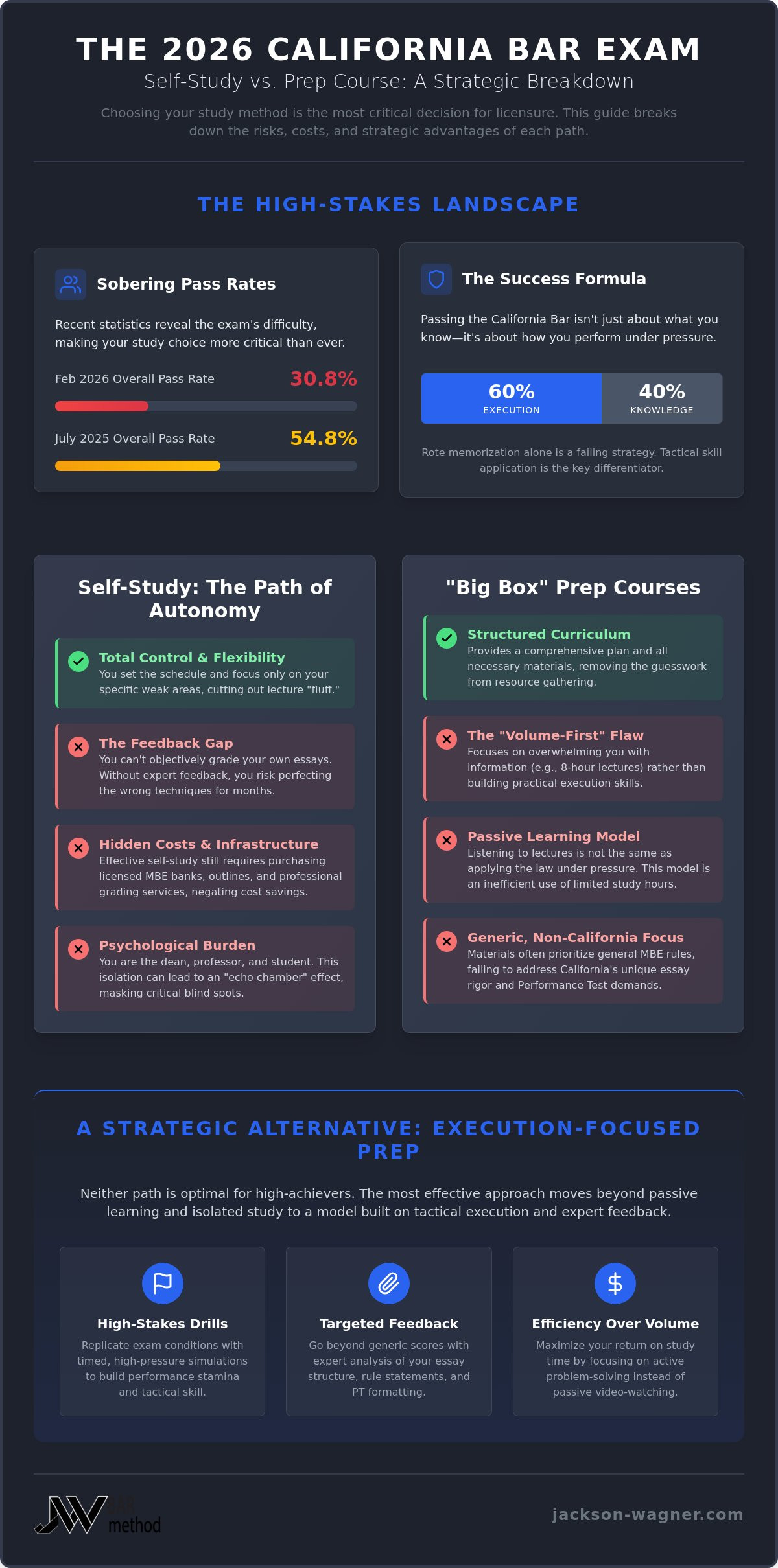
California isn't just another jurisdiction; it's a professional gatekeeper with a reputation for being the most grueling exam in the country. In 2026, the 1390 scale score requirement remains a formidable barrier that filters out thousands of candidates every cycle. When you evaluate self study vs bar prep course california options, you must realize that substantive knowledge of the law only accounts for roughly 40% of your success. The remaining 60% depends on your ability to execute under extreme pressure, a skill that rote memorization cannot provide.
The stakes extend far beyond the $878 general applicant fee or the $1,650 attorney applicant fee. Failing a six-month cycle carries a massive opportunity cost. You aren't just losing the registration fees; you're losing half a year of associate-level salary and professional momentum. For those on the Attorney’s Exam track, the pressure is even more concentrated. While you skip the MBE, the grading expectations for your written work are exceptionally high, leaving no room for the structural errors common in solo preparation.
The California Difference: Essay Rigor and Performance Tests
Unlike the standard bar examination in the United States found in UBE jurisdictions, California uses a specific grading rubric that rewards narrow, deep analysis over broad generalizations. Generic prep materials often fail here because they prioritize Multistate Bar Examination (MBE) rules that don't always align with California's unique essay requirements. The 90-minute Performance Test (PT) acts as a tactical equalizer. It punishes self-studiers who haven't mastered the art of extracting relevant facts from a dense file under a ticking clock. Without professional feedback on your PT formatting and tone, you're essentially guessing what the graders want to see.
The 2026 Pass Rate Reality Check
Recent statistics paint a sobering picture of the current environment. The February 2026 overall pass rate plummeted to 30.8%, while even the more "successful" July 2025 cycle only saw a 54.8% overall pass rate. First-time takers generally perform better, but repeat takers often find themselves trapped in a cycle of diminishing returns because they reuse the same ineffective study habits. Your choice of methodology for the 2026 exam must account for these trends. The California Bar Exam is a professional hurdle that requires tactical execution over rote memorization.
Self-Study for the CA Bar: Autonomy vs. Misdirection
Success in a solo environment isn't a matter of luck; it's a matter of infrastructure. Typically, the profile of a successful self-studier includes a recent graduate with a high academic baseline and the discipline to maintain a 60-hour weekly schedule without external oversight. However, for most applicants, the debate of self study vs bar prep course california reveals a dangerous "Feedback Gap." You cannot objectively grade your own practice essays. By the time you realize your rule statements are too broad or your analysis lacks factual depth, the 2026 exam cycle is already over.
The hidden costs of "going it alone" often negate the perceived financial benefits. To be competitive, you must still purchase licensed MBE banks, updated outlines that reflect the current California Bar Examination format, and professional essay feedback. Without these components, you aren't self-studying; you're gambling. For practicing attorneys, this path is particularly treacherous. Experienced lawyers often rely on their professional intuition, which frequently conflicts with the rigid, pedantic requirements of the State Bar. If you're an out-of-state practitioner, failing to adopt a structured methodology is the fastest way to join the 69.2% of applicants who didn't pass in February 2026.
The Pros and Cons of Going Solo
Autonomy is the primary draw of self-study. You eliminate the "fluff" of generic 8-hour lectures and focus on your specific weaknesses. But this control comes with a heavy psychological burden. You become the dean, the professor, and the student simultaneously. This "echo chamber" effect prevents you from identifying blind spots in your substantive knowledge. Without a structured feedback loop, you risk perfecting the wrong techniques for months.
Common Self-Study Pitfalls in California
Many solo applicants fall into the trap of over-studying substantive law at the expense of writing practice. Knowing the law is useless if you can't deploy it within the State Bar's specific structural expectations. Additionally, using outdated materials that don't reflect 2026 testing standards can lead to a fatal disconnect on exam day. You must simulate the high-pressure environment of the actual exam to build the necessary stamina.
Avoiding these traps requires more than just discipline; it requires a proven framework. Before committing to a solo path, consider if you have the tools to objectively measure your progress, or if you would benefit from a more strategic approach to bar prep.
Traditional Prep Courses: Why "Big Box" Methods Often Stall High-Achievers
Many applicants view legacy providers as the default choice for their licensure journey. In reality, the decision between self study vs bar prep course california legacy models often leads to a dangerous middle ground. These courses rely on a "Volume-First" philosophy that assumes more hours spent in front of a screen equals a higher probability of passing. For the 2026 cycle, this assumption is fundamentally flawed. You don't need more content; you need better execution.
Passive consumption of 8-hour video lectures doesn't translate to the tactical execution needed for the California Bar. High-achievers often find themselves "checking boxes" on a progress bar without actually mastering the application of law. When you receive feedback from these legacy programs, it's frequently generic and sourced from graders who use rigid, surface-level checklists. This leads to a false sense of security that shatters on exam day when faced with the nuanced California Bar Examination pass rates that historically penalize structural mediocrity. These graders often lack the localized expertise required to spot the subtle distinctions between a passing and failing California essay. They reward rule-dumping over the factual application that the 2026 examiners prioritize. This lack of precision is why top-tier candidates often feel stagnant despite completing 90% of a traditional course.
The Efficiency Trap: Passive Learning vs. Active Recall
Watching videos is statistically the least effective way to prepare for a professional licensing exam. It creates an "illusion of competence" where you recognize the material but cannot reproduce it under pressure. Real growth happens during active recall and high-stakes drills. Traditional courses fail to adapt to the specific needs of the California Attorney’s Exam, where experienced practitioners don't need 1L-level refreshers. They need a precision focus on California-specific grading triggers and structural discipline. Unlike specialized California-only programs, legacy providers often use the same templates for every state, ignoring the deep analytical rigor the State Bar of California demands.
Volume vs. Precision: The High-Achiever’s Dilemma
Top law graduates and practicing attorneys don't have time for a 10-week "death march" curriculum. The psychological toll of these legacy schedules often leads to burnout long before the July or February dates arrive. You need a methodology that values your "Time Currency." This realization has shifted the market toward best bar exam preparation services that prioritize precision and execution over sheer volume. By focusing on the 20% of effort that generates 80% of the results, you can bypass the administrative fluff and focus on the high-stakes writing and MBE strategies that actually move the needle for 2026.
Decision Framework: Evaluating Your Risk Profile and Timeline
Choosing between self study vs bar prep course california isn't a financial decision; it's a risk management strategy. You must first assess your "Time Currency." If you can realistically commit 50 to 60 hours per week, your options remain broad. However, if professional obligations or family commitments limit you to 20 hours, a structured, high-efficiency program is mandatory. Your academic baseline also dictates your path. A recent graduate with fresh doctrinal knowledge has a different risk profile than a 10-year practitioner who hasn't seen a Torts essay since 2016.
Structure eliminates the burden of ambiguity. If you struggle to curate a curriculum or find yourself paralyzed by the sheer volume of substantive law, self-study will likely lead to burnout. Finally, calculate the total cost of failure. Beyond the $878 general application fee or the $1,650 attorney applicant fee, you must account for six months of lost associate-level wages and the psychological toll of a repeat attempt. Choose the method that minimizes your specific failure points rather than the one that is most convenient.
The "Attorney’s Exam" Special Consideration
Out-of-state lawyers often fall victim to "Expert Blindness." You may be a brilliant litigator in your home jurisdiction—much like the legal professionals at Ronald A. Davidson Attorney at Law—but the State Bar doesn't grade on professional intuition; it grades on specific, pedantic structural triggers. The one-day Attorney's Exam requires a level of writing precision that self-study rarely provides. An accelerated prep track is almost always superior for working professionals because it strips away the 1L "fluff" and focuses exclusively on high-stakes execution.
Choosing Your 2026 Study Window
Your timeline is your most valuable asset. Standard 10-week tracks provide a methodical pace, but many high-achievers find that a 4-week accelerated "sprint" prevents the cognitive fatigue associated with longer cycles. Ensure your chosen window aligns with the latest State Bar of California requirements for 2026. If you're ready to stop guessing and start executing, explore a proven methodology for California licensure that respects your professional timeline.
The JW Bar Method: A Strategic Alternative to Traditional Prep
The polarized choice between self study vs bar prep course california legacy providers creates a false dichotomy that high-achievers no longer have to accept. The JW Bar Method is a results-oriented evolution in legal education, specifically engineered to replace the stress of high-pressure certification with a structured, modern, and reliable path to success. While solo preparation lacks a feedback loop and legacy courses drown you in passive volume, our methodology focuses on the high-stakes drills that dictate 100% of your performance outcome. We don't just teach the law; we teach the execution required to conquer the 1390 scale score.
Our California-only focus ensures that you aren't wasting mental energy on generic multistate strategies that fail to meet the State Bar's analytical rigor. Whether you're preparing for the Full Bar or the Attorney’s Exam, you need a system that prioritizes precision over sheer volume. We've stripped away the legacy "check-the-box" mentality to provide a learning environment where every minute of study is a direct investment in your California licensure—a philosophy of specialized training that is also essential in other high-stakes fields, such as the programs at seattledrivingacademy.net.
Accelerated Prep for Modern Professionals
Modern professionals don't have the luxury of wasting hundreds of hours on generic lectures. We compress the curriculum by removing administrative fluff and focusing on precision execution. Our approach relies on mentor-led feedback that identifies your specific structural weaknesses, a service that "Big Box" AI-graders simply cannot replicate. Mastering the California Bar Exam requires more than a checklist; it requires a tactical mindset that turns substantive knowledge into a passing score. By focusing exclusively on California's unique rubric, we ensure that every hour of your study time is optimized for the 2026 testing standards.
The Performance Guarantee: Assumption of Risk
We believe in our pedagogical model so deeply that we assume the financial risk of your performance. Our binary performance guarantee is a unique brand anchor that distinguishes us from more cautious, legacy competitors who offer no accountability for their low pass rates. This shifts our relationship from a mere service provider to a dedicated success partner. When you join our program, your goal becomes our liability. This is the definition of bold reliability in a field often characterized by uncertainty. Whether you're evaluating self study vs bar prep course california options for the first time or as a repeat taker, our method provides the tactical edge that turns anxiety into empowerment.
Stop navigating the 2026 landscape with outdated tools. Join the next cohort of the JW Bar Method Prep and secure your path to California licensure with absolute confidence. Our structured, expert-led environment is the modern alternative for the professional who demands results.
Secure Your 2026 California Licensure
Your path to the 2026 California Bar Exam requires more than just a collection of outlines or a progress bar on a generic video platform. The decision between self study vs bar prep course california legacy models comes down to how you value your time and your tolerance for risk. As we've analyzed, the recent 30.8% overall pass rate proves that knowing the law is only the beginning. You must master the specific tactical execution that the State Bar demands to cross the 1390 threshold.
The JW Bar Method offers a disruptive alternative built for high-achievers who demand efficiency. By choosing our pedagogical model, you benefit from California-only precision and accelerated tracks designed for the reality of a busy professional schedule. We're so confident in our results that we assume the financial risk of your performance through our binary performance guarantee. Don't settle for a generic safety net when you can have a success partner committed to your professional empowerment.
Master the California Bar with the JW Bar Method
You've already proven your competence through law school or years of practice. Now, it's time to adopt a strategy that matches your ambition. You possess the drive to become a California attorney; we provide the structured path to get you there.
Frequently Asked Questions
Is self-study enough to pass the California Bar Exam in 2026?
While possible for a small percentage of candidates, self-study is statistically risky due to the lack of objective diagnostic tools. Success requires more than discipline; it requires a deep understanding of the State Bar’s specific grading rubrics which are often opaque to solo applicants. Most self-studiers fail because they cannot identify their own structural analytical gaps. Relying on outdated or generic materials for the 2026 cycle often leads to a fatal disconnect on exam day.
How much does a typical California bar prep course cost?
Market data indicates that traditional bar prep courses generally range from $2,500 to $3,500, excluding registration and laptop fees. When you factor in the $878 general applicant fee and the $155 registration fee, the total investment frequently exceeds $4,500. It is essential to evaluate whether a course offers a specialized California focus or a generic national template. Choosing based on price alone often ignores the massive opportunity cost of a failed six-month cycle.
What is the main difference between the Full Bar Exam and the Attorney’s Exam in California?
The Full Bar Exam is a two-day test including the MBE, while the Attorney’s Exam is a one-day test consisting only of the written portions. Attorney applicants must still pay a higher registration fee of $1,650 and meet the same rigorous 1390 scale score requirement. This track demands extreme writing precision because there is no multiple-choice score to offset a weak essay performance. Precision execution is the only metric that matters for the one-day track.
Can I work full-time while preparing for the California Bar?
Yes, you can work full-time if you adopt a high-efficiency study methodology that prioritizes active recall over passive video lectures. Preparing for the 2026 exam while working requires a strict "Time Currency" budget and a condensed schedule. Many professionals find that a precision-based approach allows them to pass without taking a three-month leave of absence. Success in this scenario depends on choosing a program that values your limited time through high-impact drills.
How does the JW Bar Method differ from legacy big-box providers?
The JW Bar Method differs from legacy big-box providers by focusing exclusively on California-specific execution rather than generic, multistate volume. While national courses rely on passive video consumption and AI-graders, our method uses high-stakes drills and expert-led feedback. This results-oriented approach is designed for high-achievers who need a modern alternative to legacy "check-the-box" curriculums. We prioritize tactical execution over rote memorization of thousands of rules.
What happens if I fail the California Bar Exam after taking a prep course?
Most traditional courses offer a "free" retake, which simply means repeating the same ineffective materials that led to the initial failure. When evaluating self study vs bar prep course california options, look for a provider that assumes the financial risk of your outcome. A binary performance guarantee ensures your success is the provider's primary liability. This alignment of interests is far superior to simply offering a recycled seat in a future cohort without changing the pedagogy.
Are self-study materials like AdaptiBar enough for the essay portion?
No, multiple-choice tools are designed for the MBE and do not provide the structural feedback required for the California essay portion. Passing the written section requires mastering the State Bar's specific grading triggers and organizational expectations. Relying solely on MBE banks for the 2026 exam leaves you vulnerable to the 60% of the test where analysis and execution are the only metrics. You need professional writing critique to ensure your analysis meets California standards.
How do I know if I need an accelerated bar prep program?
You likely need an accelerated program if you are a practicing attorney or a high-achiever who values efficiency over volume. These tracks are ideal for candidates who want to master the self study vs bar prep course california dynamic by combining autonomy with structured, expert guidance. If you have a strong academic baseline, a 4-week precision track often prevents the cognitive burnout associated with traditional 10-week schedules while ensuring you hit every necessary grading metric for 2026.


