

What if effective bar prep with young children depended less on finding a perfect, uninterrupted day and more on building a routine that can survive an ordinary one? Studying for the bar with young children means working around interrupted study windows, changing childcare plans, and the fatigue that can make it hard to concentrate. Feeling torn between exam preparation and parenting is understandable, but steady progress doesn’t require marathon sessions.
You need a realistic plan, focused practice, and a way to reset when family life changes. This guide explains how to build a weekly schedule around caregiving, use short study blocks for active recall and practice questions, and protect time for rest and connection with your children. You’ll also learn how to adjust after a disrupted day without treating it as a failed week. For California candidates, structured preparation such as the JW Bar Method can help clarify what to prioritize. The goal is a repeatable study system that fits your life, not a plan that depends on everything going perfectly.
Key Takeaways
- Map your exam timeline, caregiving commitments, and available support before setting weekly study goals.
- When studying for the bar with young children, give each study block one clear task and match demanding work to your most focused hours.
- When parenting disrupts your plan, prioritize essential learning and move or shorten other tasks instead of doubling tomorrow’s workload.
- Rotate learning, practice, review, and reflection to make progress in both short windows and longer study sessions.
- A structured California bar-prep plan can clarify what to study next while leaving room to adapt as family needs change.
Studying for the Bar with Young Children Starts with a Realistic Plan
Caregiving rarely follows a perfect timetable. A child may wake early, childcare may change, or a study window may disappear when someone gets sick. That variability affects your time, energy, and ability to concentrate. A useful plan accounts for these realities instead of treating every interruption as a personal failure.
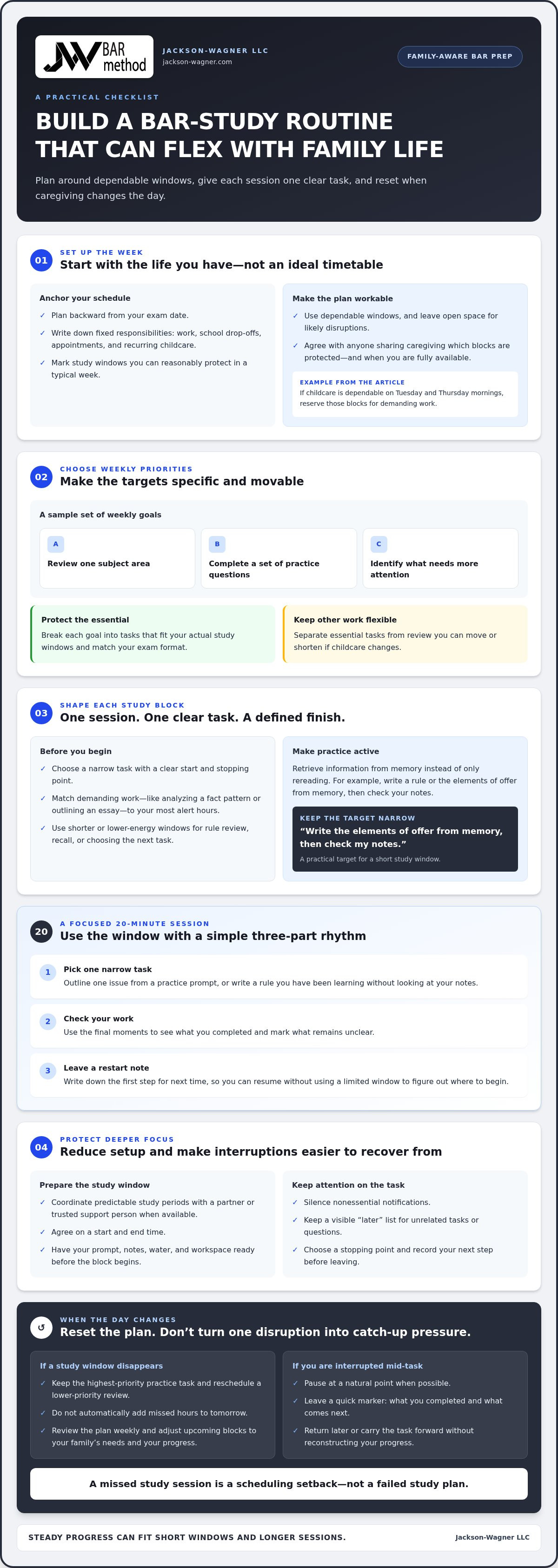
Start with the exam date and plan backward. Write down fixed responsibilities, such as work hours, school drop-offs, appointments, and recurring childcare arrangements. Then identify the study windows you can reasonably protect in a typical week. Since the bar examination is a professional licensing test with a defined format, use the requirements of your specific exam to guide what you prioritize and when you need to be ready.
How to map study time around childcare
Build your schedule around dependable windows, not an idealized daily routine. If childcare is consistently available on Tuesday and Thursday mornings, for example, reserve those blocks for demanding work. Use a shorter window after bedtime for a focused review task if you have the energy. Leave some open space in the week for likely disruptions.
- Record fixed responsibilities and recurring care arrangements first.
- Mark reliable study windows, even if they vary by day.
- Assign focused work to protected blocks and brief review to shorter windows.
Make the plan visible to anyone sharing caregiving responsibilities with you. Agree on which blocks are protected and when you’ll be fully available to your family. Clear expectations can make it easier to use study time without renegotiating the schedule every day.
How to set achievable weekly study priorities
Give each week a short list of specific goals. For example, you might review one subject area, complete a set of practice questions, and identify what needs more attention. Break each goal into tasks that fit your actual study windows, and match the practice to your exam format.
Separate essential tasks from those you can move or shorten. If a childcare change costs you a study block, preserve the highest-priority practice task and reschedule a lower-priority review. Don’t automatically add missed hours to tomorrow. Review your plan once a week, note what worked, and adjust the next week’s blocks based on your family’s needs and your progress. For California candidates, structured preparation through the JW Bar Method can provide a framework for setting priorities. Standard and accelerated tracks serve different study timelines and professional backgrounds.
Build Focused Study Blocks That Work Around Young Children
A study block works best when you know exactly what you’ll do before it begins. Give each session one task, a clear start, and a stopping point. “Study contracts” is too broad for a short window. “Write the elements of offer from memory, then check my notes” gives you a practical target and a way to finish.
Match the task to your energy as well as your schedule. Save demanding work, such as analyzing a fact pattern or drafting an essay outline, for the time of day when you’re usually most alert. Use brief or lower-energy windows for rule review, recalling key points, or deciding what to tackle in your next longer session. Active recall makes a short session purposeful because you’re retrieving information from memory rather than only rereading it.
What to do in a 20-minute bar-study session
Pick one narrow task and stay with it. For example, spend the session outlining one issue from a practice prompt or writing down a rule you’ve been learning without looking at your notes. Use the final moments to check your work, mark what remains unclear, and write down the first step for next time. That note helps you restart without using a limited study window to figure out where to begin.
If an interruption arrives, pause at a natural point and leave yourself a quick marker: what you completed and what comes next. You may be able to return to the task later, or carry it forward without reconstructing your progress.
How to protect deeper-focus time
For work that needs sustained attention, coordinate predictable study periods with a partner or trusted support person when available. Agree on the start and end time, then prepare your materials before the window begins. Having a practice prompt, notes, water, and a ready-to-use workspace can reduce setup time and help you start promptly.
- Silence nonessential notifications before beginning.
- Keep a visible “later” list for unrelated tasks or questions that come to mind.
- Choose a stopping point in advance, then record your next step before you leave.
Consistency doesn’t require every session to be long. When studying for the bar with young children, a series of focused blocks can help you keep moving even when uninterrupted hours are scarce. For California candidates, the JW Bar Method offers structured preparation for the full California Bar Exam and the California Attorney’s Exam, with standard and accelerated tracks for different study timelines. Explore California bar exam preparation to connect your study blocks to a clearer set of priorities.
When Parenting Interrupts Bar Study, Choose Recovery Over Catch-Up
A child gets sick, childcare falls through, or a planned study period turns into family time. The missed session can feel like a threat to your progress, but doubling tomorrow’s workload often adds pressure without solving the problem. A missed study session is a scheduling setback, not a failed study plan.
Reset with three quick questions: How much study time is still available this week? Which task matters most for your current preparation? What can be moved, shortened, or dropped for now? These questions tie your next step to learning priorities rather than guilt about lost hours.
What to do after a missed study session
Before moving unfinished work, check the week’s goals. Keep the most important learning or practice task, such as completing a planned essay outline, and defer a lower-priority review task if needed. Don’t try to recover every missed minute by sacrificing sleep or essential family responsibilities. Protecting your ability to focus matters more than filling every blank on the calendar.
If the original task no longer fits, scale it down without losing its purpose. You might complete one part of an assignment, review the rules you missed, or move the full task to a flexible block later in the week. Make a deliberate choice, then return to the next planned session instead of letting one disruption dictate the rest of your schedule.
How to plan for predictable and unexpected interruptions
Keep a backup list of short tasks for study windows that shrink unexpectedly. Options include recalling a rule from memory, reviewing a short set of notes, or listing questions to address in your next longer session. Leave flexible space in the week for care needs that can’t be scheduled, and use that space before pushing work into an already full day.
Look for patterns during your weekly review. If a certain time is repeatedly interrupted, stop treating it as dependable study time. Assign it a lighter task or leave it available for family needs. If a particular backup task works well in short windows, keep it on the list. Studying for the bar with young children calls for a plan that responds to real conditions. Adjusting the schedule is part of using it well, not evidence that you’ve fallen behind.
Make Bar Exam Practice Manageable Alongside Family Responsibilities
Practice doesn’t have to happen in one long sitting to be useful. Build a sequence across the study windows you have: learn a rule or concept, apply it to a question, review your answer, then note what you’ll revisit. This rotation turns scattered sessions into a connected preparation process. For a broader look at how practice fits into California exam preparation, read this California bar exam practice guide.
How to divide practice into realistic tasks
Break larger assignments into stages when a single uninterrupted block isn’t realistic. For an essay, you might read the prompt and identify issues in one window, draft an outline during a longer block, then review the issues afterward. Use brief sessions to recall rules, spot issues in a prompt, or review feedback. Reserve timed essays or other sustained work for the study periods you can rely on most.
Longer, uninterrupted block: Complete a timed practice task, draft a full response, or analyze feedback that needs careful attention.
Short study window: Recall a rule from memory, identify issues in one prompt, review a specific error, or plan the next stage of an assignment.
Choose the task based on the time and focus available, not on the assumption that every session must look the same. If parenting shifts your schedule, move a task to a better-fitting window instead of abandoning the practice sequence.
How to monitor progress without studying by the clock
Hours alone don’t show what you practiced or what still needs work. Keep a brief record after each task: what you completed, what you found difficult, and what you’ll do next. For example, note that you outlined an essay, missed an issue, and need to review the rule before trying a similar prompt.
- Completed: Record the practice task or topic you worked on.
- Unresolved: Note recurring errors, unclear rules, or missed issues.
- Next step: Choose one action that addresses the gap.
Review the record weekly. If the same weakness appears again, adjust your upcoming practice to address it. If family circumstances change, revise the workload while keeping the most useful practice tasks in view. Studying for the bar with young children is easier to manage when progress means purposeful work completed, not simply time spent at a desk. For a structured California-focused framework, explore JW Bar Method preparation.
Choose a Bar-Prep Structure That Supports Your Family-Aware Study Plan
A family-aware plan needs dependable priorities as well as room to adjust. Your study windows may shift, but knowing the next subject or task can reduce the time you spend deciding how to use a short session. Structure provides direction, while your weekly calendar makes that direction workable alongside caregiving.
For California candidates, Jackson-Wagner’s JW Bar Method provides structured preparation for the California Bar Exam and California Attorney’s Exam. Its standard and accelerated preparation tracks serve different study timelines and professional backgrounds. Choose a timeline based on your exam date and circumstances, not an idealized schedule that assumes every day is available for study.
How to assess whether a study structure fits your circumstances
Start with four practical considerations: your exam timeline, your existing knowledge, your caregiving schedule, and how much flexibility your week requires. Then consider whether a standard or accelerated preparation timeline fits the time you have before the exam and the responsibilities you need to maintain. As you compare study structures, look for a clear sequence of priorities and a timeline you can fit around your actual responsibilities.
A clear structure should help you decide what to study next, while your own schedule determines when you can do it. If a childcare change disrupts a planned block, keep the priority in view and move it to a realistic opening rather than trying to force the original timetable back into place. That balance is especially valuable when studying for the bar with young children, because the plan needs to guide your preparation without assuming family life will stay predictable.
Turn the plan into a sustainable next step
Choose one action to complete this week. Map the study windows you can depend on, identify a priority for each, or set a brief weekly review to adjust the coming week around caregiving needs. Keep the next step small enough to start and specific enough to finish.
Consistent planning can make limited study time easier to direct. If you’re preparing for a California exam, explore structured California bar preparation through the JW Bar Method.
Build a Bar Study Plan That Can Flex With Family Life
Studying for the bar with young children doesn’t require a perfect schedule. It requires clear priorities, focused study blocks, and a plan you can adjust when caregiving interrupts the day. Choose specific learning and practice tasks, track what still needs attention, and recover from missed sessions by resetting the plan instead of piling every unfinished task onto tomorrow.
A structured framework can help you decide what to study next while fitting preparation around family responsibilities. Jackson-Wagner offers preparation for the full California Bar Exam and the California Attorney’s Exam, with standard and accelerated tracks for different timelines and professional backgrounds.
Explore structured California bar preparation through the JW Bar Method and take one manageable next step toward your exam. You can make steady progress while showing up for your family, one focused session at a time.
Frequently Asked Questions
How do you study for the bar exam with a toddler?
Build a weekly plan around dependable childcare and study windows rather than expecting long sessions every day. Give each block one clear task, such as outlining an essay or reviewing a rule, and keep brief activities ready for shorter windows. Studying for the bar with young children can involve interruptions, so check your weekly priorities when a session is missed and adjust the plan instead of trying to recover every lost minute.
Can you pass the bar exam while raising young children?
Yes, raising young children does not, by itself, determine whether you can pass the bar exam. Preparation depends on factors such as your prior knowledge, available study time, exam demands, and the effectiveness of your practice. Build a sustainable routine, seek practical support where available, and review your progress regularly. Avoid comparing your schedule with someone whose caregiving responsibilities, work commitments, or preparation needs differ from yours.
How many hours a day should parents study for the bar exam?
There isn’t one daily study-hour target that fits every parent or bar candidate. Your workload depends on your exam timeline, preparation needs, and realistic childcare arrangements. Set weekly priorities and define meaningful tasks, such as reviewing a topic or completing practice questions, then assess whether your learning is progressing. Hours can help you plan, but time at a desk alone doesn’t show whether your study approach is effective.
What is the best time to study for the bar exam when you have kids?
The best time is a study window you can use consistently while concentrating. You might study before your children wake, during a regular childcare period, or after bedtime. Try realistic options and notice when you have the most focus. Schedule demanding work, such as essay analysis, during your strongest concentration periods, and save lighter tasks, such as rule review or planning, for less predictable windows.
How can I focus on bar study when my children are home?
Set one specific goal for the session and prepare your materials before you begin. If possible, coordinate a defined study period with another caregiver, and explain the boundary to your children in age-appropriate terms. Keep a short backup task ready in case the window shrinks. If a child needs your attention, pause and return when you can rather than expecting uninterrupted concentration in an unpredictable setting.
What should I do if childcare falls through during bar prep?
First, assess how much time and support remain instead of assuming you can recreate the original schedule. Choose the most important task that fits the available window, then move or remove lower-priority work. Update the rest of the week if needed. A flexible plan lets you respond to changed circumstances without turning one difficult day into a larger crisis or adding every missed task to tomorrow.
How do I balance bar exam study and parenting without burning out?
Include rest, caregiving, and focused study in a sustainable weekly plan rather than treating basic needs as obstacles to ignore. Set a manageable number of priorities, protect realistic breaks, and pay attention to persistent exhaustion or declining concentration. Ask trusted people for practical support when available. If your plan repeatedly requires sacrificing sleep or essential family responsibilities, revise its workload and timing so it better reflects your circumstances.


