

The best snacks for bar exam day aren’t elaborate or experimental. They’re familiar, easy to pack, and simple to eat during an allowed break, so food doesn’t become another decision competing for your attention. When the exam day is demanding and breaks are limited, it helps to plan what you’ll eat before you arrive.
Start with the rules: snacks generally aren’t allowed in the testing room unless your jurisdiction has authorized them. For the California Bar Exam, food isn’t allowed in the room, though water may be brought in a clear plastic container without a label. Read your current exam instructions for rules on permitted items, breaks, and where you can keep food. This guide covers practical options for breakfast and breaks, how to account for your preferences and dietary needs, and how to plan hydration. The goal is to make food logistics predictable so you can focus on the exam.
Key Takeaways
- The best snacks for bar exam day are familiar, portable, easy to open, and manageable during a scheduled break.
- Choose snacks based on how they pack and eat, as well as your preferences and dietary needs.
- Reduce mess by portioning snacks ahead of time and choosing packaging you can handle easily.
- Build a simple plan around your usual routine: include a familiar snack, a more substantial option, and permitted hydration.
- Use your official exam instructions to guide what you pack and when you can access it.
Best Snacks for Bar Exam Day: What Makes a Snack Practical?
A long exam day already asks you to manage timing, instructions, and sustained effort. Keep food decisions simple: a practical exam-day snack is familiar, portable, easy to open, and manageable during a scheduled break. It should fit your routine, not create a new challenge.
There’s no universal perfect snack. What suits one person may be inconvenient or uncomfortable for someone else. Choose food you know and can eat comfortably, rather than searching for a special option that promises better results. Food can support your routine and comfort, but it can’t guarantee focus or a higher score.
How to judge whether a snack belongs in your exam bag
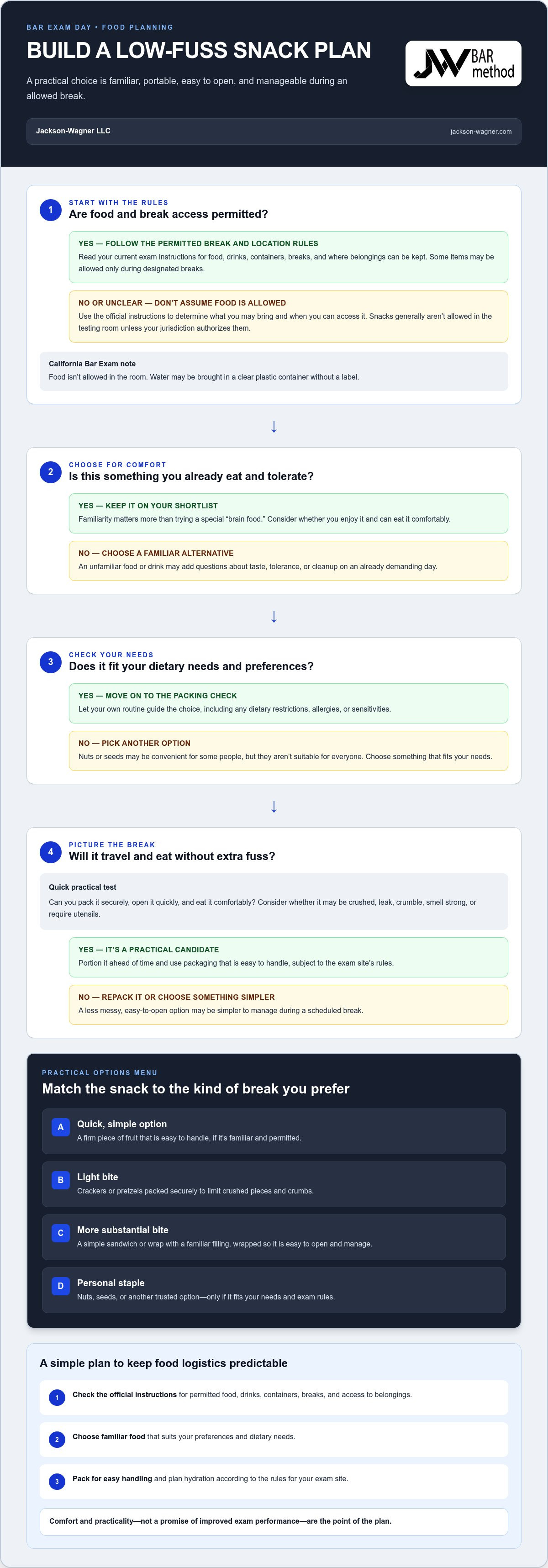
Think through the practical details before packing. Will it travel without getting crushed or leaking? Can you open it quickly? Does it leave crumbs, have a strong smell, or require utensils? A neatly portioned snack in easy-to-open packaging may be simpler to manage than something sticky, fragile, or messy.
Choose something you already eat and usually tolerate. Then check your official exam-day instructions before packing. Rules for food, drinks, containers, and access to belongings vary by jurisdiction. Some items may be permitted only during designated breaks.
Plan around your own routine, not a supposed brain food
Start with what works for you on an ordinary busy day. If you usually eat a light breakfast, an unfamiliar, heavy meal may not be a sensible experiment before an exam. If you have dietary restrictions, allergies, or sensitivities, let those needs guide your choices. Familiarity matters more than following a generic snack list.
Nutrition and brain function are related topics, as described in this general Nutrition and cognition overview. That doesn’t make any particular food a proven bar-exam performance aid. Don’t choose something just because it’s described as a “brain food.” Consider whether you enjoy it, tolerate it well, and can pack and eat it without fuss.
A useful test is to picture the break: you retrieve the snack when allowed, open it easily, eat it comfortably, and return without cleanup or extra decisions. If it fits that scenario and your dietary needs, it’s a practical candidate. Next, compare portable options and choose what suits you.
Bar Exam Day Snack Ideas: Portable Options to Consider
Use these ideas as a menu, not a prescribed diet. The best snacks for bar exam day fit your preferences, travel well, and can be eaten where and when your exam instructions allow. Colorado State University’s roundup of beneficial snacks for studying offers general ideas, but exam-day choices also need to fit your break schedule and packing rules.
Simple, familiar snacks that travel well
For a quick option, consider a firm piece of fruit, crackers, or pretzels if these are foods you already enjoy and tolerate. Choose fruit that’s easy to handle, and pack crackers or pretzels in a small, secure portion to limit crushed pieces and crumbs. A simple sandwich or wrap can suit someone who prefers a more substantial bite. Keep the filling familiar and wrap it so it’s easy to open and manage.
Packaging matters. A small, easy-to-open container or wrapper can save time during a short break. Avoid food that tends to leak, crumble heavily, or require several steps to eat. If you’re sensitive to strong smells or prefer a quiet break, factor that into your choice.
Options for different preferences and dietary needs
Nuts or seeds may be convenient if you already eat them, but they aren’t suitable for everyone. Consider allergies, dietary restrictions, and personal tolerance before packing them. If they’re not a fit, choose another familiar option, such as crackers, fruit, or a suitable individually packaged snack. Single portions can simplify packing and handling, but check what packaging the exam site permits.
Use this shortlist to compare options by practical fit:
- For minimal handling: A familiar, easy-to-peel fruit or individually packaged snack, if allowed.
- For a light bite: Crackers or pretzels packed securely to limit crumbs.
- For something more substantial: A simple sandwich or wrap that’s easy to hold and eat.
- For a personal staple: Nuts, seeds, or another trusted option that fits your needs and exam rules.
Before packing, confirm the current instructions for your jurisdiction and test site. Food, containers, and access to belongings may be restricted, so plan to eat only where permitted. For broader planning alongside practical exam-day routines, explore California bar exam preparation.
Will Snacks Distract You During the Bar Exam? Choose for Comfort
They don’t have to. A snack chosen and packed thoughtfully can be one less thing to worry about during an allowed break. Consider whether you know and tolerate the food, how messy it is, whether its packaging opens easily, and how comfortably you can eat it. These are practical comfort considerations, not claims that one snack improves exam performance.
University food guides, including the University of British Columbia’s Snacks to Fuel Your Brain, offer general ideas. Adapt any suggestion to what you already eat comfortably and to the rules for your test site. Familiar food can reduce uncertainty. Trying a new food or drink on an already demanding day may add questions about taste, tolerance, or cleanup.
Compare snack options by exam-day practicality
Use this comparison as a planning tool, not a nutritional ranking. How messy or easy to eat an item is depends on the food, portion, and packaging.
Whole fruit: Portable when packed securely; mess risk varies by type; easy to handle if it doesn’t need cutting or utensils.
Packaged crackers: Easy to portion and carry; may leave crumbs; look for packaging you can open without a struggle.
Familiar sandwich: More substantial and straightforward to eat if wrapped neatly; fillings can create mess; choose wrapping that’s easy to handle.
Before exam day, consider how each option works in a short break. If opening a wrapper takes effort, the food crumbles easily, or you’d need to manage several pieces, choose a simpler alternative. A snack can only help with comfort during a break if your instructions allow it and you can access it then.
What to avoid packing if it adds uncertainty
Skip last-minute experiments with unfamiliar foods or drinks. A new choice may be fine, but exam day isn’t the ideal time to discover that it doesn’t suit you. Leave out leaky containers, difficult wrappers, especially crumbly foods, and anything unusually messy or strongly scented if you’d feel uncomfortable eating it around others.
Personal needs come first. Account for allergies, sensitivities, and dietary restrictions, and don’t pack an option you already know causes discomfort. Check the current instructions for your jurisdiction and test site, including rules about food, packaging, and permitted items. The best snacks for bar exam day fit your routine and the rules without demanding extra attention.
How to Pack Bar Exam Day Snacks and Plan Your Breaks
A simple packing sequence keeps food decisions from taking over the morning: check the current exam instructions, choose familiar foods, portion them, then pack only what’s permitted. Rules can cover food, drinks, packaging, and storage. For the California Bar Exam, food isn’t allowed in the testing room, and water is permitted in a clear plastic container without a label. Read your current admission materials for the details that apply to your exam.
A simple snack-packing checklist
- Check the instructions. Confirm what food and drinks are allowed, which containers are permitted, and where you may store items.
- Choose familiar options. Pick foods you already enjoy and tolerate, with portions that suit your planned breaks.
- Keep packing manageable. Use permitted containers, and remove extra packaging only if the instructions allow it.
- Pack permitted hydration. Bring water or another drink only if the official instructions allow it, following any stated container requirements.
Don’t assume that bringing a snack means you can reach it during testing. Exam rules may limit when and where food is accessible. For the California Bar Exam, plan around the rule that food stays outside the testing room, and follow the instructions about storage and breaks.
Coordinate snacks with your exam-day routine
Use the official schedule to decide when food might fit. Plan a familiar breakfast and identify a simple snack or lunch for a scheduled break, rather than expecting to eat whenever you want. Keep the plan flexible enough for your usual routine, but avoid turning each pause into a complicated meal or a fresh decision.
Pack the night before. Portion your chosen foods, place them with any permitted containers, and set aside anything that needs to be kept separate. In the morning, you can review your instructions and pick up your prepared items instead of making food choices under time pressure. The best snacks for bar exam day are only one part of readiness; a clear study plan matters too. Explore California bar exam preparation as you prepare for exam day.
Build Your Own Bar Exam Day Snack Plan
A useful plan doesn’t need a long menu. Build it around your normal eating habits, dietary needs, the official exam schedule, and the rules for food and drinks. The best snacks for bar exam day are familiar choices you can pack simply and eat only when and where permitted.
A flexible sample plan for the day
Use this as a framework, not a fixed schedule. Adjust it to match your routine and the breaks listed in your exam instructions.
- Before the exam: Have a familiar breakfast that suits your appetite and usual routine.
- For an allowed break: Pack one light, easy-to-handle snack, such as a familiar piece of fruit or crackers.
- For a longer pause: Include a more substantial familiar option, such as a simple sandwich, if it fits your needs and the rules.
- For hydration: Bring water or another drink only if permitted, using a container that meets the official instructions.
Timing is flexible. Let the exam schedule determine when you can access food, then choose options that make sense for when you typically eat. If you have allergies, dietary restrictions, or foods you know don’t agree with you, swap the examples for trusted alternatives. There’s no need to force a snack just because it appears on someone else’s list.
Pair practical exam-day planning with structured preparation
Food planning can make logistics feel more settled, but it’s only one part of exam readiness. A packed snack can’t replace preparation. For guidance on organizing your approach, read the California bar exam strategic guide. If you’re considering how to structure your preparation beyond exam-day logistics, explore this bar exam preparation service guide.
Keep the food plan straightforward: choose familiar options, adapt them to your needs, and follow the current instructions. Jackson-Wagner offers structured preparation for the California Bar Exam and California Attorney’s Exam.
Make Your Exam-Day Plan Simple and Familiar
The best snacks for bar exam day are familiar, easy to pack, and suited to your dietary needs. Keep your choices manageable, and plan around the official break schedule rather than assuming you can eat at any time. Check current instructions for food, drinks, packaging, and storage before you pack.
A little planning can remove food logistics from your morning, but snacks are only one part of exam readiness. Your preparation matters too. Jackson-Wagner offers standard and accelerated JW Bar Method programs for candidates preparing for the California Bar Examination and California Attorney’s Exam.
Explore structured California bar exam preparation with Jackson-Wagner. Pack what you know works for you, follow the exam instructions, and take the day one step at a time.
Frequently Asked Questions
What are the best snacks to bring on bar exam day?
The best snacks for bar exam day are familiar, easy to pack, simple to open, and comfortable for you to eat. Fruit, crackers, pretzels, a simple sandwich, or a protein bar you already know may suit your routine. Choose based on your preferences, dietary needs, and the official exam instructions. No particular snack guarantees better focus or exam results.
Can I bring food into the bar exam?
Rules depend on the testing jurisdiction, so read your current official exam instructions before packing. Food is generally prohibited in the testing room unless the jurisdiction has authorized it. For the California Bar Exam, food isn’t allowed in the room, while water is permitted in a clear plastic container without a label. Instructions also explain rules for permitted items and breaks.
Should I bring snacks I have never tried before?
It’s usually more practical to stick with foods you already enjoy and tolerate. An unfamiliar snack or drink may add uncertainty on an already demanding day, especially if you don’t know how it suits you or how messy it is to eat. Choose familiar options that fit your dietary needs, and save food experiments for another time.
What snacks are easy to eat during a short exam break?
Choose a familiar snack that’s ready to eat, easy to open, and not messy. A piece of fruit that doesn’t need cutting, crackers in a manageable portion, or an individually packaged snack may work if permitted. Avoid options that require utensils, complicated unwrapping, or cleanup. Check your exam schedule and instructions, since you may only access food during designated breaks.
What should I avoid eating on bar exam day?
Avoid foods you know cause discomfort, trigger an allergy, or don’t fit your dietary needs. It may also help to skip unfamiliar foods and drinks, leaky containers, strongly scented options, and snacks that crumble or are difficult to open. These are practical considerations, not universal food rules. Follow your jurisdiction’s current instructions about what you can bring and where you can eat.
How much food and water should I pack for the bar exam?
Plan around your usual eating habits, the official break schedule, and when you’re allowed to access your belongings. Pack only the food you expect to eat during permitted breaks, along with any meal needed for an allowed lunch period. There’s no one amount that suits everyone. Bring water only as permitted, and follow the instructions for its container and use.
Are protein bars a good snack for bar exam day?
A protein bar can be a practical option if you’ve eaten that type before, tolerate its ingredients, and find it easy to open and eat. Check the wrapper and ingredients for potential allergy or dietary concerns, and consider whether it may crumble or become messy. Pack it only if your exam instructions allow it, and don’t rely on it to improve performance.


