

The California Performance Test isn't a test of your legal knowledge. It's a 90-minute high-stakes simulation where professional efficiency is the only metric that truly matters. Many applicants struggle with the crushing pressure of watching the clock tick down while they're still hunting for relevant facts in a bloated file. It's easy to get lost in the library or misinterpret a complex task memo when your career is on the line. These california bar performance test tips are designed to replace that academic chaos with a structured, modern framework for professional success.
We understand the frustration of running out of time to actually write the answer you've meticulously researched. This guide promises to reveal the high-stakes strategies and time-management frameworks required to turn the PT into a score-boosting asset that buffers against difficult essay topics. You'll gain a repeatable system for finishing any format, from briefs to letters, within the strict 90-minute window. By the end of this article, you'll have the confidence to handle the 2026 exam with the precision of a seasoned practitioner rather than a stressed student.
Key Takeaways
- Abandon outside legal knowledge to master the "closed-universe" format where professional instruction-following is the only metric that matters.
- Adopt the 45/45 Rule to divide your time perfectly between research and drafting, ensuring you always submit a complete, polished answer.
- Apply these expert california bar performance test tips to decode the Task Memo and navigate the fictional Library with surgical precision.
- Secure maximum points by matching your tone and format exactly to the requested deliverable, shifting seamlessly between objective and persuasive styles.
- Learn how the JW Bar Method uses high-stakes drills to transform the 90-minute session into a strategic asset for your overall bar score.
The California Bar Performance Test: Why High-Achievers Struggle
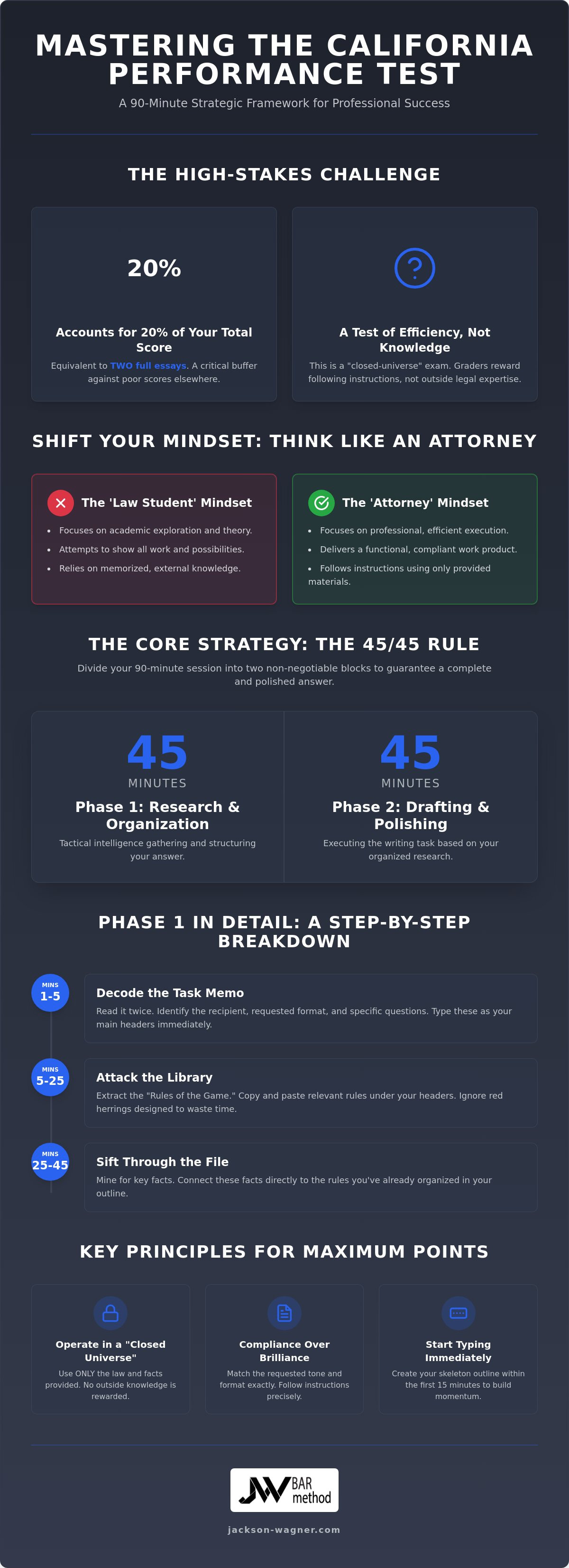
High-achievers often view the California Bar Exam as a marathon of memorization. They spend months internalizing thousands of rules, only to be blindsided by the one section that provides every rule they need. The Performance Test (PT) accounts for 20% of your total score, making it a powerful buffer against difficult essay topics. This 20% weighting is equivalent to two full essays. If you fail to master this 90-minute session, you're leaving critical points on the table that could have saved a mediocre performance on the MBE or a confusing Property essay.
Learning effective california bar performance test tips starts with acknowledging that this is a "closed-universe" exam. This means you must strictly use only the law and facts provided in the File and Library. Graders don't reward you for knowing the real-world California Evidence Code or recent Supreme Court rulings. They prioritize your ability to follow instructions and apply a specific set of fictional or provided rules to a client's problem. Legal brilliance takes a backseat to compliance. If the memo asks for a three-part analysis, giving them a five-part masterpiece will actually lower your score.
The 'Law Student' vs. 'Attorney' Mindset
Law students are trained to show their work and explore every theoretical possibility. Attorneys are hired to deliver a functional work product. The PT simulates a task assigned by a senior partner or a judge. They aren't looking for a theoretical treatise; they want a document that helps them win a case or advise a client. You must shift your focus from academic exploration to professional execution. Your job is to be the efficient associate who gets the memo right the first time. This mental shift is the foundation of a successful Performance test (bar exam) strategy.
The Danger of Over-Researching
The Library is frequently a trap for those who cannot filter relevance. It contains "red herring" cases and statutes designed to waste your time and cloud your judgment. If you spend 40 minutes reading every word of a 10-page Library, you've already lost the battle against the clock. Success requires professional triage. You must identify the specific rules that address the task memo and ignore everything else. A successful response is built on speed and selective focus. The PT is a test of professional triage and execution.
Mastering the 90-Minute Clock: Strategic Time Allocation
Time is the only resource you can't recover. On the 2026 exam, the 90-minute clock is a relentless adversary. Most students fail because they treat research and writing as a single, fluid process. They get stuck in the weeds and lose track of the horizon. To succeed, you must adopt the 45/45 Rule. This framework splits your session into two non-negotiable blocks. It ensures you spend exactly half your time gathering intelligence and exactly half executing the mission. These california bar performance test tips work because they prioritize completion over perfection.
You must start typing your skeleton outline within the first 15 minutes. This isn't optional. If you wait until the 45-minute mark to put fingers to keys, you've already lost the psychological battle. Starting early anchors your thoughts and provides a visual roadmap for the rest of your research. This disciplined approach is especially critical for those taking the California Attorney’s Exam, where professionals often struggle to shed their real-world drafting habits in favor of bar-specific speed. To truly ace the bar exam performance test, you must respect these boundaries with military discipline.
The First 45 Minutes: Research and Organization
The first block is about tactical intelligence gathering. You aren't reading for pleasure; you're mining for points. Follow this strict schedule:
- Minutes 1-5: Read the Task Memo twice. Identify the recipient, the requested format, and the specific questions you need to answer. Type these as your main headers immediately.
- Minutes 5-25: Attack the Library. Extract the "Rules of the Game" and paste them under your headers. Don't summarize; just get the rules into the document.
- Minutes 25-45: Sift through the File. Integrate facts into your rule structure as you find them. By minute 45, your outline should look like a rough, "ugly" version of the final answer.
The Final 45 Minutes: The Drafting Sprint
The second block is pure execution. Your goal is a Minimum Viable Product (MVP). An incomplete masterpiece is a failing answer, but a finished, functional response is a pass. Prioritize the "meat" of the argument. If you're short on time, skip the elaborate introduction and dive straight into the analysis. When the 10-minute warning hits, stop researching. Even if you found a new fact, ignore it. Use those final minutes to wrap up your conclusion and ensure your tone matches the Task Memo's instructions. Professionals who want to master this high-speed rhythm often choose the JW Bar Method Accelerated Prep to refine their timing and ensure they never leave a PT unfinished.
Deciphering the Components: Task Memo, Library, and File
The PT packet is a three-headed beast consisting of the Task Memo, the Library, and the File. Most applicants fail because they treat these as separate entities rather than an integrated puzzle. To succeed, you must understand that the Task Memo is your absolute source of truth for format, tone, and specific deliverables. If the memo directs you to write an objective memorandum to a senior partner, don't produce a persuasive brief for a judge. Every instruction in the memo is a point-earning opportunity. These california bar performance test tips hinge on your ability to respect the hierarchy of information provided in the prompt.
You'll be operating within the fictional State of Columbia. While the law often mimics real-world principles, you must rely solely on the statutes and cases provided in your packet. The Library contains the "rules of the game," where you must distinguish between mandatory authority, such as a Columbia Supreme Court case, and persuasive authority from a lower appellate court. The File contains the "players," which are the clients, witnesses, and documents that provide the raw facts. For a deeper look at how these components are weighted and structured, consult the Official California Bar Performance Test Instructions provided by the State Bar. This hierarchy is the bedrock of a passing score.
Extracting the 'Rule of Law' from the Library
Don't read a fictional case for the story. Read it for the holding. You must extract the legal test or the specific factors the court used to reach its decision. If the Library provides two cases, the exam likely expects you to synthesize them into a single, cohesive rule. Use statutory language as the foundation for your headings. If a statute lists three elements for a cause of action, those elements should become the primary headers in your answer. This ensures your response is organized exactly how the grader expects to see it, which maximizes your points for organization and clarity.
Fact Application: The Core of Your Score
Analysis is where you prove your professional worth. Connect every fact in the File to a specific element of the legal test you've built. Use the 'Because' Method: never state a conclusion without following it with the word "because" and a specific fact from the File. If the client's evidence is weak or conflicting, address it head-on. Acknowledge the "bad" facts and explain why the rule of law still favors your client's position or how the court might distinguish the current situation. This level of professional triage demonstrates the competency required to pass the 2026 exam.
Drafting for Maximum Points: Tone, Format, and Compliance
Drafting is where your research transforms into a measurable score. If the task memo asks for a memorandum, do not submit a letter. This sounds basic, but under the 90-minute pressure of the 2026 exam, many high-achievers default to whatever format they've used most recently in practice. Compliance with instructions is the fastest way to signal professional competence to a grader. These california bar performance test tips emphasize that your tone must shift to match the deliverable exactly. An objective memo requires a neutral, balanced analysis of both strengths and weaknesses; a persuasive brief demands a one-sided, aggressive argument that advocates for the client's position. If you miss the tone, you miss the points.
Your heading structure serves as a roadmap for the grader. Don't use generic titles like "Analysis" or "Discussion." Instead, use your outline to create specific, fact-based headers that summarize your legal conclusions. This technique, known as signposting, guides the reader through your logic without forcing them to hunt for your main points. If a grader can understand your entire argument just by reading your headings, you're already in the top tier of scores. It shows you've mastered the material and respected the grader's limited time.
The Power of Professional Formatting
Immediate credibility is built through standard legal headers. Use the "To, From, Date, Re" format for memos and proper captions for briefs. Descriptive sub-headings should tell the story of your analysis at a glance. A clean, organized layout subconsciously influences a grader, especially when they're reviewing hundreds of borderline exams. It suggests that you're a prepared professional who understands the expectations of the State of Columbia. This level of polish can be the deciding factor when your score sits on the edge of a passing grade.
Execution Under Pressure
Success requires template-driven writing. You should have a pre-set mental structure for every possible task before you even open the exam software. One common dilemma is the "Statement of Facts." Unless the task memo explicitly asks for it, don't waste time drafting a separate section for facts. Instead, weave those facts directly into your legal analysis. This keeps your response lean and focused on what actually earns points. For more on how to integrate the PT into your broader study plan, check out the definitive strategic guide to the California Bar Exam.
If you want to master these drafting nuances without the stress of trial and error, the JW Bar Method Prep - Full Exam California Bar provides the high-stakes drills you need to automate your professional execution and secure your license.
Precision Over Volume: The JW Bar Method Advantage
Generic bar prep courses often treat the Performance Test as a secondary concern, buried under mountains of substantive law lectures. We take the opposite approach. The JW Bar Method is built on the reality that the PT is a high-stakes professional simulation, not a library research project. Instead of passive reading, our system relies on high-stakes drills that force you to apply california bar performance test tips under actual exam conditions. We replace the anxiety of the unknown with a repeatable, mechanical system for success. Our confidence in this methodology is so absolute that we offer a binary performance guarantee; we assume the financial risk of your outcome because we know our system works.
Whether you're enrolled in the JW Bar Method Accelerated Prep - Full California Bar Exam or the track for the Attorney’s Exam, our focus remains on what moves the needle. We don't waste your time with legacy study models that favor volume over precision. You'll learn to strip away the "noise" of the PT packet and focus exclusively on the elements that earn points. This disruptive mentor approach positions you as a competent practitioner from the moment you open the exam software. It's about working smarter, not longer, to ensure you meet the 1390 passing threshold with room to spare.
Structured Success for Busy Professionals
Experienced lawyers and busy professionals don't have time for one-size-fits-all curricula. The JW Method integrates PT practice into a demanding schedule by focusing on tactical execution rather than theoretical fluff. This is especially vital for navigating the State Bar of California as an out-of-state applicant. You don't need more law; you need a better way to handle the 90-minute clock. Our accelerated prep tracks are designed to refine your existing drafting skills and align them with the specific, often rigid, expectations of California graders. Precision in your PT strategy isn't just a benefit; it's a necessity for licensure.
The Path to Licensure in 2026
Mastering the Performance Test gives you a massive psychological edge on exam day. When you know you can finish the PT with five minutes to spare for a final proofread, the rest of the written day feels manageable. This confidence allows you to approach the five essays with a calmer mind, knowing your PT score is working as a buffer for your total grade. The 2026 exam will reward those who prioritize professional efficiency over academic volume. It's time to stop worrying about the clock and start using it to your advantage. Master the JW Bar Method and secure your California license by choosing a prep system that values your time as much as you do.
Secure Your Professional Future in 2026
Mastering the 90-minute session requires more than just speed; it demands a fundamental shift from academic exploration to professional execution. By internalizing these california bar performance test tips, you replace the stress of the unknown with a structured, reliable path to success. You've learned how to weaponize the 45/45 time allocation rule and how to decode the Task Memo to ensure absolute compliance with every instruction. These strategies turn a high-pressure challenge into a score-boosting asset that secures your path to licensure.
Jackson-Wagner LLC offers a proprietary JW Bar Method system specifically designed for the unique rigors of California licensure. We provide accelerated prep for working attorneys and first-time takers who need to move beyond legacy industry standards. Our results-oriented approach is backed by a binary performance guarantee that distinguishes us from more cautious competitors. Secure your California license with the JW Bar Method; the only prep course with a results-driven guarantee. You've done the hard work of learning the law; now it's time to master the professional execution that brings it all together. We're ready to partner with you in this final step toward your career goals.
Frequently Asked Questions
Is the California Performance Test harder than the MPT?
The California Performance Test is often considered more challenging than the Multistate Performance Test (MPT) due to the density of the materials provided. While both exams now use a 90-minute format, California's "closed-universe" files frequently contain more complex legal issues and a higher volume of "red herring" facts. Success depends on your ability to perform professional triage under a more compressed timeline than many other jurisdictions require.
How much time should I spend reading the Library versus the File?
You should aim to spend approximately 45 minutes on research and 45 minutes on drafting. Within that first research block, spend the first 20 to 25 minutes mining the Library for the "rules of the game." Use the remaining time in that block to extract facts from the File. This balanced approach ensures you have a solid legal framework before you begin applying facts to the specific task instructions.
Do I need to cite cases in the Performance Test?
Yes, you must cite every case and statute you use from the Library to earn full points. Graders look for these citations to verify that you're operating strictly within the provided "closed-universe" law. You don't need formal Bluebook formatting; shorthand citations like the case name or statute number are sufficient as long as they clearly identify the source of your legal authority.
What happens if I don't finish the PT on the California Bar Exam?
Failing to finish the PT is a significant score penalty that's difficult to overcome. Since the PT is weighted at 20% of your total score, an incomplete answer essentially leaves the equivalent of a full essay's worth of points on the table. It's better to submit a "Minimum Viable Product" with a brief conclusion than a half-finished masterpiece that never reaches the final argument.
Can I use IRAC for every Performance Test task?
IRAC is a helpful foundation, but you must adapt it to the specific format requested in the Task Memo. While an objective memo works well with standard IRAC, a persuasive brief often requires a more aggressive "Conclusion-Rule-Application-Conclusion" (CRAC) structure. One of the best california bar performance test tips is to let the requested deliverable dictate your organization rather than forcing a rigid academic formula.
How many practice PTs should I complete before the 2026 exam?
We recommend completing at least five to eight full-length, timed practice tests to build the necessary muscle memory. This volume of practice allows you to encounter various formats, from objective memos to persuasive briefs, and ensures you can manage the 90-minute clock without panic. Consistent, timed drills are the only way to automate your professional efficiency and guarantee a passing performance.
What is the 'fictional state of Columbia' and why does it matter?
Columbia is the fictional jurisdiction where all California Performance Test tasks take place. It matters because you must ignore all real-world California or federal law and rely exclusively on the Columbia statutes and cases provided in the Library. Treating the exam as a real-world legal problem is a common mistake; you're being tested on your ability to follow instructions within this specific, isolated legal universe.
Does the Attorney's Exam have a different Performance Test than the Full Bar Exam?
No, the Performance Test is identical for both the Full Bar Exam and the Attorney's Exam. Both groups of test-takers receive the same File and Library and are held to the same grading standards during the 90-minute session. While attorneys often have more drafting experience, they must still master specific california bar performance test tips to shed their real-world habits and meet the bar's unique grading criteria.


