

A single number stands between you and your license to practice law in California, but that number isn't just a hurdle; it's a target you can hit with surgical precision. If you've been scouring the State Bar website only to feel more confused, you aren't alone. Understanding what is a passing score on the california bar exam is the first step toward dismantling the anxiety that often paralyzes even the most brilliant legal minds. With a February 2026 pass rate of just 30.8%, you cannot afford to leave your score distribution to chance or guesswork.
It's natural to feel overwhelmed by the 1390 threshold and the complex phased grading system that determines your future. We believe that clarity is the ultimate antidote to exam stress. This guide will help you master the mechanics of the 1390 cut score and explain exactly how your essays and MBE results are scaled together. You'll gain a tactical plan for score distribution that moves you from endless research into decisive execution, giving you the confidence to dominate the exam and secure your professional future.
Key Takeaways
- Master the 1390 threshold and learn exactly how the State Bar's current standards dictate your 2026 preparation strategy.
- Deconstruct the 50/50 split to balance your performance across the MBE and written portions with surgical precision.
- Demystify the phased grading process to understand what is a passing score on the california bar exam if your initial results trigger a second review.
- Identify the unique high-wire scoring risks for out-of-state practitioners taking the California Attorney’s Exam.
- Transform your approach by replacing legacy study volume with a modern, high-yield methodology designed for results.
The 1390 Threshold: Defining the Passing Score in 2026
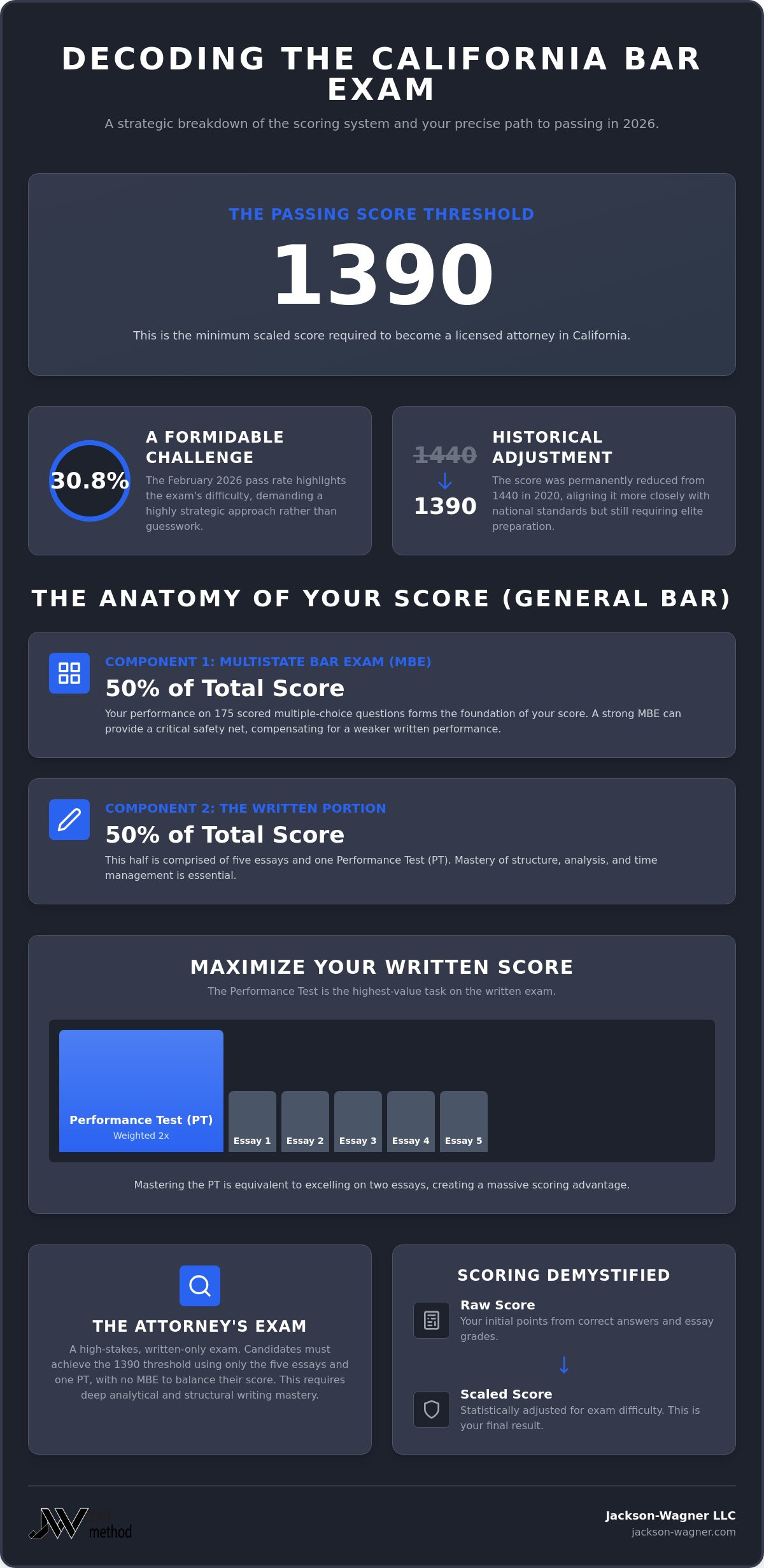
The State Bar of California currently mandates a minimum scaled score of 1390 to pass. This specific number serves as the definitive boundary between an applicant and a licensed attorney. For decades, California maintained one of the highest hurdles in the country with a 1440 requirement. The permanent reduction to 1390 in 2020 provided some relief, yet the exam remains a formidable challenge for even the most prepared candidates. When you investigate what is a passing score on the california bar exam, you must recognize that 1390 represents the total combined performance across all sections, not a simple percentage of correct answers.
Understanding the California Bar Exam passing score history helps contextualize why the current threshold is so significant. While the raw difficulty of the questions hasn't decreased, the State Bar adjusted the "cut score" to align more closely with national standards. This shift doesn't mean you can relax. Instead, it means your preparation must be more strategic. High-achieving professionals often experience intense anxiety because they're used to scoring 90% or higher on academic tests. On the California Bar, perfection is impossible. Success is about hitting that 1390 mark through consistent, authoritative performance rather than trying to ace every single sub-topic.
General Bar Exam vs. Attorney’s Exam Scoring
The 1390 threshold applies equally to both the two-day General Bar Exam and the one-day Attorney’s Exam. If you're taking the General Bar, your score is an even 50/50 split between the Multistate Bar Exam (MBE) and the written portion. This allows a strong performance in one area to compensate for a weaker showing in the other. Conversely, the Attorney’s Exam is a high-stakes, written-only event. Out-of-state practitioners must hit 1390 using only five essays and one Performance Test. Your strategy must change based on your track. General applicants should focus on MBE speed and accuracy, while Attorney’s Exam candidates must prioritize deep analysis and structural mastery in their writing.
Scaled vs. Raw Scores: The Critical Distinction
Raw scores represent the initial points you earn. For essays, these are usually scores between 40 and 100 assigned by a human grader. For the MBE, it's the number of questions you got right out of the 175 scored items. These raw numbers are never your final result. The State Bar converts them through a process of scaling to ensure fairness across different years and exam versions. Scaling is the statistical adjustment used to account for varying exam difficulty. This process prevents your pass/fail status from being a victim of "luck of the draw" regarding which specific questions appear on your exam. You shouldn't obsess over your raw percentage during practice. Instead, focus on mastering the patterns that lead to high scaled scores.
Calculating Your Total: The Weights of MBE, Essays, and PT
The path to 1390 isn't a mystery; it's a mathematical formula. According to the official California Bar Exam grading policy, your final score is an average of your scaled MBE performance and your scaled written performance. Each side carries exactly 50% of the weight. This balanced structure means you don't need to be a virtuoso in every legal subject. Instead, you need a strategy that leverages your strengths to cover your weaknesses. Many applicants fail because they treat every task with equal importance, ignoring the fact that some points are much easier to secure than others.
The written portion consists of five essay questions and one 90-minute Performance Test (PT). While the essays are critical, the PT is your secret weapon. It is weighted twice as much as a single essay, making it the highest-value task on the entire written exam. If you can master the PT, you've essentially "passed" two essays before you even look at the traditional prompts. If you're feeling overwhelmed by the sheer volume of law to memorize, using a structured approach like the JW Bar Method can help you focus on these high-yield scoring opportunities.
The MBE: Your Foundation for Success
Think of the MBE as your safety net. Because it's worth half of your total score, a dominant performance here can "carry" a mediocre written day. To understand what is a passing score on the california bar exam, you have to look at how the 175 scored questions translate into scaled points. Aiming for a raw score in the high 130s or 140s creates a massive buffer. Attorneys often struggle here because they over-analyze the questions, trying to find nuances that aren't there. The MBE rewards speed and pattern recognition, not philosophical debate. Success requires moving from a research-heavy mindset into an authoritative, execution-focused rhythm.
The Written Portion: Essays and the PT
California graders use a scale of 40 to 100 for each written task. A "passing" essay usually sits around a 65 or 70. You don't need to write a law review article for every prompt. In fact, trying for a perfect 100 is a recipe for disaster; it eats up time you need for the other questions. The PT advantage is real. Since it counts for double, a strong PT can offset a "blown" essay where you didn't recognize the specific topic. Consistency across all six written tasks is the most reliable way to hit your 1390 target without burning out. Your goal is to deliver professional, structured answers that signal competence to the grader.
Demystifying Phased Grading: How Your Exam is Actually Scored
Understanding what is a passing score on the california bar exam requires more than just knowing the 1390 number; it requires understanding the multi-step process behind it. According to the official California Bar Exam grading policy, all exams first enter Phase I. In this stage, every essay and Performance Test is read once. If your combined scaled score from the MBE and this first reading hits 1390, you pass immediately. However, if your score falls below 1350, the result is final and you fail without further review. This clear-cut separation ensures that high-performing candidates get their results quickly while those far from the mark are processed efficiently.
Grader calibration is the backbone of this system. Before a single paper is touched, graders undergo rigorous training to ensure they all view a "65" or a "75" through the same lens. This eliminates the "luck of the draw" fear that many students harbor. Even with this calibration, subjectivity can creep in, which is why the "Reread" zone exists for scores between 1350 and 1389.99. While some see this as a second chance, we view it as a danger zone. Our goal is to push your performance so far beyond the 1390 threshold that you never trigger a reread. Relying on the mercy of a second reader isn't a strategy; it's a gamble.
Phase II and the Reversal Potential
If you fall into the 1350 to 1389.99 range, your written answers are sent to Phase II. A second set of graders, who have no knowledge of your initial scores, reads every answer again. Your final written score becomes the average of these two readings. While reversals do happen, they aren't guaranteed. Statistically, many applicants who enter Phase II still fail to reach the 1390 mark. When you're calculating what is a passing score on the california bar exam, you shouldn't aim for a 1350 with the hope of a Phase II miracle. You need a buffer that keeps you in the safe "Phase I Pass" category.
The Finality of Results
Once the State Bar releases the final numbers, the door closes. California is famous for its lack of an appeals process; you cannot ask for a third reading or contest a grader's interpretation of your rule statement. If you don't meet the 1390 threshold, your score report will show exactly where you fell short. This data is vital for your next attempt, but it cannot change the past. Learning How to Navigate the State Bar of California: A 2026 Guide to Licensure Success is the best way to ensure your first score report is the only one you ever need.
The California Attorney’s Exam: Scoring for Out-of-State Practitioners
For out-of-state practitioners, the California Attorney’s Exam is frequently mischaracterized as an "easier" path to licensure. This is a dangerous misconception that leads many seasoned lawyers to failure. While the exam only lasts one day, it is a high-wire act because you have no MBE score to balance a poor writing performance. In the General Bar Exam, a high multiple-choice score can rescue a mediocre essay day. Here, 100% of your result comes from five essays and one Performance Test. When you ask what is a passing score on the california bar exam, the answer remains 1390, but your margin for error is significantly smaller without the MBE safety net.
Every single word you type must be calibrated for a specific result. Because the scoring is entirely written, your performance on the Performance Test (PT) becomes the ultimate deciding factor. Since the PT carries double the weight of a single essay, it represents roughly 28% of your total score. If you miss the mark on the PT, hitting 1390 becomes nearly impossible. Our JW Bar Method Accelerated Prep - Attorney’s Exam California Bar is specifically engineered for this high-pressure environment, stripping away legacy fluff to ensure you hit what is a passing score on the california bar exam through mechanical precision and authoritative analysis.
Written Mastery for Practicing Lawyers
Experienced attorneys often struggle because they try to "think like a lawyer" instead of "writing like a bar candidate." In practice, you might write nuanced memos that explore every ambiguity, but California graders want to see a rigid application of the IRAC (Issue, Rule, Analysis, Conclusion) format. If you deviate from this structure to show off your professional expertise, you risk losing points for clarity and organization. Adapting your style is the most critical hurdle for out-of-state practitioners. You can find a complete breakdown of these nuances in our guide on California Attorney’s Exam Requirements: The 2026 Guide to Licensure for Out-of-State Lawyers.
Strategic Planning for the One-Day Exam
Success on the one-day exam requires brutal time management. You face two three-hour sessions where every minute is accounted for. The morning consists of three essays, while the afternoon demands two essays and the high-stakes Performance Test. You must simulate these conditions during your prep to ensure your writing speed matches the 1390 requirement. Most candidates fail not because they don't know the law, but because they can't execute under the clock. Consistency across all six written tasks is the only way to secure your license without the luxury of an MBE buffer.
Beyond the Number: A Strategic Approach to Passing in 2026
Precision beats volume every time. Legacy industry standards often bury candidates under thousands of pages of low-yield law, a strategy that prioritizes exhaustive coverage over actual results. We take a different approach by identifying the specific subjects that appear most frequently on the exam. Knowing what is a passing score on the california bar exam is just the baseline; the real victory lies in identifying which topics provide the highest return on your study hours. This surgical focus ensures you aren't wasting cognitive resources on fringe rules that rarely impact the 1390 threshold.
Mental stamina is the silent factor in your success. Maintaining a 1390-level performance over two grueling days requires more than just legal knowledge; it requires a structured rhythm of execution. Our proprietary methodology is designed to move you past the anxiety of "knowing enough" into the authority of "doing enough." We're so certain of this results-oriented path that we assume the financial risk of your performance. You aren't just a student here. You're a partner in a high-stakes professional transition where failure is not an option.
The JW Bar Method Advantage
Our preparation is designed for the modern professional who requires flexibility without sacrificing rigor. We move you from the passive phase of learning the law into the active phase of executing the exam. This transition is vital for anyone asking what is a passing score on the california bar exam because it shifts the focus from academic theory to measurable output. You can explore our full philosophy in Passing the California Bar Exam in 2026: The Definitive Strategic Guide.
Securing Your 2026 Licensure
Waiting to start your preparation is the most common mistake California candidates make. The 1390 goal requires a consistent cycle of practice, feedback, and refinement. You need to see exactly where your analysis is falling short before you step into the exam center. A final checklist for your success includes mastering the IRAC structure, hitting your MBE targets, and perfecting the high-value Performance Test. Don't leave your career to chance or legacy methods that haven't evolved with the State Bar's standards.
Secure your spot in our next JW Bar Method cohort and guarantee your results.
Secure Your Legal Career Beyond the 1390 Threshold
Mastering the mechanics of the California Bar Exam is the first step toward professional licensure. You now have the clarity to navigate the 50/50 scoring split and the high stakes of phased grading. By focusing on the high-yield Performance Test and maintaining a disciplined approach to the MBE, you move from a state of uncertainty to one of authoritative execution. Understanding what is a passing score on the california bar exam is no longer a source of anxiety; it's a measurable objective within your reach.
The JW Bar Method provides the structured, accelerated preparation you need to dominate either the Full Exam or the specialized Attorney’s Exam track. Our proprietary methodology is designed for modern professionals who value efficiency over legacy volume. We're so certain of our curriculum's efficacy that we offer a binary performance guarantee, assuming the financial risk of your result. Master the California Bar with the JW Bar Method—Structured Prep with a Performance Guarantee.
Your journey to becoming a California attorney is a rigorous one, but you've already taken the most important step by arming yourself with a tactical plan. Trust your preparation, lean into the strategy, and step into the exam center with the absolute confidence of a professional who has already won.
Frequently Asked Questions
Is a 1390 on the California Bar Exam hard to achieve?
Achieving a 1390 is a significant challenge that requires a sophisticated study strategy. While the threshold was lowered from 1440, California remains one of the most difficult jurisdictions in the country. The February 2026 General Bar Exam pass rate of 30.8% reflects this rigor. Success requires more than just memorization; you must demonstrate authoritative analysis across all subjects to reach the required scaled total.
Does California accept MBE scores from other states?
No, California does not accept the transfer of MBE scores from other jurisdictions. Every applicant must take the full California Bar Exam, including the MBE portion, regardless of their performance in other states. This lack of score portability makes it essential to prepare specifically for the California testing environment and standards rather than relying on previous out-of-state results.
What happens if I get exactly 1389 on the Bar Exam?
A score of 1389 places you in the Phase II reread zone. This means your written answers will be evaluated by a second set of graders to ensure accuracy and fairness. If the average of the two readings brings your total scaled score to 1390 or higher, you pass. However, relying on this second review is a high-risk strategy that often results in a final fail, which is why we focus on staying out of this zone entirely.
How many essays do I need to pass to hit 1390?
There is no fixed number of essays you must pass because your total score is a combination of the written section and the MBE. To understand what is a passing score on the california bar exam in practical terms, you should aim for an average of 65 to 70 on each essay. A strong MBE performance can lower the writing score needed, while a weak MBE requires higher essay marks to bridge the gap to 1390.
What is the pass rate for the California Bar Exam in 2026?
The pass rate for the February 2026 General Bar Examination was 30.8%. During this cycle, 1,211 applicants passed the General Bar Exam, while 272 candidates successfully passed the Attorneys' Examination. These statistics highlight the necessity of a modern, results-driven prep method that moves beyond legacy study habits to ensure you are among the minority who succeed.
Can I see my raw scores if I pass the exam?
No, the State Bar only releases detailed score reports to applicants who fail to meet the 1390 threshold. If you pass, you'll simply receive a notification of your success without a breakdown of your raw or scaled performance. This policy keeps the focus on the binary outcome of licensure rather than individual section rankings, reinforcing the brand's results-oriented philosophy.
How much is the Performance Test worth compared to the essays?
The Performance Test (PT) is weighted as 20% of your total score, which is double the weight of a single essay. In the written portion of the exam, the PT essentially counts for two out of the seven total parts. Mastering this 90-minute task is the most efficient way to secure the points needed for a passing result without needing to be perfect on every individual essay topic.
Is the passing score different for the Attorney’s Exam?
No, the passing score for the California Attorney’s Exam is also 1390. While the exam consists only of the written portion, including five essays and one Performance Test, the final scaled result must meet the same threshold as the General Bar Exam. This makes the Attorney's Exam a high-stakes event, as there is no MBE score available to balance out your writing performance during your search for what is a passing score on the california bar exam.


