

With a pass rate that consistently hovers near 50 percent, the California Bar Exam is widely considered the most difficult licensing hurdle in the country. It's a high-stakes environment where traditional, "one-size-fits-all" prep courses often fail to deliver the results they promise. You're likely feeling the weight of 15 different subjects and the constant pressure of balancing a full-time career with an impossible reading list. We understand that anxiety because we've built our reputation on disrupting it. You don't need more outlines; you need a structured california bar study plan that prioritizes high-yield precision over mindless memorization.
This strategic framework for the 2026 exam cycle is designed to replace your stress with a clinical, results-driven roadmap. We've stripped away the fluff of legacy education models to focus on the exact pedagogical triggers that lead to mastery. In the following sections, you'll find a granular, day-by-day schedule that ensures your performance by targeting the specific subjects and skills that actually move the needle. From the February 24th start to the July 28th session, we're providing the modern architecture you need to walk into the testing center with absolute, unwavering confidence.
Key Takeaways
- Identify why reading thousands of pages of outlines fails and how to avoid the "Passive Volume Trap" that derails most candidates.
- Discover how a structured california bar study plan uses a three-phase diagnostic approach to move you from baseline theory to high-stakes execution.
- Learn to choose the right track for your specific needs, whether you require a 10-week standard schedule or a 5-week accelerated path for experienced attorneys.
- Master the "Core Output" method to replace passive study hours with high-yield drills that simulate the actual stress of the 2026 exam environment.
- Understand how aligning your preparation with a binary performance guarantee provides the financial and professional security needed to succeed.
Why Most California Bar Study Plans Fail in 2026
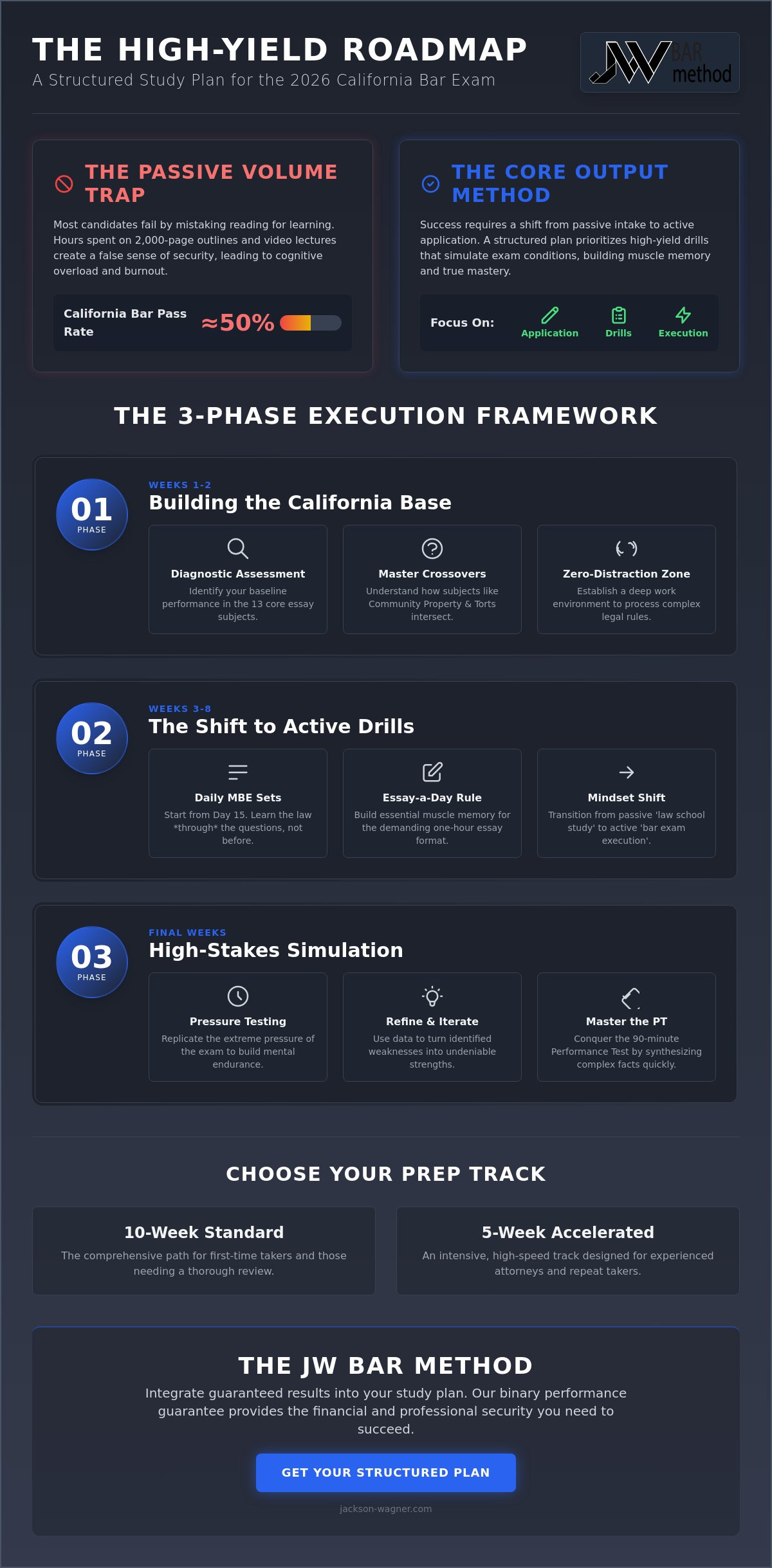
Volume is the enemy of mastery. Most candidates fall into the "Passive Volume Trap," spending hundreds of hours highlighting 2,000-page outlines and watching endless lecture videos. This approach creates a false sense of security. Reading isn't the same as doing. While you might feel productive, your brain is simply skimming the surface of the 13+ tested subjects. A truly structured california bar study plan must prioritize active output over passive intake. If you aren't applying the law to specific fact patterns daily, you aren't actually preparing; you're just procrastinating with paperwork.
Cognitive overload is a primary reason for the 50 percent failure rate. The State Bar of California doesn't just test your knowledge of legal rules. It tests your ability to perform under extreme pressure. Generic national courses often fail because they treat California as a secondary market, ignoring the specific nuances required for the essays and the Performance Test (PT). You can find a detailed California Bar Examination overview that highlights the sheer breadth of the curriculum, but knowing the list of subjects isn't enough. You need a data-driven strategy that identifies your weaknesses and forces you to iterate on them until they become strengths.
The 2026 California Bar Landscape
The current environment for the February and July 2026 exams demands a shift in focus. Pass rates remain stubbornly low, and the Bar has refined its testing of the 90-minute Performance Test to reward those who can synthesize complex facts quickly. Your plan must also recognize that Professional Responsibility is no longer just another subject; it's a mandatory component that often appears in multiple essays. If your schedule treats every subject with equal weight, you're wasting valuable time on low-yield topics while neglecting the areas that determine your success.
Precision vs. Volume in Legal Pedagogy
Efficiency beats effort every single time. We utilize the science of spaced repetition to ensure that rules move from your short-term memory into your long-term cognitive architecture. "Covering the material" is a vanity metric that leads to burnout. Instead, you must transition from a law school mindset, which rewards deep academic theory, to a bar exam execution mindset. This means focusing on the precision of your rule statements and the speed of your analysis. A structured california bar study plan isn't about how many hours you sit at your desk; it's about the quality of the drills you perform during that time.
The 3 Phases of a High-Yield California Bar Study Plan
Success on the bar exam isn't about working harder; it's about working in the correct sequence. A structured california bar study plan breaks the prep cycle into three distinct, non-negotiable phases. Each phase serves a specific neurological purpose, moving you from passive comprehension to active, high-pressure execution. If you follow a linear path without these shifts in intensity, you risk plateauing before you ever reach the exam hall.
Phase 1: Building the California Base
The first two weeks are dedicated to diagnostic assessment and foundational knowledge. You must account for the 13 fair-game essay subjects listed in the Official California Bar Exam Information. During this window, your goal is to identify your baseline performance in core areas like Civil Procedure and Professional Responsibility. This is also the time to tackle crossover subjects. Community Property and Torts, for example, often appear together in complex fact patterns. You can't just study them in isolation. You need to understand how they intersect. To make this work, you must establish a zero-distraction environment. Deep work requires a space where the complexity of California law can be fully processed without interruption.
Phase 2: The Shift to Active Drills
From week three through week eight, the focus shifts entirely to execution. This is where most students fail because they stay in reading mode for too long. Your schedule must include daily MBE sets from Day 15 onwards. Don't wait until you feel ready to start multiple-choice questions. You learn the law through the questions, not before them. We recommend the Essay-a-Day rule to build the muscle memory required for the one-hour format. Every day, you should be outlining or writing a full essay to ensure you can spot issues under time constraints. This phase also integrates the 90-minute Performance Test (PT). Mastering the PT isn't about law; it's about following instructions and managing a massive file under a ticking clock. If you want to see how this fits into a professional schedule, our JW Bar Method Prep - Full Exam California Bar provides the exact drill cadence needed for this transition.
Phase 3: The Refinement Loop
The final two weeks are for polishing your Attack Outlines. These are condensed, one-page documents that contain only the essential rule statements and triggers for each subject. You shouldn't be learning new material here. Instead, you're refining your delivery. Precision beats volume. This phase is about high-speed repetition. You're closing the loop between what you know and how fast you can get it on the page. By the time you reach the final 14 days, your structured california bar study plan should have you operating at peak cognitive efficiency, ready to handle the specific stressors of the 2026 exam dates.
Standard vs. Accelerated Prep: Choosing Your Track
Choosing the right timeline is as critical as the content itself. A structured california bar study plan isn't a static document; it's a tool that must align with your professional reality and existing legal foundation. Many candidates assume that more time automatically equals a higher pass probability. This is a common fallacy. The "Law of Diminishing Bar Prep" suggests that after a certain point, cognitive fatigue sets in and retention drops. If your schedule is too long, you'll burn out before the first essay. Efficiency, not duration, is the ultimate metric of success.
Your choice depends on three factors: your current work schedule, your prior bar exam experience, and your personal risk tolerance. While recent graduates typically benefit from a longer runway, practicing attorneys often find that a condensed, high-intensity schedule prevents the mental "leakage" that occurs during a drawn-out 12-week program. We focus on precision, ensuring every hour spent on the 2026 framework translates directly into points on the page.
The Full California Bar Exam Plan (10 Weeks)
The 10-Week Standard Track is the optimal path for first-time takers and recent law school graduates. This timeline allows for a deliberate, weekly subject rotation that balances the 200-question MBE with the 13+ possible essay topics. You'll need this time to build the physical and mental stamina required for the two-day marathon. This includes multiple full-length mock exams that simulate the actual testing environment. For a deep dive into this timeline, read our Definitive Strategic Guide to Passing the California Bar.
The Attorney’s Exam Accelerated Plan (5 Weeks)
Seasoned lawyers require a different pedagogical approach than law students. If you've been practicing for years, you don't need lectures on the basics of Torts or Contracts. You need to master California-specific nuances and the 90-minute Performance Test. The JW Bar Method Prep - Attorney’s Exam California Bar is specifically engineered for this 5-week accelerated window. It strips away the MBE entirely and focuses on high-yield essay output. View the 2026 Guide to California Attorney's Exam Requirements to confirm your eligibility for this streamlined, professional track. This structured california bar study plan ensures you remain focused on the one-day exam's unique demands without wasting time on irrelevant subjects.
Weekly High-Stakes Drill Schedule: A Sample Framework
A structured california bar study plan is only as effective as the daily drills it demands. While the three phases we discussed earlier provide the macro-architecture, your success is won in the six to eight hour "Core Output" blocks scheduled from Monday through Friday. This isn't time spent highlightling text or listening to lectures on 1.5x speed. It's time spent in the trenches of active application. By Saturday, your focus shifts to the "Simulated Stress" block, where you replicate the exhaustion of the actual exam with back-to-back timed essays and a full Performance Test. Sunday is reserved for Strategic Review, where you close the feedback loop by remediating your weakest subjects before the next week begins.
We integrate the JW Bar Method feedback loops into this routine to ensure you're never practicing in a vacuum. You don't just do a drill; you analyze the delta between your answer and the model answer. This iterative process is the only way to guarantee that your score improves week over week. If you're ready to stop guessing and start executing, our JW Bar Method Prep - Full Exam California Bar provides the precise feedback architecture required for this level of mastery.
A Typical Study Tuesday: The Precision Routine
Tuesday serves as a benchmark for your mid-week performance. Your schedule should follow a clinical three-part structure:
- Morning (3 hours): Focus on high-yield MBE subjects. Spend 90 minutes on rule refinement and 90 minutes on a 34-question timed drill.
- Afternoon (3 hours): Transition to California Essay subjects. Spend the first hour issue-spotting three past exam patterns and the final two hours writing one full-timed essay.
- Evening (1 hour): This is the most critical window. Review the model answers for your day's work and update your personal Attack Outline with any rules you missed or misapplied.
Managing the Performance Test (PT) in Your Schedule
The Performance Test is the silent killer of California Bar scores. Many candidates treat it as an afterthought because it doesn't require outside legal knowledge. This is a fatal mistake. The PT tests your ability to sort through a massive file and library under extreme time pressure. You must schedule at least two full PTs per week to master the 90-minute format. Consistency here ensures that you don't panic when faced with the complex "performance" requirements of the 2026 exam. Use our San Diego Bar Exam Readiness Checklist to track your PT progress and ensure you're meeting every administrative and pedagogical milestone on your journey to licensure.
The JW Bar Method: Integrating Guaranteed Results into Your Plan
A plan is only as good as the methodology it follows. You can have the most aesthetically pleasing calendar in the world; however, if the content within those blocks relies on outdated pedagogical standards, you're simply organizing your own failure. The JW Bar Method represents a fundamental departure from the legacy bar prep industry. We don't just provide a structured california bar study plan; we provide a precision-engineered system that we're willing to bet on financially. This is the Jackson-Wagner Guarantee. It aligns our incentives directly with your outcome, creating a partnership where your success is the only acceptable result.
Moving beyond legacy providers is a necessity for the 2026 exam cycle. Traditional courses are built on a model of mass-market volume, which often leaves individual students drowning in information without a clear path to mastery. The JW Method is the modern choice because it prioritizes active output and rapid feedback loops. We've stripped away the administrative bloat to focus on the specific cognitive triggers that lead to passing scores on the California Bar. Getting started is a seamless process of onboarding into the specific JW Bar Method Prep program that matches your career stage.
The Power of the Binary Performance Guarantee
The psychological impact of a guarantee is profound. When you know that your prep provider assumes the financial risk of your performance, your mental state shifts from high-stakes anxiety to clinical execution. It eliminates the paralyzing fear of failure and replaces it with a focus on the daily drills. This level of accountability means we are as invested in your results as you are. The JW Bar Method is a disruptive, results-oriented mentorship for California licensure.
Securing Your 2026 Licensure
Your journey begins by selecting the track that fits your status. Our JW Bar Method Prep - Full Exam California Bar is the standard for those facing the two-day marathon. Conversely, our accelerated tracks offer a streamlined path for experienced attorneys who need to master California-specific nuances without the MBE. As you execute your structured california bar study plan, ensure you're also finalizing your Moral Character Application to avoid any licensing delays. The 2026 framework is ready. It's time to stop studying and start performing.
Join the JW Bar Method and Pass the California Bar Confidently.
Take Command of Your 2026 Bar Results
The 2026 California Bar Exam doesn't reward the most hours spent; it rewards the most precise execution. By moving beyond the passive volume trap and embracing a high-stakes drill schedule, you transform your preparation from a source of anxiety into a reliable path to success. Whether you're a recent graduate on the standard track or a practicing attorney utilizing our accelerated options, your focus must remain on active output and rigorous feedback loops. Implementing a structured california bar study plan is the first step in moving from professional uncertainty to total exam mastery.
We built our proprietary JW Bar Method to be the modern alternative to legacy education. Because we focus exclusively on California State Bar requirements, we can offer a unique financial performance guarantee that traditional providers simply won't match. We're as invested in your licensure as you are. It's time to stop worrying about the pass rate and start preparing with the confidence of a proven system.
Secure Your California Licensure with the JW Bar Method
Your future in the California legal community starts with the decision to prepare differently. We're ready to help you cross that finish line.
Frequently Asked Questions
How many hours a day should I study for the California Bar Exam?
You should aim for six to eight hours of focused, active output daily. Quality of concentration matters more than the total clock time spent at your desk. If you're following a structured california bar study plan, these hours are spent on timed drills and deep analysis rather than passive reading. This approach prevents burnout while ensuring you hit the necessary pedagogical milestones for the 2026 exam cycle.
Can I pass the California Bar Exam while working full-time?
You can pass while working full-time if you utilize a high-yield, condensed schedule that prioritizes efficiency. The key is to replace generic volume with precision-targeted drills that fit into your available windows. Many practicing lawyers successfully use our accelerated prep tracks to manage their professional obligations alongside rigorous study. This requires a disciplined routine that focuses exclusively on the most frequently tested subjects and skills.
Is 8 weeks enough time to prepare for the California Bar?
Eight weeks is sufficient for a first-time taker who commits to a full-time, high-intensity study schedule. This timeline allows enough room for the three critical phases: foundation, execution, and refinement. While some legacy courses suggest longer runways, our data shows that intensity and feedback loops are more effective than duration. A focused two-month window prevents the cognitive fatigue that often leads to declining performance.
What subjects are tested on the California Bar Exam in 2026?
The 2026 exam covers 13 core subjects, including Business Associations, Civil Procedure, Community Property, and Constitutional Law. You'll also be tested on Contracts, Criminal Law, Evidence, Professional Responsibility, Real Property, Remedies, Torts, Trusts, and Wills. Professional Responsibility is particularly critical because it frequently appears in multiple essay questions. Your structured california bar study plan must balance these subjects while accounting for potential crossover patterns.
How does the California Attorney’s Exam differ from the full Bar Exam?
The California Attorney’s Exam is a one-day test consisting only of five essay questions and one 90-minute Performance Test. It omits the 200-question Multistate Bar Examination (MBE) entirely. This track is reserved for lawyers who have been in good standing in another jurisdiction for at least four years. Our specialized attorney prep tracks focus exclusively on these written components to maximize efficiency for practicing professionals who don't need to relearn MBE basics.
What is the best way to study for the California Performance Test (PT)?
The most effective way to master the Performance Test is through consistent, timed simulation starting early in your prep. You should complete at least two full PTs per week to build the stamina required for the 90-minute format. Focus on your ability to synthesize the provided "File" and "Library" quickly while strictly adhering to the task memo. PT success is about organizational discipline rather than memorizing substantive law.
Should I use a generic bar prep course or a specialized California program?
A specialized California program is superior because it addresses the specific nuances and high difficulty of the State Bar of California. Generic national courses often spread their resources too thin across multiple jurisdictions, which can lead to a lack of depth in CA-specific topics. A program tailored to this state ensures you aren't wasting time on rules that don't apply here. It provides the localized expertise needed to navigate the nation's toughest exam.
What happens if I fail the California Bar Exam using a structured plan?
If you fail while using our program, our binary performance guarantee assumes the financial risk of your outcome. We're so confident in the efficacy of the JW Bar Method that we align our success directly with yours. This accountability factor ensures you have a partner who is deeply invested in your licensure. Most students find that this assurance provides the psychological security needed to perform at their absolute peak during the exam.


