Choosing to self-study for the California Bar isn't just a test of your discipline; it's a high-stakes gamble with your professional timeline. While the allure of saving money is tempting, the reality of managing thousands of pages of material without a roadmap often leads to the exact anxiety that sinks otherwise capable candidates. Deciding between california bar self study vs prep course for the July 2026 exam is the most critical strategic choice you'll make this year. It's the difference between guessing if your essays are passing and knowing they're bulletproof.
We know that the notoriously low pass rates and the sheer volume of the MBE and performance tests feel overwhelming. You've worked too hard to let a lack of structure stand between you and your license. This guide provides a clear ROI analysis of both paths to ensure you don't just study hard, but study right. We'll break down the pedagogical differences and the financial realities of each method. By the end, you'll have the confidence to choose a strategy that guarantees you pass on your first attempt, securing your future as a California attorney without the stress of a retake.
Key Takeaways
- Learn to distinguish between "pure" self-study and structured methodologies to avoid the common pitfalls of the 2026 California Bar landscape.
- Identify the critical risks of the "outline trap" where students waste most of their time on synthesis rather than actual exam application.
- Compare the efficacy of california bar self study vs prep course through a rigorous ROI analysis of your time and professional goals.
- Use our two-step decision framework to audit your black letter law retention and determine if you can realistically manage your own curriculum.
- Explore how modern precision pedagogy and a performance guarantee can eliminate the extreme anxiety caused by California's notoriously low pass rates.
The Reality of the 2026 California Bar Exam Study Landscape
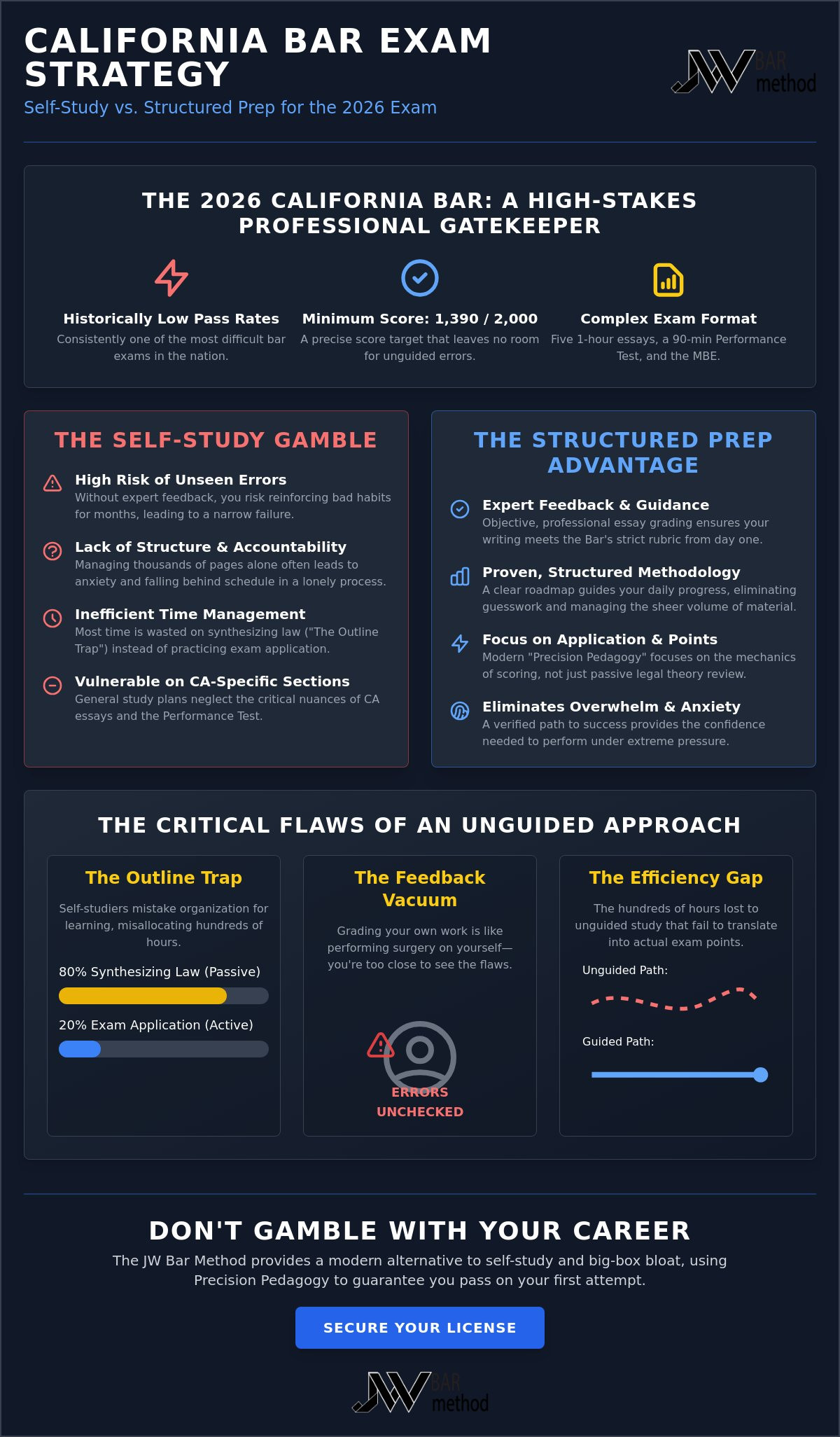
The 2026 California Bar Exam isn't just another academic hurdle; it's a professional gatekeeper designed to filter out anyone without a precise strategy. For candidates weighing the merits of california bar self study vs prep course options, the stakes have never been higher. To earn your license, you must achieve a minimum scaled score of 1,390 out of 2,000. This benchmark consistently produces some of the lowest pass rates in the nation, making the "self-study" decision a heavy burden for 2026 applicants. You aren't just taking a test. You're navigating a high-stakes professional barrier that demands a shift from passive law school reading to active, strategic application.
In this landscape, "pure" self-study involves independently managing materials provided by the Bar, essentially acting as your own professor and project manager. Structured prep, however, utilizes a rigorous methodology to guide your daily progress. Many students still fall into the trap of legacy models that rely on 1980s-style video lectures. Modern candidates require "Precision Pedagogy," a results-oriented approach that focuses on the specific mechanics of scoring rather than just broad legal theory. For a foundational California Bar Exam overview, it's clear the two-day format favors those who can apply law under extreme pressure.
Self-Study vs. Participatory Learning in 2026
Self-study requires you to be your own researcher and grader. It's a lonely process of independent resource management that often lacks the accountability needed for a grueling study schedule. In contrast, participatory learning involves a provider that verifies your progress and ensures you're hitting necessary benchmarks. The State Bar of California's 2026 standards require more than just knowing the law. They require proven competency in high-speed analysis, which is difficult to measure when you're studying in a vacuum without external verification.
Why the 'Generalist' Approach Fails in California
Generic, MBE-focused study plans often neglect the specific nuances of California-only law. This leaves candidates vulnerable during the five one-hour essay questions. Even more dangerous is the 90-minute Performance Test, which is the primary reason many self-study plans fail. Without professional feedback, you won't know if your "work product" meets the grading rubric's strict demands. We define the "California Bar Efficiency Gap" as the hundreds of hours lost to unguided study that fails to translate into actual points on the exam. Don't let your 2026 ambitions fall into this gap.
The Hidden Risks of California Bar Self-Study
Self-study often feels like a path to autonomy, but for most candidates, it becomes a "Feedback Vacuum." Grading your own essays is like performing surgery on yourself; you're simply too close to the material to identify structural flaws or analytical gaps. Without an objective, expert eye, you risk repeating the same scoring errors for ten weeks straight. By the time the July 2026 exam arrives, these uncorrected habits have become permanent, leading to the narrow failures that plague self-studiers. Choosing between california bar self study vs prep course isn't just about cost; it's about whether you can afford to study in a vacuum.
Many independent learners also fall into the "Outline Trap." They spend 80% of their time synthesizing massive amounts of law and only 20% on actual application. They mistake organization for learning. California graders aren't looking for a restatement of the law; they're looking for specific triggers and a precise dialect of legal writing. When you examine national bar exam pass rates, the unique difficulty of the California rubric becomes undeniable. Missing these "hidden" triggers is the primary reason why even brilliant researchers fail to cross the 1,390 threshold.
The Illusion of Competence in Legal Research
Success in a law firm doesn't translate to Bar Exam speed. While you might be an excellent researcher in practice, the 2026 exam demands a rapid-fire recognition of "Big Ticket" essay subjects. Self-study materials often lack the accelerated focus required to distinguish between what's interesting and what's actually tested. You don't have time to master niche topics at the expense of the core subjects that actually drive your score.
The Financial Reality of a Retake
Failing the bar is a massive financial blow. The $878 application fee and the $153 laptop fee are just the baseline costs. The true expense lies in six months of lost attorney-level income and the psychological toll of a retake. The perceived savings of the california bar self study vs prep course debate evaporate the moment you realize you're trading a career start date for a second attempt. Precision always beats volume when your license is on the line. Discover why in our analysis of the Best Bar Exam Preparation Service 2026: Why Precision Beats Volume. If you're ready to stop gambling with your timeline, it's time to adopt a structured methodology that guarantees results.
Structured Prep Courses: Big-Box Bloat vs. Precision Methods
The legacy providers that dominated the market for decades are still operating on a 1980s-style lecture model. This "Big-Box" approach relies on overwhelming students with sheer volume, often requiring you to watch over 100 hours of generic video content. For a candidate deciding between california bar self study vs prep course options in 2026, you must ask: does passive watching actually improve your essay score? The data suggests it doesn't. Modern success requires a shift from volume to precision. Precision pedagogy replaces the endless video loop with predictive analytics that target your specific cognitive blind spots, ensuring every hour of study directly contributes to your 1,390 scaled score.
Busy professionals and practicing attorneys don't have the luxury of "bloat." You need an accelerated prep model that respects your time and focuses on high-impact results. While legacy courses treat every student as a blank slate, modern precision methods use data to identify where you're already strong and where you're at risk of failure. This results-oriented strategy is the only way to navigate the extreme anxiety of the California Bar's low pass rates with absolute confidence. It's about working smarter, not just longer.
The Failure of 'One-Size-Fits-All' Outlines
Generic outlines are designed for "information dumping." They encourage you to memorize thousands of rules without teaching you how to deploy them under pressure. Graders in California aren't impressed by a restatement of the law; they want to see strategic analysis. Precision methods teach you to write specifically for the grader's rubric. We prioritize high-stakes drills over passive reading because your brain only retains what it's forced to apply. If your study material feels like a history textbook rather than a tactical manual, you're using the wrong tool.
Evaluating the 2026 ROI of Prep Programs
When auditing potential programs, look for three non-negotiables: a binary performance guarantee, high-frequency feedback, and a 100% focus on California standards. Many national providers offer a diluted curriculum that misses the state's unique nuances. This is especially critical for practicing lawyers who haven't sat in a lecture hall in years. You shouldn't be using a course designed for 3Ls. If you're an out-of-state practitioner, ensure you understand the California Attorney's Exam Requirements: The 2026 Guide to Licensure for Out-of-State Lawyers before committing to a methodology. Your prep should be as professional as your practice.
Decision Framework: Should You Self-Study for the CA Bar?
The choice between california bar self study vs prep course is a strategic audit of your current readiness. It's not a reflection of your legal mind; it's a calculation of your available resources. Before you decide to go it alone for the 2026 exam, walk through this four-step decision framework to see if you possess the necessary infrastructure for success. Most candidates who fail do so because they overestimated their ability to manage a massive curriculum while simultaneously learning the law.
- Step 1: Audit your 'Black Letter Law' retention. If you can't instantly recall the elements of a valid contract or the nuances of evidence law without reaching for a textbook, your foundation is too weak for unguided study. You need a program that builds recall, not just one that provides reading lists.
- Step 2: Evaluate your schedule. Managing your own curriculum requires approximately 400 hours of intense labor. If you don't have a pre-built roadmap, you'll waste dozens of those hours on administrative logistics and scheduling rather than actual learning.
- Step 3: Test your writing. Set a timer for 60 minutes and attempt a past California essay without any prompts or notes. If you can't produce a structured, passing response under this constraint, you need the professional feedback that self-study lacks.
- Step 4: Assess your risk tolerance. Is a nominal saving today worth a 50% higher risk of failing and losing six months of career progression? The financial and psychological cost of a retake far outweighs the initial investment in a precision prep course.
The 'Attorney's Exam' Exception
Out-of-state attorneys taking the one-day exam often underestimate the intensity of the California rubric. If you haven't taken a bar exam in over five years, your academic writing muscles have likely atrophied. Self-study is exceptionally dangerous for practitioners because you'll naturally want to answer like a lawyer; however, the Bar demands you answer like a student. Accelerated tracks for working professionals are designed to bridge this specific gap without the bloat of a traditional 3L course.
When Self-Study Actually Works (And When It Doesn't)
Successful self-studiers are typically repeat takers who missed the pass mark by fewer than 10 points and already have a functional system. If you're a first-time taker, red flags like inconsistent practice scores or an inability to spot issues in complex fact patterns indicate you need a structured course immediately. Strategic planning for the state of california state bar starts with an honest assessment of your weaknesses. If you're ready to trade uncertainty for a proven roadmap, explore our JW Bar Method Prep options today to secure your 2026 licensure.
The JW Bar Method: A Modern Alternative to Self-Study and Big-Box Bloat
The debate between california bar self study vs prep course usually misses the most important metric: your time. While self-study leaves you wandering through thousands of pages and big-box providers drown you in 400 hours of video fluff, the JW Bar Method offers a surgical alternative. We've moved beyond legacy models to focus exclusively on "How to Pass." We don't just dump information; we provide the precision pedagogy required to hit the 1,390 pass mark. By focusing 100% on the unique nuances of California, we ensure you aren't wasting a single minute on law that won't appear on your July 2026 exam.
Our binary performance guarantee is the ultimate signature of our confidence. We assume the financial risk of your outcome because our methodology is built on measurable results. If you don't pass, we haven't done our job. This level of bold reliability is what separates us from cautious, national generalists who prioritize their own margins over your licensure. You deserve a partner who is as invested in your first-attempt success as you are. We've eliminated the efficiency gap that costs candidates hundreds of hours of unguided labor.
Precision Pedagogy in Action
Our high-stakes drills are designed to bridge the gap between knowing the law and applying it under the 2026 exam's brutal constraints. These drills simulate the actual environment you'll face, forcing your brain to retrieve and deploy rules at high velocity. Elite mentorship is woven into every step, providing the expert feedback that self-studiers lack. Our Accelerated Prep serves as the essential bridge between the flexibility of modern learning and the rigid structure required to conquer the California Bar.
Securing Your 2026 Licensure
Your next step is choosing the track that aligns with your professional background. Whether you require the JW Bar Method Prep - Full Exam California Bar or the JW Bar Method Prep - Attorney’s Exam California Bar, our systems are optimized for your specific hurdle. For those with limited windows, the JW Bar Method Accelerated Prep - Full California Bar Exam condenses the curriculum without sacrificing the precision needed to win. Traditional national models are failing 2026 candidates because they prioritize volume over strategy. It's time to choose a modern, results-driven path for your California Bar Exam. Secure your future today with a methodology that guarantees you won't have to look back.
Take Command of Your 2026 Licensure Strategy
Finalizing your path for the 2026 exam cycle requires more than just a budget check; it demands a strategic assessment of your professional risk. We've explored how the california bar self study vs prep course debate is fundamentally about managing your timeline and ensuring your work product meets the state’s rigorous standards. While independent study offers perceived autonomy, it often lacks the objective feedback necessary to bridge the gap between academic knowledge and exam-day performance. Similarly, legacy national providers often overwhelm high-achieving professionals with redundant content that doesn't target specific scoring triggers.
The JW Bar Method provides a surgical alternative through our binary performance guarantee; we win only when you win. By adopting an accelerated methodology exclusively focused on California licensure, you replace the anxiety of unguided study with a structured, reliable roadmap to success. Don't settle for the "one-size-fits-all" approach of generic industry models when you can utilize a precision-built system from Jackson-Wagner LLC designed for your specific career goals.
Secure your 2026 California Bar success with the JW Bar Method—Explore our Accelerated Prep Programs
You have already done the hard work of earning your degree. Now, equip yourself with the strategic tools to secure your license on the first attempt.
Frequently Asked Questions
Is it possible to pass the California Bar Exam with only self-study in 2026?
Passing through self-study is possible, but it requires an extraordinary level of discipline and a pre-existing mastery of the California rubric. Most candidates struggle because they cannot objectively grade their own work against the 1,390 scaled score requirement. Without a roadmap, you're forced to act as both student and professor. This dual role often leads to burnout before the July 2026 exam even begins.
How much does a typical California Bar prep course cost compared to self-study?
Traditional courses for 2026 range from $1,699 for basic tiers to over $4,000 for elite packages. In contrast, the baseline cost for taking the exam includes an $878 application fee for non-attorneys and a $1,650 fee for attorneys. While self-study seems cheaper, the financial reality of a retake often makes the initial investment in a structured methodology more cost-effective in the long run.
What is the pass rate for self-study candidates on the California Bar?
Candidates who utilize structured prep programs generally see higher success rates than those who rely on pure self-study. California's overall pass rates are among the lowest in the nation. This makes the california bar self study vs prep course decision a matter of risk management. Self-studiers often fall just a few points short because they lack the expert feedback needed to refine their essay structure.
How many hours of study are required for the California Bar Exam?
Most successful candidates dedicate between 400 and 600 hours to their preparation over a 10 to 12 week period. This equates to roughly 40 to 50 hours of work per week. If you choose to self-study, a significant portion of those hours is often wasted on administrative planning. Accelerated programs aim to condense this timeframe by focusing on high-impact subjects rather than academic fluff.
Can practicing attorneys take a shorter version of the California Bar prep course?
Yes, practicing attorneys can and should utilize accelerated tracks designed for their specific professional needs. Programs like the JW Bar Method Accelerated Prep - Attorney’s Exam California Bar focus on the one-day exam format. These tracks eliminate the MBE components that aren't required for the Attorney's Exam. This allows busy practitioners to focus their limited study hours on the essays and performance tests.
What is the biggest mistake people make when self-studying for the CA Bar?
The most common mistake is falling into the "Feedback Vacuum" where you grade your own practice essays. It's impossible to objectively identify your own analytical gaps or structural weaknesses. Many self-studiers also spend too much time on theory and not enough on high-stakes drills. By the time they realize their writing doesn't meet the grader's triggers, the exam window has already closed.
Does the JW Bar Method offer a guarantee for the 2026 exam?
Yes, the JW Bar Method provides a binary performance guarantee for the 2026 exam cycle. We assume the financial risk of your outcome because our precision pedagogy is built on measurable results. This guarantee serves as a brand anchor, ensuring that our interests are perfectly aligned with your success. We don't just provide materials; we act as a partner in your professional licensure.
How does the California Attorney's Exam differ from the full Bar Exam in terms of study needs?
The Attorney's Exam is a one-day test consisting of five essays and one Performance Test, skipping the MBE entirely. While it's shorter, the pressure on each individual answer is much higher. Study needs for attorneys focus heavily on "unlearning" professional writing styles and adopting the specific dialect required by the Bar. Precision is vital because there are no multiple-choice questions to buffer a weak essay score.


