
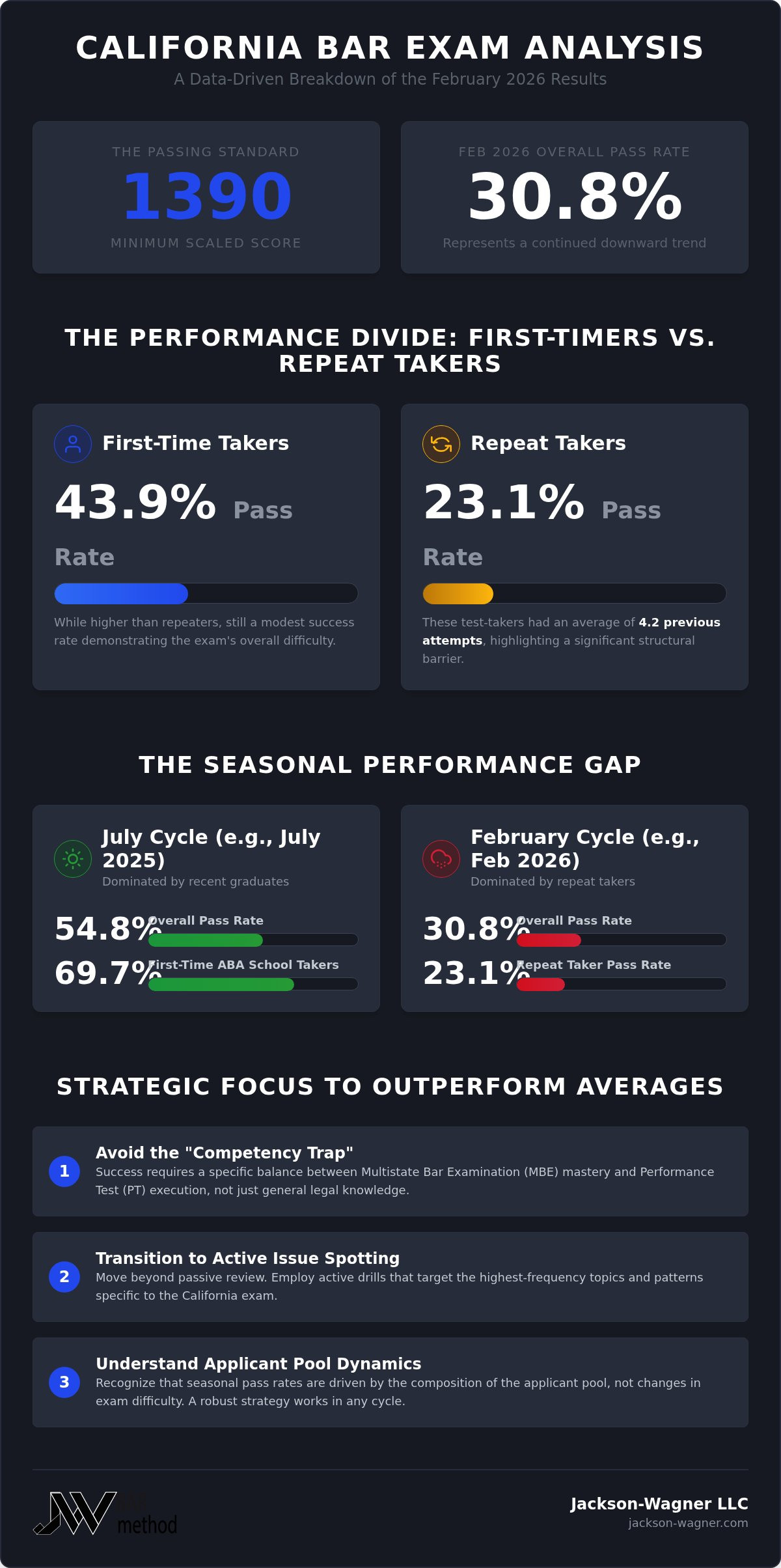
The average repeat taker in the February 2026 cycle had already attempted the exam 4.2 times, only to face a sobering 23.1% pass rate. It's a statistic that breeds a specific kind of high-stakes anxiety, especially when you realize that even first-time takers saw their success rate at a modest 43.9%. You likely feel that a strong academic record is no longer a guarantee of success in this environment. This california bar exam pass rate analysis is designed to replace that fear with a structured, data-driven path to licensure. We refuse to view these numbers as a matter of statistical luck; they're a roadmap for those ready to adopt a more sophisticated, results-oriented strategy.
You deserve a clear understanding of the metrics that define your professional entry point. We'll provide a comprehensive breakdown of performance trends across different candidate profiles and explain exactly how to beat the state's notoriously low benchmarks. By demystifying the relationship between raw performance and scaled scores, we'll validate why modern, accelerated prep methods are the superior choice for the 2026 cycle. You'll move from analyzing the odds to engineering your own success with a methodology that treats the bar exam as a solvable challenge rather than an insurmountable barrier.
Key Takeaways
- Identify the 1390 scaled score threshold and how the 2026 performance landscape shifts your study priorities.
- Uncover the critical performance divide between first-time and repeat takers in our latest California bar exam pass rate analysis.
- Avoid the "Competency Trap" by mastering the specific balance between MBE mastery and Performance Test execution.
- Transition from passive review to active issue spotting drills that target the highest-frequency topics in the 2026 syllabus.
- Discover how Jackson-Wagner LLC's proprietary architecture provides a statistical advantage over legacy study models.
The 2026 California Bar Exam Pass Rate: Current Landscape and Trends
The California Bar Exam isn't just a test of legal knowledge; it's a high-stakes gatekeeper with some of the most demanding metrics in the nation. Success is defined by a single number: a scaled score of 1390. Any california bar exam pass rate analysis must start with the reality that only 30.8% of applicants cleared this hurdle in February 2026. This represents a continued downward trend from the 33.9% seen in early 2024, confirming that the testing environment remains as rigorous as ever despite minor shifts in administration.
California maintains its reputation as a notoriously difficult jurisdiction because it refuses to offer reciprocity to out-of-state attorneys. Every applicant, regardless of experience, must prove their competency to the State Bar of California through this specific two-day format. While other states have adopted the Uniform Bar Exam or lowered their standards, California stays firm on its 1390 cut score. This creates a bottleneck that requires more than just academic intelligence to pass; it demands a precise understanding of how the curve is calculated.
Historical Context of the California Bar Exam
The pass rate landscape shifted significantly in 2020 when the passing score was permanently reduced from 1440 to 1390. While this change initially offered hope for higher success rates, the 2026 data shows that the exam's difficulty has scaled to match. Excluding the anomalous 63.6% pass rate in February 2025, which was caused by scoring adjustments after technical failures, the trend has been one of increasing volatility. Recent debates over the cut score have centered on whether 1390 is still too high compared to the national average, but for the 2026 cycle, this number remains the immovable standard. The 'cut score' is the minimum scaled value an examinee must achieve to demonstrate the proficiency required for licensure in the state of California.
July vs. February: Understanding the Seasonal Pass Rate Gap
There's a stark statistical divide between the summer and winter cycles that every candidate must consider. July 2025 saw an overall pass rate of 54.8%, bolstered by a massive influx of first-time takers from ABA-accredited law schools who achieved a 69.7% success rate. In contrast, the February 2026 cycle was dominated by repeat takers, who historically struggle with a 23.1% pass rate. This seasonal gap isn't about the exam's difficulty changing; it's about the composition of the applicant pool. Choosing a 2026 exam date requires you to be honest about your preparation level. If you're a working professional, your strategy shouldn't just be about when you take the test, but how you ensure you're in the passing minority regardless of the season's average.
Segmenting the Data: Who Passes and Why?
A granular california bar exam pass rate analysis reveals that the "overall" pass rate is often a misleading metric. To understand your actual chances, you have to look at the massive performance divide between first-time takers and those attempting the exam again. According to the February 2026 Bar Exam results, first-time takers achieved a 43.9% pass rate, while repeaters struggled at just 23.1%. This isn't just a minor statistical variance; it's a structural barrier.
The type of law school attended also dictates success. Graduates from ABA-accredited schools historically anchor the higher end of the curve, while those from California-accredited or unaccredited schools face significantly steeper climbs. If you've already failed once, the statistics are even more daunting. In July 2025, the repeater pass rate plummeted to a staggering 12.4%. This highlights why a rigorous california bar exam pass rate analysis is essential for anyone not in the first-time ABA group. Breaking out of this cycle requires a fundamental shift in pedagogy. The JW Bar Method Prep - Full Exam California Bar is specifically engineered to help repeaters bridge this gap by replacing outdated study habits with a results-driven framework. If you're looking for a way to outperform these averages, exploring a structured study methodology can be the turning point in your preparation.
ABA-Accredited Law School Performance
First-time takers from elite institutions often enter the exam with a false sense of security. While their schools provide a robust legal foundation, there's a documented gap between a high law school GPA and actual Bar Exam performance. The exam doesn't reward academic nuance; it rewards the ability to apply rules under extreme time pressure. For a deeper look at bridging this academic-to-professional gap, see our Passing the California Bar Exam in 2026: The Definitive Strategic Guide.
The California Attorney’s Exam: A Different Statistical Reality
Out-of-state attorneys face their own unique hurdles. In February 2026, the Attorneys' Examination pass rate was 57.0%, which is significantly higher than the general bar but still far from a guarantee. Many experienced practitioners fail because they rely on their "real world" experience rather than the rigid, formalistic "California way" of essay writing. Success on the one-day exam requires unlearning certain professional habits to meet the State Bar's specific grading rubrics. You can explore these nuances in our guide to California Attorney's Exam Requirements: The 2026 Guide to Licensure for Out-of-State Lawyers.
The Anatomy of Failure: Why High-Achievers Fall Below the Curve
High-achieving law students and seasoned attorneys often fall victim to the "Competency Trap." They believe that a strong academic record or years of practice will naturally translate to success. This is a dangerous assumption. A deep california bar exam pass rate analysis suggests that failure isn't usually a lack of intelligence; instead, it's a failure of application. The Official California Bar Exam Statistics show that thousands of capable candidates fail every cycle because they don't respect the exam as a unique, standardized hurdle. Graders look for a specific, rigid structure. If you deviate from the expected format or miss "buzzword" issues, your score will suffer regardless of your legal brilliance.
The psychological pressure of a 30.8% pass rate can't be ignored. Anxiety often leads to "over-studying" minor rules while neglecting the high-weight portions of the exam. This fear-based approach results in burnout and poor performance on game day. You need a strategy that replaces this anxiety with a structured, predictable path to success. Common essay formatting mistakes, like failing to clearly state a rule before applying it, trigger low scores from graders who spend only minutes on each response.
The MBE vs. Essay Weighting in 2026
The California Bar Exam uses a 50/50 weighting between the Multistate Bar Examination (MBE) and the written portions. Many candidates spend months memorizing black letter law for the MBE only to be blindsided by the written sections. You can't pass by being average at both. You must excel in application. The Performance Test is often the "silent killer" of California Bar scores because it requires candidates to synthesize unfamiliar legal materials and facts under intense time pressure, a skill that memorization alone cannot provide.
Time Management and the Working Professional
Traditional 10-week study plans were designed for full-time students with no other obligations. If you're a working professional, trying to cram 60 hours of study into a week is a recipe for failure. This legacy model is why many high-achievers fall below the curve. You don't need more time. You need better efficiency. Our JW Bar Method Accelerated Prep - Full California Bar Exam is built for those who can't sacrifice their careers for a credential. We replace passive reading with high-impact drills, ensuring that every hour you spend studying actually moves the needle on your scaled score. You don't have to choose between your job and your license.
Strategic Adjustments: How to Outperform the 2026 Pass Rate Averages
Outperforming the 2026 averages requires a radical shift from passive absorption to active execution. Most students spend hundreds of hours reading outlines, yet this passive approach fails to build the "muscle memory" needed for the actual exam. You must prioritize active issue spotting drills that force you to identify legal conflicts in real-time. By focusing on high-frequency topics within the 2026 syllabus, you ensure your study time yields the highest possible return on investment. A data-driven california bar exam pass rate analysis proves that students who master the most tested areas outperform those who try to memorize every obscure rule.
Self-grading is a trap that often leads to a false sense of security. You're likely to be too lenient on your own writing or miss the subtle formatting cues that State Bar graders demand. Professional feedback is essential to identify your "blind spots" before they manifest as a failing score on your record. You also need to simulate the 2026 exam environment exactly, including the specific timing and software constraints. Building the mental endurance for a two-day testing window is a physical requirement, not just a mental one, and it's often the difference between a 1380 and a passing 1390.
Mastering the JW Bar Method Precision
We believe precision beats volume every time. Traditional prep programs overwhelm you with thousands of pages of text, but our method distills this noise into essential knowledge. The Best Bar Exam Preparation Service 2026: Why Precision Beats Volume illustrates how we focus only on what earns points. Our curriculum prioritizes:
- High-frequency essay topics that appear in almost every cycle.
- MBE patterns that legacy programs often overlook.
- Performance Test templates designed for maximum point extraction.
For those with limited schedules, our JW Bar Method Accelerated Prep - Full California Bar Exam provides a high-intensity track that respects your time while maximizing your performance potential.
Analyzing Your Mock Exam Data
Your practice scores are the most reliable predictor of your actual 2026 performance. We use granular data to pinpoint exactly where your scaled score is falling short. Whether it's a specific MBE subject or a struggle with the Performance Test format, identifying these weaknesses early is critical. This level of individual california bar exam pass rate analysis is what separates passing candidates from those who fall into the repeater pool. Professional grading ensures you aren't guessing about your progress. You'll enter the exam room with the confidence that comes from documented improvement, not just hope; for those who value similar analytical precision in other fields, you can learn more about Wavetraders to see how expert modeling provides clarity in complex financial markets.
Secure your license and beat the averages by enrolling in the JW Bar Method Prep - Full Exam California Bar today.
The JW Bar Method: Engineering Success Against California’s Toughest Odds
When the state averages suggest a steep climb, your strategy must evolve beyond the standard curriculum. Our california bar exam pass rate analysis confirms that standard, high-volume study plans often fail to account for the specific nuances of the California curve. We developed the JW Bar Method to serve as a statistical outlier. By focusing on the exact pedagogical requirements of this jurisdiction, we've created a system that prioritizes scoring efficiency over mere memorization. We don't just provide materials; we provide a blueprint for outperforming the state's most rigorous benchmarks.
The architecture of the JW Bar Method Prep - Full Exam California Bar and the JW Bar Method Prep - Attorney’s Exam California Bar is built on the principle of "binary performance." We assume the performance risk ourselves by offering a bold guarantee that aligns our success directly with your own. This partnership replaces the typical anxiety of bar prep with a sense of security and absolute trust. We've moved away from the legacy models of the past to offer a structured, modern, and reliable path that empowers you to take control of your professional outcome.
A Modern Alternative to Legacy Prep
Legacy prep courses often rely on a "one size fits all" approach that fails to address the individual needs of the modern examinee. Jackson-Wagner LLC provides a disruptive alternative through mentor-driven, agile study environments. We focus on the precision required to clear the 1390 threshold without the unnecessary bloat of generic national programs. Our method ensures that every drill and every essay response is tuned to the specific grading expectations you'll face. For more insight into the administrative side of this process, see our guide on How to Navigate the State Bar of California: A 2026 Guide to Licensure Success.
Ready to Join the California Bar?
You have already seen the data; now it is time to choose your response to it. Enrolling in the JW Bar Method Prep - Full Exam is a commitment to a results-oriented methodology that treats you as more than just a statistic. We provide the financial assurance and authoritative mentorship required to replace stress with empowerment. Don't let a california bar exam pass rate analysis discourage you; let it drive you toward a more sophisticated way of studying. Join the JW Bar Method Accelerated Prep - Full California Bar Exam today and secure the license you have worked so hard to earn. Your future in the California Bar starts with a strategy that is engineered for success.
Secure Your Professional Future in 2026
The data doesn't lie; the path to California licensure is narrower than ever. However, as this california bar exam pass rate analysis has demonstrated, those who fail often do so by following legacy study models that prioritize volume over precision. Success in the 2026 cycle requires a radical shift toward active issue spotting and a deep understanding of the State Bar's specific grading rubrics. You don't have to be a victim of the curve when you have a structured, results-oriented framework designed specifically for this jurisdiction.
We've engineered the JW Bar Method to provide the specialized mentorship and accelerated tracks needed by today's high-achieving professionals. Whether you're preparing for the Full Exam or the Attorney's Exam, our exclusively California-focused pedagogy ensures you're training for the actual test, not a generic national average. It's time to replace anxiety with a proven methodology that assumes the performance risk so you can focus on execution. Take the final step toward your license today. Master the California Bar Exam with the JW Bar Method. You've done the work; now it's time to claim your results.
Frequently Asked Questions
What is the historical pass rate for the California Bar Exam?
Historically, the California Bar Exam pass rate fluctuates between 30% and 55% depending on the specific cycle. July sessions generally yield higher results due to the large volume of first-time takers from ABA schools. In contrast, February sessions often see lower rates, such as the 30.8% recorded in February 2026. This volatility makes a consistent california bar exam pass rate analysis vital for setting realistic expectations.
How many people fail the California Bar Exam on their first attempt?
Over half of all first-time takers typically fail the California Bar Exam during the February cycle. In February 2026, the first-time taker pass rate was 43.9%, meaning 56.1% of applicants were unsuccessful. These figures improve in July sessions, where first-time pass rates often approach 70%. However, the risk remains substantial for those who rely on legacy study habits instead of precision-based training and active drills.
Is the California Attorney's Exam easier than the full Bar Exam?
The Attorney's Exam is shorter but isn't necessarily easier than the full Bar Exam. While it omits the multiple-choice MBE, it retains the demanding essay and Performance Test portions. The February 2026 pass rate for attorneys was 57.0%, which is higher than the general exam but still requires mastering the specific "California way" of formalistic writing. Experienced lawyers often struggle because they prioritize practice experience over rigid grading rubrics.
What scaled score do I need to pass the California Bar in 2026?
You need a minimum scaled score of 1390 to pass the California Bar Exam in 2026. This threshold was reduced from 1440 in 2020 and has remained the standard for both the February and July administrations. Achieving this score requires a balanced performance across the MBE and the written portions. The 50/50 weighting means you can't afford a significant deficit in either area if you want to clear the curve.
Can I pass the California Bar Exam while working a full-time job?
Yes, you can pass while working full-time if you replace traditional 60-hour study weeks with an accelerated, high-efficiency model. Legacy prep courses often fail working professionals because they demand an impossible time commitment. Our results-oriented approach focuses on high-frequency topics and active drills. This methodology allows you to maximize every hour of study without sacrificing your career or professional obligations during the 2026 cycle.
How do ABA-accredited law schools compare to other schools in pass rates?
Graduates from ABA-accredited schools consistently achieve the highest pass rates in California. In July 2025, for example, first-time takers from these institutions reached a 69.7% pass rate. In contrast, applicants from California-accredited or unaccredited schools often face success rates below 20%. This divide reinforces the need for a specialized california bar exam pass rate analysis to identify the specific gaps in your educational background and adjust your strategy accordingly.
What happens if I fail the California Bar Exam in February 2026?
If you're unsuccessful in February 2026, you'll receive your results on May 1 and must wait for the July 2026 administration to retest. Use your score report to pivot your strategy immediately by identifying which sections fell below the 1390 threshold. Repeat takers face a difficult path, with a February 2026 pass rate of only 23.1%. This makes a structured, mentor-driven intervention essential to avoid becoming part of that statistic again.
Why is the California Bar Exam considered the hardest in the US?
California's exam is considered the most difficult due to its high cut score and its refusal to offer reciprocity to other states. Unlike jurisdictions that use the Uniform Bar Exam, California maintains its own unique essay and Performance Test standards. The sheer volume of material, combined with a notoriously strict grading scale, creates a barrier that requires absolute precision. You aren't just tested on law; you're tested on your ability to perform under extreme pressure.


